


Wednesday, August 27, 2008


Tuesday, July 01, 2008
Sunday, June 29, 2008
The cocaine has fried Slick Willie's brain
Bill Clinton is so bitter about Barack Obama's victory over his wife Hillary that he has told friends the Democratic nominee will have to beg for his wholehearted support.

Mr Obama is expected to speak to Mr Clinton for the first time since he won the nomination in the next few days, but campaign insiders say that the former president's future campaign role is a "sticking point" in peace talks with Mrs Clinton's aides.
The Telegraph has learned that the former president's rage is still so great that even loyal allies are shocked by his patronising attitude to Mr Obama, and believe that he risks damaging his own reputation by his intransigence.
A senior Democrat who worked for Mr Clinton has revealed that he recently told friends Mr Obama could "kiss my ass" in return for his support.
A second source said that the former president has kept his distance because he still does not believe Mr Obama can win the election.
Mr Clinton last week issued a tepid statement, through a spokesman, in which he said he "is obviously committed to doing whatever he can and is asked to do to ensure Senator Obama is the next president of the United States ".
Mr Obama was more effusive at his unity event with Mrs Clinton on Friday, speaking fondly of the absent former president, who attended Nelson Mandela's birthday celebrations in London instead. The candidate told the crowd: "I know how much we need both Bill and Hillary Clinton as a party. They have done so much great work. We need them badly."
But his aides said he has so far concentrated on cementing relations with Mrs Clinton first. They say they are content to let relations with Mr Clinton thaw gradually.
It has long been known that Mr Clinton is angry at the way his own reputation was tarnished during the primary battle when several of his comments were interpreted as racist.
But his lingering fury has shocked his friends. The Democrat told the Telegraph: "He's been angry for a while. But everyone thought he would get over it. He hasn't. I've spoken to a couple of people who he's been in contact with and he is mad as hell.
"He's saying he's not going to reach out, that Obama has to come to him. One person told me that Bill said Obama would have to quote kiss my ass close quote, if he wants his support.
"You can't talk like that about Obama - he's the nominee of your party, not some house boy you can order around.
"Hillary's just getting on with it and so should Bill."
Another Democrat said that despite polls showing Mr Obama with a healthy lead over Republican John McCain, Mr Clinton doesn't think he can win.
The party strategist, who was allied to one of the early rivals to Mr Obama and the former First Lady, said Mr Clinton was "very unhopeful" about the nominee's prospects in November.
"Bill Clinton knows the party will unite behind Obama, but he is telling people he doesn't believe Obama can win round voting groups, especially working-class whites, in the swing states," the strategist said.
"He just doesn't think Obama will be able to connect with the voters he needs."
Joe Klein, the author of Primary Colours, a fictionalised account of Mr Clinton's 1992 election, who has known the former president for 20 years, said he also heard that he was "very, very bitter", from people who have spoken with him.
"It's time for him to get over it or go off and do his charitable work. He knows the rules of the road. What's going on now is kind of strange. I think his behaviour is really, really shocking."
Original article posted here.Tuesday, June 10, 2008
Sunday, June 08, 2008
Friday, June 06, 2008
Thursday, June 05, 2008
Despite her withdrawl and projected endorsement, would not be the least bit surprised if Billary is behind this party unifying concept
Nick Juliano
 Some of Hillary Clinton's most ardent Internet supporters -- appearing increasingly bitter at the rapidly coalescing reality that their candidate has lost -- are beginning to declare that they are Democrats no longer and pledging their votes to presumptive GOP nominee John McCain.
While Clinton is planning to formally drop out of the race this Saturday and throw her support behind presumptive Democratic nominee Barack Obama, some of her supporters are openly derisive of her calls for party unity.
Since Clinton delivered her non-concession speech on Tuesday night, and since word emerged Wednesday that she would accept her loss this weekend, a handful of Web sites and blogs have cropped up to allow her supporter to vent and declare their support for McCain.
One site is offering Democrats for McCain bumper stickers and another has collected names of dozens of Democrats who say they are planning to leave the party.
Some pro-Clinton blogs are relishing in this destroy-the-party-in-order-to-save-it attitude, including Larry Johnson's No Quarter, which dedicated itself to spreading racially tinged rumors and innuendo about Obama throughout the primary.
Pro-Clinton blog The Confluence has started what it's calling a PUMA movement; the acronym stands for Party Unity My Ass.
Another site has cropped up calling itself the National Organization of Hillary Clinton Supporters for John McCain. The site claims to have been started by a one-time Democrat who was outraged over the Democratic Party's decision to punish delegations from Florida and Michigan for breaking party rules.
Whether Clinton's backers break into "Denver! Denver!" chants at Saturday's formal endorsement remains to be seen, but Obama likely will need plenty of help from the former first lady to shore up her coalition of women, Hispanics and blue-collar voters going into November.
Obama has had nothing but kind words for Clinton in recent weeks, as it became clear that he would end up as the nominee. At least some Clinton supporters have appreciated the warm reception they received.
It remains to be seen which faction of Team Clinton will win out.
Sunday, June 01, 2008
Wednesday, May 28, 2008
More bad news for Hill, but, nevermind, it won't stop her in the slightest
By KATHARINE Q. SEELYE
Democratic Party lawyers have determined that no more than half the delegates from Florida and Michigan can be seated at the party’s August convention, dealing a blow to Senator Hillary Rodham Clinton’s efforts to seat the full delegations from those states.
The rules committee of the Democratic National Committee meets on Saturday to determine whether to seat the delegates from these states, which were penalized for holding early primaries.
In asking that the full delegations from these states be seated, Mrs. Clinton hopes to narrow Senator Barack Obama’s delegate edge and make the case that by including the votes from these states, she will have more of the popular vote in the nominating contests, an assertion that has come under some dispute. But the party’s legal analysis, contained in a 38-page memo to the committee, says the committee can either seat only 50 percent of the delegates or seat them all but give them only half a vote, which amounts to the same thing.
Whatever the committee decides about the delegates may not be a big factor in Mrs. Clinton’s pursuit of the nomination. Even if she were awarded all the delegates in proportion to her popular vote in those states — her best-case scenario — she could not overtake Senator Obama’s delegate lead.
It is not entirely clear what the Obama campaign intends to ask for at the meeting but Mr. Obama has said he wants the delegates seated. His top aide, David Axelrod, has said that the campaign could go “half-way” on any compromise.
The important goal for the Clinton campaign is to include the popular votes from those two disputed states in its overall vote tally. The Clinton campaign is already doing this, but because Michigan and Florida have been stripped of their delegates, an air of illegitimacy hangs over their votes and her opponents do not recognize their popular vote.
If the rules committee seats even half the delegates from those states, that could confer some legitimacy on the Clinton’s inclusion of those votes in their overall tally, although a Clinton aide said that the campaign does not feel it needs the seating of the delegates to legitimize the popular vote. Those votes have been counted and certified by the secretaries of state in both states, the aide said, and the rules committee cannot alter that.
The rules committee’s meeting is important because it needs to address the decisions by Michigan and Florida to move up their primaries in violation of party rules. The committee stripped the states of their delegates as punishment for doing so. If it restores the delegates, even at half strength, it may send a message to other states that next time they can violate the calendar without serious consequences, in effect a license for chaos.
So the committee is in a box in trying to figure out how to respect the voters in Florida and Michigan, who were not responsible for this potential disenfranchisement, while still honoring voters in 48 other states where officials followed the rules.
Original article posted here.
Tuesday, May 27, 2008
Will Howard be up for the job?
Set to mediate Fla., Mich. issue
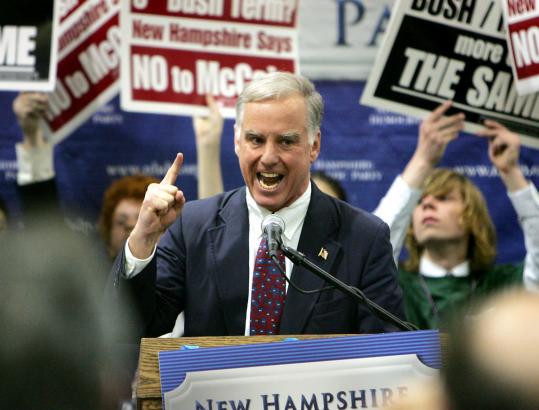 Howard Dean, chairman of the Democratic National Committee, in Manchester, N.H., last week. (Cheryl Senter/Associated Press)
 MANCHESTER, N.H. - Howard Dean arrived at this month's New Hampshire Democratic Party convention with the purposeful brusqueness that has marked his years on the national stage, climbing out of his rental car with hardly a word for anyone before retreating into a holding area.
The chairman of the Democratic National Committee was there to deliver another of his famous red-meat speeches, exhorting the party faithful to evict the Republicans from the White House. But even amid the applause, there were signs of the Democratic Party's current discord in the room. Supporters of Hillary Clinton held up signs proclaiming: "Gov. Dean, count all the votes in Florida and Michigan!"
After the speech, Dean slipped out a back door and, disappointing a small crowd angling for a word or an autograph, strapped on his seat belt and left.
These are challenging days for Dean, the former family physician and Vermont governor who has run the national committee with a strong hand, helping his party win both houses of Congress during his 3 1/2 years as chairman. Now he finds himself in a familiar position - the center of a controversy - though in an unfamiliar role: peacemaker.
On Saturday, the DNC's Rules and Bylaws Committee will meet to decide whether to seat the delegations from Florida and Michigan at the party's August national convention in Denver. The two states were barred from representation because they moved their primaries ahead of a DNC-imposed timetable; but now their votes are crucial to Clinton's dwindling chances at the presidential nomination.
Whether Dean can broker a compromise and amicably resolve the Florida and Michigan crisis - and then stitch together his party after this year's bruising nomination battle - could go a long way toward determining who is the next president. Some are skeptical about his ability to finesse such a delicate, high-stakes situation.
"Howard's a doctor - doctors don't listen to people, they tell people what's going to happen, and that's part of the problem," said Garrison Nelson, a political scientist at the University of Vermont and a longtime critic of Dean. "That has always been Howard's style."
Even Joe Trippi, who managed Dean's 2004 presidential campaign, said Dean is usually better at taking charge than persuading.
"You come in the room, and he's pretty set on who should be the best guy at this, or where the party's money is going to go," he said.
But Trippi said Dean has surprised him this year.
"I think he's become a better mediator, a bit more conciliatory on this whole issue," he said.
Dean today is a more refined version of the presidential candidate of 2004, a man who relished blunt, off-the-cuff repartee with voters and reporters. (His "scream" speech after the 2004 Iowa caucuses is still the top video that comes up after a Google search of his name.) Even a few years ago, prudence was not his specialty.
"I hate the Republicans and everything they stand for," he said in 2005. Republicans, he also said back then, are "pretty much a white, Christian party."
Lately Dean has carefully contained his spontaneity, straining to avoid diverting attention away from Clinton and Barack Obama or to appear biased in the closely fought race. Earlier this month in New Hampshire, he read a large portion of his speech. On television, he often looks as if he is holding his breath; so sober was his recent "Tonight Show" appearance that the lively audience fell silent for long stretches.
David Berg, a close friend since their days as students at Yale, said Dean understands that his role has changed from insurgent to referee and party builder.
"I think he takes the job very seriously," he said. "He's not just being a political functionary, he actually thinks this grass-roots democracy is important to the future of this country."
State-party leaders backed Dean for chairman because he promised to rebuild the party from the grass roots up. In 2005, he dispatched a team to visit each state party and determine its needs, and the national committee then sent three to five new staff to each state to work on fund-raising, organizing, communications, or technology. Massachusetts, a state so blue that presidential candidates rarely campaign here in a general election, got four workers, as did Mississippi, a bastion of Bible Belt conservatism.
Public spats over the strategy erupted between Dean and Representative Rahm Emanuel, chairman of the Democratic Congressional Campaign Committee, who wanted every dollar for closely contested midterm races. Democratic strategist Paul Begala scoffed on CNN that Dean had hired people to "wander around Utah and Mississippi and pick their nose." Even after Democrats won big in the 2006 elections, James Carville, a Democratic strategist, called for Dean's resignation, declaring that the gains should have been greater.
But Democratic leaders outside Washington hail Dean's approach, calling it essential to the party's long-term success, and credit him with making a critical difference in the 2006 elections.
"Building a party that's in a difficult circumstance is a tough, tough job that's not something that can be done in six months to a year," said Don Fowler, a former DNC chairman from South Carolina.
Dean's strategy never looked better than it did earlier this month, when Democrat Travis Childers won a special congressional election in a conservative Mississippi district. Because of Dean, the Mississippi state party was prepared to help, including Terry Cassreino, a veteran Mississippi political columnist who became the state party's communications director.
"They didn't have anything back when I was covering the capitol, politics, and government," Cassreino said. "They had maybe one staff person, and the Republican Party had a full staff. This obviously gives us a chance to compete."
Dean has withstood even harsher criticism for his handling of Florida and Michigan. He appears to have taken a hands-off approach to the Rules and Bylaws Committee's initial decision to punish the states by stripping them of their delegates, but once it was made, he supported it.
Despite the urging of the national committee, the states did not hold alternative nominating contests. Whether this was a result of Dean's diplomatic shortcomings or the state party leaders' stubbornness is unclear. Karen Thurman, chairwoman of the Florida Democratic Party, said Dean became more personally engaged this spring but before that left most of the negotiations to national committee staff and rules committee leaders, who, she said, came up with no feasible alternatives.
"I don't think he wanted this to happen to Florida, but I think he was also pretty dug-in about the rules," she said, adding that she and Dean see eye to eye on most other issues.
But James Roosevelt Jr., cochairman of the rules committee, said Dean worked quietly but intensively to try to resolve the dispute, and that he and DNC representatives labored for days on end to devise alternatives and to find ways to fund them. "Howard believed he could be most effective trying to work behind the scenes," he said.
Some say the dispute may jeopardize the Democrats' ability to compete in two important states. Kenneth M. Curtis, a former governor of Maine who was chairman of the DNC in the late 1970s and is now a superdelegate living in Florida, said Dean should "step down and let somebody new come in who wasn't tainted by this whole mess."
Dean has no intention of doing that. But much is riding on his ability to help broker a compromise this weekend. All he has to do is come up with a solution that will satisfy two scofflaw states, two warring campaigns, and a few million people who want their votes to count - without a Democratic president in the White House to back him up.
James Blanchard, a former Michigan governor and cochairman of Clinton's campaign in his state, said, "I trust Howard Dean to get this worked out."
Monday, May 26, 2008
Hillary lies and says that killing Obama is "unthinkable". Then why are other people talking about it?

| Fox News Guest Openly Calls For Obama Assassination Neo-Con obsession with killing Democratic candidate takes sick new turn as Hillary Clinton makes veiled threat |
Paul Joseph Watson
The Neo-Cons' sick obsession with assassinating Barack Obama took another bizarre turn yesterday when Fox News guest Liz Trotta openly expressed a desire to see someone "knock off" the Democratic candidate.
Trotta, former New York bureau chief of the Washington Times, referred to the Democratic frontrunner as "Osama" before quipping that it would be nice to see both Bin Laden and Barack Obama killed.
TROTTA: And now we have what some are reading as a suggestion that somebody knock off Osama — Obama. Well, both, if we could.
HOST: Talk about how you really feel.
Watch the clip
This latest example follows the trend of a bizarre and disturbing corporate media obsession with Obama being killed before he is able to take office.
Neo-Cons, who will whine and bitch all day long about how protesters should be scrutinized and often brutalized for using their right to free speech "in a time of war," apparently consider themselves above the law when it comes to making death threats against public figures.
Imagine if CNN pundits had joked about Bush being assassinated during the 2004 presidential campaign - they would have been booted off the air and interrogated by the secret service.
Keith Olbermann took Hillary Clinton to task on Friday for implying that she would stay in the Democratic race, despite the fact that she has virtually no chance of succeeding, because extraneous circumstances, such as an assassination, could change the picture.
Clinton made specific reference to the assassination of Robert F. Kennedy. Only the most naive and deluded observer could take this as anything other than a veiled threat.
Olbermann's fury is justified but, as Kurt Nimmo points out, this goes deeper than a mere faux pas on behalf of Hillary. In reality, political crime families kill the opposition and the Clintons are notorious for having their adversaries "taken care of".
Several high profile public figures have warned that Obama may be the target of an assassination attempt before he is able to occupy the White House.
Appearing on The Alex Jones Show last month, former Minnesota Governor Jesse Ventura warned that Obama could be in the crosshairs.
"I believe very strongly that if an independent candidate like myself - a rogue - were to get into the President's race legitimately, if the polls looked like he had a chance to win, I believe that candidate would either be physically assassinated or would be assassinated credibility-wise or in some manner by our government because I do not believe they would ever allow a true independent or a citizen to become President of the United States," said Ventura.
"I say this in all seriousness - watch out Barack Obama," he added.
British Nobel Prize winner Doris Lessing said Obama would be taken out if he became President in February.
"He would probably not last long, a black man in the position of president. They would kill him," Lessing told a Swedish newspaper.
Princeton University political science professor-Melissa Harris-Lacewell echoed the same sentiment a month before, saying: "For many black supporters, there is a lot of anxiety that he will be killed. It is on people's minds."
"You can't make a prediction like this - like he has a 50 per cent chance of getting shot."
"But the greater his visibility and the greater his access to people, there is a danger."
Some speculated that Obama had been set up for an assassination attempt during a February 20 rally in Dallas, after it emerged that Secret Service gave the order to stop screening for weapons a full hour before the event began.
Seeing the writing on the wall, and bookends for a dynastic disgrace
Hillary Clinton’s comment, referencing Robert Kennedy’s 1968 assassination to explain why she’s continuing her campaign, may serve as a crass punctuation point for the end of a grim period in American history, the Bush-Clinton era.
By Robert Parry
This period – roughly marked by George H.W. Bush’s rise as Vice President and then President from 1981 to 1993, Bill Clinton’s embattled two terms, and then eight years under George W. Bush – represented an extraordinary period of lost opportunities for the nation as its global power peaked and began a rapid descent.
Notable for its bitter partisanship, mindless jingoism and willful historical amnesia, this era saw the United States fail to address its bloated energy consumption, reverse the decline in its manufacturing base, stop the erosion of the middle class, provide universal health care for its citizens and wisely deploy its military might.
So, on one level, the Democratic presidential battle has been a struggle over whether Democrats want to revert back to their brief hold on the White House in the 1990s (by picking Hillary Clinton) or strike off in a new direction (by nominating Barack Obama).
Early on, some Democrats told me they supported Sen. Clinton because her election would repudiate the Bush family and its nasty brand of politics. They envisioned a hard-working and battle-tested President Hillary Clinton completing some of the reforms that Republicans thwarted in the 1990s.
However, other Democrats have come to see the Clintons as less a cats-and-dogs enemy of the Bushes than two sides of the same coin, a kind of duopoly that is more common in Third World nations where two ruling families trade power back and forth without disrupting the power structure.
In this view, Bill Clinton essentially earned his bones with the Bush family in 1993 when he swept a dustbin full of Republican scandals under the rug – including the Iran-Contra Affair, Iraq-gate and the October Surprise question.
President Clinton may have thought he was being responsible and buying some bipartisan peace. But he actually cemented an incomplete and false history of the Reagan-Bush period, thus denying the American people a thorough understanding of what their government had done over those dozen years. [For details, see Robert Parry’s Secrecy & Privilege.]
Attack Machine
Clinton also freed up the Republican attack machine from playing defense for Ronald Reagan and George H.W. Bush, enabling it to go on the offensive against Clinton and his wife. In other words, Clinton’s acquiescence to the Reagan-Bush cover-ups proved to be both wrongheaded and shortsighted.
Yet Clinton didn’t seem to learn much. Despite the pummeling he took – including suffering only the second presidential impeachment in U.S. history – Bill Clinton still kept his Justice Department on the sidelines when George W. Bush stole the Florida election and thus the White House from Al Gore in 2000. [For details, see Neck Deep.]
Then, after leaving office, Clinton made one of his chief priorities the forging of an alliance with George H.W. Bush, as they traveled around the world on humanitarian missions. This Bush-Clinton tandem became a feel-good measure of how Washington insiders gauge bipartisanship, the two ruling families working together.
Meanwhile, Hillary Clinton – having won a Senate seat from New York in 2000 – demonstrated another side of this elite bipartisanship. In 2002, she sided with President George W. Bush in his desire to invade Iraq and remained a staunch war supporter over the next several years.
All in all, at the start of 2005, the future of this Bush-Clinton duopoly looked fairly bright.
George W. Bush had secured a second term and Washington pundits lavished praise on his neoconservative vision for the Middle East, hailing the soaring rhetoric of his second Inaugural Address as well as the seemingly successful election in Iraq and other glimmers of hope across the region.
There was political talk, too, that Sen. John McCain had struck a deal with the Bushes, embracing George W. Bush’s reelection bid in 2004 with an understanding that he would get the Bush family’s backing in 2008 and possibly agree to pick Florida Gov. Jeb Bush as his running mate to set the stage for another Bush restoration in 2012.
On the Clinton side, there was optimism that Hillary Clinton was well positioned to win the Democratic nomination in 2008, with her staunch support of the Iraq War serving to dispel doubts among the general electorate about her national security credentials.
A Difficult Year
However, 2005 didn’t play out as either the Bushes or the Clintons envisioned.
The Iraqi elections only hardened the sectarian divisions and made progress toward reconciliation tougher. The death toll for U.S. soldiers and Iraqis kept rising and Iranian influenced increased.
The crises in Palestine and Lebanon also grew worse – and signs of democratic progress in Egypt and Saudi Arabia proved illusory.
Then, in summer 2005, Hurricane Katrina struck New Orleans, with the widespread death and destruction exposing the cronyism and incompetence of the Bush administration. Bush’s approval ratings dropped below 50 percent and never recovered.
Hillary Clinton’s bet on the Iraq War soured, too. She found herself on the wrong side of the dominant opinion among the Democratic base, leaving her little choice but to reposition herself as a war opponent in 2006.
Still, as the Democratic race took shape in 2007, Sen. Clinton found herself as the clear frontrunner.
She possessed the potent Clinton fund-raising machine; she benefited from nostalgia for the relatively affluent 1990s; she enjoyed strong support from older feminists; and she faced fairly weak opposition, especially with Al Gore shying from the race.
The one wild card among her rivals was the junior senator from Illinois, Barack Obama, who was a phenomenon among college students and younger voters. But he appeared struck in the 20 percentiles through summer 2007, leaving Clinton with a wide lead.
Feeling a growing confidence about her inevitability, Clinton chose to reaffirm her hard-line credentials in a Sept. 26, 2007, vote on a resolution sponsored by neoconservative Sen. Joe Lieberman urging President Bush to declare Iran’s Revolutionary Guard an international terrorist organization.
By voting with Lieberman, Clinton rejected warnings from Sen. Jim Webb, D-Virginia, that the resolution could pave the way to a wider war. Her vote also reminded many rank-and-file Democrats of her past support for Bush’s Iraq War resolution, causing them to give Obama another look.
On Dec. 17, 2007, a still-confident Bill Clinton offered voters a sense of what bipartisanship meant to Hillary Clinton. He announced that his wife’s first act in the White House would be to send him and George H.W. Bush on an around-the-world mission to explain that “America is open for business and cooperation again.”
In other words, the Clintons and the Bush patriarch would clean up some of the messes left behind by a headstrong Bush son. Implicit in this picture was the Clintons giving another pass to the Bush family. [See Consortiumnews.com’s “The Fight for Bush’s Legacy.”]
Rebellious Base
As the Democratic “base” started to rebel against this Bush-Clinton arrogance, Barack Obama’s support began to surge. In the Iowa caucuses, he pulled off a stunning victory, with Hillary Clinton stumbling in third behind John Edwards.
With dreams of their restoration suddenly threatened, the Clintons quickly turned to divisive tactics often associated with the Bushes and Republicans. Indeed, one of the arguments that I heard from Clinton operatives at the time was that it was their duty to destroy Obama now because otherwise the Republicans would do it in the fall.
In her comeback win in New Hampshire, Hillary Clinton also learned the power of playing the gender card in getting white women, particularly in the over-50 demographic, to vote for her. [See Consortiumnews.com’s “Hillary Plays a Risky Gender Card.”]
When Obama chose not to counter with the race card, the Clintons played it for him – as Bill Clinton disparaged Obama’s South Carolina victory by noting that Jesse Jackson also won there. The goal apparently was to treat Obama as the black candidate, rather than the post-racial candidate that Obama sought to be.
At first, the racial insinuations redounded negatively against the Clintons as many white Democrats – especially youth and men – voted for Obama along with a solid phalanx of blacks who were offended by what they saw as George Wallace-style racial tactics.
Though it wasn’t immediately apparent, Hillary Clinton’s campaign reached its Waterloo on Feb. 5, 2008, with the coast-to-coast Super Tuesday primaries. Instead of racking up the decisive victories that were supposed to cement her inevitable nomination, Clinton managed only a split decision with Obama.
Rather than making the later primaries irrelevant, the muddled Super Tuesday results made them more important. But the Clinton campaign had not planned for an extended campaign and needed a cash infusion from the candidate simply to stay afloat.
In the weeks after Super Tuesday, Obama went on a winning streak of 11 straight contests, building an almost insurmountable delegate lead. In a Feb. 21 debate, Clinton declared that she was “honored” to be on the same stage with him.
Some Democratic operatives were hopeful that the “honored” moment heralded an end of any nasty campaigning. However, Clinton soon reversed herself, deciding not to throw in the towel, but rather to “throw the kitchen sink” of her “oppo” research at Obama.
In the days before the Ohio and Texas primaries, Clinton ratcheted up the negative campaigning, questioning Obama’s honesty, his readiness to answer a 3 a.m. phone call, and his fitness to serve as commander in chief – ripping pages from the playbooks of Lee Atwater and Karl Rove.
When those tactics contributed to her victories in both primaries (though she lost the parallel Texas caucus), she escalated the negativity.
Before the Pennsylvania primary, the Clinton campaign borrowed Joe McCarthy’s guilt-by-association tactics by feeding the furors over Obama’s ex-pastor Jeremiah Wright (and through Wright to Louis Farrakhan and Hamas) and Obama’s tenuous links to Vietnam War radical William Ayers.
Clinton personally made a big issue out of Obama’s supposedly being “elitist” because of his comments about “bitter” small-town voters in Pennsylvania.
Strange Bedfellows
The Clinton camp also struck an enemy-of-my-enemy-is-my-friend alliance with some of the same pro-Republican media outlets that Hillary Clinton had dubbed in the 1990s the “vast right-wing conspiracy.”
This alliance of convenience made Sen. Clinton a strange bedfellow with right-wing media mogul Richard Mellon Scaife, Fox News and even Rush Limbaugh, who urged Republicans to vote for Clinton in the Democratic primaries to block Obama’s nomination.
As part of the “ghetto-izing” strategy, Clinton supporters also fed the animosity toward Obama by fanning white unease about and resentment toward this talented but little-known black politician with the exotic name.
Throughout the campaign, Clinton supporters had dropped comments about his acknowledged drug use as a young man, sent around photos of him in African garb, and referenced his family ties to Muslims. Clinton backer Geraldine Ferraro called him “lucky” to be African-American.
This George Wallace/Joe McCarthy/Lee Atwater/Karl Rove-style politics appeared to pay dividends in Pennsylvania on April 22, when Clinton won by nearly 10 points with solid support from working-class whites.
However, her momentum stalled two weeks later on May 6 when Obama won decisively in North Carolina and came close in Indiana.
Then, in an interview on May 7 with USAToday, Clinton voiced what had become a sub rosa pitch to Democratic “super-delegates” for months – that the black guy just couldn’t win in today’s America.
Clinton cited Obama’s troubles with "hard-working Americans, white Americans” who were moving toward her campaign.
Despite outrage from many rank-and-file Democrats proud of their party’s history on race relations, Hillary Clinton proved her point the next week by drawing overwhelming white, working-class support in trouncing Obama by 41 points in West Virginia.
That was followed a week later with a 35-point Clinton victory in Kentucky, but Obama countered that with an 18-point win in Oregon, virtually guaranteeing that he would end the primary battle with a majority of elected delegates.
The RFK Reference
Three days later, when asked by a South Dakota newspaper to explain why she was continuing her long-shot campaign, Clinton suggested there was some bias implied in the question.
The candidate, who had pegged her strategy on wrapping up the race by Feb. 5 and making the subsequent primaries essentially irrelevant, argued that it was natural for Democratic races to extend into June.
“We all remember Bobby Kennedy was assassinated in June in California,” Clinton said.
She later explained that the comment was meant only to provide historical context. However, others were horrified at the suggestion that she was staying in the race because of the possibility that something terrible might happen to Obama, another argument that Clinton backers have been raising privately (albeit without the notion of a violent ending).
Yet, whatever was going through Clinton’s mind, the RFK reference – when combined with the Wallace/McCarthy/Atwater/Rove tactics that preceded it – there can be little doubt that the Clintons are grasping at whatever straws still might be available, no matter how flimsy or how slimy.
This ugly denouement has the look of an ugly era reaching an ugly end.
Arguably the Bush-Clinton duopoly might have a chance at another restoration if something bad does befall Obama or if John McCain wins as a likely one-termer in November.
If Obama loses, Hillary Clinton can say “I told you so” and make another run in 2012.
And perhaps another round of nostalgia for the Bushes might give Jeb a chance to carry the Bush family’s banner back into the White House four years from now.
But it looks more and more as if the American people have chosen to move on – leaving the disasters and the disgraces of the Bush-Clinton era to a sad chapter in the history books.
Robert Parry broke many of the Iran-Contra stories in the 1980s for the Associated Press and Newsweek. His latest book, Neck Deep: The Disastrous Presidency of George W. Bush, was written with two of his sons, Sam and Nat, and can be ordered at neckdeepbook.com. His two previous books, Secrecy & Privilege: The Rise of the Bush Dynasty from Watergate to Iraq and Lost History: Contras, Cocaine, the Press & 'Project Truth' are also available there. Or go to Amazon.com.
Original article posted here.
She may be dancin', but it ain' gonna get better for ole Hillary
The Obama 17: Superdelegates in the Wings
By Jim McTague
The road to victory for Democratic presidential hopeful Hillary Clinton is straight out of a nightmare: It keeps getting steeper and steeper the closer she gets to the end. By late next week, it may become obvious even to her that she'd have a better chance at Power Ball than pulling out a backroom victory against Barack Obama.
A highly placed Democratic Party source we've dealt with for many years tells us that Obama over the next several weeks will announce support from as many as 17 superdelegates, bringing his total delegate count from the current 1,965 to 1,982. This means that he need win only 40% of the 110 pledged delegates up for grabs in primaries in Puerto Rico, Montana and South Dakota to secure the nomination. Obama-campaign spokesman Tommy Vietor said it sounded as though our source was guessing; our source says he got his information from the Obama campaign. We add that the number does not include 17 delegates won in early primaries by former candidate John Edwards, who recently jumped on the Obama bandwagon.
Clinton's strategy is to win most of the 111 delegates and then persuade 201 currently uncommitted superdelegates to support her. She argues that she would have a less difficult time defeating Republican John McCain in November because she's won primaries in key swing states, like Florida, Ohio and Pennsylvania.
Primaries in Florida and Michigan did not count because the states violated party rules. Clinton hopes to persuade her party's rules committee on May 31 to seat delegates from those states anyway so as not to disfranchise their voters. She received the most votes in those unofficial primaries. Obama wasn't on the ballot in Michigan.
Simon Rosenberg, president of NDN, which describes itself as a "progressive think tank," predicts the party will seat part of the Michigan and Florida delegations, not all of them. Democratic officials in other states want them punished for bad behavior, he says. Rosenberg, who was a member of Bill Clinton's campaign staff in 1992, says he believes Hillary is hanging on because "she believes she's the better candidate."
Sunday, May 25, 2008
Hellery's D-Day (the day she destroyed herself poltically)
Katharine Q. Seelye
Friday might have been one of the worst days of Senator Hillary Rodham Clinton’s political career. Her campaign, as everyone knows, was already struggling. But on Friday, she made a reference to Bobby Kennedy’s assassination — a terrible choice of phrase in a presidential campaign that features an African-American candidate.
Opponents seized on it, and even if they misconstrued it, she may have reduced further her seemingly slim chances of capturing the nomination.
We had a front-row seat to this very strange day, and we want to describe the whole thing for you because it says a lot about the state of Mrs. Clinton’s campaign, about the media and about politics in the Internet age.
In the morning the campaign, with its traveling press corps of about two-dozen reporters, photographers and camera operators, flew from Washington to Sioux Falls, S.D., to campaign in advance of the June 3 primary.
Mrs. Clinton had three events. First was a meeting with the editorial board of the Sioux Falls Argus Leader, which was live-streaming the interview, something a few newspapers just started doing in this election cycle.
The press corps, meanwhile, was on a bus from the airport to Brandon, a few miles away, to set up for her second event at a supermarket. (The media are sometimes in a different place from the candidate, usually when the event is private or small.)
Her interview began while we were on the bus, but Internet access was so poor, we could only pick up bits of her comments intermittently. We did hear her bat back reports that her campaign had made overtures to Senator Barack Obama’s campaign about some kind of deal for her to exit the race.
At the supermarket, we were ensconced in a café off the deli counter, where many reporters were writing about her denying the overtures while also trying to follow the live stream. Here, too, Internet access was spotty and the stream came over in choppy bursts.
Mrs. Clinton arrived from the newspaper in the midst of this, and began addressing a couple of hundred people who were seated adjacent to us, in the fresh produce section. Then our cell phones and Blackberries went off.
On the other end were editors who had seen a Drudge Report link to a New York Post item online. The Post was not with the traveling press — and apparently had a decent Internet connection.
The initial N.Y. Post item read this way: “She is still in the presidential race, she said today, because historically, it makes no sense to quit, and added that, ‘Bobby Kennedy was assassinated in June,’ making an odd comparison between the dead candidate and Barack Obama.”
Mrs. Clinton did not make that comparison. Here’s the video and here’s the transcript from the paper’s Web site, though it is not complete.
The wonderful Lisa Pease on Hillary and her RFK reference
Hillary's Shark-Jumping Moment
Okay. I am SO DONE with the Clintons.
I was no fan of theirs during their administration. And Hillary Clinton has run one of the most negative campaigns in modern history against Barack Obama, who, by contrast, has managed to stay, rather miraculously, above the fray. …
It's been disgusting to me personally to have her carrying any banner for the Democratic party, of which I've been a proud member all my life, because I feel she undermines our values.
She complains she's gotten unfair treatment because she's a woman. But Obama never complained he got unfair treatment because he was black. McCain doesn't complain about getting unfair treatment because he's old.
Everyone gets unfair treatment at times. To label it misogyny is bizarre, untrue and demeaning to all the women who have spent lifetimes fighting for equal rights.
You can't ask to be President of the United States and then whine about how unfairly you're treated. All people running for President are going to be treated unfairly.
As she says herself, if you can't stand the heat, get out of the kitchen.
When she and her husband tried to paint Obama as unelectable because he was black (and don't even try to argue in their defense - that's EXACTLY what they've been doing) they are basically speaking heresy against core Democratic values.
The Clinton Years
I'm one of the few Democrats I know who does not look back fondly on the Clinton years. I have to go back to Jimmy Carter to find a President I was at least satisfied with.
I watched in shock as the Clintons sold out our economy, our jobs and our manufacturing base with their unqualified support for NAFTA. I cheered Dick Gephardt's valiant effort to defeat his own party's President on this.
I watched as Hillary Clinton was handed the health care issue, with the full power of the presidency behind her. She couldn't get it done.
She didn't forge the necessary coalitions, and when she did compromise, it was in all the wrong places, so that by the time she brought forward a bill, there was little left worth supporting.
The best part about this campaign is that now many Democrats are finally seeing the Bill and Hillary Clinton that the right wing has hated for so long. And perhaps that common ground will help us forge some new bridges in the fall.
The problems we face in this country - reclaiming our vote, opening up government, turning the Titanic around re global warming, and finding a new energy future are too big to leave to partisan concerns.
I'm looking forward to hearing new voices rise in the Republican party, as the neocon philosophy slowly recedes from the national conversation, having utterly failed us for the past eight years.
Final Straw
Friday was the final straw for me. For her to bring up the assassination of Robert Kennedy as a reason for staying in the race was the lowest blow yet …
She was trying to make the point about June being the end of the campaign, but the subtext of course was, someone might kill Obama, and that's why she's waiting around.
Go away, Hillary. Please. Go far, far away.
Your and your husband's lies have aided in destroying people's faith in government. Go duck sniper fire in some other country.
You don't belong in our party. You couldn't even run your own campaign well. I don't want you anywhere near government. You don't deserve it.
When this campaign first started, I had no reason to get involved. I thought any of our [Democratic] leaders - John Edwards, Clinton or Obama – would do a better job than the Republicans so I planned to just sit the primaries out.
Choosing Obama
But when I saw what some Clinton supporters were saying about Obama (having 'no' record, being unqualified for any of a number of bogus reasons) that pressed my button. I have great sympathy for the underdog.
The more I read, the more I realized we'd be crazy NOT to elect Obama. He has it all.
He's smart. He's experienced. He's principled. He had a genuine, documented record of forging important legislation and getting bipartisan support.
He made a break with politics as usual to run a campaign that was truly of, by and for the people when he rejected all PAC money. He spoke out against the war when it was politically risky to do so. He chose community organizing over Wall Street.
He grew up in two countries, so he has a better understanding in his blood than most of how lucky we are here in America, and how much the rest of the world suffers, often as a result of our foreign policy abroad.
And then there's Hillary. She's a liar. She's a backstabber (telling Obama to his face how "honored" she was to share the debate with him, and then a couple of days later saying, when he wasn't there to respond, "Shame on you.")
She valued loyalty to herself over competency, which is why her campaign had so many issues.
She ran as if it were a "coronation" - rich drapery at events, spending campaign donor money as if it was water. Staying at the Bellagio in Vegas. And perhaps worst of all, claiming her husband's presidential experience as her own. (See my response to that here.)
The Feminist Question
I knew she was a climber, that the only reason she stayed with her husband after he embarrassed her in front of the world was so she could make him pay in a different way - by campaigning for her, and leveraging his connections on her behalf.
There's a wondrous kind of karma in this, in that he ended up being one of her biggest liabilities, rather than a help.
As a feminist, I was upset that our first female President would only have gotten there on her husband's coattails. She is not qualified to be President.
Why not wait for Barbara Boxer, who would make a fine President? Or Kathleen Sibelius? Or Janet Napolitano? Or Christine Gregoire? There are plenty of women who would make good presidents.
I'm not someone who would vote for someone just because she was a woman. I will vote for the best person, no matter their color, their sex or sexual orientation, or their race.
For all her nastiness, for all the lies, I have defended her staying in the race. Until today.
Look. The nomination race is over. It's been over since Obama won Wisconsin, just a week after sweeping the Potomac primaries. It's been over, mathematically, for a long time.
But I wanted to allow her and her supporters their fantasy. I saw the contest as building our Democratic party base, given us reasons to go into every state and register new voters. And that's been good for us, to a point. Until now.
She knows Obama has received death threats. She knows that people who have stood up from positions of power and said no to war have been assassinated. And she saw the press go after Gov. Huckabee for his beyond dumb and horribly unfunny allusion to the same.
The second to last straw, for me, was her comment about how the "hard-working" "white people" were voting for her, implying that other people were not so hard-working.
I wanted her excommunicated from the Democratic party for that statement alone.
But this comment was truly the last straw. Her statement on Friday was simply unconscionable.
She needs to go away. Forever. I never want to see her face on TV or hear that voice again.
Lisa Pease is a historian who has studied the Kennedy assassinations and other enduring political mysteries.
Original article posted here.Saturday, May 24, 2008
Hellery degrades herself beyond belief (maybe she should then understand why Barack should NEVER join up with his monster)
BRANDON, S.D. — Senator Hillary Rodham Clinton defended staying in the Democratic nominating contest on Friday by pointing out that her husband had not wrapped up the nomination until June 1992, adding, “We all remember Bobby Kennedy was assassinated in June in California.”
Her remarks were met with quick criticism from the campaign of Senator Barack Obama, and within hours of making them Mrs. Clinton expressed regret, saying, “The Kennedys have been much on my mind the last days because of Senator Kennedy,” referring to the recent diagnosis of Senator Edward M. Kennedy’s brain tumor. She added, “And I regret that if my referencing that moment of trauma for our entire nation and in particular the Kennedy family was in any way offensive.”
Still, the comments touched on one of the most sensitive aspects of the current presidential campaign — concern for Mr. Obama’s safety. And they come as Democrats have been talking increasingly of an Obama/Clinton ticket, with friends of the Clintons saying that Bill Clinton is musing about the possibility that the vice presidency might be his wife’s best path to the presidency if she loses the nomination.
It was in the context of discussions about her political future that Mrs. Clinton made the remarks on Friday to the editorial board of The Sioux Falls Argus Leader. She had said that some people whom she did not name were trying to push her out of the race, but she noted that historically many races had gone on longer than hers.
“My husband did not wrap up the nomination in 1992 until he won the California primary somewhere in the middle of June, right?” she said. “We all remember Bobby Kennedy was assassinated in June in California.”
Bill Burton, a spokesman for the Obama campaign, which has refrained from engaging Mrs. Clinton in recent days, said her statement “was unfortunate and has no place in this campaign.”
Privately, aides to Mr. Obama were furious about the remark.
Concerns about Mr. Obama’s safety led the Secret Service to give him protection last May, before it was afforded to any other presidential candidate, although Mrs. Clinton had protection, too, in her capacity as a former first lady. Mr. Obama’s wife, Michelle, voiced concerns about his safety before he was elected to the Senate, and some black voters have even said such fears weighed on their decision of whether to vote for him.
It was against that backdrop that Mrs. Clinton’s mentioning the Kennedy assassination in the same breath as her own political fate struck some as going too far. Representative James E. Clyburn of South Carolina, an uncommitted superdelegate, said through a spokeswoman that the comments were “beyond the pale.”
The speed at which the remarks were transmitted and reacted to illustrated the new reality candidates are grappling with in this year’s campaign, in which Mr. Obama’s own remarks about “bitter” small-town voters ricocheted around the Internet.
Mrs. Clinton’s remarks were initially reported online by The New York Post, whose reporters were not traveling with the Clinton campaign but were instead watching a live video feed of the meeting with newspaper editors. Its report quickly jumped to the Drudge Report, then whipped around the Internet and on television, with outraged comments piling up on Web sites.
Campaign aides were taken aback by the quick reaction to her remarks, but then quickly realized that Mrs. Clinton had to backpedal. She then spoke to the traveling press corps for the first time in more than a week, at a supermarket here.
“Earlier today I was discussing the Democratic primary history and in the course of that discussion mentioned the campaigns that both my husband and Senator Kennedy waged in California in June, in 1992 and 1968,” she said. “And I was referencing those to make the point that we have had nomination primary contests that go into June. That’s a historic fact.”
The remarks overshadowed a campaign trip to South Dakota in which Mrs. Clinton has increasingly been dealing with a new thematic landscape: a campaign that is more consumed by questions about its own future, rather than by Mrs. Clinton talking about issues like health care.
During the editorial board meeting Friday, Mrs. Clinton also denied reports of any contact with the Obama camp regarding an exit strategy for her. “It’s flatly, completely untrue,” she said.
Mrs. Clinton has cited her husband’s 1992 nominating battle in discussing her decision to stay in the race. While she said that he only wrapped up the nomination in June of that year, he was viewed as having secured it in March, when his last serious opponent dropped out.
Friday was not the first time Mrs. Clinton referred to the assassination of Robert F. Kennedy in such a context. In March, she told Time magazine: “Primary contests used to last a lot longer. We all remember the great tragedy of Bobby Kennedy being assassinated in June in L.A. My husband didn’t wrap up the nomination in 1992 until June. Having a primary contest go through June is nothing particularly unusual.”
Robert F. Kennedy Jr., who has endorsed Mrs. Clinton, defended her remarks in a telephone interview on Friday evening.
“I’ve heard her make that argument before,” Mr. Kennedy said, speaking on his cellphone as he drove to the family compound in Hyannis Port, Mass. “It sounds like she was invoking a familiar historical circumstance in support of her argument for continuing her campaign.”
Friday, May 23, 2008
Put Hillary down . . .

Arianna Huffington
Stop Yelling at Hillary to Stand Down and Start Yelling at the Superdelegates to Stand Up
The dust refuses to settle on the Democratic race. Hillary Clinton wants to cloud the issue with talk of Zimbabwe, Gore 2000, slavery, the civil rights movement, and fuzzy-math-derived popular vote totals. The media steadfastly refuse to clear things up by sticking to the facts, preferring to keep the horse race going.
So let's see if we can put the focus on those with the power to bring to an end this political equivalent of a 50s horror movie (The Campaign That Just Won't Die!): the superdelegates.
There are currently 212 uncommitted superdelegates (not counting Michigan and Florida). What are they waiting for?
I understand there are still three more primaries to go. But there is nothing that is going to happen in Puerto Rico or South Dakota or Montana that is going to convince Hillary Clinton to leave the race. Her argument isn't about pledged delegates, which is what is at stake in these remaining primaries. Her argument is about Florida and Michigan and convincing the superdelegates to overturn the pledged delegate majority Obama has won.
And there is also no reason for the superdelegates to wait until the Rules and Bylaws Committee meeting on May 31st. Not even the Clinton camp is delusional enough to think it is going to walk away from the meeting with enough additional pledged delegates from Michigan and Florida to overtake Obama.
So it's time for the uncommitted superdelegates to stop their dithering, come out of hiding, hop off the fence, endorse Obama and officially bring this nominating process to an end.
The Democratic leadership -- starting with Pelosi, Reid, and Dean -- should begin working behind the scenes to get all uncommitted supers to immediately commit. Let Puerto Rico, South Dakota, and Montana have their say, but start bringing the curtain down now.
And let's not just wait for the party leaders to put pressure on the superdelegates. Let's start putting pressure ourselves. Below you will find a list of all the uncommitted superdelegates. And this link will lead you to profiles of them. Please call or email the elected officials and track down the DNC members who live in your state and let them know that you want them to stand up and be counted. Now.
Hillary Clinton has more than earned the right to stay in the race until the bitter end. So it's up to the superdelegates to accelerate the bitter end.
Representatives
Bud Cramer (AL)
Gabrielle Giffords (AZ)
Nancy Pelosi (CA)
Jerry McNerney (CA)
Mike Honda (CA)
Sam Farr (CA)
Jim Costa (CA)
Bob Filner (CA)
Susan Davis (CA)
Mark Udall (CO)
John Salazar (CO)
Jim Marshall (GA)
Rahm Emanuel (IL)
Nancy Boyda (KS)
Dennis Moore (KS)
William Jefferson (LA)
Charlie Melancon (LA)
Don Cazayoux (LA)
Rep. Michael Michaud (ME)
John Sarbanes (MD)
Steny Hoyer (MD)
Chris Van Hollen (MD)
John Olver (MA)
Niki Tsongas (MA)
John Tierney (MA)
Edward Markey (MA)
Collin Peterson (MN)
Gene Taylor (MS)
Rep. Travis Childers (MS)
Rep. Rush Holt (NJ)
Rep. Bob Etheridge (NC)
Rep. Mike McIntyre (NC)
Rep. Tom Udall (NM)
Charlie Wilson (OH)
Marcia Kaptur (OH)
Rep. Zack Space (OH)
Rep. Dennis Kucinich (OH)
Rep. Dan Boren (OK)
Bob Brady (PA)
Jason Altmire (PA)
Tim Holden (PA)
Rep. Mike Doyle (PA)
John Spratt (SC)
Rep. Jim Clyburn (SC)
Lincoln Davis (TN)
Bart Gordon (TN)
Nick Lampson (TX)
Jim Matheson (UT)
Alan Mollohan (WV)
Distinguished Party
Leaders
Jimmy Carter (GA)
Al Gore (TN)
Fmr. Senator and Majority Leader
George Mitchell (NY)
Fmr. DNC Chair Bob Strauss (TX)
Senators
Ken Salazar (CO)
Joe Biden (DE)
Tom Carper (DE)
Tom Harkin (IA)
Mary Landrieu (LA)
Ben Cardin (MD)
Carl Levin (MI)
Max Baucus (MT)
Jon Tester (MT)
Harry Reid (NV)
Frank Lautenberg (NJ)
Sherrod Brown (OH)
Ron Wyden (OR)
Jack Reed (RI)
Jim Webb (VA)
Herb Kohl (WI)
Governors
Bill Ritter (CO)
Steve Beshear (KY)
Brian Schweitzer (MT)
John Lynch (NH)
Phil Bredeson (TN)
Joe Manchin (WV)
Add-Ons
Terry Goddard (AZ)
Jay Nixon (MO)
Rusty McAllister (NV)
Jerry Lee (TN)
37 Unnamed Add-Ons,
including 2 from Michigan
Joe Turnham (AL)
Nancy Worley (AL)
Don Bivens (AZ)
Lottie Shackleford (AR)
Art Torres (CA)
Hon. Carole Migden (CA)
Bob Mulholland (CA)
Christine Pelosi (CA)
Robert Rankin (CA)
Steve Ybarra (CA)
John Perez (CA)
Pat Waak (CO)
Nancy DiNardo (CT)
Donna Brazile (DC)
Christine Warnke (DC)
John Daniello (DE)
Harriet Smith-Windsor (DE)
Richard Ray (GA)
Ben Pangelinan (GU)
Chair - Vacant (HI)
Vice-Chair - Vacant (HI)
Edward Smith (IL)
Vacant (IL)
Helen Knetzer (KS)
Jennifer Moore (KY)
Nathan Smith (KY)
Chris Whittington (LA)
Claude "Buddy" Leach (LA)
Elsie Burkhalter (LA)
Sam Spencer (ME)
Jennifer DeChant (ME)
Hon. Heather Mizeur (MD)
Susan Turnbull (MD)
John Sweeney (MD)
Belkis Leong-Hong (MD)
Debra Kozikowski (MA)
James Roosevelt Jr (MA)
Carnelia Pettis Fondren (MS)
John Temporiti (MO)
Yolanda Wheat (MO)
Leila Medley (MO)
Hon. Robin Carnahan (MO)
Hon. Maria Chappelle-Nadal (MO)
Dennis McDonald (MT)
Margarett Campbell (MT)
Sam Lieberman (NV)
Hon. Yvonne Gates (NV)
Hon. Catherine Cortez Masto (NV)
Philip D. Murphy (NJ)
Raymond Buckley (NH)
Irene Stein (NY)
Ralph Dawson (NY)
David Parker (NC)
Muriel Offerman (NC)
Carol Peterson (NC)
David Strauss (ND)
Hon. Chris Redfern (OH)
Ronald Malone (OH)
Patricia Moss (OH)
Hon. Joyce Beatty (OH)
Ivan Holmes (OK)
Jim Frasier (OK)
Jay Parmley (OK)
Meredith Woods-Smith (OR)
Frank Dixon (OR)
Jenny Greenleaf (OR)
Wayne Kinney (OR)
Gail Rasmussen (OR)
Hon. Bill Bradbury (OR)
Eliseo Roques-Arroyo (PR)
Hon. Gilda Cobb-Hunter (SC)
Cheryl Chapman (SD)
Gray Sasser (TN)
Dr. Inez Crutchfield (TN)
Boyd Richie (TX)
David Hardt (TX
Denise Johnson (TX)
Betty Richie (TX)
Linda Chavez -Thompson (TX)
Helen Langan (UT)
Jim Leaman (VA)
C Richard Cranwell (VA)
Hon. Alexis Herman (VA)
Jerome Wiley Segovia (VA)
Howard Dean (VT)
Eileen Macoll (WA)
Ed Cote (WA)
Sharon Mast (WA)
David McDonald (WA)
Nick Casey Jr. (WV)
Alice Germond (WV)
Paula Zellner (WI)
Nancy Drummond (WY)
Cynthia Nunley (WY)
Marylyn Stapleton (VI)
Vacant - 1 (At-large)
Vacant - 2 (At-large)
Original article posted here.
While Hillary screams bloody murder, this is what Obama DOESN'T complain about
By Kevin Merida
Danielle Ross was alone in an empty room at the Obama campaign headquarters in Kokomo, Ind., a cellphone in one hand, a voter call list in the other. She was stretched out on the carpeted floor wearing laceless sky-blue Converses, stories from the trail on her mind. It was the day before Indiana's primary, and she had just been chased by dogs while canvassing in a Kokomo suburb. But that was not the worst thing to occur since she postponed her sophomore year at Middle Tennessee State University, in part to hopscotch America stumping for Barack Obama.
Here's the worst: In Muncie, a factory town in the east-central part of Indiana, Ross and her cohorts were soliciting support for Obama at malls, on street corners and in a Wal-Mart parking lot, and they ran into "a horrible response," as Ross put it, a level of anti-black sentiment that none of them had anticipated.
"The first person I encountered was like, 'I'll never vote for a black person,' " recalled Ross, who is white and just turned 20. "People just weren't receptive."
For all the hope and excitement Obama's candidacy is generating, some of his field workers, phone-bank volunteers and campaign surrogates are encountering a raw racism and hostility that have gone largely unnoticed -- and unreported -- this election season. Doors have been slammed in their faces. They've been called racially derogatory names (including the white volunteers). And they've endured malicious rants and ugly stereotyping from people who can't fathom that the senator from Illinois could become the first African American president.
The contrast between the large, adoring crowds Obama draws at public events and the gritty street-level work to win votes is stark. The candidate is largely insulated from the mean-spiritedness that some of his foot soldiers deal with away from the media spotlight.
Victoria Switzer, a retired social studies teacher, was on phone-bank duty one night during the Pennsylvania primary campaign. One night was all she could take: "It wasn't pretty." She made 60 calls to prospective voters in Susquehanna County, her home county, which is 98 percent white. The responses were dispiriting. One caller, Switzer remembers, said he couldn't possibly vote for Obama and concluded: "Hang that darky from a tree!"
Documentary filmmaker Rory Kennedy, the daughter of the late Robert F. Kennedy, said she, too, came across "a lot of racism" when campaigning for Obama in Pennsylvania. One Pittsburgh union organizer told her he would not vote for Obama because he is black, and a white voter, she said, offered this frank reason for not backing Obama: "White people look out for white people, and black people look out for black people."
Obama campaign officials say such incidents are isolated, that the experience of most volunteers and staffers has been overwhelmingly positive.
The campaign released this statement in response to questions about encounters with racism: "After campaigning for 15 months in nearly all 50 states, Barack Obama and our entire campaign have been nothing but impressed and encouraged by the core decency, kindness, and generosity of Americans from all walks of life. The last year has only reinforced Senator Obama's view that this country is not as divided as our politics suggest."
Campaign field work can be an exercise in confronting the fears, anxieties and prejudices of voters. Veterans of the civil rights movement know what this feels like, as do those who have been involved in battles over busing, immigration or abortion. But through the Obama campaign, some young people are having their first experience joining a cause and meeting cruel reaction.
On Election Day in Kokomo, a group of black high school students were holding up Obama signs along U.S. 31, a major thoroughfare. As drivers cruised by, a number of them rolled down their windows and yelled out a common racial slur for African Americans, according to Obama campaign staffers.
Frederick Murrell, a black Kokomo High School senior, was not there but heard what happened. He was more disappointed than surprised. During his own canvassing for Obama, Murrell said, he had "a lot of doors slammed" in his face. But taunting teenagers on a busy commercial strip in broad daylight? "I was very shocked at first," Murrell said. "Then again, I wasn't, because we have a lot of racism here."
The bigotry has gone beyond words. In Vincennes, the Obama campaign office was vandalized at 2 a.m. on the eve of the primary, according to police. A large plate-glass window was smashed, an American flag stolen. Other windows were spray-painted with references to Obama's controversial former pastor, the Rev. Jeremiah Wright, and other political messages: "Hamas votes BHO" and "We don't cling to guns or religion. Goddamn Wright."
Ray McCormick was notified of the incident at about 2:45 a.m. A farmer and conservationist, McCormick had erected a giant billboard on a major highway on behalf of Farmers for Obama. He also was housing the Obama campaign worker manning the office. When McCormick arrived at the office, about two hours before he was due out of bed to plant corn, he grabbed his camera and wanted to alert the media. "I thought, this is a big deal." But he was told Obama campaign officials didn't want to make a big deal of the incident. McCormick took photos anyway and distributed some.
"The pictures represent what we are breaking through and overcoming," he said. As McCormick, who is white, sees it, Obama is succeeding despite these incidents. Later, there would be bomb threats to three Obama campaign offices in Indiana, including the one in Vincennes, according to campaign sources.
Obama has not spoken much about racism during this campaign. He has sought to emphasize connections among Americans rather than divisions. He shrugged off safety concerns that led to early Secret Service protection and has told black senior citizens who worry that racists will do him harm: Don't fret. Earlier in the campaign, a 68-year-old woman in Carson City, Nev., voiced concern that the country was not ready to elect an African American president.
"Will there be some folks who probably won't vote for me because I am black? Of course," Obama said, "just like there may be somebody who won't vote for Hillary because she's a woman or wouldn't vote for John Edwards because they don't like his accent. But the question is, 'Can we get a majority of the American people to give us a fair hearing?' "
Obama has won 30 of 50 Democratic contests so far, the kind of nationwide electoral triumph no black candidate has ever realized. That he is on the brink of capturing the Democratic nomination, some say, is a testament to how far the country has progressed in overcoming racism and evidence of Obama's skill at bridging divides.
Obama has won five of 12 primaries in which black voters made up less than 10 percent of the electorate, and caucuses in states such as Idaho and Wyoming that are overwhelmingly white. But exit polls show he has struggled to attract white voters who didn't attend college and earn less than $50,000 a year. Today, he and Hillary Clinton square off in West Virginia, a state where she is favored and where the votes of working-class whites will again be closely watched.
For the most part, Obama campaign workers say, the 2008 election cycle has been exhilarating. On the ground, the Obama campaign is being driven by youngsters, many of whom are imbued with an optimism undeterred by racial intolerance. "We've grown up in a different world," says Danielle Ross. Field offices are staffed by 20-somethings who hold positions -- state director, regional field director, field organizer -- that are typically off limits to newcomers to presidential politics.
Gillian Bergeron, 23, was in charge of a five-county regional operation in northeastern Pennsylvania. The oldest member of her team was 27. At Scranton's annual Saint Patrick's Day parade, some of the green Obama signs distributed by staffers were burned along the parade route. That was the first signal that this wasn't exactly Obama country. There would be others.
In a letter to the editor published in a local paper, Tunkhannock Borough Mayor Norm Ball explained his support of Hillary Clinton this way: "Barack Hussein Obama and all of his talk will do nothing for our country. There is so much that people don't know about his upbringing in the Muslim world. His stepfather was a radical Muslim and the ranting of his minister against the white America, you can't convince me that some of that didn't rub off on him.
"No, I want a president that will salute our flag, and put their hand on the Bible when they take the oath of office."
Obama's campaign workers have grown wearily accustomed to the lies about the candidate's supposed radical Muslim ties and lack of patriotism. But they are sometimes astonished when public officials such as Ball or others representing the campaign of their opponent traffic in these falsehoods.
Karen Seifert, a volunteer from New York, was outside of the largest polling location in Lackawanna County, Pa., on primary day when she was pressed by a Clinton volunteer to explain her backing of Obama. "I trust him," Seifert replied. According to Seifert, the woman pointed to Obama's face on Seifert's T-shirt and said: "He's a half-breed and he's a Muslim. How can you trust that?"
* * *
Pollsters have found it difficult to accurately measure racial attitudes, as some voters are unwilling to acknowledge the role that race plays in their thinking. But some are not. Susan Dzimian, a Clinton supporter who owns residential properties, said outside a polling location in Kokomo that race was a factor in how she viewed Obama. "I think if it was somebody other than him, I'd accept it," she said of a black candidate. "If Colin Powell had run, I would be willing to accept him."
The previous evening, Dondra Ewing was driving the neighborhoods of Kokomo, looking to turn around voters like Dzimian. Ewing, 47, is a chain-smoking middle school guidance counselor, a black single mother of two and one of the most fiercely vigilant Obama volunteers in Kokomo, which was once a Ku Klux Klan stronghold. On July 4, 1923, Kokomo hosted the largest Klan gathering in history -- an estimated 200,000 followers flocked to a local park. But these are not the 1920s, and Ewing believes she can persuade anybody to back Obama. Her mother, after all, was the first African American elected at-large to the school board in a community that is 10 percent black.
Kokomo, population 46,000, is another hard-hit Midwestern industrial town stung by layoffs. Longtimers wistfully remember the glory years of Continental Steel and speak mournfully about the jobs shipped overseas. Kokomo Sanitary Pottery, which made bathroom sinks and toilets, shut down a couple of months ago and took with it 150 jobs.
Aaron Roe, 23, was mowing lawns at a local cemetery recently, lamenting his $8-an-hour job with no benefits. He had earned a community college degree as an industrial electrician, but learned there was no electrical work to be found for someone with his experience, which is to say none. Politics wasn't on his mind; frustration was. If he were to vote, it would not be for Obama, he said. "I just got a funny feeling about him," Roe said, a feeling he couldn't specify, except to say race wasn't a part of it. "Race ain't nothing," said Roe, who is white. "It's how they're going to help the country."
The Aaron Roes are exactly who Dondra Ewing was after: people with funny feelings.
At the Bradford Run Apartments, she found Robert Cox, a retiree who spent 30 years working for an electronics manufacturer making computer chips. He was in his suspenders, grilling shish kebab, which he had never eaten. "Something new," Cox said, recommended by his son who was visiting from Colorado.
Ewing was selling him hard on Obama. "There are more than two families that can run the United States of America," she said, "and their names aren't Bush and Clinton."
"Yeah, I know, I know," Cox said, remaining noncommittal.
He opened the grill and peeked at the kebabs. "It's not his race, because I got real good friends and all that," Cox continued. "If anything would keep him from getting elected, it would be his name. It might turn off some older people."
Like him?
"No, older than me," said Cox, 66.
Ewing kept talking, until finally Cox said, "Probably Obama," when asked directly how he would vote.
As she walked away, Ewing said: "I think we got him."
But truthfully, she wasn't feeling so sure.
Original article posted here.