


Group of Democrats Says Alternative Bailout Plan Could Interest GOP Members
By Adrianne Kroepsch, CQ Staff
A small group of liberal House Democrats says its alternative proposal to bolster the teetering financial system is capable of generating support from House Republicans.
Maryland’s Elijah E. Cummings and Oregon’s Peter A. DeFazio unveiled an outline of the plan Tuesday, branding it the “low risk” alternative to the $700 billion package that failed Monday in the House (HR 3997).
The group said its plan would not put taxpayers’ money on the line — and therefore the proposal has the ears of conservative House Republicans Darrell Issa of California and Arizona’s John Shadegg .
The Democrats suggested that other GOP conservatives are considering the plan, which would tighten some securities-trading rules and boost the power of the federal government to insure bank deposits. The bailout portion would be funded by fees targeted at Wall Street itself — and not by a direct infusion from the Treasury.
“There are a lot of Republicans interested in dividing the question here,” said DeFazio. “If there is a no cost or low cost alternative available, we should take it.”
But DeFazio acknowledged that his group has no specific commitments from GOP members. The interested Republicans simply want to ensure that taxpayers don’t have cover the cost of any bailout plan, he said.
“What I’m proposing is something we can agree with Republicans on, which would use both market discretion and regulatory discipline at no cost to taxpayers. Once that is resolved, we diverge. Republicans want tax cuts while Democrats want to deal with the bad mortgages,” DeFazio said.
DeFazio also hedged on whether the plan could gain enough momentum to upstage the plan proposed by Treasury Secretary Henry M. Paulson, which is still serving the as the basis for negotiations.
Nor was he certain that leaders of the House would bring his plan to the bargaining table, though he said he had been informally asked to join talks scheduled for Wednesday and Thursday. “It was far from an engraved invitation,” he said.
SEC, FDIC Changes
Under the alternate proposal, Wall Street would pay for its own bailout over time through a fee imposed on securities trading. Such an approach would essentially wipe out the underpinning of Paulson’s plan, which would be funded by taxpayers.
“I have very little confidence in Mr. Paulson,” DeFazio said.
A rough working draft of the proposal released Tuesday lists five major points. It would:
Group of Democrats Says Alternative Bailout Plan Could Interest GOP Members
• Require the Securities and Exchange Commission (SEC) to suspend “mark to market” accounting principles, which some say have worsened the crisis and could undercut bailout efforts.
• Require the SEC to permanently restrict naked short sells, the practice of selling a stock short without first borrowing the shares or ensuring they can be borrowed.
• Require the SEC to restore “the up-tick rule” permanently. The agency approved a temporary block on short sales without an up-tick in the market on Sept. 19.
• Require the Federal Deposit Insurance Corporation (FDIC) to implement a certificate program that would allow the agency to cover banks’ short-term capital needs with promissory notes.
• Increase the FDIC insurance limit on deposits to $250,000 from $100,000. Democratic presidential candidate Barack Obama made a similar proposal Tuesday.
Rep. Marcy Kaptur , D-Ohio, who was among those announcing the alternative plan, proposed an additional provision: the creation of an emergency financial crimes office within the Justice Department that would investigate any criminal acts that led to the current economic crisis.
Robert C. Scott , D-Va., Loyd Doggett, D-Texas, Rush D. Holt , D-N.J., Donna Edwards, D-Md., and Mazie K. Hirono , D-Hawaii, also voiced support for the proposal.
Holt voted for the legislation that failed Monday, but said more could be done to “get at the root of the problem.”
Original article posted here
Soros floats alternative bailout plan with Dems
By Alexander Bolton
The billionaire financier George Soros, a major Democratic financial backer, is floating his own rescue plan among Democratic lawmakers who are uncertain what to do in the wake of a surprise defeat of a proposed $700 billion rescue package proposed by Treasury Secretary Henry Paulson.
Soros has outlined his plan in an opinion editorial in the Financial Times and circulated a concept paper among decision-makers.
Specifically, the liberal philanthropist has proposed that government funds should be used to recapitalize the American banking system by purchasing equity in banks and investment firms.
Democratic Rep. Jim Moran (Va.) scheduled a meeting Tuesday afternoon with Robert Johnson, a former manager of the Soros Fund Management, to discuss the proposal.
Moran compared the proposal to Warren Buffet’s $5 billion investment in the investment firm Goldman Sachs Group in return for preferred stock and warrants to buy common stock at a discount.
Soros has also contacted Sen. Barack Obama’s (D-Ill.) presidential campaign to share his views on the financial crisis and the best way to solve it.
Soros described the plan he outlined in his concept paper in an opinion editorial that appeared in the Financial Times early Wednesday morning, Greenwich Meridian Time.
“Instead of purchasing troubled assets, the bulk of the funds ought to be used to recapitalize the banking system,” Soros wrote.
“The Treasury secretary would rely on bank examiners rather than delegate implementation of [the Troubled Asset Relief Program] to Wall Street firms,” he wrote in reference to the plan first crafted by Treasury Secretary Henry Paulson. “The bank examiners would establish how much additional equity capital each bank needs in order to be properly capitalized according to existing capital requirements.”
“The recapitalized banks would be allowed to increase their leverage, so they would resume lending,” he wrote.
Soros has emerged as a harsh critic of the Treasury Department, especially of Paulson’s proposal for the government to buy $700 billion of distressed mortgage-backed securities to restore the flow of credit in the financial markets.
It is unclear whether his entry onto the debris-strewn field of the debate will help lawmakers reach agreement on an alternative proposal or further anger House Republicans, who blew up a compromise plan on the House floor Monday.
“The two main principles are to inject more cash into the securities market and shore up home mortgages,” said Moran, who has been briefed on the proposal. “He thinks it has to be more direct than the government buying up tranches. He doesn’t think the government should be buying up toxic stock.”
“There are a lot of people with ideas, I’m going to look at what they want,” said Moran, who added that he also scheduled a meeting with Robert Dugger, managing director of Tudor Investment Corporation, a fund connected with the billionaire trader Paul Tudor Jones.
Soros, who is widely regarded as a financial wizard, could jumpstart congressional negotiations in a new direction, especially now that some strategists believe the Paulson-based plan that failed Monday will be difficult to revive.
One banking industry lobbyist said it would be very difficult politically for Republicans who voted against the package Monday to change their minds and vote for it a few days later. More than two thirds of the House Republican conference voted against the plan, which failed by a vote of 228-205.
Michael Vachon, Soros’s spokesman, said: “There have been a lot of conversations going on about the Paulson plan and George has been very critical of it.”
Democrats are fond of Soros, who has emerged as one of the party’s biggest financial backers in recent years. He spent close to $24 million to defeat President Bush in the 2004 election.
For this reason Soros is a bogeyman among many Republicans. He clashed famously with former Republican Speaker Dennis Hastert (Ill.).
During the 2004 election Hastert questioned the source of Soros’s wealth and suggested it could have links to the drug trade.
Soros has fiercely criticized Paulson’s proposal.
“Mr. Paulson’s proposal to purchase distressed mortgage-related securities poses a classic problem of asymmetric information,” Soros wrote in a Financial Times op-ed dated Sept. 24. “The securities are hard to value but the sellers know more about them than the buyer: in any auction process the Treasury would end up in the dregs.”
Soros would like the government to restore the flow of credit to the financial markets by purchasing equity in companies saddled with distressed assets, said Moran.
The international financier would also like the government to take direct action to shore up the ailing housing market.
“The scheme addresses only one half of the underlying problem -- the lack of credit availability. It does very little to enable house owners to meet their mortgage obligations and it does not address the foreclosure problem,” Soros wrote in Wednesday’s commentary .
“A revised emergency legislation could also provide more help to homeowners,” he wrote of a package based on his own proposals. “It could require the Treasury to provide cheap financing for mortgage securities whose terms have been renegotiated, based on Treasury’s cost of borrowing.”
He has also suggested prohibiting mortgage companies from charging fees on foreclosures. Many companies are quick to foreclose because they no longer own the loan itself, which has likely been turned into a security.
Instead, these companies make money by charging delinquent borrowers during the foreclosure process.
Soros’s plan could find favor among members of the Congressional Black Caucus, many of whom voted against the Paulson-based plan Monday.
Foreclosures of subprime mortgages, considered the root of the housing crisis, affects African-American homeowners disproportionately.
Robert Shapiro, chairman of Sonecon, an economic advisory firm, who served as Commerce Department undersecretary during the Clinton administration, raised questions about Soros’s proposal.
He said that if the government bought stock in troubled firms, a problem would arise regarding how Uncle Sam would be represented as a shareholder.
“How does the government vote the shares?” he asked. “It puts them in a potential conflict of interest. Regulatory interests may hurt the bottom line.”
Original article posted here.
Showing posts with label Democratic Disgrace. Show all posts
Showing posts with label Democratic Disgrace. Show all posts
Wednesday, October 01, 2008


Monday, September 29, 2008
A few brave Congresspeople stand up for atrocious and fraudulent looting of Americans
Congresswoman: Criminal Insiders Behind Bailout Bill
Original article posted here.
Rep. Kaptur: Normal legislative process has been shut down, high financial crimes committed, Republican Michael Burgess says “martial law” has been announced

Paul Joseph Watson
Prison Planet
Monday, September 29, 2008
Congresswoman Marcy Kaptur boldly slammed the bailout bill this past weekend as the work of criminal insiders who have shut down the normal legislative process to commit “high financial crimes” and defraud the American people, while Rep. Michael Burgess warns that “martial law” has been declared.
The two Congress members are part of a growing minority of representatives sounding the alarm about the dictatorial nature of the bailout bill, which is expected to be up for a vote in the House today, with most in Congress having not had the opportunity to even read the legislation.
The bill is expected to reach the Senate on Wednesday as a raft of outraged politicians cry foul about being strong-armed and accused of being unpatriotic for opposing the carte-blanche passage of a piece of legislation that fundamentally centralizes control of the financial infrastructure of the country into the hands of the government and the Federal Reserve.
“We are Constitutionally sworn to protect and defend this Republic against all enemies foreign and domestic. And my friends there are enemies,” Kaptur told the House floor.
“The people pushing this deal are the very ones who are responsible for the implosion on Wall Street. They were fraudulent then and they are fraudulent now.”
“My message to the American people don’t let Congress seal this deal. High financial crimes have been committed,” added the Democrat from Ohio.
“The normal legislative process has been shelved. Only a few insiders are doing the dealing, sounds like insider trading to me. These criminals have so much political power than can shut down the normal legislative process of the highest law making body of this land,” Kaptur concluded.
Elsewhere, Rep. Michael Burgess (R-TX) said that the only information he had received about the bailout was what talking points to use on the American people and that he had been thrown out of meetings for not blindly supporting the bill.
Ominously, Burgess also comments, “Mr. Speaker I understand we are under Martial Law as declared by the speaker last night.”
Absent any proper hearings concerning the legislation, Burgess called for the legislation to at least be posted on the Internet for 24 hours so that the American people could “see what we have done in the dark of night.”
Watch the comments of Burgess followed by Kaptur.
Original article posted here.
Sunday, September 28, 2008
Tuesday, September 02, 2008
Wednesday, August 27, 2008
While Washington bitches about secessionist elements in Georgia, they seem to be promoting the same in Bolivia
| Bolivia: Is Evo in Danger after the August 10 referendum ? The US prepares a civil war by Michel Collon | |
| Global Research, August 10, 2008 | |
| Bolivia has certainly changed. In La Paz, I attended a large reception given by the Cuban ambassador. Mojitos, buffet, dances... Where was it held? In the ceremonial hall of... the Bolivian army. Yes, the one that killed Ché.
| |
Michel Collon is a frequent contributor to Global Research. Global Research Articles by Michel Collon | |
Monday, August 25, 2008
While weazl doesn't care about bedroom activities, it does seem that O'Bummer and Biden are playing hardball with Larry Sinclair
Both Sinclair Obama Sites
Blocked On Eve Of DNC
From Lawrence Sinclair
8-24-8
One day before the start of the Democratic National Convention, www.larrysinclair0926.com and www.larryinclairbarackobama.com have been suspended by Startlogic.
Upon contacting of Startlogic, their reasons for the suspension of these web sites sounds insincere.
Startlogic claims that the sites have been suspended due to an unforeseen amount of traffice and strain on the server and that Startlogic cannot unsuspend the account nor can they allow me to access any of the files from the sites.
I find the statements by Startlogic to be complete BS.
So, folks, until I can figure out how to set up the site on a VPS private server, I guess the Obama/Biden camp have won for the day, anyway.
Thank You,
Larry Sinclair
http://Larrysinclair0926.com
http://Larrysinclair.org
http://Larrysinclairbarackobama.com
Blocked On Eve Of DNC
From Lawrence Sinclair
8-24-8
One day before the start of the Democratic National Convention, www.larrysinclair0926.com and www.larryinclairbarackobama.com have been suspended by Startlogic.
Upon contacting of Startlogic, their reasons for the suspension of these web sites sounds insincere.
Startlogic claims that the sites have been suspended due to an unforeseen amount of traffice and strain on the server and that Startlogic cannot unsuspend the account nor can they allow me to access any of the files from the sites.
I find the statements by Startlogic to be complete BS.
So, folks, until I can figure out how to set up the site on a VPS private server, I guess the Obama/Biden camp have won for the day, anyway.
Thank You,
Larry Sinclair
http://Larrysinclair0926.com
http://Larrysinclair.org
http://Larrysinclairbarackobama.com
Saturday, August 23, 2008
The Brilliance of Joe Biden. Joe Biden doesn't know his state. Says his state has 8th largest black population. It's 32.
Total Black Population (most recent) by state
| #1 | New York: | 2,892,357 | |
| #2 | Florida: | 2,557,098 | |
| #3 | Georgia: | 2,468,870 | |
| #4 | Texas: | 2,455,655 | |
| #5 | California: | 2,211,000 | |
| #6 | Illinois: | 1,865,912 | |
| #7 | North Carolina: | 1,774,909 | |
| #8 | Maryland: | 1,494,489 | |
| #9 | Louisiana: | 1,430,039 | |
| #10 | Michigan: | 1,401,812 | |
| #11 | Virginia: | 1,383,860 | |
| #12 | Ohio: | 1,306,923 | |
| #13 | South Carolina: | 1,203,926 | |
| #14 | Pennsylvania: | 1,201,045 | |
| #15 | New Jersey: | 1,161,890 | |
| #16 | Alabama: | 1,158,413 | |
| #17 | Mississippi: | 1,039,802 | |
| #18 | Tennessee: | 946,781 | |
| #19 | Missouri: | 635,418 | |
| #20 | Indiana: | 521,145 | |
| #21 | Arkansas: | 420,586 | |
| #22 | Massachusetts: | 354,865 | |
| #23 | District of Columbia: | 314,773 | |
| #24 | Connecticut: | 310,763 | |
| #25 | Kentucky: | 302,044 | |
| #26 | Wisconsin: | 299,893 | |
| #27 | Oklahoma: | 246,195 | |
| #28 | Washington: | 199,139 | |
| #29 | Minnesota: | 194,053 | |
| #30 | Arizona: | 184,805 | |
| #31 | Colorado: | 164,101 | |
| #32 | Delaware: | 157,131 | |
| #33 | Nevada: | 155,350 | |
| #34 | Kansas: | 148,997 | |
| #35 | Nebraska: | 70,615 | |
| #36 | Iowa: | 58,927 | |
| #37 | Oregon: | 58,301 | |
| #38 | Rhode Island: | 56,691 | |
| #39 | West Virginia: | 52,005 | |
| #40 | New Mexico: | 30,723 | |
| #41 | Hawaii: | 21,122 | |
| #42 | Alaska: | 19,739 | |
| #43 | Utah: | 19,110 | |
| #44 | New Hampshire: | 11,649 | |
| #45 | Maine: | 8,316 | |
| #46 | South Dakota: | 6,168 | |
| #47 | Idaho: | 6,103 | |
| #48 | North Dakota: | 4,062 | |
| #49 | Vermont: | 3,572 | |
| #50 | Wyoming: | 3,373 | |
| #51 | Montana: | 2,128 | |
| Total: | 34,996,643 | ||
| Weighted average: | 686,208.7 |
O'bummer chooses lying, hypocritical warmonger Joe Biden: carve Iraq up in three but fight Russia to preserve Georgia, despite decade of self rule
Biden: Divide Iraq into three regions

Tuesday, May 2, 2006
| | ||
He said the division of Iraq would follow the example of Bosnia a decade ago when that war-torn country was partitioned into ethnic federations under the U.S.-brokered Dayton Accords.
Biden billed his plan as a "third option" beyond the "false choice" of continuing the Bush administration policy of nurturing a unity government in Iraq or withdrawing U.S. troops immediately.
As part of the plan, the United States should withdraw most of its troops from Iraq by 2008, except for a small force to combat terrorism, Biden said.
Under Biden's proposal, the Kurdish, Sunni and Shiite regions would each be responsible for their own domestic laws, administration and internal security. The central government would control border defense, foreign affairs and oil revenues.
Powell advised Bush to send more troops to Iraq:
Separately, U.S. Secretary of State Condoleezza Rice on Sunday defended the Bush administration's Iraq war planning after her predecessor, Colin Powell, said he had made a case to send more troops to deal with the war's aftermath.
Rice also said she did not "remember specifically" what instance Powell was referring to on his recommending to President George W. Bush that more troops be sent.
In an interview with a private British television station on Sunday, Powell said there had been debates about the size of the force and how to deal with the aftermath.
"I don't think we had enough force there to impose order," he said on ITV's Jonathan Dimbleby program.
"The aftermath turned out to be much more difficult than anyone had anticipated," said Powell, adding he had favored a larger military presence to deal with the unforeseen.
"I made the case to General (Tommy) Franks, to (Defense) Secretary (Donald) Rumsfeld and to the president that I was not sure we had enough troops," Powell said. But he said the military leaders felt they had the appropriate number.
Powell's comments come amid concern about the rising death toll in Iraq, which has been a factor in driving Bush's approval ratings to the lowest of his presidency.
Since the U.S.-led invasion in March 2003, the U.S. military death toll in Iraq has grown to nearly 2,400. Iraqi military deaths are estimated at up to 6,370 and Iraqi civilian deaths at up to 38,600.
Rice, appearing on several Sunday talk shows, was responding to Powell's comments that fanned the controversy over the administration's plans for the invasion's immediate aftermath. Critics say violence and looting set the stage for a bloody insurgency and sectarian killings over the last three years.
Asked on CNN's Late Edition if she remembered Powell's dissent, Rice said, "I don't remember specifically what Secretary Powell may be referring to, but I'm quite certain that there were lots of discussions about how best to fulfill the mission when we went into Iraq."
She said Bush relied on his military advisers, and that he "asked time and time again" whether everything needed to execute the plan was available, "and he was told 'yes'."
Rice added that there would have been "potentially a lot of problems with a very, very big footprint of coalition forces at the time of the liberation of Iraq."
On CBS' Face the Nation, she said, "I'm quite certain that there are things that, in retrospect, we would do differently. But that's the nature of any big complicated operation."
After the invasion, Rumsfeld said U.S. military commanders believed there were sufficient troops to contain insurgents and establish peace.
However, troop levels were later increased amid escalating violence and to establish security in time for elections.
Bush has not set a timetable for a U.S. withdrawal, saying American soldiers will pull out as Iraqi forces take over fighting Sunni rebels and sectarian violence which has pushed Iraq to the brink of civil war.
Rice praised progress made by Iraq's own forces. But to start withdrawing troops, she said on CNN, "We really do want it to be based on conditions on the ground; so do the Iraqis. If there is anything that they recognize, it's that they are not quite ready for these tasks. But they want to take that responsibility, and we should want them to take it.�
Original article posted here.
Warmongering against Russia BEFORE fabricated false flag
Press Releases

Stand up for Georgia
April 27, 2008
By Joseph Biden and Richard Lugar
Earlier this month at the NATO summit, the United States sought to win support for the extension of Membership Action Plans (MAPs) to Ukraine and the Republic of Georgia. These plans are the final preparatory step for states seeking to join the Alliance. Both Ukraine and Georgia have established themselves as Western-looking democracies and are worthy candidates for NATO membership
Unfortunately, some NATO members balked in the face of strong Russian opposition, and because NATO works by consensus, both countries' bids failed. While the United States failed to secure MAPs, the administration did succeed in securing a pledge in the final communique that in the future, Ukraine and Georgia "will become members of NATO" and that MAPs could be extended as early as December. This was a major success after a damaging setback. While MAP is a tangible step, it does not promise membership. The communique signed by NATO leaders did.
Moscow employed its entire arsenal of military, diplomatic and economic tools to undercut support for the two former Soviet states and to intimidate NATO leaders. Russian President Vladimir Putin went so far as to threaten Ukraine with a nuclear attack while standing beside Ukrainian President Victor Yushchenko at a press conference weeks before the Bucharest summit.
The more immediate challenge is the case of tiny Georgia (population 4.6 million). The Kremlin says NATO membership is so unacceptable it is prepared to subvert the territorial integrity of the one-time Soviet Republic in the Caucasus. Moscow is undertaking legal and diplomatic steps that could lead to recognition of Abkhazia and South Ossetia, two separatist Georgian territories.
These actions are blatantly designed to undercut the extensive diplomatic proposal offered by Georgian President Mikheil Saakashvili to the separatists, which includes guarantees of broad political representation; an Abkhazian vice president; the right to veto legislation; establishment of a joint free economic zone; and international guarantees of autonomy.
These Russian actions require a timely, robust and intensive diplomatic response from Washington. This issue will not resolve itself, and significant U.S. interests are at stake.
Georgia is an important friend to the United States. Most of the country's young leadership was educated in America and, after assuming power, quickly sought to join Western institutions. Georgians have made welcome military contributions in Iraq and Afghanistan. The country hosts a large segment of the Baku-Tbilisi-Ceyhan pipeline carrying oil from the Caspian Sea to Western markets.
President Saakashvili has made impressive democratic and economic strides in the face of intense pressure from Russia. These machinations have included energy cutoffs in the middle of winter; military incursions and threats to Georgian territory; a blockade on trade; and massive subversive intelligence operations. Just this week, a Russian MiG shot down an unmanned Georgian surveillance drone as it flew over Abkhazia.
Russia is clearly trying to provoke the Georgians into an over-reaction that will tarnish Georgia's image in the West. To its great credit, Tbilisi has so far chosen the path of restraint and negotiation, as evidenced by Mr. Saakashvili's magnanimous diplomatic initiative.
But Georgia cannot win this standoff alone. A peaceful solution will require U.S. leadership, and engagement by the rest of NATO. Those NATO members who thought they could appease Moscow by denying Georgia a MAP have already learned a hard lesson. Days after the summit ended, the Russian government took further steps to pry the two breakaway regions from Georgia.
It is time for Europe to get off the fence. The European states must engage Moscow and make clear that its actions in Georgia are unacceptable and inconsistent with the assumption that several European governments made in blocking MAP for Georgia.
A peaceful solution to the crisis is possible if we act now. Washington must lead an intensive international diplomatic counteroffensive against Russia's efforts to destabilize Georgia and the region. The process should start by internationalizing the negotiations and peacekeeping missions in Abkhazia and South Ossetia, which until now have been dominated by Moscow.
The trans-Atlantic community must understand that Russia's actions are not directed solely at Georgia. They are also aimed squarely at NATO itself, whose peaceful expansion Russia has long opposed. Russia hopes to instigate confrontational responses and prolong the territorial crisis to further complicate Georgia's NATO aspirations.
America and its allies must not fall into this trap. Georgia has done its part by refusing to overreact and continues to seek a diplomatic solution. The time has come for the trans-Atlantic community to show unity and commitment. The administration should seek and our NATO allies should provide commitments to offer MAPs to Georgia and Ukraine at the next NATO meeting in December.
Joseph Biden, Delaware Democrat, is chairman of the Senate Foreign Relations Committee. Richard Lugar, Indiana Republican, is ranking minority member on the committee.
More warmongering after Georgia trip
Biden Calls For $1 Billion In Emergency Aid To Georgia
By Daniel W. Reilly
(The Politico) Fresh off a trip to the Republic of Georgia, Senate Foreign Relations Committee Chairman Joe Biden said he will ask for $1 billion in emergency aid for the war torn country.
Biden, who is rumored to be very high on Sen. Barack Obama’s list of running mates, met with Georgia's president and prime minister on the trip, further burnishing his foreign policy credentials ahead of Obama’s decision.
“I left the country convinced that Russia's invasion of Georgia may be the one of the most significant event to occur in Europe since the end of communism,” said Biden.
“When Congress reconvenes, I intend to work with the administration to seek Congressional approval for $1 billion in emergency assistance for Georgia, with a substantial down payment on that aid to be included in the Congress' next supplemental spending bill.”
While the Russian government has claimed that the Georgian military was engaged in a “genocide” in the region of South Ossetia, Biden said he did not see any evidence of it on his trip.
Biden said the $1 billion would "help the people of Georgia to rebuild their country and preserve its democratic institutions."
The senator also issued a terse warning to the former Soviet Union, saying that “Russia’s actions in Georgia will have consequences.”
Original article posted here.
Monday, August 18, 2008
What a real change in Congress can bring. America should be ashamed.
Musharraf says he will resign Pakistan presidency
(CNN) -- Pakistani President Pervez Musharraf announced his resignation Monday after weeks of pressure to relinquish power.
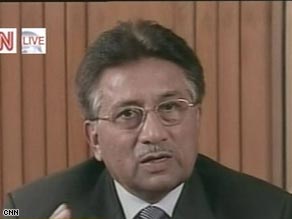
Pakistan's Pervez Musharraf has until now stubbornly resisted pressure to quit.

Musharraf told the nation in a televised address that he would step down -- nearly nine years after he seized power in a bloodless coup in 1999.
"I don't want the people of Pakistan to slide deeper and deeper into uncertainty," Musharraf said.
"For the interest of the nation, I have decided to resign as president," he said. "I am not asking for anything. I will let the people of Pakistan decide my future."  Watch Musharraf resign »
Musharraf has been a keen ally of the West in the fight on terror, receiving billions in military aid from the U.S. and launching attacks on militant groups near the country's border with Afghanistan.
He was expected to turn in his resignation to parliament Monday.
"It will be accepted, there is no second opinion about that," said Iqbal Zaffar Jhagra, the secretary general of the junior partner in the ruling coalition, the Pakistan Muslim League-N (PML-N).
Musharraf quit as the ruling coalition was taking steps to impeach him.
Local media reports said he had been granted "safe passage" out of the country.
Until now, Musharraf, 65, had resisted pressure to resign. But his power had eroded since parties opposed to his rule swept to victory in February's parliamentary elections.
Musharraf spent a large part of his speech delivering a state-of-the-union style list of Pakistan's "accomplishments" under his rule. He contrasted it with what he called the deteriorating economic situation now.
"After the elections, the nation wanted solutions from the new government," he said. "But the politicians could not do so. A personal vendetta was started."  View a timeline of Musharraf's time in power »
A coalition committee spent last week compiling a list of charges against Musharraf including corruption, economic mismanagement and violating the constitution.
Pakistan's four provincial assemblies called on the president to give up power. Parliament was expected to consider an impeachment motion Monday or Tuesday.
"I am confident that not a single charge can stand against me," Musharraf said. "I have not done anything for my personal gain. Whatever I have done, I have done it for Pakistan."
Faisal Kapadia, a commodities trader in Karachi who runs a blog about Pakistan called Deadpan Thoughts, said Musharraf's decision would get a mixed reaction.
"Leading Pakistan is not an easy task, and anyone doing it comes under a lot of criticism," he said.
"In the start, most Pakistanis were for him. And he still has some supporters -- especially because the new government, which promised to do things differently, has failed to do much in the past 100 days in power."
Musharraf grabbed power in 1999. He was serving as military chief when then-Prime Minister Nawaz Sharif dismissed him, setting off a confrontation.
As Musharraf was returning from an overseas visit in October 1999, Sharif refused to allow the commercial airliner with 200 passengers on board to land.
Within hours the army had deposed Sharif in a bloodless coup, and the plane was allowed to touch down with only 10 minutes of fuel left.
Musharraf was welcomed by a nation on the brink of economic ruin.
"I think at this point, his intentions were good," said Lt. Gen. Talat Masood, a political analyst. "He wanted to serve the country and to be different."
During his rule, Pakistan attained respectable growth rates and established a generally favorable investment climate.
Along with that came a growing middle class, a more aggressive media, and a more assertive judiciary.
"He brought parliamentary reforms. He brought women into the parliament," said Ahmed Bilal Mehboob, director of the Pakistan Institute of Legislative Development and Transparency.
But, analysts say, Musharraf never lost his military mindset.
"He in a way, always believed in a unity of command, a very centralized command, which means his command, in fact," said Masood.
After the September 11, 2001, terrorist attacks in the United States, Musharraf found himself on the frontline of the 'war on terror.'
Pakistan had supported the Taliban during the Soviet occupation of Afghanistan in the 1980s.
But after the 2001 attacks, Musharraf aligned himself with the U.S. to help rout the fundamentalist Islamic movement.
Washington gave Musharraf billions in aid as he vowed to deprive the militants of the sanctuary they had established along the country's border with Afghanistan.
He cast himself as indispensable -- to the West and to Pakistan, analysts said.
To Pakistanis he sold himself as the man who could deliver peace with India, a country with which Pakistan has fought three wars. To the West, he was the man to safeguard the country's nuclear arsenal.
However, Musharraf's popularity began to plummet last year following the March suspension of Supreme Court Chief Justice Iftikhar Chaudhry.
The move triggered protests and accusations that he was trying to influence the Supreme Court's ruling on whether he could run for another five-year term.
Chaudhry was reinstated but the damage was done.
"Undoubtedly, that was the catalyst," Masood said. "This is where he went wrong, and he underestimated the value of democracy."
Four months later, in July 2007, Pakistani security forces seized the Red Mosque in the capital city Islamabad.
The raid, intended to rout Islamic extremists who hoped to establish a Taliban-style rule in the capital, killed more than 100 people. A raft of suicide bombings followed.
In October, Musharraf was re-elected president by a parliament critics said was stacked with his supporters. Opposition parties filed a challenge.
The next month, he declared a state of emergency, suspended Pakistan's constitution, replaced the chief judge again and blacked out independent TV outlets.
Under pressure from the West, he later lifted the emergency and promised elections in January. Watch a PPP leader discuss opposition to Musharraf »
He allowed Sharif, the prime minister he deposed, to return from exile. He also let in another political foe, Benazir Bhutto. She, too, had been a prime minister, and led the Pakistan People's Party.
However, in December, the country was plunged into further turmoil when Bhutto was killed at a rally in Rawalpindi.
Musharraf's government and the CIA contend the killing was orchestrated by Baitullah Mehsud, a leader of the Pakistani Taliban with ties to al Qaeda. But nationwide polls found that a majority of Pakistanis believe Musharraf's government was complicit in the assassination.
Meanwhile, several other factors compounded Musharraf's declining popularity: a shortage of essential food items, power cuts, and a skyrocketing inflation.
Sunday, August 17, 2008
It's sad when Pakistan's government has more credibility and legitimacy than the US's
Pakistan coalition gives two-day Musharraf ultimatum
ISLAMABAD (AFP) — Pakistan's ruling coalition tightened the screw on President Pervez Musharraf Sunday, saying it would launch impeachment proceedings within two days if the key US ally does not stand down.
Defence Minister Ahmed Mukhtar told AFP that "the charge sheet will be presented in parliament by Tuesday", as coalition officials put the finishing touches to the list of allegations against him.
His comment came a day after Foreign Minister Shah Mehmood Qureshi said that the former general had to make a decision on resigning to avoid being impeached "by today or tomorrow, as there is no room for any delay".
A spokesman for Musharraf -- who seized power in a bloodless military coup in 1999 and went on to become a lynchpin in the US-led "war on terror" -- has repeatedly denied that the president is going to resign.
But Musharraf's allies and coalition officials have said separately that his aides are in talks with the government in a bid to secure him an indemnity from prosecution if he does throw in the towel.
Saudi Arabia and, reportedly, the United States and Britain, have sent envoys in a bid to resolve the crisis in the nuclear-armed nation, which is also suffering from a severe economic crunch.
A coalition source said fresh discussions were under way Sunday.
"The emissaries of Musharraf are still in contact with the government and as far as we know, Musharraf's aides are advising him either to resign seeking an assurance for indemnity or try the Supreme Court," the source told AFP.
Local newspapers said Musharraf was consulting his personal legal advisers over the possibility of challenging any impeachment move in the country's Supreme Court.
With Pakistan's powerful army taking a neutral stance towards its former chief, the court is the only institution Musharraf can still count on, as he purged it of opponents during a state of emergency last November.
The talks on getting immunity for Musharraf have also been hampered by the opposition of former premier Nawaz Sharif, who leads the second biggest group in the coalition after the Pakistan People's Party of Benazir Bhutto.
A spokesman for Sharif's party, Siddiqul Farooq, said that coalition partners and constitutional experts were gathering in Islamabad on Sunday to give the charge sheet "final shape".
No president has ever been impeached in Pakistan's 61-year history.
The army's stance is still unclear and analysts say it could react badly to seeing its former leader humiliated by impeachment. Musharraf quit as army chief in November last year under international pressure.
The coalition is counting on independent MPs and defectors from Musharraf's camp to win the two-thirds combined majority it would need in the upper and lower houses of parliament to impeach him.
Musharraf's other courses of action -- either dissolving the national assembly or imposing another state of emergency -- are fraught with risk.
The White House has also struck a neutral tone on a man long regarded as a key ally in the US-led "war on terror", saying that the impeachment threat was an internal matter.
Western allies want Pakistan to resolve the impasse so it can deal with the fight against Taliban and Al-Qaeda militants in the tribal areas bordering Afghanistan, where nearly 500 people have died in the past week.
Dozens of Islamic hardliners protested against Musharraf in the central city of Multan on Sunday, witnesses said.
Musharraf's popularity first slumped after he tried to sack the country's chief justice in March 2007.
His Supreme Court purge in November allowed him to force through his re-election to another five-year term by the outgoing parliament, but his political allies were then trounced in elections in February.
Original article posted here.
ISLAMABAD (AFP) — Pakistan's ruling coalition tightened the screw on President Pervez Musharraf Sunday, saying it would launch impeachment proceedings within two days if the key US ally does not stand down.
Defence Minister Ahmed Mukhtar told AFP that "the charge sheet will be presented in parliament by Tuesday", as coalition officials put the finishing touches to the list of allegations against him.
His comment came a day after Foreign Minister Shah Mehmood Qureshi said that the former general had to make a decision on resigning to avoid being impeached "by today or tomorrow, as there is no room for any delay".
A spokesman for Musharraf -- who seized power in a bloodless military coup in 1999 and went on to become a lynchpin in the US-led "war on terror" -- has repeatedly denied that the president is going to resign.
But Musharraf's allies and coalition officials have said separately that his aides are in talks with the government in a bid to secure him an indemnity from prosecution if he does throw in the towel.
Saudi Arabia and, reportedly, the United States and Britain, have sent envoys in a bid to resolve the crisis in the nuclear-armed nation, which is also suffering from a severe economic crunch.
A coalition source said fresh discussions were under way Sunday.
"The emissaries of Musharraf are still in contact with the government and as far as we know, Musharraf's aides are advising him either to resign seeking an assurance for indemnity or try the Supreme Court," the source told AFP.
Local newspapers said Musharraf was consulting his personal legal advisers over the possibility of challenging any impeachment move in the country's Supreme Court.
With Pakistan's powerful army taking a neutral stance towards its former chief, the court is the only institution Musharraf can still count on, as he purged it of opponents during a state of emergency last November.
The talks on getting immunity for Musharraf have also been hampered by the opposition of former premier Nawaz Sharif, who leads the second biggest group in the coalition after the Pakistan People's Party of Benazir Bhutto.
A spokesman for Sharif's party, Siddiqul Farooq, said that coalition partners and constitutional experts were gathering in Islamabad on Sunday to give the charge sheet "final shape".
No president has ever been impeached in Pakistan's 61-year history.
The army's stance is still unclear and analysts say it could react badly to seeing its former leader humiliated by impeachment. Musharraf quit as army chief in November last year under international pressure.
The coalition is counting on independent MPs and defectors from Musharraf's camp to win the two-thirds combined majority it would need in the upper and lower houses of parliament to impeach him.
Musharraf's other courses of action -- either dissolving the national assembly or imposing another state of emergency -- are fraught with risk.
The White House has also struck a neutral tone on a man long regarded as a key ally in the US-led "war on terror", saying that the impeachment threat was an internal matter.
Western allies want Pakistan to resolve the impasse so it can deal with the fight against Taliban and Al-Qaeda militants in the tribal areas bordering Afghanistan, where nearly 500 people have died in the past week.
Dozens of Islamic hardliners protested against Musharraf in the central city of Multan on Sunday, witnesses said.
Musharraf's popularity first slumped after he tried to sack the country's chief justice in March 2007.
His Supreme Court purge in November allowed him to force through his re-election to another five-year term by the outgoing parliament, but his political allies were then trounced in elections in February.
Original article posted here.
Saturday, July 26, 2008
The judiciary committee hearings on impeachment
Rep. Dennis Kucinich (D-OH) brought about today’s Judiciary Cmte. hearing on the executive power and the Bush Admin. The hearing is partly based on a single article of impeachment he brought against Pres. Bush, and on alleged misconduct and unlawful expansion of executive power.
Part 1
Part 2
Part 3
Thursday, July 24, 2008
One party, two factions. Not a dime's bit of difference.
Turley fears Dems will let alleged 'Bush crimes' stay buried forever
David Edwards and Muriel Kane
 George W. Bush has been more sparing than most presidents in handing out pardons, but it is starting to seem that the conclusion of his term in office may be marked by a generous use of the pardon power to let members of his own administration off the hook. What's more, constitutional lawyer Jonathan Turley believes that the Democrats will let him get away with it.
"The Democrats are trying very hard to show ... that they're not going to re-open these issues and that the Bush crimes will remain buried for all time," Turley told MSNBC's Keith Olbermann on Tuesday. "It would start a new administration on the same level that George Bush left it. And that's a very sad thing."
Turley was particularly concerned about a recent statement by law professor Cass Sunstein, an Obama adviser, that only "egregious" crimes by Bush officials should be prosecuted by an Obama administration.
"We've had eight years of moral relativism and the avoidance of legal process," stated Turley. "And to start a major campaign with the suggestion that we're going to distinguish between egregious and non-egregious crimes promises more of the same."
"Did we just see accountability go out the window for good?" Olbermann asked Turley.
"That would probably wrap it up," Turley replied.
"There are very few obligations that a president has to do under the Constitution, but one of them is not to violate the laws that he is supposed to enforce," explained Turley. "And what really concerns me about Cass Sunstein's statement is that I don't know what a non-egregious crime by a president or by an administration might be. I think that all crimes committed by the government, particularly the president, are egregious."
Turley further pointed to Speaker Nancy Pelosi's refusal to initiate impeachment proceedings against the president, saying, "I don't understand why some Democrats can't just simply accept a very straightforward proposition, that we'll prosecute any crimes committed by this administration, an Obama administration, a McCain administration. Because they're crimes. They're all egregious."
Sunstein's remarks followed a story in last week's New York Times, which reported that "several members of the conservative legal community in Washington said in interviews that they hoped Mr. Bush would issue such [pre-emptive] pardons. ... They said people who carried out the president’s orders should not be exposed even to the risk of an investigation and expensive legal bills."
Former Reagan Justice Department official Victoria Toensing -- recently best known for arguing that no crime was committed in the outing of former CIA officer Valerie Plame -- told the Times flatly, "The president should pre-empt any long-term investigations."
Turley noted that the Bush administration doesn't seem to care whether pre-emptive pardons would be an implicit admission of guilt. "I think this would be the ultimate and final show of contempt by this president for the rule of law," he concluded. "I think this president would find it very consistent to say, 'I can tell prople to commit crimes and then I can pardon them for it.' What is very troubling is that there appear to be Democrats on the other side who would welcome that."
This video is from MSNBC's News Live, broadcast July 22, 2008.
Original article posted here. |
weazl lifts full blogger post: but weazl thinks that it is worth repeating. Barack has become a whore. Sorry.
Fuck You Obama! You Sell-Out Piece of Shit!
Posted by willyloman on July 23, 2008
by Scott Creighton
Go fuck yourself Barack! You know the game is rigged and it’s your turn to lose, so you play the game and keep your name in good standing for the next go round. And you are a piece of shit.
 You are worse than the republicans, because at least they are standing by the positions of their constituent (however selfish and unAmerican they are). Whereas you are side stepping everything this party USED to stand for. Clinton rang in the end of the Democratic Party, and you and your corrupt staff of neo-liberal Clintonistas are turning out the lights, aren’t you?
All for your own personal agenda. You are a bastard.
And I give you the absolute last straw that I will tolerate. Your pandering cowardly speech today at Sderot was it for me. You allowed them to stage it in that fucking miserable yard where they keep the homemade rockets that are fired from Gaza. That fucking little yard where they bring people to prove how oppressed Israel has been by Gaza.
You are out of your fucking mind, you miserable little shit. How dare you stand, pandering to a nation that was just visited by member of the ANC that LIVED UNDER APARTHEID and they just recently said that what is going on in Gaza with the Palestinians is just as bad as what the South African White Regime did to them!?
Fuck you Obama! You fucking SELLOUT! Your speech three months back about racism and oppression WAS A FUCKING LIE, you bastard! You don’t give a shit about real oppression if you let these bastards use you like that. You’re a fucking tool. That’s your fucking legacy. That’s your historic nomination. You sold it out, you pathetic wimp. you sold it out, for a loss this go round and a promise for the future. You sold out CHEAP, for a little attention and some more book sales.
The reason those homemade rockets are there, you stupid little fuck, IS BECAUSE THEY DON’T BLOW UP, MORON! That’s why they don’t kill people unless they hit them in the head!
The Israelis have killed somewhere close to 100 Palestinians for every Israeli killed, shit for brains! Hell, they even kill Peace Activists who are there to help stop the ILLEGAL FUCKING INCURSIONS ONTO PALESTINIAN LAND, YOU BASTARD!
Here Barack, you wanna see a picture, motherfucker?

That’s Rachel Corrie. She was a decent human that got run over by an Israeli Bulldozer that wanted to tear down some Palestinians home. Would you “run out and settle that yourself” like you suggest you would if someone fired a “homemade rocket” at your house? Would you? What do you think about her parents, the Barack? You fucking piece of shit. Take a good look. This is what your “beacon of democracy” does, asshole.
Wanna see more?

Here’s your “democracy…”

Here’s what they think of themselves…

Here’s what your “beacon” does with kids in Gaza…

Here’s what they do to kids in Lebanon with cluster bombs (weapons of mass destruction)…

Here’s some settlers beating an old farmer with a baseball bat, just for not leaving his land when they told him to…

Here’s another picture for you Barack… that’s a Lebanese child from that “war” of 2006…

You know that prisoner exchange that just took place? All those stories about the 2 Israeli soldiers bodies that were returned? They made the Lebanese seem like monsters because they killed the two captive soldiers? Here is a picture of the other side of the exchange, you stupid bastard! 197 bodies returned to Lebanon of captives from the war the the Israelis killed. 197! Didn’t hear much about that one, did you?
Here’s a picture for you. it’s got REAL ROCKETS. The kind that blow up and kill kids! Here you go you bastard, get your picture taken with this, you sellout motherfucker!

Little Israeli girl sending a “Hello from Israel” to the children it will disfigure in Gaza or Lebanon.
So fuck you Obama! You go straight to hell. Fuck you Obama!
I will spend every hour that I can making sure that not only do you not win, but that every person I com into contact with knows exactly what kind of man you are. You are a bastard, and liar, a sellout, and a shill for the fascists that are corrupting this nation.
you go to hell you son of a bitch! and I mean that. i will do what I can to see that you lose your Senate seat in the future, since we all know you are just playing the game now…
you go to hell, Barack Obama. You turn you backs on the suffering of these people for a few votes, you don’t deserve to be president. asshole.
EDIT*** in response to a comment below, I am adding this in order to make it clearer exactly why I am so angry with Sen. Obama, that prick (sorry. i am still pissed)
I am Mad as Hell at Obama for letting the Israeli War Party use him as a tool of propaganda.
He has to have more sense than that. He is in line to be the damn PRESIDENT OF THE UNITED STATES and he is letting these warmongers of the Likud Party use him like this?
He should fire all of his aides, and apologise not only to the people of Gaza and the West Bank, but also to the millions of Israelis that don’t want to be portrayed in this fashion.
Original article posted here.
Subscribe to:
Posts (Atom)