


Baghdad tears down security barriers
Government starts to remove network of concrete walls set up at height of Iraq's sectarian conflict
Security may still be unpredictable, but officials in the Iraqi capital are planning to tear down Baghdad's network of concrete barriers and razor wire in the coming months as a measure of reconciliation creeps through its neighbourhoods.
The towering grey concrete barriers, known as T-walls, sprang up as sectarian conflict intensified in 2006 and 2007. Streets were closed and checkpoints established. Entire communities were isolated or divided, and familiar landmarks all but disappeared. Residents cowered or fled.
Now, improved security means that teams of cranes and trucks are stealing out under cover of darkness from municipal depots across the capital and removing the barriers, street by street.
A ministry of defence spokesman told the Guardian most of the concrete barriers would be gone by the end of 2009. "They are now the biggest obstacle to breathing new life into our city," said Ali Dawoud, the head of reconstruction and development at Baghdad's city council. He said that since January, 10-15% of the streets that were closed had been reopened and the barrier removal programme was growing month by month, security permitting.
Security concerns still abound. Bombs and mortars are still a regular occurrence in Baghdad; violence has flared in Iraq before a June 30 deadline for US troops to withdraw from urban areas; and yesterday the volatility of the situation was underscored by a car bomb in the Shia heartland of Nasiriya that killed more than 30 people.
But the Baghdad wall removal plan is part of a wider effort to beautify a city scarred by years of conflict. Sabah Sami, a spokesman for the Baghdad municipality, said: "Our role is to rehabilitate the streets and repair the damage made by the concrete walls to streets and pavements and because of their weight to the city's drainage and sewerage system." Each T-wall weighs about five tons. "Once they have gone from an area, we will clean and pave and then paint and plant," Sami said.
The only barriers to stay would be those protecting ministries and other official buildings.
Nobody knows how many of the barriers were deployed in the capital. Some residents likened them to tombstones, others to a thousand Berlin Walls.
But as a result of the beautification campaign, city authorities find themselves in possession of thousands of unwanted reinforced concrete slabs, standard measurement 12ft by 5ft.
On a recent trip to a southern suburb, the Guardian glimpsed a T-wall graveyard, which appeared to stretch for miles.
Suggestions have ranged from deploying them along Iraq's notoriously porous borders to massing them into a large heap as a monument to the madness of war.
"There's really not much you can do with them, other than build more walls," offered an engineer serving with the US military in Iraq.
Original article posted here.
Showing posts with label Iraq Reconciliation Plan. Show all posts
Showing posts with label Iraq Reconciliation Plan. Show all posts
Friday, June 12, 2009


Saturday, October 25, 2008
Breaking Babylon
Wrecked Iraq
What was once the most advanced Middle Eastern society - economically, socially, and technologically - has become an economic basket case, rivaling the most desperate countries in the world
Michael Schwartz.
What the Good News from Iraq Really Means
As the Smoke Clears in Iraq: Even before the spectacular presidential election campaign became a national obsession, and the worst economic crisis since the Great Depression crowded out other news, coverage of the Iraq War had dwindled to next to nothing. National newspapers had long since discontinued their daily feasts of multiple — usually front page – reports on the country, replacing them with meager meals of mostly inside-the-fold summary stories. On broadcast and cable TV channels, where violence in Iraq had once been the nightly lead, whole news cycles went by without a mention of the war.
The tone of the coverage also changed. The powerful reports of desperate battles and miserable Iraqis disappeared. There are still occasional stories about high-profile bombings or military campaigns in obscure places, but the bulk of the news is about quiescence in old hot spots, political maneuvering by Iraqi factions, and the newly emerging routines of ordinary life.
A typical "return to normal life" piece appeared October 11th in the New York Times under the headline, "Schools Open, and the First Test is Iraqi Safety." Featured was a Baghdad schoolteacher welcoming her students by assuring them that "security has returned to Baghdad, city of peace."
Even as his report began, though, Times reporter Sam Dagher hedged the "return to normal" theme. Here was his first paragraph in full:
"On the first day of school, 10-year-old Basma Osama looked uneasy standing in formation under an already stifling morning sun. She and dozens of schoolmates listened to a teacher's pep talk — probably a necessary one, given the barren and garbage-strewn playground."
This glimpse of the degraded conditions at one Baghdad public school, amplified in the body of Dagher's article by other examples, is symptomatic of the larger reality in Iraq. In a sense, the (often exaggerated) decline in violence in that country has allowed foreign reporters to move around enough to report on the real conditions facing Iraqis, and so should have provided US readers with a far fuller picture of the devastation George Bush's war wrought.
In reality, though, since there are far fewer foreign reporters moving around a quieter Iraq, far less news is coming out of that wrecked land. The major newspapers and networks have drastically reduced their staffs there and — with a relative trickle of exceptions like Dagher's fine report — what's left is often little more than a collection of pronouncements from the US military, or Iraqi and American political leaders in Baghdad and Washington, framing the American public's image of the situation there.
In addition, the devastation that is now Iraq is not of a kind that can always be easily explained in a short report, nor for that matter is it any longer easily repaired. In many cities, an American reliance on artillery and air power during the worst days of fighting helped devastate the Iraqi infrastructure. Political and economic changes imposed by the American occupation did damage of another kind, often depriving Iraqis not just of their livelihoods but of the very tools they would now need to launch a major reconstruction effort in their own country.
As a consequence, what was once the most advanced Middle Eastern society — economically, socially, and technologically — has become an economic basket case, rivaling the most desperate countries in the world. Only the (as yet unfulfilled) promise of oil riches, which probably cannot be effectively accessed or used until US forces withdraw from the country, provides a glimmer of hope that Iraq will someday lift itself out of the abyss into which the US invasion pushed it.
Consider only a small sampling of the devastation.
The Economy: Fundamental to the American occupation was the desire to annihilate Saddam Hussein's Baathist state apparatus and the economic system it commanded. A key aspect of this was the closing down of the vast majority of state-owned economic enterprises (with the exception of those involved in oil extraction and electrical generation).
In all, 192 establishments, adding up to 35% of the Iraqi economy, were shuttered in the summer and fall of 2003. These included basic manufacturing processes like leather tanning and tractor assembly that supplied other sectors, transportation firms that dominated national commerce, and maintenance enterprises that housed virtually all the technicians and engineers qualified to service the electrical, water, oil, and other infrastructural systems in the country.
Justified as the way to bring a modern free-enterprise system to backward Iraq, this draconian program was put in place by the President's proconsul in Baghdad, L. Paul Bremer III. The result? An immediate depression that only deepened in the years to follow.
One measure of this policy's impact can be found in the demise of the leather goods industry, a key pre-invasion sector of Iraq's non-petroleum economy. When a government-owned tanning operation, which all by itself employed 30,000 workers and supplied leather to an entire industry, was shuttered in late 2003, it deprived shoe-makers and other leather goods establishments of their key resource. Within a year, employment in the industry had dropped from 200,000 workers to a mere 20,000.
By the time Bremer left Iraq in the spring of 2004, the inhabitants of many cities faced 60% unemployment. Meanwhile, the country's agriculture, a key component of its economy, was also victimized by the dismantling of government establishments and services. The lush farming areas between the Tigris and Euphrates rivers suffered badly. The once-thriving date palm industry was a typical casualty. It suffered deadly infestations of pests when the occupation eliminated a government-run insecticide spraying program. Even oil refinery-based industrial towns like Baiji became cities of slums when plants devoted to non-petroleum activities were shuttered.
This economic devastation fueled the insurgency by generating desperation, anger, and willing recruits. The explosion of resistance, in turn, tended to obscure — at least for western news services — the desperate circumstances under which ordinary Iraqis labored.
As violence has subsided in Baghdad and elsewhere, demands for relief have come to the fore. These are not easily answered by a still largely non-functional central government in Baghdad whose administrative and economic apparatus was long ago dismantled, and many of whose key technical personnel had fled into exile. Meanwhile, in early 2006, the American occupation declared that further reconstruction work would be the responsibility of Iraqis. It is not clear into what channels the growing discontent over an economy that remains largely in the tank and a government that still cannot deliver ordinary services will flow.
Electricity: A critical factor in Iraq's collapse has been its decaying electrical grid. In areas where the insurgency raged, facilities involved in producing and transmitting electricity were targeted, both by the insurgents and US forces, each trying to deprive the other of needed resources. In addition, Bremer eliminated the government-owned maintenance and engineering enterprises that had been holding the electrical system together ever since the U.N. sanctions regime after the 1991 Gulf War deprived Iraq of material needed to repair and upgrade its facilities. Maintenance and replacement contracts were given instead to multinational companies with little knowledge of the existing system and — due to cost-plus contracting — every incentive to replace facilities with their own proprietary technology. In the meantime, many Iraqi technicians left the country.
The successor Iraqi governments, deprived of the capacity to manage the system's reconstruction, continued the US occupation policy of contracting with foreign companies. Even in areas of the country relatively unaffected by the fighting, those companies did the lucrative thing, replacing entire sections of the electric grid, often with inappropriate but exquisitely expensive equipment and technology.
A combination of factors — including pressure from the insurgency, the soaring costs of security, and an almost unparalleled record of endemic waste and corruption — led to costs well beyond those originally offered for the already overpriced projects. Many were then abandoned before completion as funding ran out. Completed projects were often shabbily done and just as often proved incompatible with existing facilities, introducing new inefficiencies.
In one altogether-too-typical case, Bechtel installed 26 natural gas turbines in areas where no natural gas was available. The turbines were then converted to oil, which reduced their capacity by 50% and led to a rapid sludge build-up in the equipment requiring expensive maintenance no Iraqi technicians had been trained to perform. In location after location, the turbines became inoperative.
Even before the invasion, the decrepit electrical system could not meet national demand. No province had uninterrupted service and certain areas had far less than 12 hours of service per day. The vast investments by the occupation and its successor regimes have increased electrical capacity since the invasion of 2003, but these gains have not come close to keeping up with skyrocketing demand created by the presence of hundreds of thousands of troops, private security personnel, and occupation officials, as well as by the introduction of all manner of electronic devices and products in the post-invasion period. Recent U.N. reports indicate that, in the last year, electrical capacity has slipped to less than half of demand. With priority going to military and government operations, many Baghdad neighborhoods experience less than two hours of publicly provided electricity a day, forcing citizens and business enterprises to utilize expensive and polluting gasoline generators.
In spring of this year, 81% of Iraqis reported that they had experienced inadequate electricity in the previous month. During the heat of summer and the cold of winter, these shortages create real health emergencies.
In 2004, the U.N. estimated that $20 billion in reconstruction funds would be needed for a fully operative electrical grid. The estimates now range from $40 billion to $80 billion.
Water: The Tigris and Euphrates rivers, which flow through the country from the northwest to the southeast, have since time immemorial irrigated the rich farming land that lay between them, nurtured the fish that are a staple of the Iraqi diet, and provided water for animal and human consumption. American-style warfare, with its reliance on tank, artillery, and air power, often resulted in the cratering of streets in upstream Sunni cities like Tal Afar, Falluja, and Samarra where the insurgency was strongest. One result was the wrecking of already weakened underground sewage systems. In the Sadr City section of Baghdad, for instance, where much fighting has taken place and American air power was called in regularly, there is now a lake of sewage clearly visible on satellite photographs.
The ultimate destination of significant parts of the filth from devastated sewage systems was the two rivers. Five years worth of such waste flowing through the streets and into those rivers has left them thoroughly contaminated. Their water can no longer be safely drunk by humans or animals, the remaining fish cannot be safely eaten, and the contaminated water reportedly withers the crops it irrigates.
Iraq's never-adequate water purification system has proven woefully insufficient to handle this massive flow of contamination, while inadequate electric supplies insure that the country's few functional purification plants are less than effective.
In many cities, the sewage system must be entirely reconstructed, but repairs cannot even begin without a viable electrical system, a reinvigorated engineering and construction sector, and a government capable of marshalling these resources. None of these prerequisites currently exist.
Schools: Education has been a victim of all the various pathologies current in Iraqi society. During the initial invasion, the US military often commandeered schools as forward bases, attracted by their well-defined perimeters, open spaces for vehicles, and many rooms for offices and barracks. Two incidents in which American gunfire from an occupied elementary school killed Iraqi civilians in the conservative Sunni city of Falluja may have been the literal sparks that started the insurgency. Many schools would subsequently be rendered uninhabitable by destructive battles fought in or near them.
Under the US occupation's de-Baathification policy, thousands of teachers who belonged to the Baath Party were fired, leaving hundreds of thousands of students teacherless. In addition, the shuttering of government enterprises deprived the schools of supplies — including books and teaching materials — as well as urgently needed maintenance.
The American solution, as with the electric grid, was to hire multinational firms to repair the schools and rehabilitate school systems. The result was an orgy of corruption accompanied by very little practical aid. Local school officials complained that facilities with no windows, heating, or toilet facilities were repainted and declared fit for use.
The dwindling central government presence made schools inviting arenas for sectarian conflict, with administrators, teachers, and especially college professors removed, kidnapped, or assassinated for ideological reasons. This, in turn, stimulated a mass exodus of teachers, intellectuals, and scientists from the country, removing precious human capital essential for future reconstruction.
Finally, in Baghdad, the US military began installing ten-foot tall cement walls around scores of communities and neighborhoods to wall off participants in the sectarian violence. As a result, schoolchildren were often separated from their schools, reducing attendance at the few intact facilities to those students who happened to live within the imprisoning walls.
This fall, as some of these walls were dismantled, residents discovered that many of the schools were virtually unusable. The Times's Dagher offered a vivid description, for instance, of a school in the Dolaie neighborhood which "is falling apart, and overwhelmed by the children of almost 4,000 Shiite refugee families who have settled in the Chukouk camp nearby. The roof is caving in, classroom floors and hallways are stripped bare, and in the playground a pile of burnt trash was smoldering."
The Dysfunctional Society: Much has been made in the US presidential campaign of the $70 billion oil surplus the Iraqi government built up in these last years as oil prices soared. In actuality, most of it is currently being held in American financial institutions, with various American politicians threatening to confiscate it if it is not constructively spent. Yet even this bounty reflects the devastation of the war.
De-Baathification and subsequent chaos rendered the Iraqi government incapable of effectively administering projects that lay outside the fortified, American-controlled Green Zone in the heart of Baghdad. A vast flight of the educated class to Syria, Jordan, and other countries also deprived it of the managers and technicians needed to undertake serious reconstruction on a large scale.
As a consequence, less than 25% of the funds budgeted for facility construction and reconstruction last year were even spent. Some government ministries spent less than 1% of their allocations. In the meantime, the large oil surpluses have become magnets for massive governmental corruption, further infuriating frustrated citizens who, after five years, still often lack the most basic services. Transparency International's 2008 "corruption perceptions index" listed Iraq as tied for 178th place among the 180 countries evaluated.
The Iraq that has emerged from the American invasion and occupation is now a thoroughly wrecked land, housing a largely dysfunctional society. More than a million Iraqis may have died; millions have fled their homes; many millions of others have been scarred by war, insurgency and counterinsurgency operations, extreme sectarian violence, and soaring levels of common criminality. Education and medical systems have essentially collapsed and, even today, with every kind of violence in decline, Iraq remains one of the most dangerous societies on earth.
As its crisis deepened, the various areas of social and technical devastation became ever more entwined, reinforcing one another. The country's degraded sewage and water systems, for example, have spawned two consecutive years of widespread cholera. It seems likely that this year, the disease will only subside when the cold weather makes further contagion impossible, but this "solution" also guarantees its reoccurrence each year until water purification systems are rebuilt.
In the meantime, cholera victims cannot rely on Iraq's once vaunted medical system, since two-thirds of the country's doctors have fled, its hospitals are often in a state of advanced decay and disrepair, drugs remain scarce, and equipment, if available at all, is outdated. The rebuilding of the water and medical systems, however, cannot get fully underway unless the electrical system is restored to reasonable shape. Repair of the electrical grid awaits a reliable oil and gas pipeline system to provide fuel for generators, and this cannot be constructed without the expertise of technicians who have left the country, or newly trained specialists that the educational system is now incapable of producing. And so it goes.
On a daily basis, this cauldron of misery renews powerful feelings of discontent, which explains why American military leaders regularly insist that the country's current relative quiescence is, at best, "fragile." They believe only the most minimal reductions in US forces in Iraq (still hovering at close to 150,000 troops) are advisable.
Even if Washington prefers to ignore Iraqi realities, military officials working close to the ground know that the country's state of disrepair, and an inability to deal with it in any reasonably prompt way, leaves a population in steaming discontent. At any moment, this could explode in further sectarian violence or yet another violent effort to expel the US forces from the country.
Michael Schwartz's new book, War Without End: The Iraq Debacle in Context (Haymarket, 2008), has just been released. It explains just how the militarized geopolitics of oil led the US to dismantle the Iraqi state and economy while fueling sectarian civil war inside that country. A professor of sociology at Stony Brook State University, Schwartz has written extensively on popular protest and insurgency. His work on Iraq has appeared in numerous outlets, including TomDispatch, Asia Times, Mother Jones, and Contexts. A video of him discussing "wrecked Iraq" can be seen by clicking here. His email address is ms42@optonline.net.
Original article posted here.
What was once the most advanced Middle Eastern society - economically, socially, and technologically - has become an economic basket case, rivaling the most desperate countries in the world
Michael Schwartz.
What the Good News from Iraq Really Means
As the Smoke Clears in Iraq: Even before the spectacular presidential election campaign became a national obsession, and the worst economic crisis since the Great Depression crowded out other news, coverage of the Iraq War had dwindled to next to nothing. National newspapers had long since discontinued their daily feasts of multiple — usually front page – reports on the country, replacing them with meager meals of mostly inside-the-fold summary stories. On broadcast and cable TV channels, where violence in Iraq had once been the nightly lead, whole news cycles went by without a mention of the war.
The tone of the coverage also changed. The powerful reports of desperate battles and miserable Iraqis disappeared. There are still occasional stories about high-profile bombings or military campaigns in obscure places, but the bulk of the news is about quiescence in old hot spots, political maneuvering by Iraqi factions, and the newly emerging routines of ordinary life.
A typical "return to normal life" piece appeared October 11th in the New York Times under the headline, "Schools Open, and the First Test is Iraqi Safety." Featured was a Baghdad schoolteacher welcoming her students by assuring them that "security has returned to Baghdad, city of peace."
Even as his report began, though, Times reporter Sam Dagher hedged the "return to normal" theme. Here was his first paragraph in full:
"On the first day of school, 10-year-old Basma Osama looked uneasy standing in formation under an already stifling morning sun. She and dozens of schoolmates listened to a teacher's pep talk — probably a necessary one, given the barren and garbage-strewn playground."
This glimpse of the degraded conditions at one Baghdad public school, amplified in the body of Dagher's article by other examples, is symptomatic of the larger reality in Iraq. In a sense, the (often exaggerated) decline in violence in that country has allowed foreign reporters to move around enough to report on the real conditions facing Iraqis, and so should have provided US readers with a far fuller picture of the devastation George Bush's war wrought.
In reality, though, since there are far fewer foreign reporters moving around a quieter Iraq, far less news is coming out of that wrecked land. The major newspapers and networks have drastically reduced their staffs there and — with a relative trickle of exceptions like Dagher's fine report — what's left is often little more than a collection of pronouncements from the US military, or Iraqi and American political leaders in Baghdad and Washington, framing the American public's image of the situation there.
In addition, the devastation that is now Iraq is not of a kind that can always be easily explained in a short report, nor for that matter is it any longer easily repaired. In many cities, an American reliance on artillery and air power during the worst days of fighting helped devastate the Iraqi infrastructure. Political and economic changes imposed by the American occupation did damage of another kind, often depriving Iraqis not just of their livelihoods but of the very tools they would now need to launch a major reconstruction effort in their own country.
As a consequence, what was once the most advanced Middle Eastern society — economically, socially, and technologically — has become an economic basket case, rivaling the most desperate countries in the world. Only the (as yet unfulfilled) promise of oil riches, which probably cannot be effectively accessed or used until US forces withdraw from the country, provides a glimmer of hope that Iraq will someday lift itself out of the abyss into which the US invasion pushed it.
Consider only a small sampling of the devastation.
The Economy: Fundamental to the American occupation was the desire to annihilate Saddam Hussein's Baathist state apparatus and the economic system it commanded. A key aspect of this was the closing down of the vast majority of state-owned economic enterprises (with the exception of those involved in oil extraction and electrical generation).
In all, 192 establishments, adding up to 35% of the Iraqi economy, were shuttered in the summer and fall of 2003. These included basic manufacturing processes like leather tanning and tractor assembly that supplied other sectors, transportation firms that dominated national commerce, and maintenance enterprises that housed virtually all the technicians and engineers qualified to service the electrical, water, oil, and other infrastructural systems in the country.
Justified as the way to bring a modern free-enterprise system to backward Iraq, this draconian program was put in place by the President's proconsul in Baghdad, L. Paul Bremer III. The result? An immediate depression that only deepened in the years to follow.
One measure of this policy's impact can be found in the demise of the leather goods industry, a key pre-invasion sector of Iraq's non-petroleum economy. When a government-owned tanning operation, which all by itself employed 30,000 workers and supplied leather to an entire industry, was shuttered in late 2003, it deprived shoe-makers and other leather goods establishments of their key resource. Within a year, employment in the industry had dropped from 200,000 workers to a mere 20,000.
By the time Bremer left Iraq in the spring of 2004, the inhabitants of many cities faced 60% unemployment. Meanwhile, the country's agriculture, a key component of its economy, was also victimized by the dismantling of government establishments and services. The lush farming areas between the Tigris and Euphrates rivers suffered badly. The once-thriving date palm industry was a typical casualty. It suffered deadly infestations of pests when the occupation eliminated a government-run insecticide spraying program. Even oil refinery-based industrial towns like Baiji became cities of slums when plants devoted to non-petroleum activities were shuttered.
This economic devastation fueled the insurgency by generating desperation, anger, and willing recruits. The explosion of resistance, in turn, tended to obscure — at least for western news services — the desperate circumstances under which ordinary Iraqis labored.
As violence has subsided in Baghdad and elsewhere, demands for relief have come to the fore. These are not easily answered by a still largely non-functional central government in Baghdad whose administrative and economic apparatus was long ago dismantled, and many of whose key technical personnel had fled into exile. Meanwhile, in early 2006, the American occupation declared that further reconstruction work would be the responsibility of Iraqis. It is not clear into what channels the growing discontent over an economy that remains largely in the tank and a government that still cannot deliver ordinary services will flow.
Electricity: A critical factor in Iraq's collapse has been its decaying electrical grid. In areas where the insurgency raged, facilities involved in producing and transmitting electricity were targeted, both by the insurgents and US forces, each trying to deprive the other of needed resources. In addition, Bremer eliminated the government-owned maintenance and engineering enterprises that had been holding the electrical system together ever since the U.N. sanctions regime after the 1991 Gulf War deprived Iraq of material needed to repair and upgrade its facilities. Maintenance and replacement contracts were given instead to multinational companies with little knowledge of the existing system and — due to cost-plus contracting — every incentive to replace facilities with their own proprietary technology. In the meantime, many Iraqi technicians left the country.
The successor Iraqi governments, deprived of the capacity to manage the system's reconstruction, continued the US occupation policy of contracting with foreign companies. Even in areas of the country relatively unaffected by the fighting, those companies did the lucrative thing, replacing entire sections of the electric grid, often with inappropriate but exquisitely expensive equipment and technology.
A combination of factors — including pressure from the insurgency, the soaring costs of security, and an almost unparalleled record of endemic waste and corruption — led to costs well beyond those originally offered for the already overpriced projects. Many were then abandoned before completion as funding ran out. Completed projects were often shabbily done and just as often proved incompatible with existing facilities, introducing new inefficiencies.
In one altogether-too-typical case, Bechtel installed 26 natural gas turbines in areas where no natural gas was available. The turbines were then converted to oil, which reduced their capacity by 50% and led to a rapid sludge build-up in the equipment requiring expensive maintenance no Iraqi technicians had been trained to perform. In location after location, the turbines became inoperative.
Even before the invasion, the decrepit electrical system could not meet national demand. No province had uninterrupted service and certain areas had far less than 12 hours of service per day. The vast investments by the occupation and its successor regimes have increased electrical capacity since the invasion of 2003, but these gains have not come close to keeping up with skyrocketing demand created by the presence of hundreds of thousands of troops, private security personnel, and occupation officials, as well as by the introduction of all manner of electronic devices and products in the post-invasion period. Recent U.N. reports indicate that, in the last year, electrical capacity has slipped to less than half of demand. With priority going to military and government operations, many Baghdad neighborhoods experience less than two hours of publicly provided electricity a day, forcing citizens and business enterprises to utilize expensive and polluting gasoline generators.
In spring of this year, 81% of Iraqis reported that they had experienced inadequate electricity in the previous month. During the heat of summer and the cold of winter, these shortages create real health emergencies.
In 2004, the U.N. estimated that $20 billion in reconstruction funds would be needed for a fully operative electrical grid. The estimates now range from $40 billion to $80 billion.
Water: The Tigris and Euphrates rivers, which flow through the country from the northwest to the southeast, have since time immemorial irrigated the rich farming land that lay between them, nurtured the fish that are a staple of the Iraqi diet, and provided water for animal and human consumption. American-style warfare, with its reliance on tank, artillery, and air power, often resulted in the cratering of streets in upstream Sunni cities like Tal Afar, Falluja, and Samarra where the insurgency was strongest. One result was the wrecking of already weakened underground sewage systems. In the Sadr City section of Baghdad, for instance, where much fighting has taken place and American air power was called in regularly, there is now a lake of sewage clearly visible on satellite photographs.
The ultimate destination of significant parts of the filth from devastated sewage systems was the two rivers. Five years worth of such waste flowing through the streets and into those rivers has left them thoroughly contaminated. Their water can no longer be safely drunk by humans or animals, the remaining fish cannot be safely eaten, and the contaminated water reportedly withers the crops it irrigates.
Iraq's never-adequate water purification system has proven woefully insufficient to handle this massive flow of contamination, while inadequate electric supplies insure that the country's few functional purification plants are less than effective.
In many cities, the sewage system must be entirely reconstructed, but repairs cannot even begin without a viable electrical system, a reinvigorated engineering and construction sector, and a government capable of marshalling these resources. None of these prerequisites currently exist.
Schools: Education has been a victim of all the various pathologies current in Iraqi society. During the initial invasion, the US military often commandeered schools as forward bases, attracted by their well-defined perimeters, open spaces for vehicles, and many rooms for offices and barracks. Two incidents in which American gunfire from an occupied elementary school killed Iraqi civilians in the conservative Sunni city of Falluja may have been the literal sparks that started the insurgency. Many schools would subsequently be rendered uninhabitable by destructive battles fought in or near them.
Under the US occupation's de-Baathification policy, thousands of teachers who belonged to the Baath Party were fired, leaving hundreds of thousands of students teacherless. In addition, the shuttering of government enterprises deprived the schools of supplies — including books and teaching materials — as well as urgently needed maintenance.
The American solution, as with the electric grid, was to hire multinational firms to repair the schools and rehabilitate school systems. The result was an orgy of corruption accompanied by very little practical aid. Local school officials complained that facilities with no windows, heating, or toilet facilities were repainted and declared fit for use.
The dwindling central government presence made schools inviting arenas for sectarian conflict, with administrators, teachers, and especially college professors removed, kidnapped, or assassinated for ideological reasons. This, in turn, stimulated a mass exodus of teachers, intellectuals, and scientists from the country, removing precious human capital essential for future reconstruction.
Finally, in Baghdad, the US military began installing ten-foot tall cement walls around scores of communities and neighborhoods to wall off participants in the sectarian violence. As a result, schoolchildren were often separated from their schools, reducing attendance at the few intact facilities to those students who happened to live within the imprisoning walls.
This fall, as some of these walls were dismantled, residents discovered that many of the schools were virtually unusable. The Times's Dagher offered a vivid description, for instance, of a school in the Dolaie neighborhood which "is falling apart, and overwhelmed by the children of almost 4,000 Shiite refugee families who have settled in the Chukouk camp nearby. The roof is caving in, classroom floors and hallways are stripped bare, and in the playground a pile of burnt trash was smoldering."
The Dysfunctional Society: Much has been made in the US presidential campaign of the $70 billion oil surplus the Iraqi government built up in these last years as oil prices soared. In actuality, most of it is currently being held in American financial institutions, with various American politicians threatening to confiscate it if it is not constructively spent. Yet even this bounty reflects the devastation of the war.
De-Baathification and subsequent chaos rendered the Iraqi government incapable of effectively administering projects that lay outside the fortified, American-controlled Green Zone in the heart of Baghdad. A vast flight of the educated class to Syria, Jordan, and other countries also deprived it of the managers and technicians needed to undertake serious reconstruction on a large scale.
As a consequence, less than 25% of the funds budgeted for facility construction and reconstruction last year were even spent. Some government ministries spent less than 1% of their allocations. In the meantime, the large oil surpluses have become magnets for massive governmental corruption, further infuriating frustrated citizens who, after five years, still often lack the most basic services. Transparency International's 2008 "corruption perceptions index" listed Iraq as tied for 178th place among the 180 countries evaluated.
The Iraq that has emerged from the American invasion and occupation is now a thoroughly wrecked land, housing a largely dysfunctional society. More than a million Iraqis may have died; millions have fled their homes; many millions of others have been scarred by war, insurgency and counterinsurgency operations, extreme sectarian violence, and soaring levels of common criminality. Education and medical systems have essentially collapsed and, even today, with every kind of violence in decline, Iraq remains one of the most dangerous societies on earth.
As its crisis deepened, the various areas of social and technical devastation became ever more entwined, reinforcing one another. The country's degraded sewage and water systems, for example, have spawned two consecutive years of widespread cholera. It seems likely that this year, the disease will only subside when the cold weather makes further contagion impossible, but this "solution" also guarantees its reoccurrence each year until water purification systems are rebuilt.
In the meantime, cholera victims cannot rely on Iraq's once vaunted medical system, since two-thirds of the country's doctors have fled, its hospitals are often in a state of advanced decay and disrepair, drugs remain scarce, and equipment, if available at all, is outdated. The rebuilding of the water and medical systems, however, cannot get fully underway unless the electrical system is restored to reasonable shape. Repair of the electrical grid awaits a reliable oil and gas pipeline system to provide fuel for generators, and this cannot be constructed without the expertise of technicians who have left the country, or newly trained specialists that the educational system is now incapable of producing. And so it goes.
On a daily basis, this cauldron of misery renews powerful feelings of discontent, which explains why American military leaders regularly insist that the country's current relative quiescence is, at best, "fragile." They believe only the most minimal reductions in US forces in Iraq (still hovering at close to 150,000 troops) are advisable.
Even if Washington prefers to ignore Iraqi realities, military officials working close to the ground know that the country's state of disrepair, and an inability to deal with it in any reasonably prompt way, leaves a population in steaming discontent. At any moment, this could explode in further sectarian violence or yet another violent effort to expel the US forces from the country.
Michael Schwartz's new book, War Without End: The Iraq Debacle in Context (Haymarket, 2008), has just been released. It explains just how the militarized geopolitics of oil led the US to dismantle the Iraqi state and economy while fueling sectarian civil war inside that country. A professor of sociology at Stony Brook State University, Schwartz has written extensively on popular protest and insurgency. His work on Iraq has appeared in numerous outlets, including TomDispatch, Asia Times, Mother Jones, and Contexts. A video of him discussing "wrecked Iraq" can be seen by clicking here. His email address is ms42@optonline.net.
Original article posted here.
Even the puppet stops dancing
Iraq's prime minister won't sign U.S. troop deal, official says
By ROY GUTMANFearing political division in the parliament and the country at large, Iraqi Prime Minister Nouri al-Maliki won't sign the just-completed agreement on the status of U.S. troops in Iraq, a leading lawmaker said on Friday.
Shelving the new accord would constitute a major setback both for the Bush administration, which has been seeking to establish a legal basis for the extended presence of the 151,000 U.S. troops in this country, and for Iraq, which gained notable concessions in the draft accord reached one week ago.
"No, he will not" submit the agreement to the parliament, Sheikh Jalal al-Din al-Sagheer, the deputy head of the Islamic Supreme Council of Iraq, told McClatchy Newspapers. "For this matter, we need national consensus."
Instead, al-Sagheer said, Iraq's political leaders are thinking about seeking an extension of the United Nations mandate for the presence of U.S. troops that expires on Dec. 31. Russia, a member of the U.N. Security Council, had given Iraq a direct assurance that it wouldn't veto an extension, he said, adding that it was likely to last between six months and a year.
Ali al-Adeeb, the chief of staff of al-Maliki's Dawa party, said Wednesday that the Iraqi parliament "cannot approve this pact in its current form."
Top U.S. military officials have warned of serious consequences should the agreement not be signed. Adm. Mike Mullen, the chairman of the Joint Chiefs of Staff, said earlier this week that Iraq's forces "will not be ready to provide for their security" after the current U.N. mandate runs out. "And in that regard there is great potential for losses of significant consequence," Mullen said.
Gen. Ray Odierno, the top U.S. commander in Iraq, told USA Today: "Without (a security agreement), we would potentially have to cease all operations."
Iraqis, however, are adamant that the accord must be open to further amendments if they are to approve it.
"The problem is that when we were given the latest draft, we were told the American negotiators will accept no amendments to it, and the Iraqi government has more requirements," said al-Sagheer, an Islamic cleric who later led the Friday prayers broadcast on national television.
He said al-Maliki had come to the Political Council for National Security, a top decision-making body, and said the new accord was the best he could obtain, but it did not include everything Iraq wanted.
If al-Maliki signed the accord and turned it over to the parliament, "I'm sure that the agreement will not be approved for 10 years," Sagheer said.
The cleric said the draft accord was "good, in general," but its timing was bad. If an Iraqi negotiator accepted the agreement, "he will be taken as an agent for the Americans," and if he were to reject it, "he will be taken for an agent for Iran."
A second factor is that the accord comes just before the U.S. elections, and an Iraqi negotiator had to ask whether it was best to negotiate with the lame-duck Bush administration or its successor. Still more important, al-Sagheer said, was the approaching provincial elections in Iraq, which could be held early next year.
"Iraqi politicians don't want to give their competitors the chance to use this agreement to destroy them," he said.
The accord contains a number of American concessions, calling for a U.S. troop withdrawal onto their bases by June 2009 and a complete withdrawal by the end of 2011 - both dates subject to extension but only if the Iraqi government requests it.
The accord also would allow Iraq to prosecute U.S. troops except when they're on bases or on military operations, strips private military contractors of U.S. legal protection and reclaims control over Baghdad's "Green" zone, the location of U.S. missions and many of the government headquarters.
Al-Sagheer said the setting of a timetable for U.S. troop withdrawal was a "historic" accomplishment.
He also acknowledged that an extension of the current U.N. mandate might not reflect the gains made in the status of forces draft.
"For everything there is a price," he said. "And although (the accord) has many advantages, it also has many disadvantages, as it does for the coalition forces."
The problem for Iraqis, he said, was "the feeling with some of the parties that America has no intention of withdrawing within the timetable." Iraqis, he said, had so many negative experiences while a British mandate under the League of Nations from 1920 to 1932 that they fear a written agreement. "We have the feeling that if the Iraqi government accepts the demands, it will give a legal right to be occupied, so we don't have any kind of sovereignty."
Other politicians say that if Washington agrees to extend the negotiations, the talks will never end.
"This is all a game to win time. When the current issues are settled, they will just find new ones. ... They are delaying to appease Iran," said Mithal al-Alusi, a secular Sunni legislator who is critical of the current Shiite-led government.
Tuesday, October 21, 2008
Massive Iraqi resistance
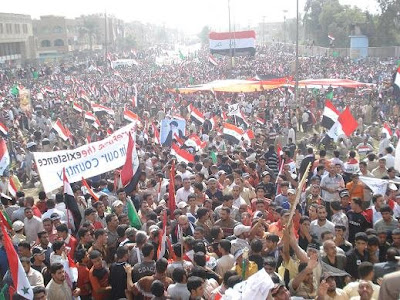
ANOTHER MILLION IRAQI DEMONSTRATORS: GET OUT OF OUR COUNTRY
Baghdad witnessed another demonstration with more than one million Iraqi, Arabs and Kurds and others, Muslims and Christians and others, Sunnis and Shiites and others demonstrated together against the occupation and the long term agreement, asking for a complete withdrawal the leaves no permanent bases, no troops, and no mercenaries.
Its really sad to watch how the mainstream U.S. media and politicians ignore Iraq's massive non violent resistance, whether it was the annual one million Iraqis demonstration, or whether it was the other forms of non-violent resistants like voting for the current anti-occupation parliament, signing petitions, writing poems and books, or even talking against the current occupation.
Ignoring the Iraqi non-violent resistance will definitely push more Iraqis to choose armed resistance as the way to get their country back. The bottom line is that people want their country back; if they manage to get it back through signing petitions and demonstrating, they'll be more than happy. If they can't they'll use force.
Choosing which type of resistance to adopt from the huge continuum (that starts from writing a word and ends by holding a gun) is a two way dialog: if the U.S. government reacted more to Iraqis demonstrating, i'm sure than more one million Iraqis will demonstrate.


Its really sad to watch how the mainstream U.S. media and politicians ignore Iraq's massive non violent resistance, whether it was the annual one million Iraqis demonstration, or whether it was the other forms of non-violent resistants like voting for the current anti-occupation parliament, signing petitions, writing poems and books, or even talking against the current occupation.
Ignoring the Iraqi non-violent resistance will definitely push more Iraqis to choose armed resistance as the way to get their country back. The bottom line is that people want their country back; if they manage to get it back through signing petitions and demonstrating, they'll be more than happy. If they can't they'll use force.
Choosing which type of resistance to adopt from the huge continuum (that starts from writing a word and ends by holding a gun) is a two way dialog: if the U.S. government reacted more to Iraqis demonstrating, i'm sure than more one million Iraqis will demonstrate.


Sunday, September 21, 2008
Iraq finding its own way. The crony puppet evolves.
When success is failure in Iraq
By Michael Schwartz
As the George W Bush administration was entering office in 2000, Donald Rumsfeld exuberantly expressed grandiose ambitions for Middle East domination, telling a National Security Council meeting: "Imagine what the region would look like without Saddam and with a regime that's aligned with US interests. It would change everything in the region and beyond."
A few weeks later, Bush speechwriter David Frum offered an even more exuberant version of the same vision to the New York Times Magazine: "An American-led overthrow of Saddam Hussein, and the replacement of the radical Baathist dictatorship with a new government more closely aligned with the United States, would put America more wholly in charge of the region than any power since the Ottomans, or maybe even the Romans."
From the moment on May 1, 2003, when the president declared "major combat operations ... ended" on the deck of the USS Abraham Lincoln, such exuberant administration statements have repeatedly been deflated by events on the ground. Left unsaid through all the twists and turns in Iraq has been this: Whatever their disappointments, administration officials never actually gave up on their grandiose ambitions. Through thick and thin, Washington has sought to install a regime "aligned with US interests" - a government ready to cooperate in establishing the United States as the predominant power in the Middle East.
Recently, with significantly lower levels of violence in Iraq extending into a second year, Washington insiders have begun crediting themselves with - finally - a winning strategy (a claim neatly punctured by Juan Cole, among other Middle East experts). In this context, actual Bush policy aims have, once again, emerged more clearly, but so has the administration's striking and continual failure to implement them - thanks to the Iraqis.
In the past few weeks, the Iraqi government of Prime Minister Nuri al-Maliki has made it all too clear that, in the long run, it has little inclination to remain "aligned with US interests" in the region. In fact, we may be witnessing a classic "tipping point", a moment when Washington's efforts to dominate the Middle East are definitively deep-sixed.
The client state that the Bush administration has spent so many years and hundreds of billions of dollars creating, nurturing, and defending has shown increasing disloyalty and lack of gratitude, as well as an ever stronger urge to go its own way. Under the pressure of Iraqi politics, Maliki has moved strongly in the direction of a nationalist position on two key issues: the continuing American occupation and the future of Iraqi oil. In the process, he has sought to distance his government from the Bush administration and to establish congenial relationships, if not an outright alliance, with Washington's international adversaries, including the Bush administration's mortal enemy, Iran.
Withdrawal becomes an official issue
Perhaps the most dramatic symbol of this new independence is the Iraqi government's resistance to a Washington proposal for a SOFA (Status Of Forces Agreement), which will allow for a permanent and uninhibited US military presence in Iraq.
With the impending expiration of the UN resolutions that gave the US military legal cover to keep a presence in Iraq, the SOFA negotiations are crucial. They began with a proposal that expressed the full extent of Washington's ambitions to utilize Iraq as the base for making the US "more wholly in charge of the region than any power since the Ottomans, or maybe even the Romans". The proposal, which was first leaked to the press in June 2008, was essentially a major land grab, and included provisions like the following that would not have seemed out of place in a 19th century colonial treaty:
An indefinite number of US troops would remain in Iraq indefinitely, stationed on up to 58 bases in locations determined by the United States.
These troops would be allowed to mount attacks on any target inside Iraq without the permission of, or even notification to, Iraqi authorities.
US military and civilian authorities would be free to use Iraqi territory to mount attacks against any of Iraq's neighbors without permission from the Iraqi government.
The US would control Iraqi airspace up to 30,000 feet, freeing the US Air Force to strike as it wishes inside Iraq and creating the basis for the use of, or passage through, Iraq's air space for planes bent on attacking other countries.
The US military and its private contractors would be immune from Iraqi law, even for actions unrelated to their military duties.
Iraq's Defense, Interior and National Security ministries (and all of Iraq's arms purchases) would be under US supervision for 10 years.
When leaked - clearly by Iraqis involved in the negotiations - this proposal generated opposition across the political spectrum from parliament to the streets. It was even denounced by the usually silent Grand Ayatollah Ali al-Sistani, the most influential Shi'ite Ayatollah. Soon, Maliki made clear his own rejection of the proposal, setting in motion a chaotic negotiating process in which the Iraqis seem to have argued vehemently for a more modest, briefer US presence, as well as a definite deadline for full withdrawal - a proposal that was an anathema to the Bush administration.
By early August, when the details of a new proposal endorsed by US Secretary of State Condoleezza Rice began to leak out, it was clear that US negotiators had given way, granting significant concessions to the Iraqi side. According to Iraqi insiders, the new draft agreement called for US troops to be completely withdrawn from Iraqi cities, where most of the fighting usually takes place, by the summer of 2009. All US troops - not just the "combat" troops usually mentioned when Democrats talk about withdrawal timelines in Iraq - would have to be gone by the end of 2011.
If the leaked draft were implemented, the US would leave behind those 58 bases, including the five massive "enduring" bases into which the Bush administration has poured billions of dollars. Moreover, the unhindered scope of action Washington had originally demanded for its forces would be dramatically limited: The US would not have the right to attack other countries from Iraqi soil, its ability to conduct operations within Iraq would be circumscribed, and immunity from prosecution would be restricted to US military personnel (and then only when they were participating in approved military actions).
Symptomatic of the loosening US grip on its Iraqi client government were the reactions of the two sides to the leaked provisions of the new version of the agreement. Rice declared it "acceptable" and explained uneasily that the timeline proposed was not the sort of fixed withdrawal date that the Bush administration had long, adamantly, rejected, but an "aspirational ... time horizon" that would depend on "conditions" in Iraq.
Maliki, in all likelihood responding to the fervor of public protests to Rice's comments, immediately declared the agreement unacceptable unless the deadline for withdrawal was time-based and unconditional. In a well publicized speech to a gathering of tribal sheiks, he said that any agreement must be based on the principle that "no foreign soldier remains in Iraq after a specific deadline, not an open time frame". In further clarifying his remarks, a key aide told the Associated Press that "the last American soldiers must leave Iraq by the end of 2011, regardless of conditions at the time".
The latest reports suggest that a further round of secret negotiations had restored some US demands, including full immunity for American soldiers (but not mercenary fighters), and application of the withdrawal deadline to combat troops only. Such concessions by Maliki, however, appeared certain to trigger another round of protests, and resistance in the streets and in the Iraqi parliament.
Whatever their outcome, the still-unfinished negotiations point to something quite new in the relationship between the two governments. Until recently, the Iraqi leadership faithfully sought to enact whatever policies the Bush administration favored (though its capacity to implement them was always in question). With the proposed SOFA, this posture disappeared, replaced by a clear antagonism to Washington's desires. With its formidable weapons (including 146,000 soldiers on the ground), Washington is bound to win at least some of these confrontations, but what we may be seeing is the end of the dream of a regime "closely aligned" with US policies.
The re-emergence of oil nationalism
Nothing better highlights this transformation than oil policy. From the beginning of its occupation of Iraq, the Bush administration sought to quadruple Iraqi oil production by delivering control of the industry to the major international oil companies. Once given free rein to act at their own discretion, Washington policymakers believed that the oil majors would invest vast sums in modernizing existing fields, activate undeveloped reserves using the most advanced technology available, and discover major new fields utilizing state-of-the-art exploration and extraction methods.
Up until 2007, the Iraqi government was an active ally in this enterprise, even though the vast majority of Iraqis - including the powerful oil workers union, the religious leadership, and a majority of parliament - vehemently opposed these plans, demanding instead that control of the industry remain in government hands. In 2004, the US-appointed Iraqi government enthusiastically endorsed an International Monetary Fund agreement that mandated the development of major Iraqi oil reserves by international oil companies.
When those companies found the legal basis for such investment too fragile to risk vast sums of capital, the Iraqi government - surrounded by American advisors - immediately began work on an oil law which would presumably provide a more secure foundation for the investment. In the meantime, informal advice was accepted from the oil majors, whose technicians were placed in charge of various engineering operations within the country.
In 2007, when the oil law was finally delivered to the Iraqi parliament, it met with unremitting opposition, and the always strong oil unions immediately began a ferocious resistance campaign that stalled the law.
None of these developments altered the Bush administration's determination to push the law through. They did not, however, anticipate that the Maliki administration itself would become a further source of opposition. As Charles Ries told journalists on leaving his position as US economic ambassador to Iraq in August 2008 after a year of failure: "When I got here ... I was quite optimistic it was only a month or two [before the petroleum bill would be passed, but the] more I understood what the real issues were ... it was clear this was going to be a major political challenge."
While Ries was on the job, even the leadership of the Ministry of Oil, until then a pro-American bastion, went into opposition. One symptom of this was its failure to complete five no-bid contracts (which did not even include either investment or extraction rights) with oil consortia led by the usual suspects - Exxon Mobil, Royal Dutch Shell, BP, Total and Chevron - designed to increase Iraqi production by 500,000 barrels per day. Oil Minister Hussein al-Shahrastani told the Wall Street Journal that a key reason for the faltering negotiations was the desire of the oil companies for "preferential treatment for future oil-exploration deals". This comment, like the faltering negotiations, hinted at the abandonment of the Bush administration's long-desired version of an Iraqi oil policy.
The new attitude was underscored when the Oil Ministry revived a Saddam Hussein-era agreement with the China National Petroleum Corporation, which was now granted a US$3 billion contract to develop the Ahdab oil field. Given the growing US-China rivalry over the control of foreign oil sources, the symbolism of this act could not have been clearer - especially since the earlier contract had been unceremoniously canceled by the United States at the beginning of the occupation in 2003. No less important, this was a "service contract" whose terms did not follow US guidelines calling for the reduction or elimination of Iraqi government control of the oil industry.
Soon after announcing this new agreement, Oil Minister Shahrastani offered what might be seen as a declaration of oil policy independence. "[Global] oil supplies," he declared, "meet and may slightly exceed current world demand". The world, that is, had plenty of oil, and so there was, he insisted, no global need to rush pell-mell into oil development agreements that might not, in the long run, be of use to Iraq.
This represented an attack on the fundamental premise of US oil policy - that, as Vice President Dick Cheney told an oil industry gathering back in 1999: "By 2010 we will need on the order of an additional 50 million barrels a day. So where is the oil going to come from? While many regions of the world offer great oil opportunities, the Middle East, with two-thirds of the world's oil and the lowest cost, is still where the prize ultimately lies."
Significantly, in 2001 - and before 9/11 - the Cheney Energy Task Force, working with the National Security Council, would make this commitment the centerpiece of administration for Middle Eastern policy, defining the world situation as one in which the supply of oil must be drastically increased to meet the demand for an "additional 50 million barrels a day".
Oil-producing countries of the Middle East never embraced Cheney's analysis and consistently resisted US efforts to encourage, induce or coerce dramatic increases in oil production. Instead, they viewed the "shortage" of oil as a natural result of market forces, beneficial to their own economies.
With the success of the US invasion, the Iraqi government threatened to become a maverick among the Organization of the Petroleum Exporting Countries (OPEC), endorsing US supported plans that, theoretically, would have quadrupled Iraqi production within 10 years. So Shahrastani's comments were a signal that Iraq was rejoining OPEC's ranks and potentially opening a new era in post-invasion Iraqi politics in which the government he represented would no longer be a reliable ally of the United States.
Nail in the coffin of American defeat?
Implicit in these actions is a new attitude toward, and assessment of, the US presence in Iraq. Maliki and his cohorts appear to have adopted the viewpoint of journalist Nir Rosen that "the Americans are just one more militia," just the most powerful of the rogue forces that they have to manage and eventually eliminate.
As the Iraqi government accumulates an expanding lake of petrodollars and finds ways to shake themselves loose from the clutches of US banks and US government administrators, its leaders will have the resources to pursue policies that reflect their own goals. The decline in violence, taken in the US as a sign of American "success," has actually accelerated this process. It has made the Maliki regime feel ever less dependent for its survival on the American presence, while strengthening internal and regional forces resistant or antagonistic to Washington's Middle East ambitions.
The respected Iraqi newspaper Azzaman pointed to one of these forces in a recent editorial, "Iran has emerged as the country's top trading partner. Its firms are present in the Kurdish north and southern Iraq carrying out projects worth billions of dollars. Iranian goods are the most conspicuous merchandise in Iraqi shops. Iraq, though occupied and administered by America, has grown to be so dependent on Iran that some analysts see it as a satellite state of Tehran."
To support this contention, Azzaman asserted: "The Ministry of Oil and other key portfolios such the Ministry of Interior and Finance are in the hands of pro-Iran Shi'ite factions." Citing Oil Ministry sources, it suggested that recent changes in oil policy actually reflected Iranian pressure to "exclude US oil majors from contracts to develop the country's massive oil fields".
Azzaman may be overemphasizing Iranian influence, since there are myriad internal Iraqi influences that continue to press against Washington's desire for a client regime. Parliament, the Sunni and Shi'ite religious leaderships, powerful unions, and the Sunni and Shi'ite insurgencies have all registered broad opposition to continued US presence and influence.
As all this occurs, US leverage over the Iraqi government, though still formidable, is in decline. The Bush administration - or its soon-to-be elected successor - may face a difficult dilemma: whether to accept some version of the withdrawal demands of the Iraqi government, or re-escalate the war in yet one more attempt to create a government that is "aligned with US interests".
The recent declaration by the Pentagon that only the most modest of troop reductions is militarily feasible in the foreseeable future may be a symptom of this dilemma. Without a full complement of US troops, after all, it will be increasingly difficult to convince the Maliki regime to re-embrace policies favored by Washington.
The question remains: can anything reverse the centripetal forces pulling Iraq from Washington's orbit? Will the president's "surge" strategy prove to have been the nail in the coffin of its hopes for US dominance in the Middle East?
If this turns out to be the case, then watch out domestically. The inevitable controversy over "who lost Iraq" - an echo of those earlier controversies over "who lost China" and "who lost Vietnam" - is bound to be on the way.
Michael Schwartz's new book, War Without End: The Iraq Debacle in Context (Haymarket, 2008), will be released later this month. It explains just how the militarized geopolitics of oil led the US to dismantle the Iraqi state and economy while fueling sectarian civil war inside that country. A professor of sociology at Stony Brook State University, Schwartz has written extensively on popular protest and insurgency. His e-mail address is ms42@optonline.net.
Original article posted here.
By Michael Schwartz
As the George W Bush administration was entering office in 2000, Donald Rumsfeld exuberantly expressed grandiose ambitions for Middle East domination, telling a National Security Council meeting: "Imagine what the region would look like without Saddam and with a regime that's aligned with US interests. It would change everything in the region and beyond."
A few weeks later, Bush speechwriter David Frum offered an even more exuberant version of the same vision to the New York Times Magazine: "An American-led overthrow of Saddam Hussein, and the replacement of the radical Baathist dictatorship with a new government more closely aligned with the United States, would put America more wholly in charge of the region than any power since the Ottomans, or maybe even the Romans."
From the moment on May 1, 2003, when the president declared "major combat operations ... ended" on the deck of the USS Abraham Lincoln, such exuberant administration statements have repeatedly been deflated by events on the ground. Left unsaid through all the twists and turns in Iraq has been this: Whatever their disappointments, administration officials never actually gave up on their grandiose ambitions. Through thick and thin, Washington has sought to install a regime "aligned with US interests" - a government ready to cooperate in establishing the United States as the predominant power in the Middle East.
Recently, with significantly lower levels of violence in Iraq extending into a second year, Washington insiders have begun crediting themselves with - finally - a winning strategy (a claim neatly punctured by Juan Cole, among other Middle East experts). In this context, actual Bush policy aims have, once again, emerged more clearly, but so has the administration's striking and continual failure to implement them - thanks to the Iraqis.
In the past few weeks, the Iraqi government of Prime Minister Nuri al-Maliki has made it all too clear that, in the long run, it has little inclination to remain "aligned with US interests" in the region. In fact, we may be witnessing a classic "tipping point", a moment when Washington's efforts to dominate the Middle East are definitively deep-sixed.
The client state that the Bush administration has spent so many years and hundreds of billions of dollars creating, nurturing, and defending has shown increasing disloyalty and lack of gratitude, as well as an ever stronger urge to go its own way. Under the pressure of Iraqi politics, Maliki has moved strongly in the direction of a nationalist position on two key issues: the continuing American occupation and the future of Iraqi oil. In the process, he has sought to distance his government from the Bush administration and to establish congenial relationships, if not an outright alliance, with Washington's international adversaries, including the Bush administration's mortal enemy, Iran.
Withdrawal becomes an official issue
Perhaps the most dramatic symbol of this new independence is the Iraqi government's resistance to a Washington proposal for a SOFA (Status Of Forces Agreement), which will allow for a permanent and uninhibited US military presence in Iraq.
With the impending expiration of the UN resolutions that gave the US military legal cover to keep a presence in Iraq, the SOFA negotiations are crucial. They began with a proposal that expressed the full extent of Washington's ambitions to utilize Iraq as the base for making the US "more wholly in charge of the region than any power since the Ottomans, or maybe even the Romans". The proposal, which was first leaked to the press in June 2008, was essentially a major land grab, and included provisions like the following that would not have seemed out of place in a 19th century colonial treaty:
An indefinite number of US troops would remain in Iraq indefinitely, stationed on up to 58 bases in locations determined by the United States.
These troops would be allowed to mount attacks on any target inside Iraq without the permission of, or even notification to, Iraqi authorities.
US military and civilian authorities would be free to use Iraqi territory to mount attacks against any of Iraq's neighbors without permission from the Iraqi government.
The US would control Iraqi airspace up to 30,000 feet, freeing the US Air Force to strike as it wishes inside Iraq and creating the basis for the use of, or passage through, Iraq's air space for planes bent on attacking other countries.
The US military and its private contractors would be immune from Iraqi law, even for actions unrelated to their military duties.
Iraq's Defense, Interior and National Security ministries (and all of Iraq's arms purchases) would be under US supervision for 10 years.
When leaked - clearly by Iraqis involved in the negotiations - this proposal generated opposition across the political spectrum from parliament to the streets. It was even denounced by the usually silent Grand Ayatollah Ali al-Sistani, the most influential Shi'ite Ayatollah. Soon, Maliki made clear his own rejection of the proposal, setting in motion a chaotic negotiating process in which the Iraqis seem to have argued vehemently for a more modest, briefer US presence, as well as a definite deadline for full withdrawal - a proposal that was an anathema to the Bush administration.
By early August, when the details of a new proposal endorsed by US Secretary of State Condoleezza Rice began to leak out, it was clear that US negotiators had given way, granting significant concessions to the Iraqi side. According to Iraqi insiders, the new draft agreement called for US troops to be completely withdrawn from Iraqi cities, where most of the fighting usually takes place, by the summer of 2009. All US troops - not just the "combat" troops usually mentioned when Democrats talk about withdrawal timelines in Iraq - would have to be gone by the end of 2011.
If the leaked draft were implemented, the US would leave behind those 58 bases, including the five massive "enduring" bases into which the Bush administration has poured billions of dollars. Moreover, the unhindered scope of action Washington had originally demanded for its forces would be dramatically limited: The US would not have the right to attack other countries from Iraqi soil, its ability to conduct operations within Iraq would be circumscribed, and immunity from prosecution would be restricted to US military personnel (and then only when they were participating in approved military actions).
Symptomatic of the loosening US grip on its Iraqi client government were the reactions of the two sides to the leaked provisions of the new version of the agreement. Rice declared it "acceptable" and explained uneasily that the timeline proposed was not the sort of fixed withdrawal date that the Bush administration had long, adamantly, rejected, but an "aspirational ... time horizon" that would depend on "conditions" in Iraq.
Maliki, in all likelihood responding to the fervor of public protests to Rice's comments, immediately declared the agreement unacceptable unless the deadline for withdrawal was time-based and unconditional. In a well publicized speech to a gathering of tribal sheiks, he said that any agreement must be based on the principle that "no foreign soldier remains in Iraq after a specific deadline, not an open time frame". In further clarifying his remarks, a key aide told the Associated Press that "the last American soldiers must leave Iraq by the end of 2011, regardless of conditions at the time".
The latest reports suggest that a further round of secret negotiations had restored some US demands, including full immunity for American soldiers (but not mercenary fighters), and application of the withdrawal deadline to combat troops only. Such concessions by Maliki, however, appeared certain to trigger another round of protests, and resistance in the streets and in the Iraqi parliament.
Whatever their outcome, the still-unfinished negotiations point to something quite new in the relationship between the two governments. Until recently, the Iraqi leadership faithfully sought to enact whatever policies the Bush administration favored (though its capacity to implement them was always in question). With the proposed SOFA, this posture disappeared, replaced by a clear antagonism to Washington's desires. With its formidable weapons (including 146,000 soldiers on the ground), Washington is bound to win at least some of these confrontations, but what we may be seeing is the end of the dream of a regime "closely aligned" with US policies.
The re-emergence of oil nationalism
Nothing better highlights this transformation than oil policy. From the beginning of its occupation of Iraq, the Bush administration sought to quadruple Iraqi oil production by delivering control of the industry to the major international oil companies. Once given free rein to act at their own discretion, Washington policymakers believed that the oil majors would invest vast sums in modernizing existing fields, activate undeveloped reserves using the most advanced technology available, and discover major new fields utilizing state-of-the-art exploration and extraction methods.
Up until 2007, the Iraqi government was an active ally in this enterprise, even though the vast majority of Iraqis - including the powerful oil workers union, the religious leadership, and a majority of parliament - vehemently opposed these plans, demanding instead that control of the industry remain in government hands. In 2004, the US-appointed Iraqi government enthusiastically endorsed an International Monetary Fund agreement that mandated the development of major Iraqi oil reserves by international oil companies.
When those companies found the legal basis for such investment too fragile to risk vast sums of capital, the Iraqi government - surrounded by American advisors - immediately began work on an oil law which would presumably provide a more secure foundation for the investment. In the meantime, informal advice was accepted from the oil majors, whose technicians were placed in charge of various engineering operations within the country.
In 2007, when the oil law was finally delivered to the Iraqi parliament, it met with unremitting opposition, and the always strong oil unions immediately began a ferocious resistance campaign that stalled the law.
None of these developments altered the Bush administration's determination to push the law through. They did not, however, anticipate that the Maliki administration itself would become a further source of opposition. As Charles Ries told journalists on leaving his position as US economic ambassador to Iraq in August 2008 after a year of failure: "When I got here ... I was quite optimistic it was only a month or two [before the petroleum bill would be passed, but the] more I understood what the real issues were ... it was clear this was going to be a major political challenge."
While Ries was on the job, even the leadership of the Ministry of Oil, until then a pro-American bastion, went into opposition. One symptom of this was its failure to complete five no-bid contracts (which did not even include either investment or extraction rights) with oil consortia led by the usual suspects - Exxon Mobil, Royal Dutch Shell, BP, Total and Chevron - designed to increase Iraqi production by 500,000 barrels per day. Oil Minister Hussein al-Shahrastani told the Wall Street Journal that a key reason for the faltering negotiations was the desire of the oil companies for "preferential treatment for future oil-exploration deals". This comment, like the faltering negotiations, hinted at the abandonment of the Bush administration's long-desired version of an Iraqi oil policy.
The new attitude was underscored when the Oil Ministry revived a Saddam Hussein-era agreement with the China National Petroleum Corporation, which was now granted a US$3 billion contract to develop the Ahdab oil field. Given the growing US-China rivalry over the control of foreign oil sources, the symbolism of this act could not have been clearer - especially since the earlier contract had been unceremoniously canceled by the United States at the beginning of the occupation in 2003. No less important, this was a "service contract" whose terms did not follow US guidelines calling for the reduction or elimination of Iraqi government control of the oil industry.
Soon after announcing this new agreement, Oil Minister Shahrastani offered what might be seen as a declaration of oil policy independence. "[Global] oil supplies," he declared, "meet and may slightly exceed current world demand". The world, that is, had plenty of oil, and so there was, he insisted, no global need to rush pell-mell into oil development agreements that might not, in the long run, be of use to Iraq.
This represented an attack on the fundamental premise of US oil policy - that, as Vice President Dick Cheney told an oil industry gathering back in 1999: "By 2010 we will need on the order of an additional 50 million barrels a day. So where is the oil going to come from? While many regions of the world offer great oil opportunities, the Middle East, with two-thirds of the world's oil and the lowest cost, is still where the prize ultimately lies."
Significantly, in 2001 - and before 9/11 - the Cheney Energy Task Force, working with the National Security Council, would make this commitment the centerpiece of administration for Middle Eastern policy, defining the world situation as one in which the supply of oil must be drastically increased to meet the demand for an "additional 50 million barrels a day".
Oil-producing countries of the Middle East never embraced Cheney's analysis and consistently resisted US efforts to encourage, induce or coerce dramatic increases in oil production. Instead, they viewed the "shortage" of oil as a natural result of market forces, beneficial to their own economies.
With the success of the US invasion, the Iraqi government threatened to become a maverick among the Organization of the Petroleum Exporting Countries (OPEC), endorsing US supported plans that, theoretically, would have quadrupled Iraqi production within 10 years. So Shahrastani's comments were a signal that Iraq was rejoining OPEC's ranks and potentially opening a new era in post-invasion Iraqi politics in which the government he represented would no longer be a reliable ally of the United States.
Nail in the coffin of American defeat?
Implicit in these actions is a new attitude toward, and assessment of, the US presence in Iraq. Maliki and his cohorts appear to have adopted the viewpoint of journalist Nir Rosen that "the Americans are just one more militia," just the most powerful of the rogue forces that they have to manage and eventually eliminate.
As the Iraqi government accumulates an expanding lake of petrodollars and finds ways to shake themselves loose from the clutches of US banks and US government administrators, its leaders will have the resources to pursue policies that reflect their own goals. The decline in violence, taken in the US as a sign of American "success," has actually accelerated this process. It has made the Maliki regime feel ever less dependent for its survival on the American presence, while strengthening internal and regional forces resistant or antagonistic to Washington's Middle East ambitions.
The respected Iraqi newspaper Azzaman pointed to one of these forces in a recent editorial, "Iran has emerged as the country's top trading partner. Its firms are present in the Kurdish north and southern Iraq carrying out projects worth billions of dollars. Iranian goods are the most conspicuous merchandise in Iraqi shops. Iraq, though occupied and administered by America, has grown to be so dependent on Iran that some analysts see it as a satellite state of Tehran."
To support this contention, Azzaman asserted: "The Ministry of Oil and other key portfolios such the Ministry of Interior and Finance are in the hands of pro-Iran Shi'ite factions." Citing Oil Ministry sources, it suggested that recent changes in oil policy actually reflected Iranian pressure to "exclude US oil majors from contracts to develop the country's massive oil fields".
Azzaman may be overemphasizing Iranian influence, since there are myriad internal Iraqi influences that continue to press against Washington's desire for a client regime. Parliament, the Sunni and Shi'ite religious leaderships, powerful unions, and the Sunni and Shi'ite insurgencies have all registered broad opposition to continued US presence and influence.
As all this occurs, US leverage over the Iraqi government, though still formidable, is in decline. The Bush administration - or its soon-to-be elected successor - may face a difficult dilemma: whether to accept some version of the withdrawal demands of the Iraqi government, or re-escalate the war in yet one more attempt to create a government that is "aligned with US interests".
The recent declaration by the Pentagon that only the most modest of troop reductions is militarily feasible in the foreseeable future may be a symptom of this dilemma. Without a full complement of US troops, after all, it will be increasingly difficult to convince the Maliki regime to re-embrace policies favored by Washington.
The question remains: can anything reverse the centripetal forces pulling Iraq from Washington's orbit? Will the president's "surge" strategy prove to have been the nail in the coffin of its hopes for US dominance in the Middle East?
If this turns out to be the case, then watch out domestically. The inevitable controversy over "who lost Iraq" - an echo of those earlier controversies over "who lost China" and "who lost Vietnam" - is bound to be on the way.
Michael Schwartz's new book, War Without End: The Iraq Debacle in Context (Haymarket, 2008), will be released later this month. It explains just how the militarized geopolitics of oil led the US to dismantle the Iraqi state and economy while fueling sectarian civil war inside that country. A professor of sociology at Stony Brook State University, Schwartz has written extensively on popular protest and insurgency. His e-mail address is ms42@optonline.net.
Original article posted here.
Sunday, August 24, 2008
Iraqis more familiar with Joe Biden than Americans . . .
VP choice Biden unpopular in Iraq for autonomy plan
Peter Graff and Khalid al-Ansary
BAGHDAD, Aug 23 (Reuters) - Senator Joe Biden may be one of the only U.S. politicians that can get Iraq's feuding Sunni, Shi'ite and Kurdish politicians to agree. But not in a good way.
Across racial and religious boundaries, Iraqi politicians on Saturday bemoaned Democratic presidential contender Barack Obama's choice of running mate, known in Iraq as the author of a 2006 plan to divide the country into ethnic and sectarian enclaves.
"This choice of Biden is disappointing, because he is the creator of the idea of dividing Iraq," Salih al-Mutlaq, head of National Dialogue, one of the main Sunni Arab blocs in parliament, told Reuters.
"We rejected his proposal when he announced it, and we still reject it. Dividing the communities and land in such a way would only lead to new fighting between people over resources and borders. Iraq cannot survive unless it is unified, and dividing it would keep the problems alive for a long time."
Delaware senator Biden unveiled his plan to divide Iraq into a federation of autonomous Sunni, Shi'ite and Kurdish zones at a time when sectarian killing in Iraq was out of control and getting worse.
"The idea, as in Bosnia, is to maintain a united Iraq by decentralising it, giving each ethno-religious group -- Kurd, Sunni Arab and Shiite Arab -- room to run its own affairs," he proposed in a May 2006 piece he co-wrote in the New York Times.
"The Kurdish, Sunni and Shiite regions would each be responsible for their own domestic laws, administration and internal security. The central government would control border defence, foreign affairs and oil revenues," Biden said.
LESS RELEVANT
At the time, many Iraqi politicians hinted at a need for communities to be divided. Since then, however, violence has ebbed and nearly all mainstream politicians speak out against such ideas.
"The original 'Biden plan' seems less relevant in Iraq today than at any point," said Reidar Visser, a Norwegian academic and editor of the Iraq-focused website historiae.org. "The trend in parliament is clearly in a more national direction, with political parties coming together across sectarian divides.
"In other words, there is a very strong Iraqi mobilisation against precisely the core elements of the Biden plan, and it would be extremely unwise of the Democratic Party to make Biden's ideas the centrepiece of their Iraq strategy," he added.
Today, even Kurds who already have their own autonomous enclave in northern Iraq say they oppose the "Biden plan".
"We don't support establishing federal regions on a sectarian basis. For example our region is not ethnic, it contains Kurds and non-Kurds. The regions should be established on a geographic basis," said Kurdish lawmaker Mahmoud Othman.
Ezzet al-Shabender, a member of parliament from the secularist Iraqi List of former prime minister Ayad Allawi, actually credited the broad-based disgust triggered by Biden's proposal for helping Iraqi politicians bury their differences.
"His project was the reason behind the unity of many political blocs that once differed in viewpoints," he said, comparing it to the Balfour Declaration, a 1917 British note that backed the creation of Israel and is regarded across the Arab world as the ultimate colonial injustice.
"Such a person, if he would assume the vice-presidency post, would not serve to improve Iraq-USA relations."
Original article posted here.
Peter Graff and Khalid al-Ansary
BAGHDAD, Aug 23 (Reuters) - Senator Joe Biden may be one of the only U.S. politicians that can get Iraq's feuding Sunni, Shi'ite and Kurdish politicians to agree. But not in a good way.
Across racial and religious boundaries, Iraqi politicians on Saturday bemoaned Democratic presidential contender Barack Obama's choice of running mate, known in Iraq as the author of a 2006 plan to divide the country into ethnic and sectarian enclaves.
"This choice of Biden is disappointing, because he is the creator of the idea of dividing Iraq," Salih al-Mutlaq, head of National Dialogue, one of the main Sunni Arab blocs in parliament, told Reuters.
"We rejected his proposal when he announced it, and we still reject it. Dividing the communities and land in such a way would only lead to new fighting between people over resources and borders. Iraq cannot survive unless it is unified, and dividing it would keep the problems alive for a long time."
Delaware senator Biden unveiled his plan to divide Iraq into a federation of autonomous Sunni, Shi'ite and Kurdish zones at a time when sectarian killing in Iraq was out of control and getting worse.
"The idea, as in Bosnia, is to maintain a united Iraq by decentralising it, giving each ethno-religious group -- Kurd, Sunni Arab and Shiite Arab -- room to run its own affairs," he proposed in a May 2006 piece he co-wrote in the New York Times.
"The Kurdish, Sunni and Shiite regions would each be responsible for their own domestic laws, administration and internal security. The central government would control border defence, foreign affairs and oil revenues," Biden said.
LESS RELEVANT
At the time, many Iraqi politicians hinted at a need for communities to be divided. Since then, however, violence has ebbed and nearly all mainstream politicians speak out against such ideas.
"The original 'Biden plan' seems less relevant in Iraq today than at any point," said Reidar Visser, a Norwegian academic and editor of the Iraq-focused website historiae.org. "The trend in parliament is clearly in a more national direction, with political parties coming together across sectarian divides.
"In other words, there is a very strong Iraqi mobilisation against precisely the core elements of the Biden plan, and it would be extremely unwise of the Democratic Party to make Biden's ideas the centrepiece of their Iraq strategy," he added.
Today, even Kurds who already have their own autonomous enclave in northern Iraq say they oppose the "Biden plan".
"We don't support establishing federal regions on a sectarian basis. For example our region is not ethnic, it contains Kurds and non-Kurds. The regions should be established on a geographic basis," said Kurdish lawmaker Mahmoud Othman.
Ezzet al-Shabender, a member of parliament from the secularist Iraqi List of former prime minister Ayad Allawi, actually credited the broad-based disgust triggered by Biden's proposal for helping Iraqi politicians bury their differences.
"His project was the reason behind the unity of many political blocs that once differed in viewpoints," he said, comparing it to the Balfour Declaration, a 1917 British note that backed the creation of Israel and is regarded across the Arab world as the ultimate colonial injustice.
"Such a person, if he would assume the vice-presidency post, would not serve to improve Iraq-USA relations."
Original article posted here.
Wednesday, July 23, 2008
Saturday, July 12, 2008
Asian Times suggest the Moron loses
Bush outfoxed in the Iraqi sands
By Gareth Porter
WASHINGTON - Iraqi Prime Minister Nuri al-Maliki's demand for a timetable for complete United States military withdrawal from Iraq, confirmed on Tuesday by his National Security Adviser Mowaffak al-Rubaie, has signaled the almost certain defeat of the George W Bush administration's aim of establishing a long-term military presence in the country.
The official Iraqi demand for US withdrawal confirms what was becoming increasingly clear in recent months - that the Iraqi administration has decided to shed its military dependence on the United States.
The two strongly pro-Iranian Shi'ite factions supporting the government in Baghdad, the Supreme Islamic Iraqi Council (SIIC) and Maliki's own Da'wa party, were under strong pressure from both Iran and their own Shi'ite population and from Shi'ite clerics, including the pre-eminent Grand Ayatollah Ali Sistani, to demand US withdrawal.
The statement by Rubaie came immediately after he had met with Sistani, thus confirming earlier reports that Sistani was opposed to any continuing US military presence.
The Bush administration has had doubts in the past about the loyalties of those two Shi'ite groups and of the SIIC's Badr Corps paramilitary organization, and it maneuvered in 2005 and early 2006 to try to weaken their grip on the Interior Ministry and the police.
By 2007, however, the Bush administration hoped that it had forged a new level of cooperation with Maliki aimed at weakening their common enemy, Muqtada al-Sadr's anti-occupation Mahdi Army. SIIC leader Abdul Aziz al-Hakim was invited to the White House in December 2006 and met with Secretary of State Condoleezza Rice in November 2007.
The degree of cooperation with the Maliki regime against the Sadrists was so close that the Bush administration even accepted for a brief period in late 2007 Maliki's argument that Iran was restraining the Mahdi Army by pressing Muqtada to issue his August 2007 ceasefire order.
In November, Bush and Maliki agreed on a set of principles as the basis for negotiating agreements on the stationing of US forces and bilateral cooperation, including a US guarantee of Iraq's security and territorial integrity. In February 2008, US and Iraqi military planners were already preparing for a US-British-Iraqi military operation later in the summer to squeeze the Sadrists out of the southern city of Basra.
But after the US draft agreement of March 7 was given to the Iraqi government, the attitude of the Maliki government toward the US military presence began to shift dramatically, just as Iran was playing a more overt role in brokering ceasefire agreements between the two warring Shi'ite factions.
The first indication was Maliki's refusal to go along with the Basra plan and his sudden decision to take over Basra immediately without US troops. General David Petraeus, who this week was confirmed by the US Senate as as Washington's most senior commander in the Middle East, later said a company of US Army troops was attached to some units as advisers "just really because we were having a problem figuring where was the front line".
That Maliki decision was followed by an Iranian political mediation of the intra-Shi'ite fighting in Basra, at the request of a delegation from the two pro-government parties. The result was that Muqtada's forces gave up control of the city, even though they were far from having been defeated.
US military officials were privately disgruntled at that development, which effectively canceled the plan for a much bigger operation against the Sadrists during the summer. Weeks later, a US "defense official" would tell the New York Times, "We may have wasted an opportunity in Basra to kill those that needed to be killed."
In another sign of the shifting Iraqi position away from Washington, in early May, Maliki refused to cooperate with a scheme of Vice President Dick Cheney and Petraeus to embarrass Iran by having the Iraqi government publicly accuse it of arming anti-government Shi'ites in the South. The prime minister angered US officials by naming a committee to investigate the US charges.
Even worse for the Bush administration, a delegation of Shi'ite officials to Tehran that was supposed to confront Iran over the arms issue instead returned with a new Iranian strategy for dealing with Muqtada, according to Alissa J Rubin of the New York Times: reach a negotiated settlement with him.
The Maliki government began to apply the new Iranian strategy immediately. On May 10, Maliki and Muqtada reached an accord on Sadr City, the Shi'ite slum in Baghdad, where pitched battles were being fought between US troops and the Sadrists.
The new accord prevented a major US escalation of violence against the Mahdi Army stronghold and ended heavy US bombing there. Seven US battalions had been poised to assault Sadr City with tanks and armored cars in a battle expected to last several weeks.
Under the new pact, Muqtada allowed Iraqi troops to patrol in his stronghold, in return for the government's agreement not to arrest any Sadrist troops unless they were found with "medium and heavy weaponry".
The new determination to keep US forces out of the intra-Shi'ite conflict was accompanied by a new tough line in the negotiations with the Bush administration on Status of Forces Agreements. In a May 21 briefing for US Senate staff, Bush administration officials said Iraq was now demanding "significant changes to the form of the agreements". These agreements are due to replace the United Nations resolutions authorizing the US presence in Iraq which expires at the end of this year.
The Maliki government was rejecting the US demand for access to bases with no time limit as well as for complete freedom to use them without consultation with the Iraqi government, as well as its demand for immunity for its troops and contractors. The Iraqis were asserting that these demands violated Iraqi sovereignty. By early June, Iraqi officials were openly questioning for the first time whether Iraq needed a US military presence at all.
The unexpected Iraqi resistance to the US demands reflected the underlying influence of Iran on the Maliki government as well as Muqtada's recognition that he could achieve his goal of liberating Iraq from US occupation through political-diplomatic means rather than through military pressures.
Iran put very strong pressure on Iraq to reject the agreement, as soon as it saw the initial US draft. It could cite the fact that the draft would allow the US to use Iraqi bases to attack Iran, which was known to be a red line in Iran-Iraq relations.
The Iranians could argue that an Iraqi Shi'ite administration could not depend on the United States, which was committed to a strategy of alliance with Sunni regimes in the region against the Shi'ite ones.
Iran was able to exploit a deep vein of Iraqi Shi'ite suspicion that the US might still try to overthrow the Shi'ite government, using former prime minister Iyad Allawi and some figures in the Iraqi army. When the US draft dropped an earlier US commitment to defend Iraq against external aggression and pledged only to "consult" in the event of an external threat, Iran certainly exploited the opening to push Maliki to reject the agreement.
The use of military bases in Iraq to project US power into the region to carry out regime change in Iran and elsewhere had been an essential part of the neo-conservative plan for invading Iraq from the beginning.
The Bush administration raised the objective of a long-term military presence in Iraq based on the "Korea model" last year at the height of the US celebration of the pacification of the Sunni stronghold of Anbar province, which it viewed as sealing its victory in the war.
But the Iraqi demand for withdrawal makes it clear that the Bush administration was not really in control of events in Iraq, and that Shi'ite political opposition and Iranian diplomacy could trump US military power.
Gareth Porter is an investigative historian and journalist specializing in US national security policy. The paperback edition of his latest book, Perils of Dominance: Imbalance of Power and the Road to War in Vietnam, was published in 2006.
Original article posted here.
Thursday, July 10, 2008
No sectarian divide on this issue
Sistani opposes Iraq-US security deal
Iraq's most senior cleric voices opposition to a proposed security deal with the US, saying such a deal would threaten Iraq's sovereignty.
In a meeting with Iraqi national security adviser Muwaffaq Al-Rubaie on Tuesday, Grand Ayatollah Ali Sistani expressed his concerns over the security deal by calling it an excuse that will justify the presence of US forces in Iraq.
Ayatollah Sistani had earlier noted that any long-term pact with the US should observe four key terms: safeguarding Iraqis' interests, national sovereignty, national consensus, and parliament approval.
On Monday, Iraqi Prime Minister Nouri al-Maliki suggested a timetable for the departure of US forces from Iraq.
However, Washington played down calls for a firm withdrawal deadline, saying any pullout will be based on the conditions on the ground.
"We're looking at conditions, not calendars here," State Department spokesman Gonzalo Gallegos said on Tuesday.
Baghdad and Washington are negotiating a treaty that would allow the American troops to stay in Iraq after their mandate under the UN expires in December 2008.
The controversial security deal has faced fierce opposition from Iraqi religious and political figures who believe the deal would turn the country into a US colony.
Original article posted here.
 Iraq's Grand Ayatollah Ali Sistani |
In a meeting with Iraqi national security adviser Muwaffaq Al-Rubaie on Tuesday, Grand Ayatollah Ali Sistani expressed his concerns over the security deal by calling it an excuse that will justify the presence of US forces in Iraq.
Ayatollah Sistani had earlier noted that any long-term pact with the US should observe four key terms: safeguarding Iraqis' interests, national sovereignty, national consensus, and parliament approval.
On Monday, Iraqi Prime Minister Nouri al-Maliki suggested a timetable for the departure of US forces from Iraq.
However, Washington played down calls for a firm withdrawal deadline, saying any pullout will be based on the conditions on the ground.
"We're looking at conditions, not calendars here," State Department spokesman Gonzalo Gallegos said on Tuesday.
Baghdad and Washington are negotiating a treaty that would allow the American troops to stay in Iraq after their mandate under the UN expires in December 2008.
The controversial security deal has faced fierce opposition from Iraqi religious and political figures who believe the deal would turn the country into a US colony.
Original article posted here.
Tuesday, June 17, 2008
The not-so-hidden Iraqi imperial designs
Finally, the U.S. Mega-Bases in Iraq Make the News
Tom Engelhardt, TomDispatch.com,
It's just a $5,812,353 contract -- chump change for the Pentagon -- and not even one of those notorious "no-bid" contracts either. Ninety-eight bids were solicited by the Army Corps of Engineers and 12 were received before the contract was awarded this May 28th to Wintara, Inc. of Fort Washington, Maryland, for "replacement facilities for Forward Operating Base Speicher, Iraq." According to a Department of Defense press release, the work on those "facilities" to be replaced at the base near Saddam Hussein's hometown, Tikrit, is expected to be completed by January 31, 2009, a mere 11 days after a new president enters the Oval Office. It is but one modest reminder that, when the next administration hits Washington, American bases in Iraq, large and small, will still be undergoing the sort of repair and upgrading that has been ongoing for years.
Tom Engelhardt, TomDispatch.com,
 |
| U.S. soldiers guide a concrete barrier into position as a crane lowers it to a street opening near the Joint Security Station in Shula, Iraq. (Photo: DoD) |
It's just a $5,812,353 contract -- chump change for the Pentagon -- and not even one of those notorious "no-bid" contracts either. Ninety-eight bids were solicited by the Army Corps of Engineers and 12 were received before the contract was awarded this May 28th to Wintara, Inc. of Fort Washington, Maryland, for "replacement facilities for Forward Operating Base Speicher, Iraq." According to a Department of Defense press release, the work on those "facilities" to be replaced at the base near Saddam Hussein's hometown, Tikrit, is expected to be completed by January 31, 2009, a mere 11 days after a new president enters the Oval Office. It is but one modest reminder that, when the next administration hits Washington, American bases in Iraq, large and small, will still be undergoing the sort of repair and upgrading that has been ongoing for years.
In fact, in the last five-plus years, untold billions of taxpayer dollars have been spent on the construction and upgrading of those bases. When asked back in the fall of 2003, only months after Baghdad fell to U.S. troops, Lt. Col. David Holt, the Army engineer then "tasked with facilities development" in Iraq, proudly indicated that "several billion dollars" had already been invested in those fast-rising bases. Even then, he was suitably amazed, commenting that "the numbers are staggering." Imagine what he might have said, barely two and a half years later, when the U.S. reportedly had 106 bases, mega to micro, all across the country.
By now, billions have evidently gone into single massive mega-bases like the U.S. air base at Balad, about 60 miles north of Baghdad. It's a "16-square-mile fortress," housing perhaps 40,000 U.S. troops, contractors, special ops types, and Defense Department employees. As the Washington Post's Tom Ricks, who visited Balad back in 2006, pointed out -- in a rare piece on one of our mega-bases -- it's essentially "a small American town smack in the middle of the most hostile part of Iraq." Back then, air traffic at the base was already being compared to Chicago's O'Hare International or London's Heathrow -- and keep in mind that Balad has been steadily upgraded ever since to support an "air surge" that, unlike the President's 2007 "surge" of 30,000 ground troops, has yet to end.
Building Ziggurats
While American reporters seldom think these bases -- the most essential U.S. facts on the ground in Iraq -- are important to report on, the military press regularly writes about them with pride. Such pieces offer a tiny window into just how busily the Pentagon is working to upgrade and improve what are already state-of-the-art garrisons. Here's just a taste of what's been going on recently at Balad, one of the largest bases on foreign soil on the planet, and but one of perhaps five mega-bases in that country:
Consider, for instance, this description of an air-field upgrade from official U.S. Air Force news coverage, headlined: "'Dirt Boyz' pave way for aircraft, Airmen":
"In less than four months, Balad Air Base Dirt Boyz have placed and finished more than 12,460 feet of concrete and added approximately 90,000 square feet of pavement to the airfield… Without the extra pavement courtesy of the Dirt Boyz, fewer aircraft would be able to be positioned and maintained at Balad AB. Having fewer aircraft at the base would directly affect the Air Force's ability to place surveillance assets in the air and to drop munitions on targets... The ongoing flightline projects at Balad AB consist of concrete pad extensions that will provide occupation surfaces for multiple aircraft of various types."
Or here's a proud description of what Detachment 6 of the 732nd Expeditionary Civil Engineer Squadron did on its recent tour in Balad:
"'We constructed more than 25,000 square feet of living, dining and operations buildings from the ground up,' said Staff Sgt. John Wernegreen… 'This project gave the [U.S.] Army's [3rd Squadron, 2nd Stryker Cavalry Regiment] and Iraqi army [soldiers] a place to carry out their mission of controlling the battlespace around the Eastern Diyala Province.'"
And here's a caption, accompanying an Air Force photo of work at Balad: "Airmen of the 407th Expeditionary Civil Engineer Squadron pavement and equipment team repair utility cuts here June 11. The team replaced approximately 30 cubic meters of concrete over newly installed power line cables." And another: "Expeditionary Civil Engineer Squadron heavy equipment operator, contours a new sidewalk here, June 10. Sidewalk repair is being accomplished throughout the base housing area to eliminate tripping hazards." (The sidewalks on such bases go with bus routes, traffic lights, and speeding tickets -- in a country parts of which the U.S. has helped turn into little more than a giant pothole.)
Or how about this caption for a photo of military men on upgrade duty working on copper cable as "part of the new tents to trailers project." It's little wonder that, in another rare piece, NPR's defense correspondent Guy Raz reported, in October 2007, that Balad was "one giant construction project, with new roads, sidewalks, and structures going up… all with an eye toward the next few decades."
Think of this as the greatest American story of these years never told -- or more accurately, since there have been a few reports on a couple of these mega-bases -- never shown. After all, what an epic of construction this has been, as the Pentagon built a series of fortified American towns, each some 15 to 20 miles around, with many of the amenities of home, including big name fast-food franchises, PXes, and the like, in a hostile land in the midst of war and occupation. In terms of troops, the President may only have put his "surge" strategy into play in January 2007, but his Pentagon has been "surging" on base construction since April 2003.
Now, imagine as well that hundreds of thousands of Americans have passed through these mega-bases, including the enormous al-Asad Air Base (sardonically nicknamed "Camp Cupcake" for its amenities) in the Western desert of Iraq, and the ill-named (or never renamed) Camp Victory on the edge of Baghdad. Troops have surged through these bases, of course. Private contractors galore. Hired guns. Pentagon officials. Military commanders. Top administration figures. Visiting Congressional delegations. Presidential candidates. And, of course, the journalists.
It has been, for instance, a commonplace of these years to see a TV correspondent reporting on the situation in Iraq, or what the American military had to say about Iraq, from Baghdad's enormous Camp Victory. And yet, if you think about it, that camera, photographing ABC's fine reporter Martha Raddatz or other reporters on similar stop-overs, never pans across the base itself. You don't even get a glimpse, unless you have access to homemade G.I. videos or Pentagon-produced propaganda.
Similarly, last year, the President landed at Camp Cupcake for a meeting with Iraqi Prime Minister Nouri al-Maliki with reporters in tow. You could see shots of him getting off the plane (just as he does everywhere), goofing around with troops, or shaking hands with the Iraqi prime minister but, as far as I know, none of the reporters with him stayed on to give us a view of the base itself.
Imagine if just about no one knew that the pyramids had been built. Ditto the Great Wall of China. The Hanging Gardens of Babylon. The Coliseum. The Eiffel Tower. The Statue of Liberty. Or any other architectural wonder of the world you'd care to mention.
After all, these giant bases, rising from the smashed birthplace of Western civilization, were not only built on (and sometimes out of bits of) the ancient ruins of that land, but are functionally modern ziggurats. They are the cherished monuments of the Bush administration. Even though its spokespeople have regularly refused to use the word "permanent" in relation to them -- in fact, in relation to any U.S. base on the planet -- they have been built to long outlast the Bush administration itself. They were, in fact, clearly meant to be key garrisons of a Pax Americana in the Middle East for generations to come. And, not surprisingly, they reek of permanency. They are the unavoidable essence -- unless, like most Americans, you don't know they're there -- of Bush administration planning in Iraq. Without them, no discussion of Iraq policy in this country really makes sense.
And that, of course, is what makes their missing-in-action quality on the American landscape so striking. Yes, a couple of good American reporters have written pieces about one or two of them, but most Americans, as we know, get their news from television and -- though no one can watch all the news that flows, 24/7, into American living rooms, it's a reasonable bet that a staggering percentage of Americans have never had the opportunity to see the remarkable structures their tax dollars have paid for, and continue to pay for, in occupied Iraq.
This is the sort of thing you might expect of Bush-style offshore prisons, or gulags, or concentration camps. And yet Americans have regularly and repeatedly seen what Guantanamo looks like. They have seen something of what Abu Ghraib prison in Iraq looks like. But not the bases. Perhaps one explanation lies in this: On rare occasions when Americans are asked by pollsters whether they want "permanent bases" in Iraq, significant majorities answer in the negative. You can only assume that, as on many other subjects, the Bush administration preferred to fly under the radar screen on this one -- and the media generally concurred.
And let's remember one more base, though it's never called that: the massive imperial embassy, perhaps the biggest on the planet, being built, for nearly three-quarters of a billion dollars, on a nearly Vatican-sized 104-acre plot of land inside the Green Zone in Baghdad. It will be home to 1,000 "diplomats." It will cost an estimated $1.2 billion a year just to operate. With its own electricity and water systems, its anti-missile defenses, recreation, "retail and shopping" areas, and "blast-resistant" work spaces, it is essentially a fortified citadel, a base inside the fortified American heart of the Iraq capital. Like the mega-bases, it emits an aura of American, not Iraqi, "sovereignty." It, too, is being built "for the ages."
A Land Grab, American-style
The issue of the mega-bases in Iraq first surfaced barely days after Baghdad had fallen. It was on April 20, 2003, to be exact, and on the front-page of the New York Times in a piece headlined, "Pentagon Expects Long-Term Access to Key Iraq Bases." Thom Shanker and Eric Schmitt wrote: "American military officials, in interviews this week, spoke of maintaining perhaps four bases in Iraq that could be used in the future," including what became Camp Victory. The story, and the very idea of "permanent" bases, was promptly denied by Secretary of Defense Donald Rumsfeld -- then essentially disappeared from the news for years. (To this day, again as far as I know, the New York Times has never written another significant front-page story on the subject.)
Now, however, the bases are, suddenly and startlingly, in the news (and, of course, being written about and discussed on TV as if they had long been part of everyday media analysis). This week, in fact, they hit the front page of the Washington Post, due to protests by Iraqi leaders close to the Bush administration. They were angered by, and leaking like mad about, American strong-arm tactics in negotiations for a long-term Status of Forces Agreement (SOFA) that would officially embed American-controlled bases in Iraq for the long-term, potentially tie the hands of a future American president on Iraq policy, and represent a sovereignty grab of the first order. (A typical comment from a pro-Maliki Iraqi politician in that Post piece: "The Americans are making demands that would lead to the colonization of Iraq…")
The growing Iraqi protests -- in the streets, in parliament, and among the negotiators -- certainly helped spark coverage in this country. A persistent and intrepid British reporter, Patrick Cockburn of The Independent, helpfully broke the story of Bush administration demands days before it became significant news here.
But most of the credit should really go to the Bush administration itself, which, despite the long-term flow of events in Iraq, still wanted it all. Greed, coupled with desperation, seems to have done the trick. In all the years of the occupation, the officials of this administration have had a tin ear for the post-colonial era they inhabit. It's never penetrated their consciousness that the greatest story of the twentieth century was the way previously subjected and colonized peoples had gained (or regained) their sovereignty.
The administration indicated this, back in 2003, with its very dream of garrisoning a major, potentially hostile, intensely nationalistic Arab nation in the heart of the oil lands of the planet. That the building of enormous American bases and the basing of troops in relatively peaceful Saudi Arabia after the First Gulf War led to disaster -- think: Osama bin Laden -- mattered not a whit to top administration officials.
It couldn't have been clearer just how little they cared for Iraqi sovereignty or pride when L. Paul Bremer III, George W. Bush's personal representative and viceroy in Baghdad, before officially "returning sovereignty" to the Iraqis in June 2004, signed the infamous (though, in this country, little noted) Order 17. As the law of the land in Iraq, among other things, it ensured that all foreigners involved in the occupation project would be granted "freedom of movement without delay throughout Iraq," and neither their vessels, nor their vehicles, nor their aircraft would be "subject to registration, licensing or inspection by the [Iraqi] Government." Nor in traveling would foreign diplomats, soldiers, consultants, security guards, or any of their vehicles, vessels, or planes be subject to "dues, tolls, or charges, including landing and parking fees," and so on.
When it came to imports, including "controlled substances," there were to be no customs fees or inspections, taxes, or much of anything else; nor was there to be the slightest charge for the use of Iraqi "headquarters, camps, and other premises" occupied, nor for the use of electricity, water, or other utilities. And all private contractors were to have total immunity from prosecution anywhere in the country. This was, of course, freedom as theft. Order 17 would have seemed familiar to any nineteenth century European colonialist. It granted what used to be termed "extraterritoriality" to Americans. Think of it as a giant get-out-of-jail-free card for an occupying nation.
Now, imagine, that, even after years of disaster, even in a state of discontrol, with unsecured global oil supplies surging toward $140 a barrel, the Bush administration remained in the same Order 17 frame of mind. They began their negotiations with the Iraqis accordingly. Cockburn (and other journalists subsequently) would report that they were asking for Order 17-style immunity for the U.S. military and all private contractors in the country, as well as the use of up to 58 bases, even though they evidently "only" had 30 major ones in the country. (A leading politician of the Badr Organization claimed that American negotiators were actually pushing for the use of a startling 200 facilities across the country.)
They also evidently insisted on control over Iraqi air space up to 29,000 feet, the right to bring troops in and out of the country without informing the Iraqis, and the right to "conduct military operations in Iraq and to detain individuals when necessary for imperative reasons of security," again without notification to the Iraqis, no less approval of any sort. They may even have insisted on the freedom to strike other countries from their Iraqi bases, again without consultation or approval. In addition, reported Cockburn, they were attempting to force their Iraqi counterparts to agree to such a deal by threatening to deny them at least $20 billion in Iraqi oil funds on deposit in the Federal Reserve Bank of New York.
Gulf Newsreported as well that, under the American version of the agreement, "Iraqi security institutions such as Defense, Interior and National Security ministries, as well as armament contracts, will be under American supervision for ten years." This was partially confirmed by the Washington Post's Walter Pincus, who reported on a multi-year contract just awarded to a private contractor by the Pentagon to supply "mentors to officials with Iraq's Defense and Interior ministries… [ who] would 'advise, train [and] assist... particular Iraqi officials.'"
Had the Bush administration exhibited the slightest constraint, they might have constructed a far more cosmetic version of the permanent garrisoning of Iraq. They might have officially turned the mega-bases over to the Iraqis and leased them back for next to nothing. They could have let the stunning facts they had built on the ground speak for themselves. They could have offered "joint commands" and other palliative remedies (as they are now evidently considering doing) that would have made their long-term sovereignty grab look far less significant -- without necessarily being so. But their ability to strategize outside the (Bush) box has long been limited.
Think of them as "the me generation" on steroids, going global and imperial. Or give them credit for consistency. They're mad dreamers who still can't wake up, even when they find themselves in a roomful of smelling salts.
Instead, with their secret SOFA negotiations, they've attempted to fly under the radar screens of both the U.S. Congress and the Iraqi people. They wanted to embed permanent bases and a long-term policy of occupation in Iraq in perpetuity without letting the matter rise to the level of a treaty. (Hence, no advice and consent from the U.S. Senate.)
Not surprisingly, this episode, too, is threatening to end in debacle. The Iraqi leadership is in virtual revolt. Across the political spectrum, as Tony Karon of the Rootless Cosmopolitan blog has written, the negotiations have forced upon the Iraqis "a kind of snap survey or straw poll… on the long-term U.S. presence, and goals for Iraq" from which the Americans are likely to emerge the losers.
The idea of timetables for American departure is again being floated in Iraq. According to Reuters, "A majority of the Iraqi parliament has written to Congress rejecting a long-term security deal with Washington if it is not linked to a requirement that U.S. forces leave," and unnamed American officials are now beginning to mutter about no SOFA deal being achieved before the Bush administration leaves office.
The administration's man in Baghdad, Prime Minister Maliki, has declared the initial U.S. proposal at a "dead end" and has even begun threatening to ask American forces to leave when their UN mandate expires at year's end. (Though much of this may be bluff on his part, what choice does he have? Given Iraqi attitudes toward being garrisoned forever by the U.S. military, no Iraqi leader could remain in a position of even passing power and agree to such terms. It would be like stamping and sealing your own execution order.)
The Sadrists are in the streets protesting the American presence and their leader has just called for a "new militia offensive" against U.S. forces. The pro-Iranian, but American-backed, Badrists are outraged. ("Is there sovereignty for Iraq -- or isn't there? If it is left to [the Bush administration], they would ask for immunity even for the American dogs.") The Iranians are vehemently voting no. Opinion in the region, whether Shiite or Sunni, seems to be following suit. The U.S. Congress is up in arms, demanding more information and possibly heading for hearings on the SOFA agreement and the bases. Presidential candidate Barack Obama has insisted that any deal be submitted to Congress, the very thing the Bush administration has organized for more than a year to avoid.
And miracle of all miracles, the mainstream media is finally writing about the bases as if they mattered. Someday, before this is over, all of us may actually see what was built in our names with our dollars. That will be a shock, especially when you consider what the Bush administration has proved incapable of building, or rebuilding, in New Orleans and elsewhere in this country. In the meantime, the President appears headed for yet another self-inflicted defeat.
Tom Engelhardt, co-founder of the American Empire Project, runs the Nation Institute's TomDispatch.com. The World According to TomDispatch: America in the New Age of Empire (Verso, 2008), a collection of some of the best pieces from his site, has just been published. Focusing on what the mainstream media hasn't covered, it is an alternative history of the mad Bush years. A brief video in which Engelhardt discusses the American mega-bases in Iraq can be viewed by clicking here.
[Sources for this piece and further reading: In his recent articles, as in his past unembedded reporting, Patrick Cockburn has shown what a good journalist can still do for the rest of us. Special thanks go to Nick Turse for his superb and speedy research on this piece and to Christopher Holmes for superb proofreading on demand. In gathering material, I've also relied on a number of sites, including Juan Cole's invaluable Informed Comment blog (which I visit daily without fail), those splendid hunter-gatherers of the news at Antiwar.com and Cursor.org's daily Media Patrol, Dan Froomkin's superb White House Watch blog in the Washington Post, and sharp-eyed Paul Woodward at his War in Context blog. For those of you who want to get a little more sense of the endless base-building activities of the Bush administration, check out the chatty newsletter (PDF file) of the Redhorse Association, "a group of past and present members of the U.S. Air Force Prime Beef and Red Horse combat engineer units."]
Subscribe to:
Posts (Atom)