Showing posts with label Poland. Show all posts

Tuesday, August 12, 2008

Medvedev falls for West's bluff, then immediately made to look like a fool with presidents from Ukraine, Poliand, Latvia and Lithuania laughing

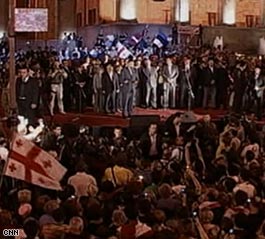
Presidents attend Georgia rally after cease-fire deal


Presidents attend Georgia rally after cease-fire deal

The presidents of Ukraine, Lithuania, Latvia and Poland showed support for Georgia by appearing on stage with Georgia's president in front of a large crowd in Tbilisi. Earlier, the Russian and French presidents announced a six-point plan for settling the conflict in Georgia.

MOSCOW, Russia (CNN) -- The Russian and French presidents announced Tuesday a six-point plan of principles for settling the immediate conflict in Georgia but stopped short of tackling the issues that sparked the violence.
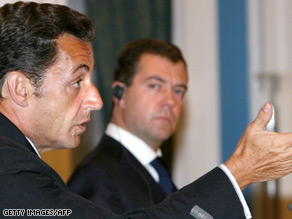
Nicolas Sarkozy, left, and Dmitry Medvedev outline the deal and the problems ahead.

Nicolas Sarkozy, left, and Dmitry Medvedev outline the deal and the problems ahead.

"We have not achieved peace yet, but we have achieved a provisional cease-fire of hostilities," French President Nicolas Sarkozy said.

The points include Russian agreements to conclude all military operations, return Russian armed forces to the line preceding the beginning of operations and not use force again in Georgia.

In return, Georgia would return its armed forces to their normal and permanent locations.

Both sides would provide free access for humanitarian assistance; and international consideration of the issues of South Ossetia and Abkhazia would be undertaken.

"All we need to do now is to stop suffering, stop the death of people," Sarkozy said. Stopping the fighting "is the most important objective."

He emphasized that the meeting with Russia's President Dmitry Medvedev was not intended to solve all of the issues, such as Georgia's territorial integrity and South Ossetia's desire for independence.

"There are bigger problems relating to South Ossetia that we cannot resolve here," Sarkozy said, who arrived in Moscow as current head of the European Union.

Sarkozy said he and Medvedev agreed that Georgia is an independent country and that Russia has no intention of annexing it. But Medvedev also said "sovereignty is based on the will of the people" and "territorial integrity can be demonstrated by the actual facts on the ground."

Medvedev said, "I think that these are some very good principles in order to resolve the problem which has arisen from this very dramatic situation and these principles can be used by Georgia and South Ossetia."

Medvedev said he had ordered an end to military operations against Georgia, but Tbilisi reported more attacks after the statement was made. Video Watch Georgia's reaction to halt in fighting »

Medvedev said, "the aggressor has been punished and has incurred very significant losses. Its armed forces are disorganized."

Tens of thousands of Georgians converged on the capital, Tbilisi, for a day of rallies. In the evening they waved French, U.S. and Georgian flags at a rally where President Mikhail Saakashvili was joined by the leaders of Ukraine, Poland, Lithuania and Lativia. Video Watch the rally »

U.S. Secretary of State Condoleeza Rice said, "I wanted to make very clear that the United States stands for the territorial integrity of Georgia, for the sovereignty of Georgia; that we support its democratically elected government and people, and are reviewing options for humanitarian and reconstruction assistance to Georgia. But the most important thing right now is that these military operations need to stop."

U.S. officials said they were considering flying aid from bases in Germany to Georgia. There was also consideration being given to sending U.S. Navy ships into the Black Sea to conduct humanitarian relief missions.

Violence has raged since Thursday, when Georgia launched a crackdown on separatist fighters in autonomous South Ossetia, where most people have long supported independence.

Russia, which supports the separatists, responded Friday, sending tanks across its border into South Ossetia. The conflict quickly spread to parts of Georgia and to Abkhazia, another separatist region.

Russia said it wanted to stop Georgian military actions against its peacekeepers in the breakaway regions.

The Georgian government said that despite Medvedev's announcement, Russian warplanes struck two Georgian villages and bombed an ambulance outside the breakaway province of South Ossetia. Video Watch more on the fighting in South Ossetia »

Medvedev warned in his announcement that "when pockets of resistance and other aggressive actions occur," a decision concerning destruction had to be made.

Earlier, a Georgian Interior Ministry official said Russian bombs had hit one of the three pipelines carrying oil to the Black Sea port of Poti. There was no oil in the pipeline at the time. Interactive map: See how far the Russians have advanced »

UK-based energy giant BP later said it had shut down three oil pipelines in the region as a "precautionary measure" linked to the security situation. None of its pipelines had been attacked.

A Dutch cameraman was killed Tuesday morning in an incident in Gori, the Dutch Foreign Ministry confirmed. He was identified as Stan Storimans of RTL TV. The correspondent who accompanied him was also injured.

One Russian diplomat said that up to 2,000 people had died in the conflict. Up to 100,000 people are thought to have been displaced by the violence, which has left South Ossetia's capital of Tskhinvali in ruins.

Russian Foreign Minister Sergey Lavrov said Tuesday that his country wanted a demilitarized zone to be created in Georgian territory before a cease-fire could take effect. Video Watch Lavrov speak about Georgia »

Lavrov said that it would be best if Saakashvili stepped down as Georgia's president, something he has not offered to do, but that Russia was not demanding his resignation.

Original article posted here.

Monday, August 11, 2008

Wandering into trouble

Poland, Baltics condemn Russia over Georgia

WARSAW, Aug 9 (Reuters) - Poland and the Baltic states came together on Saturday to issue a harsh condemnation of Russia for what they described as aggression in Georgia and urged NATO and the European Union to oppose it.

The former Soviet republics of Latvia, Lithuania and Estonia and Poland, a client state of Moscow under communism, are wary of a resurgent Russia using its muscle to again dominate its neighbours.

"The European Union and NATO must take up the initiative and oppose the spread of imperialist and revisionist policy in the east of Europe," said the statement from the presidents of the four countries.

The appeal followed Russia's bombing of Georgia in the conflict over South Ossetia, where Russian troops are backing separatists fighting a Georgian attempt to bring the territory under control. Georgia is another former Soviet state.

Moscow accuses Georgia of aggression and says it is protecting its citizens in South Ossetia.

The statement from Poland and the Baltic countries said they would use every available means to ensure that Moscow's "aggression against a small state in Europe is not passed over in silence or with meaningless statements equating the victims with the perpetrators."

Georgian President Mikheil Saakashvili has said the conflict with the Russians could have consequences elsewhere.

"They have claims to Crimea, in Ukraine, they have claims to some parts of the Baltic countries, they have claims to some parts of eastern Europe. If you know, they have a free hand and free rights here in Georgia everybody will be unsafe,"

Original article posted here.

Wednesday, October 24, 2007

Poland: Yet another declining Bush crony. The empire continues to collapse

Poland prepares for new government

By RYAN LUCAS

Donald Tusk, leader of Poland's pro-business Civic Platform party, leaves parliament after a meeting with party leaders about forming a new government a day after his landslide win in general elections in Warsaw, Poland, Monday, Oct. 22, 2007.
WARSAW, Poland --Poland's prospective new prime minister turned Monday to forming a government that wants lower taxes, Polish troops out of Iraq, and better relations with the rest of Europe.

Donald Tusk, whose Civic Platform party soundly defeated Prime Minister Jaroslaw Kaczynski's Law and Justice party Sunday, turned aside questions about an alliance with either of two smaller parties needed to reach a majority.

He said after a Civic Platform leadership meeting that the new parliament would meet Nov. 5 "and only then serious talks about the political future will be possible."

Another party official, Bogdan Zdrojewski, said the party's national council will meet Nov. 10 to decide on potential coalition partners.

Tusk wants to turn Poland from Kaczynski's focus on rooting out former communists and toward seizing the economic opportunities that come with membership in the European Union, which Poland joined in 2004.

He also wants to bring Poland's 900 troops home from Iraq and push for more rewards for Poland in return for hosting a U.S. missile defense base aimed at stopping potential attacks from Iran.

With 99 percent of the results in, Civic Platform led with 41.4 percent and a projected 209 seats in the 460-seat lower house of parliament. Kaczynski's Law and Justice party trailed with 32.2 percent and 166 seats.

Turnout was 53.8 percent, higher than in any parliamentary election since the 1989 fall of communism, a sign of the passionate debate about Poland's overall direction and place in Europe during the campaign. Two years ago, when Law and Justice defeated Civic Platform, turnout was 40.57 percent.

Kaczynski's twin, President Lech Kaczynski, has the job of nominating his brother's replacement. Lech Kaczynski is in office until 2010 and could make life awkward for the new government by exercising his veto.

The new government is expected to be tighter with public money, and the Standard & Poor's credit rating agency said that while the government's debt rating was unchanged, a Civic Platform-led government "could ultimately benefit the ratings."

Poland's economy has shown a strong growth rate of 5.8 percent annually in the first six months of the year, but unemployment is at 12 percent, and many have left for work in Britain and Ireland.

The Civic Platform party wants to cap annual increases in government spending and run smaller deficits, a step that would bring Poland toward joining the euro currency.

Tusk's top economic adviser, Zbigniew Chlebowski, said the party would seek to link the zloty in a 15 percent trading band with the euro in 2009, a necessary test of monetary stability before joining.

Kaczynski also supported joining the euro, but was in less of a hurry and favored more government spending and social welfare benefits. His defeat appeared to be a verdict by younger, European-oriented Poles against his assertive stance toward Europe and his focus on barring former communists from public life.

Kaczynski clashed with the European Union on a number of issues, including Polish voting strength, a proposal to build a highway through a protected peat bog and the death penalty.

Short of the 231 seats needed for a majority, Civic Platform has said it could join with the Polish Peasants Party, which received 8.9 percent and 31 seats, to form a government. Another party, the Left and Democrats, offers another possible coalition partner.

Kaczynski forced the election two years early in a failed gamble to strengthen his support after a coalition with two smaller parties collapsed.

Original article posted here
.