


Showing posts with label Propaganda. Show all posts
Showing posts with label Propaganda. Show all posts
Friday, June 12, 2009
Both Left and Right using killer to distort unpleasant truths...Throwing the baby out with the bathwater. Sorry, Keith: 9/11 WAS an inside job.
Just because a racist killer does something reprehensible (and stupid) doesn't make everything that he says wrong.


Sunday, August 31, 2008
Yes, a little old, but full of info and definitely not dated
Embedding the Analysts: Modern-Day Propaganda?Commentary by Bill Berkowitz | | ||
| |||
| |||
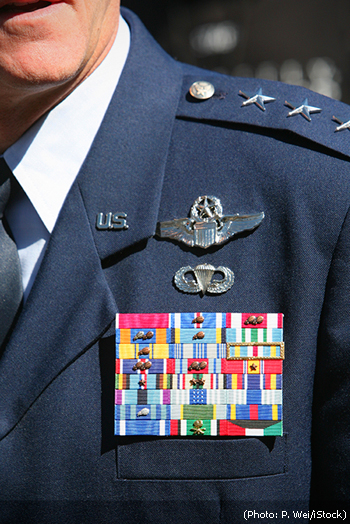 Over the course of the Iraq War, the Pentagon has used hand-picked retired military officers as “message force multipliers” to shape public opinion, a New York Times investigation revealed last month.
Friday, August 22, 2008
Smoke screen
Report: Fire, not bombs, leveled WTC 7 building
| ||||||||||


GAITHERSBURG, Maryland (AP) — Federal investigators said Thursday they have solved a mystery of the Sept. 11, 2001, attacks: the collapse of World Trade Center building 7, a source of long-running conspiracy theories.
The 47-story trapezoid-shaped building sat north of the World Trade Center towers, across Vesey Street in lower Manhattan in New York. On Sept. 11, it was set on fire by falling debris from the burning towers, but skeptics long have argued that fire and debris alone should not have brought down such a big steel-and-concrete structure.
Scientists with the National Institute of Standards and Technology say their three-year investigation of the collapse determined the demise of WTC 7 was actually the first time in the world a fire caused the total failure of a modern skyscraper.
"The reason for the collapse of World Trade Center 7 is no longer a mystery," said Dr. Shyam Sunder, the lead investigator on the NIST team.
Investigators also concluded that the collapse of the nearby towers broke the city water main, leaving the sprinkler system in the bottom half of the building without water.
The building has been the subject of a wide range of conspiracy theories for the last seven years, partly because the collapse occurred about seven hours after the twin towers came down. That fueled suspicion that someone intentionally blew up the building in a controlled demolition.
Critics like Mike Berger of the group 9/11 Truth said he wasn't buying the government's explanation.
"Their explanation simply isn't sufficient. We're being lied to," he said, arguing that there is other evidence suggesting explosives were used on the building.
Sunder said his team investigated the possibility that an explosion inside the building brought it down, but found there was no large boom or other noise that would have occurred with such a detonation. Investigators also created a giant computer model of the collapse, based partly on news footage from CBS News, that they say shows that internal column failure brought down the building.
Investigators also ruled out the possibility that the collapse was caused by fires from a substantial amount of diesel fuel that was stored in the building, most of it for generators for the city's emergency operations command center.
The 77-page report concluded that the fatal blow to the building came when the 13th floor collapsed, weakening a critical steel support column that led to catastrophic failure.
"When this critical column buckled due to lack of floor supports, it was the first domino in the chain," said Sunder.
The NIST investigators issued more than a dozen building recommendations as a result of their inquiry, most of which repeat earlier recommendations from their investigation into the collapse of the two large towers.
In both instances, investigators concluded that extreme heat caused some steel beams to lose strength, causing further failures throughout the buildings until the entire structure succumbed.
The recommendations include building skyscrapers with stronger connections and framing systems to resist the effects of thermal expansion, and structural systems designed to prevent damage to one part of a building from spreading to other parts.
No one was killed in the collapse of building 7 because it had been fully evacuated. A new, slightly taller World Trade Center 7 opened in 2006.
A spokesman for the leaseholder of the World Trade Center, developer Larry Silverstein, praised the government's work.
"Hopefully this thorough report puts to rest the various 9/11 conspiracy theories, which dishonor the men and women who lost their lives on that terrible day," said Silverstein spokesman Dara McQuillan.
In discussing the findings, the investigator Sunder acknowledged that some may still not be convinced, but insisted the science behind their findings is "incredibly conclusive."
"The public should really recognize the science is really behind what we have said," he said, adding: "The obvious stares you in the face."
Monday, August 18, 2008
Wednesday, August 13, 2008
Trying to unravel part of the propaganda you've been fed
In the modern world you cant wage a war just with your tanks and planes.
You have to use media. In Germany during WWII they would say "Truth is not what happened, truth is what we tell people".
Yesterday Russian military aircrafts bombed several Georgian military bases. It worth mentioning that military men are located in the a five-storied buildings which look exactly alike residential. The reason for this is simple, they were built in the Soviet Union times and there was not much diversity in architecture.
This morning (its 7 a.m. Moscow time right now) one can read on the BBC news site. Russia deaf to Western voices, Reuters agency posts a horrible pictures of Russian bombardments of allegedly civilian residential buildings. But what if you take a closer look?
Warning: the pictures contain scenes with blood and allegedly injured people.
For instance on this picture you can see one obviously dead body of a person in a checkered shirt. The other body is carried by medics, carried as if it was a dead body, but you can notice that the hand of a person is holding a woman medic's sleeve. Well so far everything looks pretty real, except maybe for one guy in black who doesn't look anyhow concerned.

Now on this picture we see a crying man and a body in his hands. But look closely! This is the same checkered shirt, same trousers and shoes, the same person. So does it mean that the crying man took the body brought it some place else? Hardly so, this is just one of the participants of the show. And again if you look close enough you can notice that the guy crying is the person in black from the previous picture.

Now here he is again, alone still with some clothes on, or may be he got changed.

Generally if you see the pictures you can notice that nothing happens around the scene. No people running, and there are actually not a lot of people for a big residential building area if it was really bombed.
Well, I'm cant be sure that some Russian rockets didn't hit by accident some building adjacent to a military base, but look, they ruinedTskhinvally. They did it on purpose, and now they blame us! They started military offence in the first day of Olympics. Bombed Russian peacekeepers barracks and Russia is to be blamed? No, I don't think so.
Now, look at the other side. There's no pictures from the capital of South Ossetia which is totally ruined now, and the good reason we don't have pictures from where is because when there's no power for your equipment, even satellite link would be hardly of any use. And if you have a tape, you have to get it out of the city and to survive as well. Two Russian reporters are injured already, others try to relay videos via satellite phones, but the quality is pretty bad as they have to compress it to the minimum size.
And some news:
The capital of S.Ossetia is being under fire again, there's a road from where, called Zarskaya road or Zar road, it's been attacked by Georgian tanks overnight. The attack was repelled, but Georgians still have positions for firing the road. The chief of Russian 58th army was injured, when his convoy was going along this road. Two reporters and members of a TV crew as well were injured in the same convoy.
Original article posted here.
You have to use media. In Germany during WWII they would say "Truth is not what happened, truth is what we tell people".
Yesterday Russian military aircrafts bombed several Georgian military bases. It worth mentioning that military men are located in the a five-storied buildings which look exactly alike residential. The reason for this is simple, they were built in the Soviet Union times and there was not much diversity in architecture.
This morning (its 7 a.m. Moscow time right now) one can read on the BBC news site. Russia deaf to Western voices, Reuters agency posts a horrible pictures of Russian bombardments of allegedly civilian residential buildings. But what if you take a closer look?
Warning: the pictures contain scenes with blood and allegedly injured people.
For instance on this picture you can see one obviously dead body of a person in a checkered shirt. The other body is carried by medics, carried as if it was a dead body, but you can notice that the hand of a person is holding a woman medic's sleeve. Well so far everything looks pretty real, except maybe for one guy in black who doesn't look anyhow concerned.
Now on this picture we see a crying man and a body in his hands. But look closely! This is the same checkered shirt, same trousers and shoes, the same person. So does it mean that the crying man took the body brought it some place else? Hardly so, this is just one of the participants of the show. And again if you look close enough you can notice that the guy crying is the person in black from the previous picture.
Now here he is again, alone still with some clothes on, or may be he got changed.
Generally if you see the pictures you can notice that nothing happens around the scene. No people running, and there are actually not a lot of people for a big residential building area if it was really bombed.
Well, I'm cant be sure that some Russian rockets didn't hit by accident some building adjacent to a military base, but look, they ruinedTskhinvally. They did it on purpose, and now they blame us! They started military offence in the first day of Olympics. Bombed Russian peacekeepers barracks and Russia is to be blamed? No, I don't think so.
Now, look at the other side. There's no pictures from the capital of South Ossetia which is totally ruined now, and the good reason we don't have pictures from where is because when there's no power for your equipment, even satellite link would be hardly of any use. And if you have a tape, you have to get it out of the city and to survive as well. Two Russian reporters are injured already, others try to relay videos via satellite phones, but the quality is pretty bad as they have to compress it to the minimum size.
And some news:
The capital of S.Ossetia is being under fire again, there's a road from where, called Zarskaya road or Zar road, it's been attacked by Georgian tanks overnight. The attack was repelled, but Georgians still have positions for firing the road. The chief of Russian 58th army was injured, when his convoy was going along this road. Two reporters and members of a TV crew as well were injured in the same convoy.
Original article posted here.
Sunday, July 27, 2008
How's that Afghanistan war workin' out for ya?
Taliban winning the war of words
By Aunohita Mojumdar
KABUL - In the first week of July, several people were killed in a village in the eastern Afghan province of Nangarhar by international forces. The US-led coalition forces described the operation as a precision air strike which had killed militants. Locals said they were civilians. Claims. Counter-claims. It seemed business as usual until investigations revealed that the air strike had in fact bombed a wedding party, killing 50, including the bride.
Though the incident was reported widely with concern for the civilian casualties, there was less attention on the other "collateral damage" it caused - the casualty of credibility.
The war of words between anti-government militants and pro-government forces has become so routine that little attention is paid to the contradictions in the claims. In the process, the anti-government insurgents are gaining, a dangerous situation when the government's legitimacy is already under question.
The power of the militants' propaganda is evident from a new report published by the Brussels-based independent International Crisis Group (ICG) this week. The report, "Taliban Propaganda: Winning the War of Words", argues that the Taliban are "successfully tapping into the strains of Afghan nationalism and exploiting policy failures by the Kabul government and its international backers". The result, it says, "is weakening public support for nation-building, even though few actively support the Taliban".
A boom in independent media, with the help of generous donor support, began in 2001 following the ouster of the Taliban. As media houses mushroomed, however, little attention was paid to the efficacy of the communication strategies of the government and the international community.
Despite considerable funding of the offices of the communications departments of various ministries and high-level offices, little in the way of accountability has been sought from them. While media houses have had to "perform or perish", the communication wings of most government institutions bumbled along.
Take for example access to the media. The presidential spokesman (of Hamid Karzai) and the spokesman of the Ministry of Interior are arguably the two most important offices which give the government's viewpoint on major events. Yet among the media based in Kabul, these two are reliably known as the least accessible and their spokesmen are always "in meetings". Their offices, by relying on single individuals to impart information, are largely mute in their absence.
While spokesmen for Operation Enduring Freedom (OEF) and the North Atlantic Treaty Organization-led International Security Assistance Force are available and provide regular updates to the media, the office of the OEF is outside Kabul at the Bagram military base while the NATO media office is based in its headquarters in the capital.
Both bases are heavily fortified, making them difficult to access. The international forces also fail to provide transcripts of their press conferences, even though entering the military compounds is a tedious process which forces many journalists to opt out of attending the regular meetings.
Though the Taliban are understandably not easy to access, they provide ready updates on information and operations and their own claims. According to the ICG, the Taliban's rudimentary website is updated several times a day and the Taliban are able to put out their story rapidly, though its messages are sometimes contradictory.
The speed of the Taliban in communicating with the media is "much easier when spokesmen do not need to establish facts", the ICG states. However, the credibility that could compensate for the pro-government forces' lack of speed is also missing. Attuned to a military culture in which information is just part of propaganda in a situation of conflict, the international forces feel justified in presenting their version of the truth in the ongoing war. Unfortunately, this impacts not just on the military forces, but on the entire international community and the government.
Rather than step up their efforts to communicate, the pro-government forces are relying more on efforts to contain and control the media. Local journalists are from time to time issued "guidelines" on their content. A new media bill that is still on hold has invited fierce opposition from local journalists as it seeks to impose greater curbs on media content.
Journalists are also detained both by the government's national security apparatus and the international forces. While journalists cannot expect automatic exemption from the processes adopted by security agencies, the failure to charge the detainees or to produce any evidence leads to the assumption that the journalists were detained in connection with their professional work - an issue raised by the International Justice Network in Kabul last week.
When tasked with their lack of credibility or media savvy, pro-government spokesmen are prone to compare their efforts with those of the Taliban. However, this comparison is usually counter-productive since it invites the media to view the two "sides" as equal contending parties who need to be evaluated by the same yardstick, rather than automatically distancing the pro-government forces from the Taliban on the basis of a higher moral ground.
"The Taliban are adept at exploiting local disenfranchisement and disillusionment," the ICG report points out, emphasizing that "the Kabul administration needs to ensure it is seen as one worth fighting for, not least by ending the culture of impunity and demanding accountability of its members".
The ICG argues that the Taliban's propaganda is weakening public support for nation-building, even though few actively support the Taliban. The Karzai government and its allies must make greater efforts, through word and deed, it says, to address sources of alienation exploited in Taliban propaganda, particularly by ending arbitrary detentions and curtailing civilian casualties from aerial bombing.
"Whatever the military benefits of arbitrary detentions, they are far outweighed by the alienation they cause. The effectiveness of aerial bombardment, even if strictly exercised within the bounds of international law, must be considered against the damage to popular support," it says.
Aunohita Mojumdar is an Indian journalist who is currently based in Kabul. She has reported on the South Asian region for 16 years and has covered the Kashmir conflict and post-conflict situation in Punjab extensively.
Original article posted here.
By Aunohita Mojumdar
KABUL - In the first week of July, several people were killed in a village in the eastern Afghan province of Nangarhar by international forces. The US-led coalition forces described the operation as a precision air strike which had killed militants. Locals said they were civilians. Claims. Counter-claims. It seemed business as usual until investigations revealed that the air strike had in fact bombed a wedding party, killing 50, including the bride.
Though the incident was reported widely with concern for the civilian casualties, there was less attention on the other "collateral damage" it caused - the casualty of credibility.
The war of words between anti-government militants and pro-government forces has become so routine that little attention is paid to the contradictions in the claims. In the process, the anti-government insurgents are gaining, a dangerous situation when the government's legitimacy is already under question.
The power of the militants' propaganda is evident from a new report published by the Brussels-based independent International Crisis Group (ICG) this week. The report, "Taliban Propaganda: Winning the War of Words", argues that the Taliban are "successfully tapping into the strains of Afghan nationalism and exploiting policy failures by the Kabul government and its international backers". The result, it says, "is weakening public support for nation-building, even though few actively support the Taliban".
A boom in independent media, with the help of generous donor support, began in 2001 following the ouster of the Taliban. As media houses mushroomed, however, little attention was paid to the efficacy of the communication strategies of the government and the international community.
Despite considerable funding of the offices of the communications departments of various ministries and high-level offices, little in the way of accountability has been sought from them. While media houses have had to "perform or perish", the communication wings of most government institutions bumbled along.
Take for example access to the media. The presidential spokesman (of Hamid Karzai) and the spokesman of the Ministry of Interior are arguably the two most important offices which give the government's viewpoint on major events. Yet among the media based in Kabul, these two are reliably known as the least accessible and their spokesmen are always "in meetings". Their offices, by relying on single individuals to impart information, are largely mute in their absence.
While spokesmen for Operation Enduring Freedom (OEF) and the North Atlantic Treaty Organization-led International Security Assistance Force are available and provide regular updates to the media, the office of the OEF is outside Kabul at the Bagram military base while the NATO media office is based in its headquarters in the capital.
Both bases are heavily fortified, making them difficult to access. The international forces also fail to provide transcripts of their press conferences, even though entering the military compounds is a tedious process which forces many journalists to opt out of attending the regular meetings.
Though the Taliban are understandably not easy to access, they provide ready updates on information and operations and their own claims. According to the ICG, the Taliban's rudimentary website is updated several times a day and the Taliban are able to put out their story rapidly, though its messages are sometimes contradictory.
The speed of the Taliban in communicating with the media is "much easier when spokesmen do not need to establish facts", the ICG states. However, the credibility that could compensate for the pro-government forces' lack of speed is also missing. Attuned to a military culture in which information is just part of propaganda in a situation of conflict, the international forces feel justified in presenting their version of the truth in the ongoing war. Unfortunately, this impacts not just on the military forces, but on the entire international community and the government.
Rather than step up their efforts to communicate, the pro-government forces are relying more on efforts to contain and control the media. Local journalists are from time to time issued "guidelines" on their content. A new media bill that is still on hold has invited fierce opposition from local journalists as it seeks to impose greater curbs on media content.
Journalists are also detained both by the government's national security apparatus and the international forces. While journalists cannot expect automatic exemption from the processes adopted by security agencies, the failure to charge the detainees or to produce any evidence leads to the assumption that the journalists were detained in connection with their professional work - an issue raised by the International Justice Network in Kabul last week.
When tasked with their lack of credibility or media savvy, pro-government spokesmen are prone to compare their efforts with those of the Taliban. However, this comparison is usually counter-productive since it invites the media to view the two "sides" as equal contending parties who need to be evaluated by the same yardstick, rather than automatically distancing the pro-government forces from the Taliban on the basis of a higher moral ground.
"The Taliban are adept at exploiting local disenfranchisement and disillusionment," the ICG report points out, emphasizing that "the Kabul administration needs to ensure it is seen as one worth fighting for, not least by ending the culture of impunity and demanding accountability of its members".
The ICG argues that the Taliban's propaganda is weakening public support for nation-building, even though few actively support the Taliban. The Karzai government and its allies must make greater efforts, through word and deed, it says, to address sources of alienation exploited in Taliban propaganda, particularly by ending arbitrary detentions and curtailing civilian casualties from aerial bombing.
"Whatever the military benefits of arbitrary detentions, they are far outweighed by the alienation they cause. The effectiveness of aerial bombardment, even if strictly exercised within the bounds of international law, must be considered against the damage to popular support," it says.
Aunohita Mojumdar is an Indian journalist who is currently based in Kabul. She has reported on the South Asian region for 16 years and has covered the Kashmir conflict and post-conflict situation in Punjab extensively.
Original article posted here.
Saturday, July 26, 2008
Friday, July 25, 2008
Sunday, July 13, 2008
Thursday, July 10, 2008
The battle of propaganda. Does the West need to doctor Iranian photos? Maybe
In an Iranian Image, a Missile Too Many  In the four-missile version of the image released Wednesday by Sepah News, the media arm of Iran’s Revolutionary Guard, two major sections (encircled in red) appear to closely replicate other sections (encircled in orange). (Illustration by The New York Times; photo via Agence France-Presse)
  The Los Angeles Times, The Palm Beach Post and Chicago Tribune, among others, used the image on the front pages on Thursday.
  Our homepage at 3:56 p.m. on Wednesday.
 Top, the image that Agence France-Presse obtained from Sepah News on Wednesday. Below, another image that The Associated Press received from the same source on Thursday.
Original article posted here.
In the four-missile version of the image released Wednesday by Sepah News, the media arm of Iran’s Revolutionary Guard, two major sections (encircled in red) appear to closely replicate other sections (encircled in orange). (Illustration by The New York Times; photo via Agence France-Presse)Updated, 1:23 p.m., Agence France-Presse has retracted the image as “apparently digitally altered.”
As news spread across the world of Iran’s provocative missile tests, so did an image of four missiles heading skyward in unison. Unfortunately, it appeared to contain one too many missiles, a point that had not emerged before the photo appeared on the front pages of The Los Angeles Times, The Financial Times, The Chicago Tribune and several other newspapers as well as on BBC News, MSNBC, Yahoo! News, NYTimes.com and many other major news Web sites.
The Los Angeles Times, The Palm Beach Post and Chicago Tribune, among others, used the image on the front pages on Thursday. Our homepage at 3:56 p.m. on Wednesday. Agence France-Presse said that it obtained the image from the Web site of Sepah News, the media arm of the Iranian Revolutionary Guards, on Wednesday. But there was no sign of it there later in the day. Today, The Associated Press distributed what appeared to be a nearly identical photo from the same source, but without the fourth missile.
As the above illustration shows, the second missile from the right appears to be the sum of two other missiles in the image. The contours of the billowing smoke match perfectly near the ground, as well in the immediate wake of the missile. Only a small black dot in the reddish area of exhaust seems to differ from the missile to its left, though there are also some slight variations in the color of the smoke and the sky.
Does Iran’s state media use Photoshop? The charge has been leveled before. So far, though, it can’t be said with any certainty whether there is any official Iranian involvement in this instance. Sepah apparently published the three-missile version of the image today without further explanation.
For its part, Agence France-Presse retracted its four-missile version this morning, saying that the image was “apparently digitally altered” by Iranian state media. The fourth missile “has apparently been added in digital retouch to cover a grounded missile that may have failed during the test,” the agency said. Later, it published an article quoting several experts.
Throughout the day, several news sites have taken steps to disown the photograph that they ran on Wednesday, including LATimes.com and MSNBC.com.
In a sentiment no doubt expressed by news organizations everywhere on Wednesday, an MSNBC editor admitted that the four-missile picture was initially welcomed with open arms. “As the media editor working the msnbc.com home page yesterday, I was frustrated with the quality of a fuzzy video image we published of the Iranian missile launch,” Rich Shulman, associate multimedia editor, said. “So I was thrilled when the top image crossed the news wires.”
Top, the image that Agence France-Presse obtained from Sepah News on Wednesday. Below, another image that The Associated Press received from the same source on Thursday. Original article posted here.
Sunday, July 06, 2008
Freedom of the press
U.S. Journalist Photographs Grisly Aftermath of Attack in Iraq, Gets Booted by Military

Remains of U.S. Marines killed by a suicide bomber in Fallujah on Jun. 26. Credit: Zoriah Miller
U.S. journalist Zoriah Miller says he was censored by the U.S. military in the Iraqi city of Fallujah after photographing Marines who died in a suicide bombing.
On Jun. 26, a suicide bomber attacked a city council meeting in Fallujah, 69 kms west of Baghdad, between local tribal sheikhs and military officials.
Three Marines, Cpl. Marcus Preudhomme, Capt. Philip Dykeman, and Lt. Col. Max Galeai, assigned to 2d Battalion, 3rd Marine Division based in Kaneohe Bay, Hawaii, died in the attack.
The explosion also killed two interpreters and 20 Iraqis, including the mayor of the nearby town of Karmah, two prominent sheikhs and their sons, and another sheikh and his brother. All were members of the local "awakening council," one of the U.S.-backed militias that have taken up arms against al Qaeda in Iraq, according to U.S. and Iraqi authorities.
Miller was embedded with Marines on a patrol one block from the attack when it occurred. He had originally turned down the option of going to report on the city council meeting that was bombed.
Miller ran with the Marines he was with to the scene of the attack. "As I ran I saw human pieces...a skull cap with hair, bone shards," he told IPS during a telephone interview from the so-called Green Zone in Baghdad. "When we arrived at the building it was chaotic. There were Iraqis, police and civilians running around screaming. Bodies were being pulled out of the building."
"I went in and there were over 20 people's remains all over the place," Miller continued, "Of the Marines I jogged in with, someone started to vomit. Others were standing around, not knowing what to do. It was completely surreal."
"At that moment I realized this was far beyond anything I'd experienced, and I realized I wanted to focus and make sure I could capture what it felt like, and the visual horror," Miller explained.
"I thought, 'Nobody in the U.S. has any idea what it means when they hear that 20 people died in a suicide bombing.' I want people to be able to associate those numbers with the scene and the actual loss of human life. And to show why soldiers are suffering from PTSD [post-traumatic stress disorder]," Miller told IPS.
Miller was taken out of the building by Marines, but then allowed back inside where he took one last photo of the carnage before they closed the scene to him.
"We spent most of the rest of the day as Marines picked up body parts and put them in buckets and bags," he said.
In an Iraqi Police station in Karmah, the Naval Criminal Investigative Service (NCIS) was brought in to investigate the bombing. Millers' photos were the only ones of the scene, so the NCIS team asked for them.
"I made them copies, but then one of the Marines came in and told me to delete my memory card after I give them the photos, and I refused," Miller told IPS, "I told the NCIS that if they forced me to delete them, I would stop sharing them. So they stopped pressing that issue."
Miller said that he was following the rules for embedded journalists. "That evening, during the debriefing, the guys [Marines] I was with told me that the higher-ups had said I was a stand-up guy and behaved well and to treat me well. The guys I was with were all very much on my side."
Miller explained to IPS that he meticulously showed his photos to the Marines he was with to make sure he was not going to show any photos that would upset the family members of the deceased Marines. "They were all okay with them, so then about 96 hours after the bombing I published the photos on my blog."
Then things got interesting.
"Tuesday [Jul. 1] I awoke to a call in their combat operations centre, and the person on the phone told me they were a PAO (Public Affairs Officer) at Camp Fallujah, and he wanted me to take my blog down right away," Miller told IPS. "I asked them why, and was then called back after five minutes by a higher ranking PAO who claimed I had broken my contract by showing photos of dead Americans with U.S. uniforms and boots."
Miller said the PAO claimed he was not allowed, by the embed contract, to show dead or wounded U.S. citizens or soldiers in the field. "I never signed any contract for that," Miller said.
He was called back after another five minutes and told his embed was terminated and they would send him back to Baghdad on the next flight. He was then taken back to Camp Fallujah where he said, "Everyone was extremely angry and fired up at me."
Nevertheless, the lower ranking Marines he had embedded with "were on my side, and they told me they thought that what was happening was wrong."
Miller explained that he grew nervous when the flight was canceled due to a sandstorm, and then a security guard was assigned to him.
"I started to feel uncomfortable with this," Miller explained. "The next day, Gen. Kelly, [Major General John Kelly, who is the Commanding General of the I Marine Expeditionary Force] wanted to have some words with me. I was to meet with him at 3 pm, and we sat outside in the sun for two hours and he never showed."
Miller was told he would be flown out that night, but he was deleted from the flight and told that General Kelly wanted to see him, so he waited again until Thursday, Jul. 3. Again the general did not appear, so Miller was given an official letter about the grounds for the termination of his embed, signed by Gen. Kelly, and flown to Baghdad.
"Now, as I think about it, I think they needed the extra time to figure out what they were going to say about my dismissal," Miller said. "Their original reason ended up being bogus, so they had to figure something else out."
The letter he was given stated reasons for his dismissal as "you photographed the remains of U.S. soldiers", "you posted these images along with detailed commentary", and "by posting the images and your commentary you violated 14 H and O of the news media agreement you signed."
In addition, the letter, which Miller read to IPS, stated, "By providing detailed information of the effectiveness of the attack and the response of U.S. forces to it, you have put all U.S. forces in Iraq at greater risk for harm."
Miller feels the reason for his dismissal is otherwise.
"The bottom line is that the thing they cited as the reason for my dismissal was 'information the enemy could use against you.' They realized, probably from keeping track of my blog, that I was not showing identifiable features of a soldier ... and they couldn't find a reason to kick me out. Because it was a high ranking person who got killed, they were all fired up."
Miller concluded, "Up to that point they said it was because I showed pictures of bodies with pieces of uniform and boots. The letter, though, doesn't mention that at all. I checked the document I had about ground rules for media embeds, and I followed them."
The Pentagon would not comment on the story when contacted by IPS, saying they had no information on Miller's case beyond what Central Command had already posted.
Monday, June 30, 2008
More evidence of the brainwashing and manipulation of Americans
Iran-Contra's 'Lost Chapter'
As historians ponder George W. Bush’s disastrous presidency, they may wonder how Republicans perfected a propaganda system that could fool tens of millions of Americans, intimidate Democrats, and transform the vaunted Washington press corps from watchdogs to lapdogs.
To understand this extraordinary development, historians might want to look back at the 1980s and examine the Iran-Contra scandal’s “lost chapter,” a narrative describing how Ronald Reagan’s administration brought CIA tactics to bear domestically to reshape the way Americans perceived the world.
That chapter – which we are publishing here for the first time – was “lost” because Republicans on the congressional Iran-Contra investigation waged a rear-guard fight that traded elimination of the chapter’s key findings for the votes of three moderate GOP senators, giving the final report a patina of bipartisanship.
Under that compromise, a few segments of the draft chapter were inserted in the final report’s Executive Summary and in another section on White House private fundraising, but the chapter’s conclusions and its detailed account of how the “perception management” operation worked ended up on the editing room floor.
The American people thus were spared the chapter’s troubling finding: that the Reagan administration had built a domestic covert propaganda apparatus managed by a CIA propaganda and disinformation specialist working out of the National Security Council.
“One of the CIA’s most senior covert action operators was sent to the NSC in 1983 by CIA Director [William] Casey where he participated in the creation of an inter-agency public diplomacy mechanism that included the use of seasoned intelligence specialists,” the chapter’s conclusion stated.
“This public/private network set out to accomplish what a covert CIA operation in a foreign country might attempt – to sway the media, the Congress, and American public opinion in the direction of the Reagan administration’s policies.”
However, with the chapter’s key findings deleted, the right-wing domestic propaganda operation not only survived the Iran-Contra fallout but thrived.
So did some of the administration’s collaborators, such as South Korean theocrat Sun Myung Moon and Australian press mogul Rupert Murdoch, two far-right media barons who poured billions of dollars into pro-Republican news outlets that continue to influence Washington’s political debates to this day.
Before every presidential election, Moon’s Washington Times plants derogatory – and often false – stories about Democratic contenders, discrediting them and damaging their chances of winning the White House.
For instance, in 1988, the Times published a bogus account suggesting that the Democratic nominee Michael Dukakis had undergone psychiatric treatment. In 2000, Moon’s newspaper pushed the theme that Al Gore suffered from clinical delusions. [For details, see Robert Parry’s Secrecy & Privilege.]
As for Murdoch, his giant News Corp. expanded into American cable TV with the founding of Fox News in 1996. Since then, the right-wing network has proved highly effective in promoting attack lines against Democrats or anyone else who challenges the Republican power structure.
As President George W. Bush herded the nation toward war with Iraq in 2002-03, Fox News acted like his sheep dogs making sure public opinion didn’t stray too far off. The “Fox effect” was so powerful that it convinced other networks to load up with pro-war military analysts and to silence voices that questioned the invasion. [See Neck Deep.]
Seeds of Propaganda
The seeds of this private/public collaboration can be found in the 84-page draft Iran-Contra chapter, entitled “Launching the Private Network.” [There appear to have been several versions of this “lost chapter.” This one I found in congressional files.]
The chapter traces the origins of the propaganda network to President Reagan’s “National Security Decision Directive 77” in January 1983 as his administration sought to promote its foreign policy, especially its desire to oust Nicaragua’s leftist Sandinista government.
In a Jan. 13, 1983, memo, then-National Security Advisor William Clark foresaw the need for non-governmental money to advance this cause. “We will develop a scenario for obtaining private funding,” Clark wrote.
As administration officials began reaching out to wealthy supporters, lines against domestic propaganda soon were crossed as the operation took aim at not only at foreign audiences but at U.S. public opinion, the press and congressional Democrats who opposed funding Nicaraguan rebels, known as contras.
At the time, the contras were earning a gruesome reputation as human rights violators and terrorists. To change this negative perception of the contras, the Reagan administration created a full-blown, clandestine propaganda operation.
“An elaborate system of inter-agency committees was eventually formed and charged with the task of working closely with private groups and individuals involved in fundraising, lobbying campaigns and propagandistic activities aimed at influencing public opinion and governmental action,” the draft chapter said.
Heading this operation was a veteran CIA officer named Walter Raymond Jr., who was recruited by another CIA officer, Donald Gregg, before Gregg shifted from his job as chief of the NSC’s Intelligence Directorate to become national security adviser to then-Vice President George H.W. Bush.
[The draft chapter doesn’t use Raymond’s name in its opening pages, apparently because some of the information came from classified depositions. However, Raymond’s name is used later in the chapter and the earlier citations match Raymond’s role.]
According to the draft report, the CIA officer recruited for the NSC job had served as Director of the Covert Action Staff at the CIA from 1978 to 1982 and was a “specialist in propaganda and disinformation.”
“The CIA official [Raymond] discussed the transfer with [CIA Director William] Casey and NSC Advisor William Clark that he be assigned to the NSC as Gregg’s successor [in June 1982] and received approval for his involvement in setting up the public diplomacy program along with his intelligence responsibilities,” the chapter said.
“In the early part of 1983, documents obtained by the Select [Iran-Contra] Committees indicate that the Director of the Intelligence Staff of the NSC [Raymond] successfully recommended the establishment of an inter-governmental network to promote and manage a public diplomacy plan designed to create support for Reagan Administration policies at home and abroad.”
Raymond “helped to set up an elaborate system of inter-agency committees,” the draft chapter said, adding:
“In the Spring of 1983, the network began to turn its attention toward beefing up the Administration’s capacity to promote American support for the Democratic Resistance in Nicaragua [the contras] and the fledgling democracy in El Salvador.
“This effort resulted in the creation of the Office of Public Diplomacy for Latin America and the Caribbean in the Department of State (S/LPD), headed by Otto Reich,” a right-wing Cuban exile from Miami.
Though Secretary of State George Shultz wanted the office under his control, President Reagan insisted that Reich “report directly to the NSC,” where Raymond oversaw the operations as a special assistant to the President and the NSC’s director of international communications, the chapter said.
“At least for several months after he assumed this position, Raymond also worked on intelligence matters at the NSC, including drafting a Presidential Finding for Covert Action in Nicaragua in mid-September” 1983, the chapter said.
In other words, although Raymond was shifted to the NSC staff in part to evade prohibitions on the CIA influencing U.S. public opinion, his intelligence and propaganda duties overlapped for a time as he was retiring from the spy agency.
Key Player
Despite Raymond’s formal separation from the CIA, he acted toward the U.S. public much like a CIA officer would in directing a propaganda operation in a hostile foreign country. He was the go-to guy to keep the operation on track.
“Reich relied heavily on Raymond to secure personnel transfers from other government agencies to beef up the limited resources made available to S/LPD by the Department of State,” the chapter said.
“Personnel made available to the new office included intelligence specialists from the U.S. Air Force and the U.S. Army. On one occasion, five intelligence experts from the Army’s 4th Psychological Operations Group at Fort Bragg, North Carolina, were assigned to work with Reich’s fast-growing operation. …
“White House documents also indicate that CIA Director Casey had more than a passing interest in the Central American public diplomacy campaign.”
The chapter cited an Aug. 9, 1983, memo written by Raymond describing Casey’s participation in a meeting with public relations specialists to brainstorm how “to sell a ‘new product’ – Central America – by generating interest across-the-spectrum.”
In an Aug. 29, 1983, memo, Raymond recounted a call from Casey pushing his P.R. ideas. Alarmed at a CIA director participating so brazenly in domestic propaganda, Raymond wrote that “I philosophized a bit with Bill Casey (in an effort to get him out of the loop)” but with little success.
The chapter added: “Casey’s involvement in the public diplomacy effort apparently continued throughout the period under investigation by the Committees,” including a 1985 role in pressuring Congress to renew contra aid and a 1986 hand in further shielding S/LPD from the oversight of Secretary Shultz.
A Raymond-authored memo to Casey in August 1986 described the shift of S/LPD – then run by neoconservative theorist Bob Kagan who had replaced Reich – to the control of the Bureau of Inter-American Affairs, which was headed by Assistant Secretary of State Elliott Abrams, another prominent neoconservative.
Another important figure in the pro-contra propaganda was NSC staffer Oliver North, who spent a great deal of his time on the Nicaraguan public diplomacy operation even though he is better known for arranging secret arms shipments to the contras and to Iran’s radical Islamic government, leading to the Iran-Contra scandal.
The draft chapter cited a March 10, 1985, memo from North describing his assistance to CIA Director Casey in timing disclosures of pro-contra news “aimed at securing Congressional approval for renewed support to the Nicaraguan Resistance Forces.”
North’s Operatives
The Iran-Contra “lost” chapter depicts a sometimes Byzantine network of contract and private operatives who handled details of the domestic propaganda while concealing the hand of the White House and the CIA.
“Richard R. Miller, former head of public affairs at AID, and Francis D. Gomez, former public affairs specialist at the State Department and USIA, were hired by S/LPD through sole-source, no-bid contracts to carry out a variety of activities on behalf of the Reagan administration policies in Central America,” the chapter said.
“Supported by the State Department and White House, Miller and Gomez became the outside managers of [North operative] Spitz Channel’s fundraising and lobbying activities.
“They also served as the managers of Central American political figures, defectors, Nicaraguan opposition leaders and Sandinista atrocity victims who were made available to the press, the Congress and private groups, to tell the story of the Contra cause.”
Miller and Gomez facilitated transfers of money to Swiss and offshore banks at North’s direction, as they “became the key link between the State Department and the Reagan White House with the private groups and individuals engaged in a myriad of endeavors aimed at influencing the Congress, the media and public opinion,” the chapter said.
In its conclusion, the draft chapter read:
“The State Department was used to run a prohibited, domestic, covert propaganda operation. Established despite resistance from the Secretary of State, and reporting directly to the NSC, the [S/LPD] attempted to mask many of its activities from the Congress and the American people.”
However, the American people never got to read a detailed explanation of this finding nor see the evidence. In October 1987, as the congressional Iran-Contra committees wrote their final report, Republicans protested the inclusion of this explosive information.
Though the Democrats held the majority, the GOP had leverage because Rep. Lee Hamilton, D-Indiana, the House chairman, wanted some bipartisanship in the final report, especially since senior Republicans, including Rep. Dick Cheney, R-Wyoming, were preparing a strongly worded minority report.
Hamilton and the Democrats hoped that three moderate Republicans – William Cohen of Maine, Warren Rudman of New Hampshire and Paul Trible of Virginia – would break ranks and sign the majority report. However, the Republicans objected to the draft chapter about Ronald Reagan’s covert propaganda campaign.
As part of a compromise, some elements of the draft chapter were included in the Executive Summary but without much detail and shorn of the tough conclusions. Nevertheless, Cohen protested even that.
“I question the inordinate attention devoted in the Executive Summary to the Office of Public Diplomacy and its activities in support of the Administration’s polices,” Cohen wrote in his additional views. “The prominence given to it in the Executive Summary is far more generous than just.”
Long-Term Consequences
However, the failure of the Iran-Contra report to fully explain the danger of CIA-style propaganda intruding into the U.S. political process would have profound future consequences. Indeed, the evidence suggests that today’s powerful right-wing media gained momentum as part of the Casey-Raymond operations of the early 1980s.
According to one Raymond-authored memo dated Aug. 9, 1983, then-U.S. Information Agency director Charles Wick “via Murdock [sic] may be able to draw down added funds” to support pro-Reagan initiatives.
Raymond’s reference to Rupert Murdoch possibly drawing down “added funds” suggests that the right-wing media mogul was already part of the covert propaganda operation.
In line with its clandestine nature, Raymond also suggested routing the “funding via Freedom House or some other structure that has credibility in the political center.”
Unification Church founder Sun Myung Moon, publisher of the Washington Times, also showed up in the Iran-Contra operations, using his newspaper to raise contra funds and assigning his CAUSA political group to organize support for the contras.
In the two decades since the Iran-Contra scandal, both Murdoch and Moon have continued to pour billions of dollars into media outlets that have influenced the course of U.S. history, often through the planting of propaganda and disinformation much like a CIA covert action might do in a hostile foreign country.
Further, to soften up the Washington press corps, Reich’s S/LPD targeted U.S. journalists who reported information that undermined the pro-contra propaganda. Reich sent his teams out to lobby news executives to remove or punish out-of-step reporters – with a disturbing degree of success. [For more, see Parry’s Lost History.]
Some U.S. officials implicated in the Iran-Contra propaganda operations are still around, bringing the lessons of the 1980s into the new century.
For instance, Elliott Abrams. Though convicted of misleading Congress in the Iran-Contra Affair and later pardoned by President George H.W. Bush – Abrams is now deputy adviser to George W. Bush’s NSC, where he directs U.S.-Middle East policy.
Bob Kagan remains another prominent neocon theorist in Washington, writing op-eds for the Washington Post. Oliver North was given a news show on Fox.
Otto Reich now is advising Republican presidential candidate John McCain on Latin American affairs. Lee Hamilton is a senior national security adviser to Democratic candidate Barack Obama.
Enduring Skills
Beyond these individuals, the manipulative techniques that were refined in the 1980s – especially the skill of exaggerating foreign threats – have proved durable, bringing large segments of the American population into line behind the Iraq War in 2002-03.
Only now – with more than 4,100 U.S. soldiers and hundreds of thousands of Iraqis dead – are many of these Americans realizing that were manipulated by clever propaganda, that their perceptions had been managed.
For instance, the New York Times recently pried loose some 8,000 pages of Pentagon documents revealing how the Bush administration had manipulated the public debate on the Iraq War by planting friendly retired military officers on TV news shows.
Retired Green Beret Robert S. Bevelacqua, a former analyst on Murdoch’s Fox News, said the Pentagon treated the retired military officers as puppets: “It was them saying, ‘we need to stick our hands up your back and move your mouth for you.’” [NYT, April 20, 2008, or see Consortiumnews.com’s “US News Media’s Latest Disgrace.”]
Bush’s former White House press secretary Scott McClellan described similar use of propaganda tactics to justify the Iraq War in his book, What Happened: Inside the Bush White House and Washington’s Culture of Deception.
From his insider vantage point, McClellan cited the White House’s “carefully orchestrated campaign to shape and manipulate sources of public approval” – and he called the Washington press corps “complicit enablers.”
None of this would have been so surprising – indeed Americans might have been forewarned and forearmed – if Lee Hamilton and other Democrats on the Iran-Contra committees had held firm and published the scandal’s “lost chapter” two decades ago.
Robert Parry broke many of the Iran-Contra stories in the 1980s for the Associated Press and Newsweek. His latest book, Neck Deep: The Disastrous Presidency of George W. Bush, was written with two of his sons, Sam and Nat, and can be ordered at neckdeepbook.com. His two previous books, Secrecy & Privilege: The Rise of the Bush Dynasty from Watergate to Iraq and Lost History: Contras, Cocaine, the Press & 'Project Truth' are also available there. Or go to Amazon.com.
Thursday, June 26, 2008
The Clown Criminal Cabal's venture into broadcasting, with predictable results
Lost in Translation: Alhurra—America’s Troubled Effort to Win Middle East Hearts and Minds
by Dafna Linzer
An Arab-language television network and radio station, founded by the Bush administration to promote a positive image of the United States, has aired anti-American and anti-Israeli viewpoints, has showcased pro-Iranian policies and recently gave air time to a militant who called for the death of American soldiers in Iraq.
So far, U.S. taxpayers have spent nearly $500 million to fund those broadcasts. The television station, called Alhurra, and the radio network, Sawa, were meant to provide an American perspective on world events and counter the wave of global criticism that had been building against the Bush administration since the invasion of Iraq in 2003.
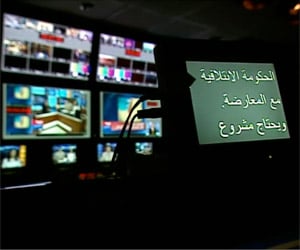
Inside Alhurra's Springfield, Va., studios (photo courtesy of 60 Minutes)
Alhurra’s reporters and commentators operate with little oversight. Alhurra’s president, Brian Conniff, does not speak Arabic and is unable to understand anything broadcast on the radio and television networks he is paid to manage. Conniff has no journalism experience and worked previously as a government auditor. His news director, Daniel Nassif, grew up in Lebanon and has no background in television. Before coming to the network, he helped promote the political aspirations in Washington of a Lebanese Christian former general.
Both men said in interviews that they are providing effective supervision of the network’s five 24-hour radio and television broadcasts and they praised their staff as professional and committed. A string of highly publicized “mistakes” are behind them, Conniff said.
That does not appear to be the case.
Last year, outraged members of Congress threatened to withhold funding for Alhurra, which means “The Free One,” after the network aired a report on a Holocaust deniers conference in Tehran. The reporter who covered the conference told viewers that Jews had provided no scientific evidence of the Holocaust.
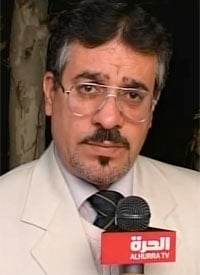
Ahmad Amin worked for the U.S.-funded Sawa radio station for more than a year after network executives told Congress he had been fired for uncritical reporting of a 2006 Holocaust deniers conference which aired on Alhurra.
But this week, in response to a joint investigation by ProPublica and CBS’ 60 Minutes, network executives acknowledged that Amin continued to work for Radio Sawa until June 12.
Two people with knowledge of the matter said that in the past week, all of Amin’s previous reports had been purged from Radio Sawa’s electronic storage system. Deirdre Kline, the spokeswoman for Sawa and Alhurra, did not respond to queries about whether his previous reports were available.
The ProPublica/60 Minutes examination of the Springfield, Va.-based Alhurra and Sawa found an untrained, largely foreign staff with little knowledge of the country whose values and policies they were hired to promote. There appeared to be little oversight of the daily operations.
During a visit to Alhurra’s studios in June, reporters, producers, cameramen and technical staff were busy preparing broadcasts for an audience half-way around the world. Conniff, who is the president of Alhurra and Radio Sawa, sat in on a morning editorial meeting but could not understand it – his Middle Eastern staff discussed the day’s stories in Arabic and no one offered Conniff a simultaneous translation.
“There is no adult supervision there by people who know what is on the actual broadcasts,” said William Rugh, who served as U.S. Ambassador in Yemen and the United Arab Emirates. “You need bilingual managers who understand both languages and cultures and understand journalism.”
Financial accountability also appears to be lacking. In its four years, the network has been unable to provide full documentation to auditors to account for its spending, according to two people familiar with the records and a 2006 report by the Government Accountability Office.
U.S. experts on the Arab world have long worried that the network was doing little to help America’s image in the region. Unpublished reports, audits and internal government e-mail show a steady stream of concern inside the State Department, in Congress, at the government’s broadcasting headquarters and even inside the network itself that Alhurra and Sawa are undermining U.S. policy goals while sometimes promoting the interests of Iran and its allies. ProPublica is making available, for the first time, some of these documents.
Alhurra and Sawa have remained impervious to reform, in part because the Arabic-language broadcasts are beamed only overseas. No one translates the full broadcasts into English, making it nearly impossible for non-Arabic speakers to effectively know what is going on the air. A small team inside the State Department set up to monitor foreign broadcasts stopped watching Alhurra long ago, one senior diplomat said, and never listened to Radio Sawa.
Despite its years of difficulties, Alhurra’s budget has steadily increased. It began with a $67 million budget in 2004 and has asked for $112 million in 2009. Half the government’s investment in public diplomacy -- an effort in promoting this country’s image overseas -- goes to foreign broadcasting. Alhurra and Sawa get the largest share of that money.
Cutting Through ‘The Barriers of Hateful Propaganda’
Alhurra was unveiled as a bold foreign policy innovation in 2004. In his State of the Union address, just three weeks before the network went on air, President Bush announced that the United States was launching a television station for the Middle East and expanded radio broadcasts in Arabic and Farsi.
Such an audacious strategy, Bush said, would “cut through the barriers of hateful propaganda,” that his administration had come to blame for the loss of global support for the United States. He was proposing what would become the largest and most expensive effort in America’s long history of public diplomacy.
Unlike Al Jazeera, Bush said, this new, U.S.-funded network “will begin providing reliable news and information across the region.”
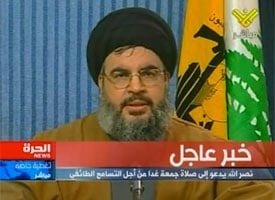
Hassan Nasrallah, leader of Hezbollah, whose speeches were carried live and unedited on Alhurra. The State Department lists Hezbollah as a terrorist organization.
When Hezbollah leader Hassan Nasrallah railed against the U.S. government and threatened Israel, Alhurra carried it live and unedited. When U.S. combat deaths in Iraq surpassed 4,000 in March, Radio Sawa interviewed an anonymous militant who told listeners: “Occupation is occupation. We need to resist them and kill more than 4,000.” In March, Alhurra aired a documentary on the “The Crusades” -- a series of military campaigns that Christian Europe waged against the Muslim world during the Middle Ages. Muslim staffers saw the program as an unfortunate reprise of Bush’s 2001 comment that the coming “war on terrorism,” would be a “crusade.”
In May, after Bush addressed Muslim leaders at a peace conference in Egypt, Alhurra offered its viewers analyses only by guests critical of U.S. policy. The expert invited to shed light on the Palestinian perspective described Israel as an “occupying and racist state,” that “perpetrates a holocaust against 1.5 million Palestinians in Gaza.”
Conniff said he was unfamiliar with the broadcast but that any suggestion that Alhurra was biased against Israel was wrong.
He also said Nassif and another employee keep him informed of programming decisions and that he feels his system works.
Yet, Arabic speakers in the State Department have sent repeated memos and e-mails to the Broadcasting Board of Governors, which oversees Alhurra and Sawa, and to Karen Hughes, who served as Undersecretary of State for Public Diplomacy and Public Affairs until last year.
Alberto Fernandez, an Arabic speaker who served as the top public diplomacy officer for the Middle East until recently, wrote Hughes in May 2007 that Alhurra’s Baghdad operation was stocked “with radical Shi’a Islamists who favored their political brethren and discriminated against and intimidated members of other parties … especially during the Iraqi electoral season.”
Earlier, State Department officials attributed the poor showing of Washington’s preferred candidate for Prime Minister in the 2005 vote, in part, to the negative coverage he received on Alhurra, in favor of Islamist candidates who enjoyed support from Iran.
A senior U.S. diplomat who worked closely with Hughes at the time said she focused on other aspects of public diplomacy such as exchange programs and did not want to wade deeply into “the mess Alhurra was in.”
One official said Hughes had instructed an Arabic speaker on the State Department’s media response team to monitor Alhurra for a week during the spring of 2007. The assignment resulted in a brief report that described Alhurra’s programming as “very pro-Lebanese, pro-Hezbollah,” another diplomat said.
The Changing Face of U.S. Overseas Broadcasts
U.S. radio broadcasts to the Middle East formally began in 1950 when the Voice of America -- the broadcasting arm created to counter Nazi propaganda -- beamed its radio programs in Arabic. They were aimed at countries the United States feared would fall under Soviet influence.
“VOA’s Arabic service would always have a little reading from the Koran when it opened its news hour,” said Nicholas J. Cull, a media and public diplomacy professor at the University of Southern California. “The point then was to showcase the United States as religiously tolerant as opposed to the Godless Communists.”
The Sept. 11 attacks changed VOA’s mission. The Arabic service was suddenly criticized for failing to reach a youthful audience. In the hope of appealing to young men who were being recruited by Islamic fundamentalists, the station was rebranded as Radio Sawa, which means “Together.” The station blended news bulletins with Arabic and English language pop songs.
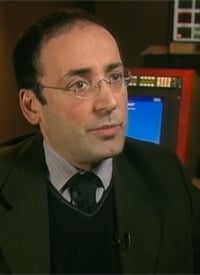
Mouafac Harb, Alhurra's first news director. Harb helped set up Radio Sawa before coming to Alhurra. He was largely responsible for hiring the network staff and getting it on air within four months. But he has been criticized in government reports for signing lucrative deals with friends in his native Lebanon. (Photo courtesy of 60 Minutes)
Bush Administration officials championed Sawa, but it was immediately criticized by U.S. diplomats stationed in the Middle East. Cables from U.S. diplomats in Cairo and Abu Dhabi, also reviewed by ProPublica, complained that the quality of the newscasts were poor, the newsreaders seemed unprofessional and lacked credibility.
In addition, a never-released report by the State Department’s Inspector General shared with ProPublica found “irregularities in contracting,” a hiring process that “may have been marred by favoritism toward Lebanese candidates or candidates of Lebanese ancestry,” and a “lack of strategic goals and objectives.”
Two years later, Harb was named the first news director for the Alhurra television network. He rented the abandoned studios of a former local television station in Virginia and spruced up the sets. He then filled the newsroom largely with inexperienced Christian Lebanese reporters hired in his native Beirut and signed lucrative sole-source contracts with friends who ran advertising agencies, production companies and warehouses across the Middle East. Some low-level staff members were highly paid, including a hairdresser from Lebanon who coiffed the anchors for $100,000 a year.
New hires were promised an American Green Card if they lasted two years with the network.
Harb did not respond to e-mail requests for comment.
Harb told Congress the network had achieved soaring viewership and popularity in the Middle East. He dismissed polls that showed Alhurra with no more than 2 percent of the Middle East audience share and blamed complaints about the content on his initial budget, which he believed was too small to allow Alhurra to compete with media giants such as Al Jazeera.
While Harb projected a confident air, unease was growing at the State Department, particularly over Alhurra’s coverage of Lebanese politics and news from Iraq.
According to a series of internal e-mails, State Department officials had been trying to rein in Harb for years. In his 2007 e-mail to Karen Hughes, Alberto Fernandez, the public diplomacy chief, wrote that Middle East experts inside the State Department and the U.S. embassy in Baghdad had complained “in 2004, 2005 and 2006.”
Alhurra’s leadership, the e-mail said, had “stocked much of its Washington and Lebanon staff with partisans of former Lebanese general Michel Aoun who is now closely allied to the terrorist group Hezbollah.” Fernandez noted the “excessive and fawning” coverage Aoun enjoyed from Alhurra, “even though Aoun has now become quite a poisonous critic of the US and an apologist for Hezbollah’s efforts to bring down Lebanon’s nascent democracy.”
Officials from Hamas, Islamic Jihad, the Popular Front for the Liberation of Palestine and even an al-Qaida financier appeared as talk-show guests on Alhurra while Harb was in charge. Alhurra’s policy is to pay guests; honorariums range from $150 to $1,500 for a single appearance, documents show.
Still, Alhurra was awarded key interviews with senior U.S. government officials. When Bush addressed the Arab world after the revelations of torture at Iraq’s Abu Ghraib prison, he appeared on Alhurra, interviewed by Harb.
In a 2005 oversight hearing, Harb acknowledged that he had cut procedural corners on hiring and contracting but said he had to call on friends to launch the station in four months.
Following Congressional and government inquiries into the financial and management issues at Alhurra that multiplied in the spring of 2006, Harb resigned and returned to Beirut with his wife, a telegenic TV host who had anchored her own cultural affairs program for the network.
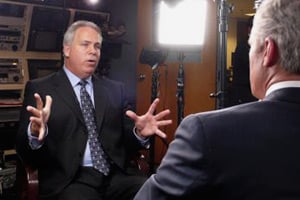
Larry Register, a former CNN executive with 20 years of news experience, replaced Mouafac Harb in 2006, but resigned seven months later after missteps that included authorizing the airing of three reports on a Holocaust deniers conference. (Photo courtesy of 60 Minutes)
“It infuriated me as a U.S. citizen to walk in there and see the money just flowing out the door. A true waste of taxpayer money,” said Register, who had previously served as CNN bureau chief in Jerusalem.
Register said the newsroom had broken-up into “militias” along ethnic, religious and national lines.
“It felt like somebody had picked up the Middle East and brought it to Springfield, Virginia, of all places.” Register said he tried to establish editorial oversight, produce a credible newscast and, above all, win viewers.
But it didn’t take long for Register to get into trouble.
Part of Alhurra’s problem, he said, was that viewers saw it as an American propaganda station, unwilling to cover big stories in the region. When Israel assassinated the spiritual leader of the Palestinian group Hamas, Alhurra ran a cooking show. Register told the staff he wouldn’t shy away from the truth.
In his first weeks, Register approved the live, unedited broadcast of a speech by Hezbollah leader Hassan Nasrallah. Nasrallah is one of the most influential figures in the Arab world today but he is a terrorist to the United States government. Alhurra officials said the speech violated the network’s code of ethics which states that Alhurra will not be a platform for “terrorists.”
The following week, Alhurra aired Ahmad Amin’s report on the Holocaust deniers conference.
Three months later, as Register continued to ferret out financial arrangements and side-deals at the station, the Wall Street Journal’s opinion page reported on the two broadcasts.
Congress expressed outrage, particularly over the Holocaust report from Tehran. Several called for Register's resignation and after seven months on the job, he quit.
At a May 2007 Congressional hearing, members of the Broadcasting Board of Governors and Alhurra executives assured lawmakers that Amin had been fired and that editorial safety nets were now in place.
Joaquin Blaya, a member of the government board, was asked directly whether Amin had been dismissed.
His response to Congressman Mike Pence (R-Ind.): “that is correct,” according to transcripts of the hearings. Congressional officials said neither Alhurra nor the BBG has since informed the appropriate oversight committees that Amin continued to work for Radio Sawa.
Blaya did not respond to requests for comment. Kline, spokeswoman for the network, said that Blaya and Brian Conniff were “talking specifically” in their testimony about whether Amin was employed by Alhurra, the television network. She said he stopped working for Alhurra in 2007.
“There was no mention of Sawa during the hearings,” Kline said in e-mail, “and it would be incorrect to imply otherwise.”
Kline offered conflicting explanations of Amin’s status in a series of e-mails over several days to ProPublica.
She initially said that Conniff only recently learned of Amin’s continued employment and was stunned that Register had failed to carry out orders to end Amin’s relationship with the radio station. Register, however, did not oversee Sawa during his brief time at the network. The radio station was run by Nassif, now the current news director. When pressed, Kline later said Nassif had known the reporter was still on the Radio Sawa payroll but had never been told to fire him.
An internal e-mail shows that Amin was let go on June 12, the day after he covered a state visit to Tehran by Iraqi Prime Minister Nuri al-Maliki and just as ProPublica and 60 Minutes were raising questions about him. Kline declined to say when Amin was fired or what had precipitated it.
Alhurra: A Ratings Flop
Alhurra has not come close to realizing the Bush Administration’s hope that it would someday compete with Al Jazeera, the most-watched station in the Middle East. According to six years of polling by Zogby and the University of Maryland, Al Jazeera remains the favored channel for news for more than 50 percent of Middle East viewers.

Photo courtesy of 60 Minutes
Al Arabiya, another competitor launched a year before Alhurra, has a 9 percent slice of the audience. That station, which is funded by the Saudi government, has a budget considered to be comparable to Alhurra’s, and its coverage is generally welcomed by the Bush administration.
Alhurra has a separate broadcast for Iraq where its share of audience is larger. Still, Alhurra is the number four network in Iraq, behind Al Jazeera and two others. After four years on air, Telhami said, Alhurra’s impact on public opinion has been “less than zero.”
“For most people in the region,” he said “it’s not really on the radar screen.”
James Glassman, who replaced Hughes at the State Department, disagrees. He said government polling shows that even if Alhurra ranks low by percent, millions of people are still watching. He said that as many as 26 million -- roughly 8.5 percent of the Arabic speaking population of the Middle East -- tune into Alhurra for some period of time each week.
“Our idea with Alhurra was to create a network that provided high quality, professional journalism with American standards,” Glassman said. The aim, he said, was “balance, objectivity, which really did not exist in the Middle East.”
But William Rugh, the former ambassador who speaks Arabic and has written extensively on Arab media, said Al Jazeera’s coverage of the United States is more in-depth than Alhurra’s and he says the top-rated station covers issues and sparks debate in ways that Alhurra does not.
“Al Jazeera has a whole series of talk shows in which very sensitive, controversial issues are raised by the participants and they have women’s shows as well. They deal with short comings of various Arab governments way beyond what Alhurra does and it is shocking that in some ways, Al Jazeera has done better than Alhurra in covering the United States.”
A study due out next month by a University of Southern California team questions whether the network has achieved either objectivity or professionalism. The review was commissioned by the Broadcasting Board of Governors, which oversees Alhurra.
Researchers involved in the project, who spoke on the condition of anonymity, said the BBG set tight parameters for the study, telling investigators to focus only on content aired on Alhurra’s pan-Arab station and not to compare it with broadcasts by competitors. Researchers were not allowed to interview Alhurra staff or to select the period of coverage to examine.
After reviewing broadcasts from the month of November, the USC team concluded that reporters and anchormen on Alhurra cited claims about Washington’s “war on terror” that were unsubstantiated, or not backed up by evidence, 30 percent of the time. The study found that personal opinion was often expressed on-air. Objectivity was rated low.
The researchers studied the network’s coverage of the three-day Mideast summit in Annapolis, Md. and found that it strongly favored U.S. and Israeli government positions. Throughout November, they concluded, the network also strongly supported the Iraqi government and was especially favorable to pro-Iranian political figures inside Iraq.
At round-table discussions held in Egypt and Lebanon, audiences gave Alhurra low marks. In Cairo, participants laughed after watching clips, researchers said. The viewers pointed out that Alhurra programs included poor translations. They said it was difficult to understand the Lebanese accents of some hosts and reporters and they noted embarrassing misspellings, including the word “Syria.”
Conniff said he and his staff have worked hard to improve the station’s quality. Alhurra has made election coverage a specialty area and offers programming on women’s issues, American culture and blue jeans.
A recent report by the State Department’s Inspector General noted that Alhurra now has a functioning assignment desk, holds regular editorial meetings and has hosted mini-training sessions with journalism professors.
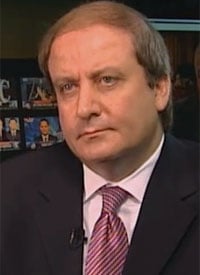
Daniel Nassif, who has no previous television experience, replaced Larry Register as Alhurra's news director in June 2007. In addition to Alhurra's three 24-hour broadcasts, he also oversees Sawa's two radio services. (Photo courtesy of 60 Minutes)
Glassman, the Undersecretary of State who was chairman of the BBG for the last six months, said U.S. taxpayers are right to be concerned about Alhurra. “We’ve made mistakes and we will and have rectified them.”
However, he said Alhurra was delivering high-quality programming to a “part of the world that’s absolutely critical to American interests, that is not hearing and seeing this kind of broadcasting right now. And it makes the world safer, I believe, that we’re doing what we’re doing.”
Glassman, who was initially skeptical of Alhurra, added another thought.
“It wouldn’t be bad if we got put out of business. That is to say, if the Arab world’s own media became so good as, let’s say, the media in Poland did after the fall of the Iron Curtain. Now, is that going to happen in five years? I kind of doubt it. But it’s certainly possible.”
Robert Lewis contributed research to this story.
Subscribe to:
Posts (Atom)