


Belarus President Seeks to Deploy Russia Missiles
By ALAN CULLISON
MINSK, Belarus -- President Alexander Lukashenko is in talks with Moscow about placing in Belarus advanced Iskander missiles that could hit targets deep inside Europe.
President Alexander Lukashenko of Belarus, left, who met Oct. 26 near Moscow with Russian President Dmitry Medvedev, says that Belarus would like to deploy missiles even if it doesn't reach an agreement with Moscow.
The talks raise the ante in the debate over a U.S. plan to deploy missile defense in Europe. They also complicate Western hopes for warmer ties with Belarus, which some in the U.S. and Europe hope could help to counterbalance an increasingly hostile Kremlin.
In an interview with The Wall Street Journal, Mr. Lukashenko said that he would like to see closer relations with the West but that he sympathizes with Russia on two flashpoints that have rocked relations -- the conflict in Georgia and U.S. plans to place antimissile systems in Europe to counter a potential threat from Iran.
Mr. Lukashenko said he "absolutely supports" Russia's plans to place Iskander missiles in Kaliningrad that would target the U.S. missile system. Kaliningrad is a Russian enclave in Europe that borders NATO members Poland and Lithuania, and missiles there could reach the proposed U.S. missile sites in Poland.
Mr. Lukashenko said Russia also had proposed putting Iskander missiles in Belarus, which is situated between Russia and Poland. And if a deal on the issue isn't reached, Belarus itself would like to deploy the missiles, he said.
"Even if Russia does not offer these promising missiles, we will purchase them ourselves," said Mr. Lukashenko, who said the technology for the Iskander optics and fire-control systems comes from Belarus. "Right now we do not have the funds, but it is part of our plans -- I am giving away a secret here -- to have such weapons."
Analysts said it is far from clear that Russia would really need to place missiles inside Belarus. The Kremlin has offered to give up its Kaliningrad plans if Washington drops its missile-defense system. Mr. Lukashenko's missile ambitions also could be a bargaining chip in his maneuvering between Russia and the West.
Though closely allied with and heavily dependent on Moscow, Mr. Lukashenko, a former collective-farm boss who has kept a tight grip on Belarus since he was elected president 14 years ago, has resisted the Kremlin's embrace.
But financial necessity may be tugging harder at Minsk than before. On Wednesday, Russia announced that it agreed to grant Belarus a $2 billion stabilization loan to shore up the government's finances, which have been strained by the credit crisis.
Under loan terms, Belarus agreed to pay for future oil and gas debts in rubles, a major priority of the Kremlin, which has sought to expand the use of the Russian currency beyond its borders.
Advisers to Mr. Lukashenko said he has lately put out feelers to improve relations with the U.S. and Europe, which slapped his government with sanctions in 2006 after he was accused of rigging his re-election. Sanctions were eased this year, after Mr. Lukashenko ordered the release of some political prisoners.
Like other leaders of former Soviet states, he has resisted Moscow pressure to side with the Kremlin in its conflict with Georgia by recognizing the breakaway regions of South Ossetia and Abkhazia. So far the only countries to confer recognition are Russia and Nicaragua.
But he signaled he may tip toward Moscow on the issue and echoed Russia's argument that the West paved the way for the independence of Georgia's breakaway regions by recognizing Kosovo.
Original article posted here.
Lukashenko, in His Own Words
Below, excerpts from Belarus President Alexander Lukashenko's interview with The Wall Street Journal Tuesday. The interview was conducted in Russian, and translated by the Journal.
On the release of political opponent Alexander Kozulin earlier this year:
"The West perceived this as some kind of step toward democracy. You are welcome, thank you very much. You know, strictly between us, sometimes I think if they could find five or six more political prisoners here and told us to free them, and that then perhaps we would make a few more steps forward, we would do it readily. We could free even more. But they haven't found any more."
On the possibility of recognizing South Ossetia and Abkhazia:
"If you [the West] recognized Kosovo, why not recognize Abkhazia? I don't see any problems here. There is a precedent[hellip] Europe and America understand our position and our situation. And I will be honest, they are no longer pushing it as rigidly with us as before. So I don't think there would be negative repercussions for our relations or the like. I think this question is finished. It is no longer as acute as it was two months ago."
On the financial crisis:
"And I warned the Americans and others. No one listened to me. As it turned out, I was right. Now in America they are talking about an alternative to this ultraliberal market system, where everything is allowed, where you can eat more than what you make, and spend more than what you earn."
On Barack Obama:
"I look at Obama, a young man, a good-looking person. That is my first impression, I feel sorry for him. He looks 100% like Lukashenko, when I came to power after the downfall of the Soviet Union. The store shelves were empty, a severe financial crisis."
Showing posts with label Medvedev. Show all posts
Showing posts with label Medvedev. Show all posts
Friday, November 14, 2008


Tuesday, August 26, 2008
Russia not so scared, and calling the West's bluff
Russia recognises Georgian rebels | ||||||
| Russian president speaks to BBC President Dmitry Medvedev has declared that Russia formally recognises the independence of the breakaway Georgian regions of South Ossetia and Abkhazia. Mr Medvedev told the BBC Russia had tried to preserve Georgian unity for 17 years, but that the situation had changed after this month's violence. He said Moscow now felt obliged to recognise South Ossetia and Abkhazia as other countries had done with Kosovo. The decree, in defiance of a plea from the US, has provoked a wave of protest. Georgia accused Russia of an unconcealed annexation of its territory, and said the decrees had no legal force.
The US and France called the Russian move regrettable, while the UK said it categorically rejected it. Nato said the declaration violated numerous UN Security Council resolutions that Russia itself had endorsed. However the leaders of Abkhazia and South Ossetia, which have had de facto independence since the early 1990s, thanked Russia. Fighting between Russia and Georgia began on 7 August after the Georgian military tried to retake South Ossetia by force. Russian forces subsequently launched a counter-attack and the conflict ended with the ejection of Georgian troops from both South Ossetia and Abkhazia and an EU-brokered ceasefire. 'No easy choice' In an announcement on Russian state television, President Medvedev said he had signed a decree to recognise Abkhazia and South Ossetia as independent states. He instructed the Russian foreign ministry to open negotiations on formal diplomatic relations with the two regions and called on other states to follow his country's example. Mr Medvedev said he had "taken into account the expression of free will by the Ossetian and Abkhaz peoples" and accused Georgia of failing over many years to negotiate a peaceful settlement to the problem.
"That was no easy choice to make, but it is the sole chance of saving people's lives," he added. The move followed votes in both houses of parliament on Monday, which called on Moscow to recognise the regions' independence. In an interview with the BBC at his residency in Sochi, on the border with Abkhazia, Mr Medvedev later said Russia had been obliged to act following a "genocide" started by Georgian President Mikhail Saakashvili against separatists in South Ossetia. The president compared Russia's recognition of Abkhazia and South Ossetia to the West's recognition of Kosovo, which unilaterally declared independence from Serbia in February 2008. He also denied that Russia had breached the ceasefire agreement with Georgia, saying pursuing the security of the two regions included addressing their status. "The most important thing was to prevent a humanitarian catastrophe to save the lives of people for whom we are responsible, because most of them they are Russian citizens," he said. "So we had to take a decision recognising the two states as independent." Mr Medvedev said relations with the West were deteriorating sharply and that a new Cold War could not be excluded, but that Russia did not want one. "There are no winners in a Cold War," he said. Violation Georgian Deputy Foreign Minister Giga Bokeria responded to the Russian announcement angrily, saying: "This is an unconcealed annexation of these territories, which are a part of Georgia." Western countries, including the US, Germany, the UK and France immediately condemned the move.
US Secretary of State Condoleezza Rice, speaking from the West Bank city of Ramallah, said the decision was "regrettable". "Since the United States is a permanent member of the Security Council this simply will be dead on arrival in the Security Council," she said. Late on Monday, the US state department had warned that recognition of the two provinces' independence would be "a violation of Georgian territorial integrity" and "inconsistent with international law". In a statement, it said President George W Bush had called on Russia's leadership to "meet its commitments and not recognise these separatist regions". In the two breakaway regions, however, Moscow's move was warmly welcomed. The leader of South Ossetia's separatist government, Eduard Kokoity, said he would ask Moscow to set up a military base on his territory. In the South Ossetian capital of Tskhinvali there were scenes of jubilation while residents in Abkhazia took to the streets to celebrate the news, firing into the air. "We feel happy," said Aida Gabaz, a 38-year-old lawyer in the Abkhaz capital Sukhumi. "We all have tears in our eyes. We feel pride for our people." 'New understanding' Earlier on Tuesday, Russia cancelled a visit by Nato's secretary general, one of a series of measures to suspend co-operation with the military alliance.
Russia's ambassador to Nato said the trip would be delayed until relations between the two were clarified. Dmitry Rogozin said a "new understanding" needed to be reached between Russia and Nato. The BBC's Humphrey Hawksley, in Moscow, says the recognition is bound to dramatically heighten tensions in Russia's already fragile relationship with the West. He says this and a series of other announcements indicate that Russia is preparing itself for a showdown. Although most of Russia's forces pulled out of the rest of Georgia last Friday, it is maintaining a presence both within the two rebel regions and in buffer zones imposed round their boundaries. Port control Some Russian troops also continue to operate near the Black Sea port of Poti, south of Abkhazia, where Russia says it will carry out regular inspections of cargo. HAVE YOUR SAY Russia is right to recognise South Ossetia and guarantee its security Branco, Bulgaria The US said on Tuesday that its warships would deliver aid to Georgia's port of Poti, which is under Russian control. The move could mean US and Russian forces coming face to face. Earlier, the head of European security organisation, the OSCE, Alexander Stubb, accused Russia of trying to empty South Ossetia of Georgians. Speaking to the BBC's Europe Today programme, he said: "They are clearly trying to empty southern Ossetia from Georgians, which I don't think goes by any of the books that we deal with in international relations". At a checkpoint in South Ossetia, the BBC's Gabriel Gatehouse said a South Ossetian commander said many Georgian civilians had already left of their own accord, because they were scared of the guns. | ||||||

 This is an unconcealed annexation of these territories, which are a part of Georgia


Thursday, August 14, 2008
As weazl said earlier, after Russian (Medevdev) misstep, Russia having to put its foot down STRONGLY this time (read: Putin).
Georgia-Russia Shaky Cease Fire
Confusion in the Caucus region: are Russian tanks rolling back into Georgia?
By ZOE MAGEE
Russia responded angrily to President Bush's harsh words this morning about their handling of the situation in the former Soviet republic of Georgia, where Russian and Georgian troops have been fighting since last week.
Russia's Foreign Minister, Sergei Lavrov, told reporters that Washington was playing a dangerous game by supporting Georgia's President Mikhail Saakashvili.
"We understand that this current Georgian leadership is a special project of the United States, but one day the United States will have to choose between defending its prestige over a virtual project or real partnership which requires joint action," Lavrov said.
While the Russian president, Dmitry Medvedev, was meeting at Meiendorf Castle with Turkish Prime Minister Recep Erdogan, Lavrov minced no words in his criticism of Bush's remarks, calling it the work of "bad speech writers."
"Frankly speaking, once again I was surprised by the skills of the speech writers who prepared the statement of the U.S. president," Lavrov said.
"Bush's speech said nothing of how Georgia was armed all these years, including by the United States," he said, adding, "We have more than once warned our partners that this is a dangerous game."
The fighting erupted last week following an attack by Georgian troops on Thursday on the pro-Russian enclave of South Ossetia.
Earlier today, President Bush, responding to reports that the Russians were not abiding by a cease-fire warned Russia to "keep its word" and end attacks on Georgia, as he dispatched a military plane loaded with supplies for Georgian refugees.
The president spoke briefly in the White House Rose Garden after Georgian officials accused Russia of violating the cease-fire both sides agreed to on Tuesday.
"To begin to repair the damage to its relations with the United States, Europe and other nations, and to begin restoring its place in the world, Russia must keep its word and act to end this crisis," Bush said.
He announced that he will send Secretary of State Condoleezza Rice to Paris and then Tblisi to help negotiate the peace plan and to show the administration's "unwavering support" for the Georgian government.
"The United States stands with the democratically elected government of Georgia and insists that the sovereignty and territorial integrity of Georgia be respected," Bush said.
Secretary of Defense Robert Gates, who was standing next to the president and Rice, is to coordinate humanitarian relief in the region.Original article posted here.
Tuesday, August 12, 2008
Medvedev falls for West's bluff, then immediately made to look like a fool with presidents from Ukraine, Poliand, Latvia and Lithuania laughing
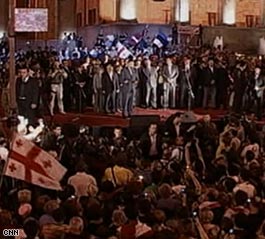
Presidents attend Georgia rally after cease-fire deal
The presidents of Ukraine, Lithuania, Latvia and Poland showed support for Georgia by appearing on stage with Georgia's president in front of a large crowd in Tbilisi. Earlier, the Russian and French presidents announced a six-point plan for settling the conflict in Georgia.


MOSCOW, Russia (CNN) -- The Russian and French presidents announced Tuesday a six-point plan of principles for settling the immediate conflict in Georgia but stopped short of tackling the issues that sparked the violence.
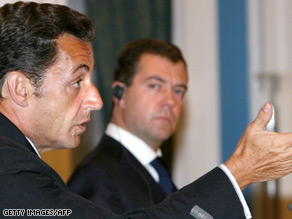
Nicolas Sarkozy, left, and Dmitry Medvedev outline the deal and the problems ahead.

"We have not achieved peace yet, but we have achieved a provisional cease-fire of hostilities," French President Nicolas Sarkozy said.
The points include Russian agreements to conclude all military operations, return Russian armed forces to the line preceding the beginning of operations and not use force again in Georgia.
In return, Georgia would return its armed forces to their normal and permanent locations.
Both sides would provide free access for humanitarian assistance; and international consideration of the issues of South Ossetia and Abkhazia would be undertaken.
"All we need to do now is to stop suffering, stop the death of people," Sarkozy said. Stopping the fighting "is the most important objective."
He emphasized that the meeting with Russia's President Dmitry Medvedev was not intended to solve all of the issues, such as Georgia's territorial integrity and South Ossetia's desire for independence.
"There are bigger problems relating to South Ossetia that we cannot resolve here," Sarkozy said, who arrived in Moscow as current head of the European Union.

Sarkozy said he and Medvedev agreed that Georgia is an independent country and that Russia has no intention of annexing it. But Medvedev also said "sovereignty is based on the will of the people" and "territorial integrity can be demonstrated by the actual facts on the ground."
Medvedev said, "I think that these are some very good principles in order to resolve the problem which has arisen from this very dramatic situation and these principles can be used by Georgia and South Ossetia."
Medvedev said he had ordered an end to military operations against Georgia, but Tbilisi reported more attacks after the statement was made.  Watch Georgia's reaction to halt in fighting »
Medvedev said, "the aggressor has been punished and has incurred very significant losses. Its armed forces are disorganized."
Tens of thousands of Georgians converged on the capital, Tbilisi, for a day of rallies. In the evening they waved French, U.S. and Georgian flags at a rally where President Mikhail Saakashvili was joined by the leaders of Ukraine, Poland, Lithuania and Lativia. Watch the rally »
U.S. Secretary of State Condoleeza Rice said, "I wanted to make very clear that the United States stands for the territorial integrity of Georgia, for the sovereignty of Georgia; that we support its democratically elected government and people, and are reviewing options for humanitarian and reconstruction assistance to Georgia. But the most important thing right now is that these military operations need to stop."
U.S. officials said they were considering flying aid from bases in Germany to Georgia. There was also consideration being given to sending U.S. Navy ships into the Black Sea to conduct humanitarian relief missions.
Violence has raged since Thursday, when Georgia launched a crackdown on separatist fighters in autonomous South Ossetia, where most people have long supported independence.
Russia, which supports the separatists, responded Friday, sending tanks across its border into South Ossetia. The conflict quickly spread to parts of Georgia and to Abkhazia, another separatist region.
Russia said it wanted to stop Georgian military actions against its peacekeepers in the breakaway regions.
The Georgian government said that despite Medvedev's announcement, Russian warplanes struck two Georgian villages and bombed an ambulance outside the breakaway province of South Ossetia. Watch more on the fighting in South Ossetia »
Medvedev warned in his announcement that "when pockets of resistance and other aggressive actions occur," a decision concerning destruction had to be made.
Earlier, a Georgian Interior Ministry official said Russian bombs had hit one of the three pipelines carrying oil to the Black Sea port of Poti. There was no oil in the pipeline at the time.  Interactive map: See how far the Russians have advanced »
UK-based energy giant BP later said it had shut down three oil pipelines in the region as a "precautionary measure" linked to the security situation. None of its pipelines had been attacked.
A Dutch cameraman was killed Tuesday morning in an incident in Gori, the Dutch Foreign Ministry confirmed. He was identified as Stan Storimans of RTL TV. The correspondent who accompanied him was also injured.
One Russian diplomat said that up to 2,000 people had died in the conflict. Up to 100,000 people are thought to have been displaced by the violence, which has left South Ossetia's capital of Tskhinvali in ruins.
Russian Foreign Minister Sergey Lavrov said Tuesday that his country wanted a demilitarized zone to be created in Georgian territory before a cease-fire could take effect. Watch Lavrov speak about Georgia »
Lavrov said that it would be best if Saakashvili stepped down as Georgia's president, something he has not offered to do, but that Russia was not demanding his resignation.
Tuesday, July 08, 2008
Russia tells the US not even to think about it . . .
U.S.-Lithuanian Talks on Nmd Are Unacceptable - Medvedev
TOYKO, Japan. July 7 (Interfax) - Moscow does not tolerate any possibility of talks between the United States and Lithuania on missile defense issues, Russian President Dmitry Medvedev said.
"The Russian president openly expressed serious concerns at a meeting with U.S. President [George] Bush about media reports that the U.S. and Lithuania have been in talks on a possibility to deploy a base of missile interceptors. It was stated that this is absolutely unacceptable," Russian presidential aide Sergei Prikhodko told journalists after a meeting between Medvedev and Bush.
Medvedev "stated that there is no real progress in the Russian- U.S. dialog on the missile defense issue," Prikhodko said.
"Many promising ideas, which have been voiced at the high political level, have been given up. In particular, we still cannot understand up to the end how the proposed transparency measures will be realized," the official said.
Bush showed at the meeting that the U.S. administration is aimed at continuing the dialog, Prikhodko said.
Original article posted here.
TOYKO, Japan. July 7 (Interfax) - Moscow does not tolerate any possibility of talks between the United States and Lithuania on missile defense issues, Russian President Dmitry Medvedev said.
"The Russian president openly expressed serious concerns at a meeting with U.S. President [George] Bush about media reports that the U.S. and Lithuania have been in talks on a possibility to deploy a base of missile interceptors. It was stated that this is absolutely unacceptable," Russian presidential aide Sergei Prikhodko told journalists after a meeting between Medvedev and Bush.
Medvedev "stated that there is no real progress in the Russian- U.S. dialog on the missile defense issue," Prikhodko said.
"Many promising ideas, which have been voiced at the high political level, have been given up. In particular, we still cannot understand up to the end how the proposed transparency measures will be realized," the official said.
Bush showed at the meeting that the U.S. administration is aimed at continuing the dialog, Prikhodko said.
Original article posted here.
Subscribe to:
Posts (Atom)