Showing posts with label Ukraine. Show all posts

Wednesday, September 03, 2008

The latest US crony puppet state on the verge of collapse after leading party comes under investigation for arming another crony criminal US puppet.

Ukraine: lawmakers to probe weapons to Georgia
The Associated Press
Published: September 2, 2008
E-Mail Article
Listen to Article
Printer-Friendly
3-Column Format
Translate
Share Article

Text Size

KIEV, Ukraine: Ukrainian lawmakers voted Tuesday to form a panel to investigate their country's weapons supplies to Georgia following Russia's war with that nation last month.

Ukraine has been a major supplier of weapons to its ally Georgia, whom it backed firmly in the conflict. Ukrainian military officials say the arms supplies are perfectly lawful and will not be halted.

But Valeriy Konovalyuk, a lawmaker from the opposition Party of Regions, which has ties to Moscow, told the legislature Tuesday that he believes Ukraine was engaged in "illegal weapons supplies." He did not elaborate.

The legislature voted to set up a panel to look into the claims.

Last month's military conflict between Georgia and Russia, which ended with Russian troops pushing deep into Georgia and Moscow's recognition of two Georgian breakaway provinces' independence, has deeply divided Ukrainian politicians and the public.
Today in Europe
Georgians eager to rebuild army
Cheney arrives in Azerbaijan
Two Georgians went to war but never got to fight

Pro-Western President Viktor Yushchenko has firmly backed his Georgian counterpart Mikhail Saakashvili and condemned Moscow's actions. Both leaders seek to make their countries NATO members and shed Russia's influence — steps that have angered Moscow. But the opposition Party of Regions, which has ties to Moscow, and the Communists have swung their support behind the Kremlin.

Parliament debated all day Tuesday, but failed to pass a resolution on the conflict, as the president had asked them to.

The issue is especially contentious since many here worry that Ukraine, where the Russian Black Sea Fleet is based, could be Russia's next target.

Analysts say that a war between Russia and Ukraine is highly unlikely. While Georgia is a small nation of 4.6 million people, Ukraine is roughly the size of France, with a population of 46 million.

Russia also relies on Ukraine for transporting its natural gas to European consumers, and it is Ukraine's energy supplier and top trading partner. But Ukraine is likely to come under immense economic and diplomatic pressure from Moscow to give up its NATO aspirations.

British Foreign Secretary David Miliband was here recently to offer support, and U.S. Vice President Dick Cheney is expected to visit soon.
Orignal article posted here.

Tuesday, August 12, 2008

Medvedev falls for West's bluff, then immediately made to look like a fool with presidents from Ukraine, Poliand, Latvia and Lithuania laughing

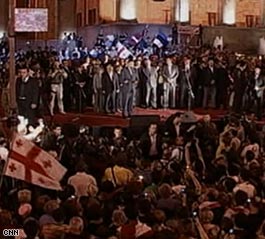
Presidents attend Georgia rally after cease-fire deal


Presidents attend Georgia rally after cease-fire deal

The presidents of Ukraine, Lithuania, Latvia and Poland showed support for Georgia by appearing on stage with Georgia's president in front of a large crowd in Tbilisi. Earlier, the Russian and French presidents announced a six-point plan for settling the conflict in Georgia.

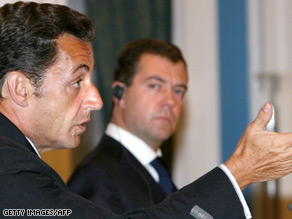
MOSCOW, Russia (CNN) -- The Russian and French presidents announced Tuesday a six-point plan of principles for settling the immediate conflict in Georgia but stopped short of tackling the issues that sparked the violence.

Nicolas Sarkozy, left, and Dmitry Medvedev outline the deal and the problems ahead.

Nicolas Sarkozy, left, and Dmitry Medvedev outline the deal and the problems ahead.

"We have not achieved peace yet, but we have achieved a provisional cease-fire of hostilities," French President Nicolas Sarkozy said.

The points include Russian agreements to conclude all military operations, return Russian armed forces to the line preceding the beginning of operations and not use force again in Georgia.

In return, Georgia would return its armed forces to their normal and permanent locations.

Both sides would provide free access for humanitarian assistance; and international consideration of the issues of South Ossetia and Abkhazia would be undertaken.

"All we need to do now is to stop suffering, stop the death of people," Sarkozy said. Stopping the fighting "is the most important objective."

He emphasized that the meeting with Russia's President Dmitry Medvedev was not intended to solve all of the issues, such as Georgia's territorial integrity and South Ossetia's desire for independence.

"There are bigger problems relating to South Ossetia that we cannot resolve here," Sarkozy said, who arrived in Moscow as current head of the European Union.

Sarkozy said he and Medvedev agreed that Georgia is an independent country and that Russia has no intention of annexing it. But Medvedev also said "sovereignty is based on the will of the people" and "territorial integrity can be demonstrated by the actual facts on the ground."

Medvedev said, "I think that these are some very good principles in order to resolve the problem which has arisen from this very dramatic situation and these principles can be used by Georgia and South Ossetia."

Medvedev said he had ordered an end to military operations against Georgia, but Tbilisi reported more attacks after the statement was made. Video Watch Georgia's reaction to halt in fighting »

Medvedev said, "the aggressor has been punished and has incurred very significant losses. Its armed forces are disorganized."

Tens of thousands of Georgians converged on the capital, Tbilisi, for a day of rallies. In the evening they waved French, U.S. and Georgian flags at a rally where President Mikhail Saakashvili was joined by the leaders of Ukraine, Poland, Lithuania and Lativia. Video Watch the rally »

U.S. Secretary of State Condoleeza Rice said, "I wanted to make very clear that the United States stands for the territorial integrity of Georgia, for the sovereignty of Georgia; that we support its democratically elected government and people, and are reviewing options for humanitarian and reconstruction assistance to Georgia. But the most important thing right now is that these military operations need to stop."

U.S. officials said they were considering flying aid from bases in Germany to Georgia. There was also consideration being given to sending U.S. Navy ships into the Black Sea to conduct humanitarian relief missions.

Violence has raged since Thursday, when Georgia launched a crackdown on separatist fighters in autonomous South Ossetia, where most people have long supported independence.

Russia, which supports the separatists, responded Friday, sending tanks across its border into South Ossetia. The conflict quickly spread to parts of Georgia and to Abkhazia, another separatist region.

Russia said it wanted to stop Georgian military actions against its peacekeepers in the breakaway regions.

The Georgian government said that despite Medvedev's announcement, Russian warplanes struck two Georgian villages and bombed an ambulance outside the breakaway province of South Ossetia. Video Watch more on the fighting in South Ossetia »

Medvedev warned in his announcement that "when pockets of resistance and other aggressive actions occur," a decision concerning destruction had to be made.

Earlier, a Georgian Interior Ministry official said Russian bombs had hit one of the three pipelines carrying oil to the Black Sea port of Poti. There was no oil in the pipeline at the time. Interactive map: See how far the Russians have advanced »

UK-based energy giant BP later said it had shut down three oil pipelines in the region as a "precautionary measure" linked to the security situation. None of its pipelines had been attacked.

A Dutch cameraman was killed Tuesday morning in an incident in Gori, the Dutch Foreign Ministry confirmed. He was identified as Stan Storimans of RTL TV. The correspondent who accompanied him was also injured.

One Russian diplomat said that up to 2,000 people had died in the conflict. Up to 100,000 people are thought to have been displaced by the violence, which has left South Ossetia's capital of Tskhinvali in ruins.

Russian Foreign Minister Sergey Lavrov said Tuesday that his country wanted a demilitarized zone to be created in Georgian territory before a cease-fire could take effect. Video Watch Lavrov speak about Georgia »

Lavrov said that it would be best if Saakashvili stepped down as Georgia's president, something he has not offered to do, but that Russia was not demanding his resignation.

Original article posted here.

Monday, April 07, 2008

With humans gone, live thrives

Chernobyl: No People But A Thriving Ecosystem
By Rusty Rockets

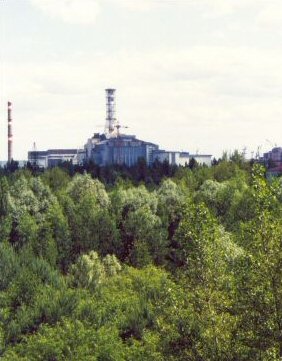
When the Chernobyl nuclear reactor melted down in 1986, scores of people died, many more became ill with acute radiation sickness, and 135,000 people were evacuated. The blast spread more than 200 times the radioactivity of the bombs that were dropped on Hiroshima and Nagasaki combined. The prognosis for Chernobyl and its environs – succinctly dubbed by the Soviets as the "Zone of Alienation" – was grim. But surprisingly, Chernobyl’s surrounding flora and fauna have flourished remarkably. In Wormwood Forest: A Natural History of Chernobyl (October 2005, Joseph Henry Press), author Mary Mycio vividly describes an extraordinary – and at times unearthly – new ecosystem that is flourishing in this no-man’s land, where radiation levels are too intense for people to live.

In 1986, people were already overwrought as a result of the tense and relentless brinkmanship presented on the nightly news in an era when two superpowers existed. As Martin Amis wrote: “Of course, the mid-to-late Eighties was one of the warmer phases of the Cold War: the time of the Reagan build-up, or spend-up; ‘the evil empire’; Star Wars (‘the force was with us’). Gorbachev had yet to show his hand, and it was hereabouts that Reagan accused the Russian language of having no word for détente.” The threat of nuclear war always seemed imminent and our anxiousness was further heightened by the unsettling predictions of what would occur should a nuclear exchange eventuate.

Popular culture ensured that apocalyptic wasteland scenarios were welded in the public psyche. So when Chernobyl melted down, it was no surprise that the world’s media painted a grim picture. As a reflection of that time, Mycio recalls how a friend called her up and exclaimed: "A nuclear bomb exploded in Ukraine!" Chernobyl may not have been the nuclear apocalypse that we were all waiting for, but it may as well have been. We were all obviously prepared for the worst.

As Mycio says, the very word “Chernobyl” has become a synonym for “horrific disaster,” conjuring the frightful radioactive deserts that form the landscapes of Atomic Age science fiction and resonate deeply in modern imaginations haunted by the specter of nuclear war. Mary Mycio’s first assumptions prior to visiting the Zone were probably not too dissimilar from anybody else asked to speculate on the disaster. “Whenever I thought about the irradiated lands 50 miles north of Kiev, it was like contemplating a black hole. All I could picture was a dead zone, like a giant parking lot paved with asphalt or a barren desert of dust and ash where nothing could grow and nothing living could survive without protective gear. Only gloomy shades of black and gray colored my mental images,” writes Mycio.
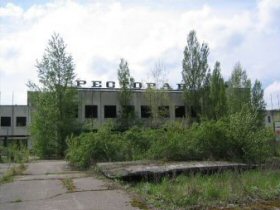
But Wormwood Forest tells an astonishing tale that while tragic, is in many respects uplifting. The book’s important and remarkable observations come at a high price, but the Chernobyl disaster clearly demonstrates what happens to the environment when humans are not present. “Though Chernobyl is widely considered the worst environmental disaster in history, the Zone’s evacuation has – paradoxically – allowed nature to flourish. Nature barely notices radiation – at least the type and levels of radiation Chernobyl released. Human activities are far more damaging. In a way, we are the environmental disaster,” says Mycio. Ten years after the disaster, Mycio discovered a wilderness teeming with large animals, even more than before the nuclear disaster, with many of them members of rare and endangered species. Like the forests, fields and swamps of this burgeoning wilderness, everything is radioactive, and will be for the next 400,000 years. Packed into the muscles and bones of every animal inhabitant is Cesium-137 and strontium-90 respectively. But, quite astonishingly, they are thriving. Chernobyl’s flourishing new ecosystem is: “one of the first examples of how, in the absence of human intervention, nature in the Zone could recover its balance – even in the face of radioactive: “ghost towns and villages [that] stand in tragic testimony to the devastating effects of technology gone awry,” adds Mycio.

Mycio, originally from Long Island, earned a bachelor’s degree in biology from Hunter College and a law degree from New York University in 1984. While working toward her degree, Mycio also spent a number of years in the East Village of New York, at the heart of the East Coast Ukrainian community, promoting Ukrainian affairs and issues. While working as a freelance journalist, Mycio felt she needed to write a book that dealt specifically with a Ukrainian theme. Mycio recently told The Ukrainian Weekly that after the Chernobyl disaster occurred, she became fixated on collecting as much information on the disaster as she possibly could in the hope of writing a book that exposed the criminal negligence of the Soviet government. However, the book was to become something even more fascinating and useful than a railing against the machinations of the Soviet government. “What I tried to do was weave personal travels with lyrical explanations of the natural history and science of Chernobyl. It’s the story of my travels in a radioactive wilderness.”

As it happens, Mycio’s book release coincides with a 600 page Chernobyl Forum Report that was released in early September. The Forum is made up of 8 United Nations agencies, including the International Atomic Energy Agency (IAEA), World Health Organization (WHO), United Nations Development Program (UNDP), Food and Agriculture Organization (FAO), United Nations Environment Program (UNEP), United Nations Office for the Coordination of Humanitarian Affairs (UN-OCHA), United Nations Scientific Committee on the Effects of Atomic Radiation (UNSCEAR), and the World Bank, as well as the governments of Belarus, Russia and Ukraine. The report states that a total of up to four thousand people could eventually die of radiation exposure from the 1986 Chernobyl nuclear power plant disaster. This figure represents a massive departure from the original predictions made that suggested anywhere up to hundreds-of-thousands of fatalities. As of mid-2005 fewer than 50 deaths had been directly attributed to radiation from the disaster, almost all being highly exposed rescue workers, many who died within months of the accident but others who died as late as 2004, the report says. The report also notes that while 4,000 cases of thyroid cancer, mainly in children and adolescents at the time of the accident, have resulted from the accident's contamination, the survival rate among such cancer victims, judging from experience in Belarus, has been almost 99 percent.

According to The Ukrainian Weekly, the Chernobyl Forum report has drawn much criticism from groups in the Ukraine. Alexander Kuzma, executive director of the Children of Chernobyl Relief and Development Fund, says the casualty figures are “dubious, at best.” Mycio can understand the frustration felt by such individuals, who she claims have had their concerns marginalized for years. Mycio told The Ukrainian Weekly that while there was nothing wrong with the environmental report, the predicted health effects are somewhat more controversial. “They based their prediction of future cancer on the people they studied, but they didn’t study all the people who were affected,” she pointed out. Mycio claims that there are about 1 million considered “highly affected” by Chernobyl, but the Chernobyl Forum only examined 600,000 of them, while ignoring 400,000. “They’re making conclusions based on a limited, incomplete population,” Mycio said. She also adds that the report states that there have been no increases in solid cancer tumors as a result of Chernobyl, yet there haven’t been any epidemiological studies of these tumors. “That’s logically incorrect,” states Mycio. “Since there are no epidemiological studies on the changes in the rate of solid tumors, it’s impossible to make any conclusions.” Despite these concerns, however, Mycio believes that to some extent the Chernobyl case in regard to fatalities has been exaggerated.

The Chernobyl disaster also intersects with a number of other present day worries, such as our dependence on fossil fuels in spite of many scientists claiming that the Earth’s once bountiful reserves have entered their twilight years. Not to mention the effects of global warming that will continue to linger as a legacy of our longer than necessary dalliance with fossil fuels. Having spent a considerable amount of time researching and writing on the effects of the Chernobyl disaster, Mycio’s thinking on these important issues has been transformed in fundamental ways. “For the record, I have gone from adamant opponent of nuclear energy to ambivalent supporter – at least for giving a window of time for reducing our dependence on fossil fuels while pursuing research on alternative energy sources,” says Mycio. She explains that: “Initially, the disaster made me oppose nuclear energy. In 1986 that was a painless position to hold, because the price of American dependence on foreign oil had not yet become two Iraq wars, the second of which still has undetermined costs and consequences. Nor had I yet moved to Ukraine, whose complete dependence on Russian fossil fuels seriously compromised the young state’s political independence. It was also before I could feel the real evidence of global warming on my own skin.”

Many people may find it unbelievable that Chernobyl’s story can go from worst-ever-environmental-disaster-in-history, to flourishing eco wilderness, twenty odd years later. Mycio states emphatically that she has never been approached by anyone looking to influence her assessment of the Chernobyl situation. An apologist she is not. The book is as much about the resilience and tenacity of a woman eager to get at the truth of something close to her heart, as it is about the resilience of nature itself in the face of what we assume to be insurmountable odds. As Mycio says: “The extraordinary and unexpected fate of the evacuated ‘Zone of Alienation’ around Chernobyl provides only a part of the answer. I hope that the rest will form in the mind of the reader after joining me on my journeys through the fascinating, beautiful – and radioactive – Wormwood Forest.”

Further reading:

Mary Mycio’s Wormwood Forest homepage: http://chernobyl.in.ua/en/chapter_1/1
UN Chernobyl Forum Report (12 MB!):
http://www.iaea.org/NewsCenter/Focus/Chernobyl/pdfs/05-28601_Chernobyl.pdf

Original article posted here.

Tuesday, June 12, 2007

Singing Washington's song. American crony Yushenko trying to rush Ukraine into NATO when he doesn't even have a mandate to rule

Putin 'not kidding' on missile threat, Yushchenko warns

'The recent events, I think, show to everyone that we have quite a creaky security balance,' Ukraine's President says in exclusive interview with The Globe and Mail

KIEV — Ukrainian President Viktor Yushchenko said he took seriously Russian President Vladimir Putin's recent threat to target Europe with ballistic missiles, and said such talk has heightened his country's desire to quickly join the North Atlantic Treaty Organization.

In a wide-ranging interview with The Globe and Mail, Mr. Yushchenko also complained of Russian interference in his country's turbulent domestic politics. Despite heated opposition from the Kremlin, the pro-Western politician said he still plans to take his country into NATO and the European Union.

“I think the President of Russia is not kidding,” he said, referring to Mr. Putin's warning last week that Russia could aim its missiles at “new targets in Europe” if the United States pushes ahead with its controversial plans to build an anti-missile shield based in Poland and the Czech Republic.

Although Mr. Putin has since moved to defuse the standoff by suggesting the former Soviet republic of Azerbaijan as a possible location for a joint missile-defence system that would include Russia, Mr. Yushchenko said the new belligerence of Ukraine's larger neighbour demonstrates the need for his country to be swiftly brought under NATO's security umbrella.

“The recent events, I think, show to everyone that we have quite a creaky security balance. This really triggers some concerns and could be really painful.”

“It's becoming more and more apparent that the best response to all the challenges regarding defence and security policy can only be given through a collective system of defence,” he said, sitting in a chandelier-lit meeting room in the country's Soviet-era Presidential Administration building. He gave the interview one day after meeting Mr. Putin in the Russian city of St. Petersburg.

“Our defence and security doctrine is formally determined in law. And a key aspect of this doctrine is to provide Ukraine's accession to the European Union and the North Atlantic bloc.”

As he spoke, young activists from his Our Ukraine party, waving the banners of the Orange Revolution that brought Mr. Yushchenko to office in 2004, handed out pro-NATO pamphlets on one of Kiev's main squares.

Russia, which was furious over NATO's 2004 expansion into the former Soviet republics of Latvia, Lithuania and Estonia, has already made it clear that it would view Ukraine's accession with hostility. Despite repeated assertions that NATO does not view Russia as an enemy, the Kremlin remains suspicious of the military alliance's relentless eastward expansion.

The possibility that Ukraine, which for centuries was part of the Russian and then Soviet empires, might join NATO has been identified as a red line by senior figures in Mr. Putin's administration, which sees the country as an integral part of Russia's “sphere of influence.” It would threaten the future of Russia's Black Sea fleet, which is stationed at the Ukrainian port of Sevastopol.

His eyeglasses placed atop a pile of notes on a table frequently used for official meetings with members of rival political factions, Mr. Yushchenko said he was willing to answer any questions Mr. Putin might have about Ukraine's desire to join NATO, but would not change his mind. “This is a policy that is not against somebody. … This is the policy that is most suitable for the security and defence of the nation.”

Ukraine has been pushing to join NATO since the Orange Revolution, an uprising that was motivated in part by a popular desire to break free of centuries of Russian influence over the country. While the White House has indicated that it supports Ukraine's future membership, progress has been slow since Mr. Yushchenko's arch-rival, the Kremlin-backed Viktor Yanukovich, won control of parliament and assumed the prime minister's post last year.

The continuing feud between the two men has left the country effectively without a government for much of the year. Alleging that Mr. Yanukovich's allies were attempting to buy control of Ukraine's parliament, the Rada, Mr. Yushchenko dissolved the body in April and called fresh elections, a move Mr. Yanukovich said was unconstitutional. After weeks of duelling street protests – and a brief tug-of-war over who controlled 40,000 Interior Ministry soldiers – the two called a truce and agreed to hold elections on Sept. 30.

Mr. Yushchenko said Monday that the political crisis was now over, but described the coming elections as crucial for the country's future direction.

The 2004 presidential elections, which triggered the Orange Revolution after official results initially showed Mr. Yanukovich had won, were often portrayed as a struggle over whether Ukraine would face east, toward Russia, or west, toward the EU. Mr. Yushchenko said Ukrainians now face an equally stark choice between having a true democracy, or preserving the corrupt system that has undermined Ukraine's progress since it became an independent state 16 years ago.

With polls showing Mr. Yanukovich's party currently in the lead, and many Ukrainians disillusioned with the Orange Revolution and its perceived failure to deliver on the promises made three years ago, Mr. Yushchenko gave a robust defence of his record in office thus far. He described the country's economy as booming, with a doubling of foreign direct investment over the past two years and record low unemployment.

He nonetheless acknowledged that the pro-Western alliance led by himself and his off-again, on-again ally Yulia Tymoshenko had squandered a lot of its political capital through infighting that eventually led Mr. Yushchenko to fire Ms. Tymoshenko from the prime minister's post. Though allies once more, their spectacular falling out turned off many supporters and cleared the way for Mr. Yanukovich to stage a startling political comeback.

But in the continuing political turmoil, Mr. Yushchenko again saw a Russian hand. “There are some political forces in Russia that want to keep the old political order in Ukraine. But I emphasize that we are an independent state, a sovereign country. It is us who determine our domestic and foreign policies.”

Original article posted here.

Tuesday, April 03, 2007

Another Failure in the Making: CIA Sponsored Orange Revolution Dissolving at the Seams -- Dissolves Parliament

Battle lines drawn after Yushchenko dissolves parliament

Ukrainian opposition leader Julia Timoshenko (R) shakes hands with Ukrainian President Viktor Yushchenko before last consultation of leaders of parliamentary groups and President in presidential office in Kiev on Monday, 02 April 2007. Ukrainian President Viktor Yushchenko ordered parliament dissolved on Monday, triggering a constitutional crisis.  EPA/SERGEY DOLZHENKO

Ukrainian opposition leader Julia Timoshenko (R) shakes hands with Ukrainian President Viktor Yushchenko before last consultation of leaders of parliamentary groups and President in presidential office in Kiev on Monday, 02 April 2007. Ukrainian President Viktor Yushchenko ordered parliament dissolved on Monday, triggering a constitutional crisis.

Kiev - Ukraine's political players on Tuesday were taking up hard-line negotiating positions, and speaking little of compromise, as the country reacted to news President Viktor Yushchenko had dissolved parliament and sparked a constitutional crisis.

A pro-Europe politician supporting market reforms, Yushchenko ordered the legislature dismissed on Monday evening, citing alleged constitutional violations in forming the ruling coalition and calling for early elections.

Prime Minister Viktor Yanukovich, leader of a parliament majority supporting close relations with Russia and government support to big business, denounced Yushchenko's order as illegal.

Between 255 and 262 pro-Yanukovich members of parliament depending on the time - in any case a working majority in the 450-seat house - attended an unprecedented early-morning emergency session of parliament devoted to passing a raft of bills aimed at making Yushchenko's order null and void.

The legislature, after sometimes vicious speeches against Yushchenko, dismissed the leadership of the central election committee and made illegal financing of any election in the immediate future.

By constitutional statute, early elections would take place May 27.

'We will not be dictated to,' Parliamentary Speaker Oleksander Moroz said.

Ukraine's national legislature the Verhovna Rada in addition took a first step towards placing the dispute in the hands of the supreme constitutional court, passing a resolution declaring Yushchenko's dissolution order unconstitutional and asking the court to rule on the matter by Friday.

Roman Zwarych, a top Yushchenko spokesman, worked into the early morning hours as well, appearing on news programmes on most of the country's major channels to describe the Rada moves as 'illegal' on grounds Yushchenko's dismissal of parliament made any Rada session impossible until new elections are held.

Politicians on both sides of the conflict were quick in media interviews to allege substantial military forces, often 15,000 special-force police supported by tanks, were en route to Kiev to impose martial law.

Vasyl Pushko, head of the national police force, dismissed the allegations, saying that 'aside from the placement of a few additional guards to government buildings' in the capital, he had not ordered any security reinforcements to the capital.

Security guards at parliament were admitting only MPs and accredited journalists - a move widely seen as intended to prevent a physical takeover of the legislature by either side.

Street demonstrators were on hand as well, those supporting Yushchenko in tents pitched in Kiev's central Maidan square, Yanukovich supporters in a competing encampment in a park next to parliament.

Each side numbered a few hundred, and spent the night quietly. A column of some 2,000 pro-Yanukovich demonstrators snarled morning traffic in the centre of the Ukrainian capital, but otherwise Kiev's streets and sidewalks were typical of a normal work day, police said.

Yushchenko scored an important vote of support over the night, as the country's leaders took sides in the conflict, with Defence Minister Anatoly Hrystenko stating 'the army will follow the law ... and orders issued by its legal commander-in-chief, the president.'

Regional police bosses checked in with support to one of the two sides throughout the morning, with senior officials in the Russian- speaking Kharkiv and Crimea provinces expressing support to Yanukovich, and the Ukrainian-speaking Lutsk province to Yushchenko.

In Washington, the US State Department urged the Ukrainian leadership to resolve the crisis peacefully.

'We are monitoring closely developments in Ukraine and urge all parties to respect the rule of law and resolve disputes nonviolently, in a manner consistent with Ukraine's democratic values and national interests,' spokesman Sean McCormack said in a statement.

Original article posted here.