


Thursday, October 23, 2008


Monday, September 15, 2008
Rare article from Newsweek that actually says something helpful about international news: focus on Bolivian crisis
Despite winning last month's recall election, President Evo Morales faces escalating violence from protesters who don't want to share the nation's natural-gas wealth.
Relations between Bolivia's President, Evo Morales, and the country's wealthy easterners were tense from the start. Since Morales's election in 2005, the eastern provinces, known as the "Media Luna," or half moon, which have grown rich on natural gas, have fought bitterly over a new constitution that would redistribute some of that wealth to the western provinces. The opposition has requently waged disruptive strikes. Protests began to take a more violent turn after Morales trounced the opposition in last month's recall election. This week at least eight Bolivians were killed in clashes. Opposition groups blew up part of a natural gas pipeline and vandalized government offices, causing millions of dollars worth of damage. They have also succeeded in disrupting trade with Brazil and Argentina, which rely on Bolivia's natural gas.
Relations between Bolivia and the United States have quickly deteriorated as well. Bolivia expelled U.S. ambassador Philip Goldberg for "conspiring against democracy" and in response the Bush administration sent the Bolivian ambassador in Washington packing. In a show of support, Hugo Chavez, Venezuela's president and staunch Evo ally, ejected the American envoy from Caracas. On Friday, Morales sent troops into the eastern provinces to restore order. To find out where it's all headed, Newsweek's Michael Miller talked with economist and Bolivia expert Mark Weisbrot, co-director of the Center for Economic and Policy Research in Washington, D.C. Excerpts:
Newsweek: How serious is the fallout between the United States and Bolivia?
Weisbrot: I think it's serious. I think that this thing was coming for a long time. There had been a number of incidents. There was the incident with the Peace Corps and the Fulbright scholar [asked to spy by the U.S. Embassy]. And then there are the meetings between the ambassador and the opposition. Obviously he's the ambassador: he should meet with everybody. But the way he did and the timing of it was considered unfriendly. I think you have a bigger structural problem, which is that you have USAID funding groups in Bolivia but they won't disclose who they are. They are doing this now in Venezuela too. These are polarized countries. So on that basis both of these governments [Bolivia and Venezuela] just assume that Washington is doing what it has always done, which is to fund the people that they are sympathetic to.
How much influence do eastern Bolivia's large estate owners have? What kind of pressure do opposition groups exert in Bolivia?
Quite a bit. That's what this conflict is really about. You have the most concentrated land ownership in almost the entire world in Bolivia, with around two thirds of the land owned by six tenths of one percent―not even one percent―of the landowners. Obviously Evo Morales ran on a platform of land reform. He is not talking about confiscating huge amounts of land, but there is going to be some redistribution. There is the hydrocarbon revenue, which goes disproportionately to the Media Luna states with the opposition governors. So those are the two big economic reasons for this conflict.
Which one, land or hydrocarbons, is really the central issue?
That is a tough question. The hydrocarbons are more immediate because [the government has] already begun some redistribution there. Morales has not touched the landowners. So I guess you could say that [hydrocarbons] are the bigger issue.
I was in Bolivia a couple months ago and I met with the Central Bank and the ministries. The government has $ 7 billion in reserves right now in the Central Bank, which is an awful lot [considering] their whole GDP is only $13.2 billion. Most of it is owned by the prefectures, the provinces, so they have a lot of money. So it is hard to explain why they would raise such a fuss over the government wanting to take a small part of that and use it for some pensions
for people over 60, which also goes to their own residents.
How does this tie into the recent recall election in Bolivia? Wasn't that election meant to resolve this impasse between the Morales government and the opposition provinces?
It did show some things. First of all, Morales got 67 percent of the vote, which is as big as you get in politics in the world without fixing the election. And the other thing it showed is if you look at the Media Luna provinces, while it's true that the opposition won, the vote for Morales also went up enormously as compared to what he got in 2005. So his support, his mandate, really increased quite a bit since the 2005 election. What you are seeing right now is that the people who could not win anything at the ballot box are trying to use other means. They are cutting off the gas, which is very serious.
What are the financial consequences of opposition groups disrupting Bolivia's natural gas pipeline?
It's huge. It's more of a problem for Brazil than it is for Bolivia: they get half their gas from Bolivia and more than half in the industrial region of Sao Paolo. For Bolivia it is quite a lot of money. It is a $100 million estimated just to fix [the gas pipeline] and $8 million per day of revenue lost as well. But it is even worse than that because the opposition can really sabotage the whole economy. Everything that the government is doing in terms of the next five years as far as extending gas supply to Brazil and Argentina, if Bolivia can't be a reliable gas supplier then those countries are going to have to look elsewhere. So it is a form of serious sabotage. The [Morales government] is calling it "terrorism."
Will Morales's mandate enable him to act more forcefully toward the breakaway provinces or is he going to have to wait for the constitutional referendum in December?
I think he is going to have to do something. The government has been very pacifist and I think they don't get enough credit for that. Most governments in the world would have sent in the military in force and a lot of people would have been killed. He has been extremely restrained. He has tried to avoid violence at all costs and the opposition has been emboldened by that. They just keep escalating. Now they are taking it to a different stage and I don't know how much more the government can just try to ignore it. They really depend on these gas exports, as do Brazil and Argentina. Brazil issued a statement the other day that said they will not tolerate an interruption in the constitutional order in Bolivia. Whether that means they will send troops, I don't know.
Does this have a financial impact on the United States? Or is the decision to expel the Bolivian ambassador simply a quid pro quo response? Is there real money at stake for the United States?
I don't think there is really anything at stake for the United States. If [by antagonizing Morales] they push Chavez too far, there is always the chance that he could cut off oil. But it is unlikely.
What type of fallout will there from Morales' use of troops in the eastern provinces?
It depends on what the [government forces do] and on their capacity for crowd control and using non-lethal weapons. Look at what happened prior to Morales: they are still trying to extradite the former president [Gonzalo Sanchez de Lozada] for all the people who were killed in the demonstrations back then. Morales has been on the other side of this and he knows that things can get out of control. So he is trying to do everything to avoid that but it's not easy when you have an opposition that is not operating by the same rules.
Wednesday, September 03, 2008
The full force of fascism in America
Massive police raids on suspected protesters in Minneapolis
[updated below (with video) - Update II - Update III - Update IV]
Protesters here in Minneapolis have been targeted by a series of highly intimidating, sweeping police raids across the city, involving teams of 25-30 officers in riot gear, with semi-automatic weapons drawn, entering homes of those suspected of planning protests, handcuffing and forcing them to lay on the floor, while law enforcement officers searched the homes, seizing computers, journals, and political pamphlets. Last night, members of the St. Paul police department and the Ramsey County sheriff's department handcuffed, photographed and detained dozens of people meeting at a public venue to plan a demonstration, charging them with no crime other than "fire code violations," and early this morning, the Sheriff's department sent teams of officers into at least four Minneapolis area homes where suspected protesters were staying.
Jane Hamsher and I were at two of those homes this morning -- one which had just been raided and one which was in the process of being raided. Each of the raided houses is known by neighbors as a "hippie house," where 5-10 college-aged individuals live in a communal setting, and everyone we spoke with said that there had never been any problems of any kind in those houses, that they were filled with "peaceful kids" who are politically active but entirely unthreatening and friendly. Posted below is the video of the scene, including various interviews, which convey a very clear sense of what is actually going on here.
In the house that had just been raided, those inside described how a team of roughly 25 officers had barged into their homes with masks and black swat gear, holding large semi-automatic rifles, and ordered them to lie on the floor, where they were handcuffed and ordered not to move. The officers refused to state why they were there and, until the very end, refused to show whether they had a search warrant. They were forced to remain on the floor for 45 minutes while the officers took away the laptops, computers, individual journals, and political materials kept in the house. One of the individuals renting the house, an 18-year-old woman, was extremely shaken as she and others described how the officers were deliberately making intimidating statements such as "Do you have Terminator ready?" as they lay on the floor in handcuffs. The 10 or so individuals in the house all said that though they found the experience very jarring, they still intended to protest against the GOP Convention, and several said that being subjected to raids of that sort made them more emboldened than ever to do so.
Several of those who were arrested are being represented by Bruce Nestor, the President of the Minnesota chapter of the National Lawyers' Guild. Nestor said that last night's raid involved a meeting of a group calling itself the "RNC Welcoming Committee", and that this morning's raids appeared to target members of "Food Not Bombs," which he described as an anti-war, anti-authoritarian protest group. There was not a single act of violence or illegality that has taken place, Nestor said. Instead, the raids were purely anticipatory in nature, and clearly designed to frighten people contemplating taking part in any unauthorized protests.
Nestor indicated that only 2 or 3 of the 50 individuals who were handcuffed this morning at the 2 houses were actually arrested and charged with a crime, and the crime they were charged with is "conspiracy to commit riot." Nestor, who has practiced law in Minnesota for many years, said that he had never before heard of that statute being used for anything, and that its parameters are so self-evidently vague, designed to allow pre-emeptive arrests of those who are peacefully protesting, that it is almost certainly unconstitutional, though because it had never been invoked (until now), its constitutionality had not been tested.
There is clearly an intent on the part of law enforcement authorities here to engage in extreme and highly intimidating raids against those who are planning to protest the Convention. The DNC in Denver was the site of several quite ugly incidents where law enforcement acted on behalf of Democratic Party officials and the corporate elite that funded the Convention to keep the media and protesters from doing anything remotely off-script. But the massive and plainly excessive preemptive police raids in Minnesota are of a different order altogether. Targeting people with automatic-weapons-carrying SWAT teams and mass raids in their homes, who are suspected of nothing more than planning dissident political protests at a political convention and who have engaged in no illegal activity whatsoever, is about as redolent of the worst tactics of a police state as can be imagined.
UPDATE: Here is the first of the videos, from the house that had just been raided:
Jane Hamsher has more here, and The Minnesota Independent has a report on another one of the raided houses, here.
UPDATE II: Here is the video we took from the second house as the raid was occurring. We were barred from entering but spoke with neighbors outside as well as with Bruce Nestor, the President of the Minnesota Lawyer's Guild, regarding these raids:
Over at FDL, Lindsay Beyerstein spoke with the property owner whose house -- the fourth one we now know of -- was being raided while the raid was in progress, and Lindsay has details here ("About an hour and a half ago 20 to 30 heavily armed police officers surrounded the house. One of my roommates said 'I want to see a warrant' and she was immediately detained"). Meanwhile, Indy Media of Twin Cities -- an association of independent journalists in the area -- just told me that several of their journalists have been detained while trying to cover these raids. Their site, with ongoing updates, is here.
The Uptake also has several reports of the various raids, including video of the raid at the property whose owner Bernstein spoke with as the raid occurred. That video includes an interview with a lawyer from the National Lawyer's Guild who was detained and put in handcufffs, explaining that the surrounded house is one where various journalists are staying. Additionally, a photojournalist with Democracy Now was detained at that house as well. So, both journalists and lawyers -- in addition to protesters -- have been detained and arrested even though not a single violent or criminal act has occurred.
UPDATE III: FDL has the transcript of part of my discussion about these raids with the National Lawyer Guild's Minnesota President -- here.
The Uptake has this amazing video interview with the Democracy Now producer who was detained today. As the DN producer explains, she was present at a meeting of a group called "I-Witness" -- which videotaped police behavior at the 2004 GOP Convention in New York and helped get charges dismissed against hundreds of protesters who were arrested. The police surrounded the St. Paul house where they were meeting even though they had no warrant, told them that anyone who exited the house would be arrested, and then -- even though they finally, after several hours, obtained a warrant only for the house next door -- basically broke into the house, pointed weapons at everyone inside, handcuffed them, searched the house, and then left. Here is a blog post from one of the members of I-Witness asking for help during the time when they were forced to stay inside the house (see the second post -- it reads like a note from a hostage crying out for help). This is truly repugnant, extreme police behavior designed to intimidate protesters, police critics and others, and it ought to infuriate anyone and everyone who cares about basic liberties.
Original article posted here.
Tuesday, September 02, 2008
Monday, August 18, 2008
Saturday, July 26, 2008
Tuesday, July 08, 2008
weazl doesn't stand behind Lyndon Larouche's political history, but he does stand behind what he says in this video . . .
. . . Not that Obama is going to change something. But at least at one time, he wanted to.
Sunday, July 06, 2008
Freedom of the press
U.S. Journalist Photographs Grisly Aftermath of Attack in Iraq, Gets Booted by Military

U.S. journalist Zoriah Miller says he was censored by the U.S. military in the Iraqi city of Fallujah after photographing Marines who died in a suicide bombing.
On Jun. 26, a suicide bomber attacked a city council meeting in Fallujah, 69 kms west of Baghdad, between local tribal sheikhs and military officials.
Three Marines, Cpl. Marcus Preudhomme, Capt. Philip Dykeman, and Lt. Col. Max Galeai, assigned to 2d Battalion, 3rd Marine Division based in Kaneohe Bay, Hawaii, died in the attack.
The explosion also killed two interpreters and 20 Iraqis, including the mayor of the nearby town of Karmah, two prominent sheikhs and their sons, and another sheikh and his brother. All were members of the local "awakening council," one of the U.S.-backed militias that have taken up arms against al Qaeda in Iraq, according to U.S. and Iraqi authorities.
Miller was embedded with Marines on a patrol one block from the attack when it occurred. He had originally turned down the option of going to report on the city council meeting that was bombed.
Miller ran with the Marines he was with to the scene of the attack. "As I ran I saw human pieces...a skull cap with hair, bone shards," he told IPS during a telephone interview from the so-called Green Zone in Baghdad. "When we arrived at the building it was chaotic. There were Iraqis, police and civilians running around screaming. Bodies were being pulled out of the building."
"I went in and there were over 20 people's remains all over the place," Miller continued, "Of the Marines I jogged in with, someone started to vomit. Others were standing around, not knowing what to do. It was completely surreal."
"At that moment I realized this was far beyond anything I'd experienced, and I realized I wanted to focus and make sure I could capture what it felt like, and the visual horror," Miller explained.
"I thought, 'Nobody in the U.S. has any idea what it means when they hear that 20 people died in a suicide bombing.' I want people to be able to associate those numbers with the scene and the actual loss of human life. And to show why soldiers are suffering from PTSD [post-traumatic stress disorder]," Miller told IPS.
Miller was taken out of the building by Marines, but then allowed back inside where he took one last photo of the carnage before they closed the scene to him.
"We spent most of the rest of the day as Marines picked up body parts and put them in buckets and bags," he said.
In an Iraqi Police station in Karmah, the Naval Criminal Investigative Service (NCIS) was brought in to investigate the bombing. Millers' photos were the only ones of the scene, so the NCIS team asked for them.
"I made them copies, but then one of the Marines came in and told me to delete my memory card after I give them the photos, and I refused," Miller told IPS, "I told the NCIS that if they forced me to delete them, I would stop sharing them. So they stopped pressing that issue."
Miller said that he was following the rules for embedded journalists. "That evening, during the debriefing, the guys [Marines] I was with told me that the higher-ups had said I was a stand-up guy and behaved well and to treat me well. The guys I was with were all very much on my side."
Miller explained to IPS that he meticulously showed his photos to the Marines he was with to make sure he was not going to show any photos that would upset the family members of the deceased Marines. "They were all okay with them, so then about 96 hours after the bombing I published the photos on my blog."
Then things got interesting.
"Tuesday [Jul. 1] I awoke to a call in their combat operations centre, and the person on the phone told me they were a PAO (Public Affairs Officer) at Camp Fallujah, and he wanted me to take my blog down right away," Miller told IPS. "I asked them why, and was then called back after five minutes by a higher ranking PAO who claimed I had broken my contract by showing photos of dead Americans with U.S. uniforms and boots."
Miller said the PAO claimed he was not allowed, by the embed contract, to show dead or wounded U.S. citizens or soldiers in the field. "I never signed any contract for that," Miller said.
He was called back after another five minutes and told his embed was terminated and they would send him back to Baghdad on the next flight. He was then taken back to Camp Fallujah where he said, "Everyone was extremely angry and fired up at me."
Nevertheless, the lower ranking Marines he had embedded with "were on my side, and they told me they thought that what was happening was wrong."
Miller explained that he grew nervous when the flight was canceled due to a sandstorm, and then a security guard was assigned to him.
"I started to feel uncomfortable with this," Miller explained. "The next day, Gen. Kelly, [Major General John Kelly, who is the Commanding General of the I Marine Expeditionary Force] wanted to have some words with me. I was to meet with him at 3 pm, and we sat outside in the sun for two hours and he never showed."
Miller was told he would be flown out that night, but he was deleted from the flight and told that General Kelly wanted to see him, so he waited again until Thursday, Jul. 3. Again the general did not appear, so Miller was given an official letter about the grounds for the termination of his embed, signed by Gen. Kelly, and flown to Baghdad.
"Now, as I think about it, I think they needed the extra time to figure out what they were going to say about my dismissal," Miller said. "Their original reason ended up being bogus, so they had to figure something else out."
The letter he was given stated reasons for his dismissal as "you photographed the remains of U.S. soldiers", "you posted these images along with detailed commentary", and "by posting the images and your commentary you violated 14 H and O of the news media agreement you signed."
In addition, the letter, which Miller read to IPS, stated, "By providing detailed information of the effectiveness of the attack and the response of U.S. forces to it, you have put all U.S. forces in Iraq at greater risk for harm."
Miller feels the reason for his dismissal is otherwise.
"The bottom line is that the thing they cited as the reason for my dismissal was 'information the enemy could use against you.' They realized, probably from keeping track of my blog, that I was not showing identifiable features of a soldier ... and they couldn't find a reason to kick me out. Because it was a high ranking person who got killed, they were all fired up."
Miller concluded, "Up to that point they said it was because I showed pictures of bodies with pieces of uniform and boots. The letter, though, doesn't mention that at all. I checked the document I had about ground rules for media embeds, and I followed them."
The Pentagon would not comment on the story when contacted by IPS, saying they had no information on Miller's case beyond what Central Command had already posted.
Wednesday, July 02, 2008
More psy ops bullshit: the dead boogieman is dying
From ANI
Washington, July 2: Two officials of the US' intelligence agency CIA have claimed that Al Qaeda chief Osama bin Laden was on death bed as he suffered from a terminal kidney disease, and may live only for a few months.
The intelligence agency also managed to get the names of some of the medications Bin Laden was taking.
One of the two CIA officials familiar with the report that came out six-nine months ago, quoted it as saying, "Based on his current pharmaceutical intake we would expect that he has no more than 6-18 months to live and impending kidney failure."
Pakistan President Pervez Musharraf was the first person to claim that Laden suffered from kidney disease and was on dialysis.
"It's trying to make a diagnosis from thousands of miles away with only fragments of the medical chart," the Time magazine quoted Paul Pillar, the former top analyst and deputy director of the CIA's counter-terrorism centre, as saying.
Frances Fragos Townsend, who was chief of the White House Homeland Security Council said, "I've read all the same conflicting reports that people have talked to you about. I never found one set of reporting more persuasive than another."
Original article posted here.
Tuesday, July 01, 2008
Monday, June 30, 2008
More evidence of the brainwashing and manipulation of Americans
Iran-Contra's 'Lost Chapter'
As historians ponder George W. Bush’s disastrous presidency, they may wonder how Republicans perfected a propaganda system that could fool tens of millions of Americans, intimidate Democrats, and transform the vaunted Washington press corps from watchdogs to lapdogs.
To understand this extraordinary development, historians might want to look back at the 1980s and examine the Iran-Contra scandal’s “lost chapter,” a narrative describing how Ronald Reagan’s administration brought CIA tactics to bear domestically to reshape the way Americans perceived the world.
That chapter – which we are publishing here for the first time – was “lost” because Republicans on the congressional Iran-Contra investigation waged a rear-guard fight that traded elimination of the chapter’s key findings for the votes of three moderate GOP senators, giving the final report a patina of bipartisanship.
Under that compromise, a few segments of the draft chapter were inserted in the final report’s Executive Summary and in another section on White House private fundraising, but the chapter’s conclusions and its detailed account of how the “perception management” operation worked ended up on the editing room floor.
The American people thus were spared the chapter’s troubling finding: that the Reagan administration had built a domestic covert propaganda apparatus managed by a CIA propaganda and disinformation specialist working out of the National Security Council.
“One of the CIA’s most senior covert action operators was sent to the NSC in 1983 by CIA Director [William] Casey where he participated in the creation of an inter-agency public diplomacy mechanism that included the use of seasoned intelligence specialists,” the chapter’s conclusion stated.
“This public/private network set out to accomplish what a covert CIA operation in a foreign country might attempt – to sway the media, the Congress, and American public opinion in the direction of the Reagan administration’s policies.”
However, with the chapter’s key findings deleted, the right-wing domestic propaganda operation not only survived the Iran-Contra fallout but thrived.
So did some of the administration’s collaborators, such as South Korean theocrat Sun Myung Moon and Australian press mogul Rupert Murdoch, two far-right media barons who poured billions of dollars into pro-Republican news outlets that continue to influence Washington’s political debates to this day.
Before every presidential election, Moon’s Washington Times plants derogatory – and often false – stories about Democratic contenders, discrediting them and damaging their chances of winning the White House.
For instance, in 1988, the Times published a bogus account suggesting that the Democratic nominee Michael Dukakis had undergone psychiatric treatment. In 2000, Moon’s newspaper pushed the theme that Al Gore suffered from clinical delusions. [For details, see Robert Parry’s Secrecy & Privilege.]
As for Murdoch, his giant News Corp. expanded into American cable TV with the founding of Fox News in 1996. Since then, the right-wing network has proved highly effective in promoting attack lines against Democrats or anyone else who challenges the Republican power structure.
As President George W. Bush herded the nation toward war with Iraq in 2002-03, Fox News acted like his sheep dogs making sure public opinion didn’t stray too far off. The “Fox effect” was so powerful that it convinced other networks to load up with pro-war military analysts and to silence voices that questioned the invasion. [See Neck Deep.]
Seeds of Propaganda
The seeds of this private/public collaboration can be found in the 84-page draft Iran-Contra chapter, entitled “Launching the Private Network.” [There appear to have been several versions of this “lost chapter.” This one I found in congressional files.]
The chapter traces the origins of the propaganda network to President Reagan’s “National Security Decision Directive 77” in January 1983 as his administration sought to promote its foreign policy, especially its desire to oust Nicaragua’s leftist Sandinista government.
In a Jan. 13, 1983, memo, then-National Security Advisor William Clark foresaw the need for non-governmental money to advance this cause. “We will develop a scenario for obtaining private funding,” Clark wrote.
As administration officials began reaching out to wealthy supporters, lines against domestic propaganda soon were crossed as the operation took aim at not only at foreign audiences but at U.S. public opinion, the press and congressional Democrats who opposed funding Nicaraguan rebels, known as contras.
At the time, the contras were earning a gruesome reputation as human rights violators and terrorists. To change this negative perception of the contras, the Reagan administration created a full-blown, clandestine propaganda operation.
“An elaborate system of inter-agency committees was eventually formed and charged with the task of working closely with private groups and individuals involved in fundraising, lobbying campaigns and propagandistic activities aimed at influencing public opinion and governmental action,” the draft chapter said.
Heading this operation was a veteran CIA officer named Walter Raymond Jr., who was recruited by another CIA officer, Donald Gregg, before Gregg shifted from his job as chief of the NSC’s Intelligence Directorate to become national security adviser to then-Vice President George H.W. Bush.
[The draft chapter doesn’t use Raymond’s name in its opening pages, apparently because some of the information came from classified depositions. However, Raymond’s name is used later in the chapter and the earlier citations match Raymond’s role.]
According to the draft report, the CIA officer recruited for the NSC job had served as Director of the Covert Action Staff at the CIA from 1978 to 1982 and was a “specialist in propaganda and disinformation.”
“The CIA official [Raymond] discussed the transfer with [CIA Director William] Casey and NSC Advisor William Clark that he be assigned to the NSC as Gregg’s successor [in June 1982] and received approval for his involvement in setting up the public diplomacy program along with his intelligence responsibilities,” the chapter said.
“In the early part of 1983, documents obtained by the Select [Iran-Contra] Committees indicate that the Director of the Intelligence Staff of the NSC [Raymond] successfully recommended the establishment of an inter-governmental network to promote and manage a public diplomacy plan designed to create support for Reagan Administration policies at home and abroad.”
Raymond “helped to set up an elaborate system of inter-agency committees,” the draft chapter said, adding:
“In the Spring of 1983, the network began to turn its attention toward beefing up the Administration’s capacity to promote American support for the Democratic Resistance in Nicaragua [the contras] and the fledgling democracy in El Salvador.
“This effort resulted in the creation of the Office of Public Diplomacy for Latin America and the Caribbean in the Department of State (S/LPD), headed by Otto Reich,” a right-wing Cuban exile from Miami.
Though Secretary of State George Shultz wanted the office under his control, President Reagan insisted that Reich “report directly to the NSC,” where Raymond oversaw the operations as a special assistant to the President and the NSC’s director of international communications, the chapter said.
“At least for several months after he assumed this position, Raymond also worked on intelligence matters at the NSC, including drafting a Presidential Finding for Covert Action in Nicaragua in mid-September” 1983, the chapter said.
In other words, although Raymond was shifted to the NSC staff in part to evade prohibitions on the CIA influencing U.S. public opinion, his intelligence and propaganda duties overlapped for a time as he was retiring from the spy agency.
Key Player
Despite Raymond’s formal separation from the CIA, he acted toward the U.S. public much like a CIA officer would in directing a propaganda operation in a hostile foreign country. He was the go-to guy to keep the operation on track.
“Reich relied heavily on Raymond to secure personnel transfers from other government agencies to beef up the limited resources made available to S/LPD by the Department of State,” the chapter said.
“Personnel made available to the new office included intelligence specialists from the U.S. Air Force and the U.S. Army. On one occasion, five intelligence experts from the Army’s 4th Psychological Operations Group at Fort Bragg, North Carolina, were assigned to work with Reich’s fast-growing operation. …
“White House documents also indicate that CIA Director Casey had more than a passing interest in the Central American public diplomacy campaign.”
The chapter cited an Aug. 9, 1983, memo written by Raymond describing Casey’s participation in a meeting with public relations specialists to brainstorm how “to sell a ‘new product’ – Central America – by generating interest across-the-spectrum.”
In an Aug. 29, 1983, memo, Raymond recounted a call from Casey pushing his P.R. ideas. Alarmed at a CIA director participating so brazenly in domestic propaganda, Raymond wrote that “I philosophized a bit with Bill Casey (in an effort to get him out of the loop)” but with little success.
The chapter added: “Casey’s involvement in the public diplomacy effort apparently continued throughout the period under investigation by the Committees,” including a 1985 role in pressuring Congress to renew contra aid and a 1986 hand in further shielding S/LPD from the oversight of Secretary Shultz.
A Raymond-authored memo to Casey in August 1986 described the shift of S/LPD – then run by neoconservative theorist Bob Kagan who had replaced Reich – to the control of the Bureau of Inter-American Affairs, which was headed by Assistant Secretary of State Elliott Abrams, another prominent neoconservative.
Another important figure in the pro-contra propaganda was NSC staffer Oliver North, who spent a great deal of his time on the Nicaraguan public diplomacy operation even though he is better known for arranging secret arms shipments to the contras and to Iran’s radical Islamic government, leading to the Iran-Contra scandal.
The draft chapter cited a March 10, 1985, memo from North describing his assistance to CIA Director Casey in timing disclosures of pro-contra news “aimed at securing Congressional approval for renewed support to the Nicaraguan Resistance Forces.”
North’s Operatives
The Iran-Contra “lost” chapter depicts a sometimes Byzantine network of contract and private operatives who handled details of the domestic propaganda while concealing the hand of the White House and the CIA.
“Richard R. Miller, former head of public affairs at AID, and Francis D. Gomez, former public affairs specialist at the State Department and USIA, were hired by S/LPD through sole-source, no-bid contracts to carry out a variety of activities on behalf of the Reagan administration policies in Central America,” the chapter said.
“Supported by the State Department and White House, Miller and Gomez became the outside managers of [North operative] Spitz Channel’s fundraising and lobbying activities.
“They also served as the managers of Central American political figures, defectors, Nicaraguan opposition leaders and Sandinista atrocity victims who were made available to the press, the Congress and private groups, to tell the story of the Contra cause.”
Miller and Gomez facilitated transfers of money to Swiss and offshore banks at North’s direction, as they “became the key link between the State Department and the Reagan White House with the private groups and individuals engaged in a myriad of endeavors aimed at influencing the Congress, the media and public opinion,” the chapter said.
In its conclusion, the draft chapter read:
“The State Department was used to run a prohibited, domestic, covert propaganda operation. Established despite resistance from the Secretary of State, and reporting directly to the NSC, the [S/LPD] attempted to mask many of its activities from the Congress and the American people.”
However, the American people never got to read a detailed explanation of this finding nor see the evidence. In October 1987, as the congressional Iran-Contra committees wrote their final report, Republicans protested the inclusion of this explosive information.
Though the Democrats held the majority, the GOP had leverage because Rep. Lee Hamilton, D-Indiana, the House chairman, wanted some bipartisanship in the final report, especially since senior Republicans, including Rep. Dick Cheney, R-Wyoming, were preparing a strongly worded minority report.
Hamilton and the Democrats hoped that three moderate Republicans – William Cohen of Maine, Warren Rudman of New Hampshire and Paul Trible of Virginia – would break ranks and sign the majority report. However, the Republicans objected to the draft chapter about Ronald Reagan’s covert propaganda campaign.
As part of a compromise, some elements of the draft chapter were included in the Executive Summary but without much detail and shorn of the tough conclusions. Nevertheless, Cohen protested even that.
“I question the inordinate attention devoted in the Executive Summary to the Office of Public Diplomacy and its activities in support of the Administration’s polices,” Cohen wrote in his additional views. “The prominence given to it in the Executive Summary is far more generous than just.”
Long-Term Consequences
However, the failure of the Iran-Contra report to fully explain the danger of CIA-style propaganda intruding into the U.S. political process would have profound future consequences. Indeed, the evidence suggests that today’s powerful right-wing media gained momentum as part of the Casey-Raymond operations of the early 1980s.
According to one Raymond-authored memo dated Aug. 9, 1983, then-U.S. Information Agency director Charles Wick “via Murdock [sic] may be able to draw down added funds” to support pro-Reagan initiatives.
Raymond’s reference to Rupert Murdoch possibly drawing down “added funds” suggests that the right-wing media mogul was already part of the covert propaganda operation.
In line with its clandestine nature, Raymond also suggested routing the “funding via Freedom House or some other structure that has credibility in the political center.”
Unification Church founder Sun Myung Moon, publisher of the Washington Times, also showed up in the Iran-Contra operations, using his newspaper to raise contra funds and assigning his CAUSA political group to organize support for the contras.
In the two decades since the Iran-Contra scandal, both Murdoch and Moon have continued to pour billions of dollars into media outlets that have influenced the course of U.S. history, often through the planting of propaganda and disinformation much like a CIA covert action might do in a hostile foreign country.
Further, to soften up the Washington press corps, Reich’s S/LPD targeted U.S. journalists who reported information that undermined the pro-contra propaganda. Reich sent his teams out to lobby news executives to remove or punish out-of-step reporters – with a disturbing degree of success. [For more, see Parry’s Lost History.]
Some U.S. officials implicated in the Iran-Contra propaganda operations are still around, bringing the lessons of the 1980s into the new century.
For instance, Elliott Abrams. Though convicted of misleading Congress in the Iran-Contra Affair and later pardoned by President George H.W. Bush – Abrams is now deputy adviser to George W. Bush’s NSC, where he directs U.S.-Middle East policy.
Bob Kagan remains another prominent neocon theorist in Washington, writing op-eds for the Washington Post. Oliver North was given a news show on Fox.
Otto Reich now is advising Republican presidential candidate John McCain on Latin American affairs. Lee Hamilton is a senior national security adviser to Democratic candidate Barack Obama.
Enduring Skills
Beyond these individuals, the manipulative techniques that were refined in the 1980s – especially the skill of exaggerating foreign threats – have proved durable, bringing large segments of the American population into line behind the Iraq War in 2002-03.
Only now – with more than 4,100 U.S. soldiers and hundreds of thousands of Iraqis dead – are many of these Americans realizing that were manipulated by clever propaganda, that their perceptions had been managed.
For instance, the New York Times recently pried loose some 8,000 pages of Pentagon documents revealing how the Bush administration had manipulated the public debate on the Iraq War by planting friendly retired military officers on TV news shows.
Retired Green Beret Robert S. Bevelacqua, a former analyst on Murdoch’s Fox News, said the Pentagon treated the retired military officers as puppets: “It was them saying, ‘we need to stick our hands up your back and move your mouth for you.’” [NYT, April 20, 2008, or see Consortiumnews.com’s “US News Media’s Latest Disgrace.”]
Bush’s former White House press secretary Scott McClellan described similar use of propaganda tactics to justify the Iraq War in his book, What Happened: Inside the Bush White House and Washington’s Culture of Deception.
From his insider vantage point, McClellan cited the White House’s “carefully orchestrated campaign to shape and manipulate sources of public approval” – and he called the Washington press corps “complicit enablers.”
None of this would have been so surprising – indeed Americans might have been forewarned and forearmed – if Lee Hamilton and other Democrats on the Iran-Contra committees had held firm and published the scandal’s “lost chapter” two decades ago.
Robert Parry broke many of the Iran-Contra stories in the 1980s for the Associated Press and Newsweek. His latest book, Neck Deep: The Disastrous Presidency of George W. Bush, was written with two of his sons, Sam and Nat, and can be ordered at neckdeepbook.com. His two previous books, Secrecy & Privilege: The Rise of the Bush Dynasty from Watergate to Iraq and Lost History: Contras, Cocaine, the Press & 'Project Truth' are also available there. Or go to Amazon.com.
Sunday, June 29, 2008
New York Times, after warmongering and cheerleading, now expressing indignation over torture. Not new.
By BOB HERBERT
Thursday was the 21st anniversary of the United Nations Convention Against Torture.
It was also the same day that two Bush administration lawyers appeared before a House subcommittee to answer questions about their roles in providing the legal framework for harsh interrogation techniques that inevitably rose to the level of torture and shamed the U.S. before the rest of the world.
The lawyers, both former Justice Department officials, were David Addington, who is now Dick Cheney’s chief of staff, and John Yoo, now a law professor at the University of California, Berkeley. There is no danger of either being enshrined as heroes in the history books of the future.
For most Americans, torture is something remote, abstract, reprehensible, but in the eyes of some, perhaps necessary — when the bomb is ticking, for example, or when interrogators are trying to get information from terrorists willing to kill Americans in huge numbers.
Reality offers something much different. We saw the hideous photos from Abu Ghraib. And now the Nobel Prize-winning organization Physicians for Human Rights has released a report, called “Broken Laws, Broken Lives,” that puts an appropriately horrifying face on a practice that is so fundamentally evil that it cannot co-exist with the idea of a just and humane society.
The report profiles 11 detainees who were tortured while in U.S. custody and then released — their lives ruined — without ever having been charged with a crime or told why they were detained. All of the prisoners were men, and all were badly beaten. One was sodomized with a broomstick, the report said, and forced by his interrogators to howl like a dog while a soldier urinated on him.
He fainted, the report said, “after a soldier stepped on his genitals.”
Officials at Physicians for Human Rights said extensive medical and psychological examinations were conducted — and in two cases prior medical records were consulted — to help corroborate the testimony of the detainees. The organization has a long and credible history of documenting such abuses.
Leonard Rubenstein, president of Physicians for Human Rights, said: “In doing the evaluations, we used international standards, medical assessments of torture and ill treatment, and meticulously assessed physical and psychological evidence of torture and ill treatment, and the long-term physical and mental health consequences.”
The most effective element of the report is the way in which it takes torture out of the realm of the abstract to show not just the horror and cruelty of the torture itself, but the way in which it absolutely devastates the body, soul and psyche of its victims.
The detainees profiled in the report were abused at facilities in Afghanistan, Iraq and Guantánamo Bay, Cuba. Three said they had been subjected to electric shocks. One said he was stabbed in the cheek with a screwdriver and hit in the head and in the jaw with a rifle.
In an example of how medical evidence was used to back up a detainee’s account, the report said scarring on one of the prisoner's thumbs “was highly consistent with the scarring caused by electric shock.”
In addition to the physical mistreatment, the detainees reported that various gruesome forms of humiliation, including sexual humiliation, were pervasive. They said men were paraded nude in front of female soldiers, forced to watch pornography, and forced to disrobe before female interrogators.
The sheer number of different ways in which detainees were reported to have been abused was mind-boggling. They were deprived of sleep, forced to endure extremes of heat and cold, chained in crouching positions for 18 to 20 hours at a time, told that their female relatives would be raped, that they themselves would be killed, and on and on. All to no good end.
The ostensible purpose of mistreating prisoners is to inflict pain and induce disorientation and despair, creating so much agony that the prisoners give up valuable intelligence in order to end the suffering. But torture is not an interrogation technique; it’s a criminal attack on a human being.
What the report makes clear is that once the green light is given to torture, the guaranteed result is an ever-widening landscape of broken bodies, ruined lives and profound shame to all involved.
Nearly all of the detainees profiled in the report have experienced excruciating psychological difficulties since being released. Several said that they had contemplated suicide. As one put it: “No sorrow can be compared to my torture experience in jail. That is the reason for my sadness.”
Congress and the public do not know nearly enough about the nation’s post-Sept. 11 interrogation practices. When something as foul as torture is on the table, there is a tendency to avert one’s eyes from the most painful truths.
It’s a tendency we should resist.
Original article posted here.
Thursday, June 26, 2008
The Clown Criminal Cabal's venture into broadcasting, with predictable results
Lost in Translation: Alhurra—America’s Troubled Effort to Win Middle East Hearts and Minds
An Arab-language television network and radio station, founded by the Bush administration to promote a positive image of the United States, has aired anti-American and anti-Israeli viewpoints, has showcased pro-Iranian policies and recently gave air time to a militant who called for the death of American soldiers in Iraq.
So far, U.S. taxpayers have spent nearly $500 million to fund those broadcasts. The television station, called Alhurra, and the radio network, Sawa, were meant to provide an American perspective on world events and counter the wave of global criticism that had been building against the Bush administration since the invasion of Iraq in 2003.
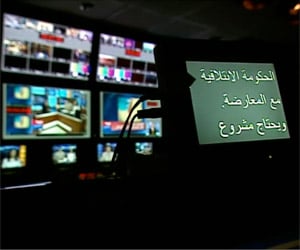
Inside Alhurra's Springfield, Va., studios (photo courtesy of 60 Minutes)
Alhurra’s reporters and commentators operate with little oversight. Alhurra’s president, Brian Conniff, does not speak Arabic and is unable to understand anything broadcast on the radio and television networks he is paid to manage. Conniff has no journalism experience and worked previously as a government auditor. His news director, Daniel Nassif, grew up in Lebanon and has no background in television. Before coming to the network, he helped promote the political aspirations in Washington of a Lebanese Christian former general.
Both men said in interviews that they are providing effective supervision of the network’s five 24-hour radio and television broadcasts and they praised their staff as professional and committed. A string of highly publicized “mistakes” are behind them, Conniff said.
That does not appear to be the case.
Last year, outraged members of Congress threatened to withhold funding for Alhurra, which means “The Free One,” after the network aired a report on a Holocaust deniers conference in Tehran. The reporter who covered the conference told viewers that Jews had provided no scientific evidence of the Holocaust.
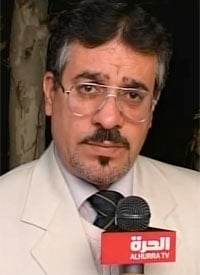
Ahmad Amin worked for the U.S.-funded Sawa radio station for more than a year after network executives told Congress he had been fired for uncritical reporting of a 2006 Holocaust deniers conference which aired on Alhurra.
But this week, in response to a joint investigation by ProPublica and CBS’ 60 Minutes, network executives acknowledged that Amin continued to work for Radio Sawa until June 12.
Two people with knowledge of the matter said that in the past week, all of Amin’s previous reports had been purged from Radio Sawa’s electronic storage system. Deirdre Kline, the spokeswoman for Sawa and Alhurra, did not respond to queries about whether his previous reports were available.
The ProPublica/60 Minutes examination of the Springfield, Va.-based Alhurra and Sawa found an untrained, largely foreign staff with little knowledge of the country whose values and policies they were hired to promote. There appeared to be little oversight of the daily operations.
During a visit to Alhurra’s studios in June, reporters, producers, cameramen and technical staff were busy preparing broadcasts for an audience half-way around the world. Conniff, who is the president of Alhurra and Radio Sawa, sat in on a morning editorial meeting but could not understand it – his Middle Eastern staff discussed the day’s stories in Arabic and no one offered Conniff a simultaneous translation.
“There is no adult supervision there by people who know what is on the actual broadcasts,” said William Rugh, who served as U.S. Ambassador in Yemen and the United Arab Emirates. “You need bilingual managers who understand both languages and cultures and understand journalism.”
Financial accountability also appears to be lacking. In its four years, the network has been unable to provide full documentation to auditors to account for its spending, according to two people familiar with the records and a 2006 report by the Government Accountability Office.
U.S. experts on the Arab world have long worried that the network was doing little to help America’s image in the region. Unpublished reports, audits and internal government e-mail show a steady stream of concern inside the State Department, in Congress, at the government’s broadcasting headquarters and even inside the network itself that Alhurra and Sawa are undermining U.S. policy goals while sometimes promoting the interests of Iran and its allies. ProPublica is making available, for the first time, some of these documents.
Alhurra and Sawa have remained impervious to reform, in part because the Arabic-language broadcasts are beamed only overseas. No one translates the full broadcasts into English, making it nearly impossible for non-Arabic speakers to effectively know what is going on the air. A small team inside the State Department set up to monitor foreign broadcasts stopped watching Alhurra long ago, one senior diplomat said, and never listened to Radio Sawa.
Despite its years of difficulties, Alhurra’s budget has steadily increased. It began with a $67 million budget in 2004 and has asked for $112 million in 2009. Half the government’s investment in public diplomacy -- an effort in promoting this country’s image overseas -- goes to foreign broadcasting. Alhurra and Sawa get the largest share of that money.
Cutting Through ‘The Barriers of Hateful Propaganda’
Alhurra was unveiled as a bold foreign policy innovation in 2004. In his State of the Union address, just three weeks before the network went on air, President Bush announced that the United States was launching a television station for the Middle East and expanded radio broadcasts in Arabic and Farsi.
Such an audacious strategy, Bush said, would “cut through the barriers of hateful propaganda,” that his administration had come to blame for the loss of global support for the United States. He was proposing what would become the largest and most expensive effort in America’s long history of public diplomacy.
Unlike Al Jazeera, Bush said, this new, U.S.-funded network “will begin providing reliable news and information across the region.”
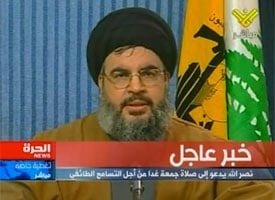
Hassan Nasrallah, leader of Hezbollah, whose speeches were carried live and unedited on Alhurra. The State Department lists Hezbollah as a terrorist organization.
When Hezbollah leader Hassan Nasrallah railed against the U.S. government and threatened Israel, Alhurra carried it live and unedited. When U.S. combat deaths in Iraq surpassed 4,000 in March, Radio Sawa interviewed an anonymous militant who told listeners: “Occupation is occupation. We need to resist them and kill more than 4,000.” In March, Alhurra aired a documentary on the “The Crusades” -- a series of military campaigns that Christian Europe waged against the Muslim world during the Middle Ages. Muslim staffers saw the program as an unfortunate reprise of Bush’s 2001 comment that the coming “war on terrorism,” would be a “crusade.”
In May, after Bush addressed Muslim leaders at a peace conference in Egypt, Alhurra offered its viewers analyses only by guests critical of U.S. policy. The expert invited to shed light on the Palestinian perspective described Israel as an “occupying and racist state,” that “perpetrates a holocaust against 1.5 million Palestinians in Gaza.”
Conniff said he was unfamiliar with the broadcast but that any suggestion that Alhurra was biased against Israel was wrong.
He also said Nassif and another employee keep him informed of programming decisions and that he feels his system works.
Yet, Arabic speakers in the State Department have sent repeated memos and e-mails to the Broadcasting Board of Governors, which oversees Alhurra and Sawa, and to Karen Hughes, who served as Undersecretary of State for Public Diplomacy and Public Affairs until last year.
Alberto Fernandez, an Arabic speaker who served as the top public diplomacy officer for the Middle East until recently, wrote Hughes in May 2007 that Alhurra’s Baghdad operation was stocked “with radical Shi’a Islamists who favored their political brethren and discriminated against and intimidated members of other parties … especially during the Iraqi electoral season.”
Earlier, State Department officials attributed the poor showing of Washington’s preferred candidate for Prime Minister in the 2005 vote, in part, to the negative coverage he received on Alhurra, in favor of Islamist candidates who enjoyed support from Iran.
A senior U.S. diplomat who worked closely with Hughes at the time said she focused on other aspects of public diplomacy such as exchange programs and did not want to wade deeply into “the mess Alhurra was in.”
One official said Hughes had instructed an Arabic speaker on the State Department’s media response team to monitor Alhurra for a week during the spring of 2007. The assignment resulted in a brief report that described Alhurra’s programming as “very pro-Lebanese, pro-Hezbollah,” another diplomat said.
The Changing Face of U.S. Overseas Broadcasts
U.S. radio broadcasts to the Middle East formally began in 1950 when the Voice of America -- the broadcasting arm created to counter Nazi propaganda -- beamed its radio programs in Arabic. They were aimed at countries the United States feared would fall under Soviet influence.
“VOA’s Arabic service would always have a little reading from the Koran when it opened its news hour,” said Nicholas J. Cull, a media and public diplomacy professor at the University of Southern California. “The point then was to showcase the United States as religiously tolerant as opposed to the Godless Communists.”
The Sept. 11 attacks changed VOA’s mission. The Arabic service was suddenly criticized for failing to reach a youthful audience. In the hope of appealing to young men who were being recruited by Islamic fundamentalists, the station was rebranded as Radio Sawa, which means “Together.” The station blended news bulletins with Arabic and English language pop songs.
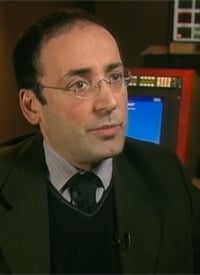
Mouafac Harb, Alhurra's first news director. Harb helped set up Radio Sawa before coming to Alhurra. He was largely responsible for hiring the network staff and getting it on air within four months. But he has been criticized in government reports for signing lucrative deals with friends in his native Lebanon. (Photo courtesy of 60 Minutes)
Bush Administration officials championed Sawa, but it was immediately criticized by U.S. diplomats stationed in the Middle East. Cables from U.S. diplomats in Cairo and Abu Dhabi, also reviewed by ProPublica, complained that the quality of the newscasts were poor, the newsreaders seemed unprofessional and lacked credibility.
In addition, a never-released report by the State Department’s Inspector General shared with ProPublica found “irregularities in contracting,” a hiring process that “may have been marred by favoritism toward Lebanese candidates or candidates of Lebanese ancestry,” and a “lack of strategic goals and objectives.”
Two years later, Harb was named the first news director for the Alhurra television network. He rented the abandoned studios of a former local television station in Virginia and spruced up the sets. He then filled the newsroom largely with inexperienced Christian Lebanese reporters hired in his native Beirut and signed lucrative sole-source contracts with friends who ran advertising agencies, production companies and warehouses across the Middle East. Some low-level staff members were highly paid, including a hairdresser from Lebanon who coiffed the anchors for $100,000 a year.
New hires were promised an American Green Card if they lasted two years with the network.
Harb did not respond to e-mail requests for comment.
Harb told Congress the network had achieved soaring viewership and popularity in the Middle East. He dismissed polls that showed Alhurra with no more than 2 percent of the Middle East audience share and blamed complaints about the content on his initial budget, which he believed was too small to allow Alhurra to compete with media giants such as Al Jazeera.
While Harb projected a confident air, unease was growing at the State Department, particularly over Alhurra’s coverage of Lebanese politics and news from Iraq.
According to a series of internal e-mails, State Department officials had been trying to rein in Harb for years. In his 2007 e-mail to Karen Hughes, Alberto Fernandez, the public diplomacy chief, wrote that Middle East experts inside the State Department and the U.S. embassy in Baghdad had complained “in 2004, 2005 and 2006.”
Alhurra’s leadership, the e-mail said, had “stocked much of its Washington and Lebanon staff with partisans of former Lebanese general Michel Aoun who is now closely allied to the terrorist group Hezbollah.” Fernandez noted the “excessive and fawning” coverage Aoun enjoyed from Alhurra, “even though Aoun has now become quite a poisonous critic of the US and an apologist for Hezbollah’s efforts to bring down Lebanon’s nascent democracy.”
Officials from Hamas, Islamic Jihad, the Popular Front for the Liberation of Palestine and even an al-Qaida financier appeared as talk-show guests on Alhurra while Harb was in charge. Alhurra’s policy is to pay guests; honorariums range from $150 to $1,500 for a single appearance, documents show.
Still, Alhurra was awarded key interviews with senior U.S. government officials. When Bush addressed the Arab world after the revelations of torture at Iraq’s Abu Ghraib prison, he appeared on Alhurra, interviewed by Harb.
In a 2005 oversight hearing, Harb acknowledged that he had cut procedural corners on hiring and contracting but said he had to call on friends to launch the station in four months.
Following Congressional and government inquiries into the financial and management issues at Alhurra that multiplied in the spring of 2006, Harb resigned and returned to Beirut with his wife, a telegenic TV host who had anchored her own cultural affairs program for the network.
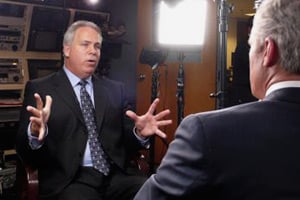
Larry Register, a former CNN executive with 20 years of news experience, replaced Mouafac Harb in 2006, but resigned seven months later after missteps that included authorizing the airing of three reports on a Holocaust deniers conference. (Photo courtesy of 60 Minutes)
“It infuriated me as a U.S. citizen to walk in there and see the money just flowing out the door. A true waste of taxpayer money,” said Register, who had previously served as CNN bureau chief in Jerusalem.
Register said the newsroom had broken-up into “militias” along ethnic, religious and national lines.
“It felt like somebody had picked up the Middle East and brought it to Springfield, Virginia, of all places.” Register said he tried to establish editorial oversight, produce a credible newscast and, above all, win viewers.
But it didn’t take long for Register to get into trouble.
Part of Alhurra’s problem, he said, was that viewers saw it as an American propaganda station, unwilling to cover big stories in the region. When Israel assassinated the spiritual leader of the Palestinian group Hamas, Alhurra ran a cooking show. Register told the staff he wouldn’t shy away from the truth.
In his first weeks, Register approved the live, unedited broadcast of a speech by Hezbollah leader Hassan Nasrallah. Nasrallah is one of the most influential figures in the Arab world today but he is a terrorist to the United States government. Alhurra officials said the speech violated the network’s code of ethics which states that Alhurra will not be a platform for “terrorists.”
The following week, Alhurra aired Ahmad Amin’s report on the Holocaust deniers conference.
Three months later, as Register continued to ferret out financial arrangements and side-deals at the station, the Wall Street Journal’s opinion page reported on the two broadcasts.
Congress expressed outrage, particularly over the Holocaust report from Tehran. Several called for Register's resignation and after seven months on the job, he quit.
At a May 2007 Congressional hearing, members of the Broadcasting Board of Governors and Alhurra executives assured lawmakers that Amin had been fired and that editorial safety nets were now in place.
Joaquin Blaya, a member of the government board, was asked directly whether Amin had been dismissed.
His response to Congressman Mike Pence (R-Ind.): “that is correct,” according to transcripts of the hearings. Congressional officials said neither Alhurra nor the BBG has since informed the appropriate oversight committees that Amin continued to work for Radio Sawa.
Blaya did not respond to requests for comment. Kline, spokeswoman for the network, said that Blaya and Brian Conniff were “talking specifically” in their testimony about whether Amin was employed by Alhurra, the television network. She said he stopped working for Alhurra in 2007.
“There was no mention of Sawa during the hearings,” Kline said in e-mail, “and it would be incorrect to imply otherwise.”
Kline offered conflicting explanations of Amin’s status in a series of e-mails over several days to ProPublica.
She initially said that Conniff only recently learned of Amin’s continued employment and was stunned that Register had failed to carry out orders to end Amin’s relationship with the radio station. Register, however, did not oversee Sawa during his brief time at the network. The radio station was run by Nassif, now the current news director. When pressed, Kline later said Nassif had known the reporter was still on the Radio Sawa payroll but had never been told to fire him.
An internal e-mail shows that Amin was let go on June 12, the day after he covered a state visit to Tehran by Iraqi Prime Minister Nuri al-Maliki and just as ProPublica and 60 Minutes were raising questions about him. Kline declined to say when Amin was fired or what had precipitated it.
Alhurra: A Ratings Flop
Alhurra has not come close to realizing the Bush Administration’s hope that it would someday compete with Al Jazeera, the most-watched station in the Middle East. According to six years of polling by Zogby and the University of Maryland, Al Jazeera remains the favored channel for news for more than 50 percent of Middle East viewers.

Photo courtesy of 60 Minutes
Al Arabiya, another competitor launched a year before Alhurra, has a 9 percent slice of the audience. That station, which is funded by the Saudi government, has a budget considered to be comparable to Alhurra’s, and its coverage is generally welcomed by the Bush administration.
Alhurra has a separate broadcast for Iraq where its share of audience is larger. Still, Alhurra is the number four network in Iraq, behind Al Jazeera and two others. After four years on air, Telhami said, Alhurra’s impact on public opinion has been “less than zero.”
“For most people in the region,” he said “it’s not really on the radar screen.”
James Glassman, who replaced Hughes at the State Department, disagrees. He said government polling shows that even if Alhurra ranks low by percent, millions of people are still watching. He said that as many as 26 million -- roughly 8.5 percent of the Arabic speaking population of the Middle East -- tune into Alhurra for some period of time each week.
“Our idea with Alhurra was to create a network that provided high quality, professional journalism with American standards,” Glassman said. The aim, he said, was “balance, objectivity, which really did not exist in the Middle East.”
But William Rugh, the former ambassador who speaks Arabic and has written extensively on Arab media, said Al Jazeera’s coverage of the United States is more in-depth than Alhurra’s and he says the top-rated station covers issues and sparks debate in ways that Alhurra does not.
“Al Jazeera has a whole series of talk shows in which very sensitive, controversial issues are raised by the participants and they have women’s shows as well. They deal with short comings of various Arab governments way beyond what Alhurra does and it is shocking that in some ways, Al Jazeera has done better than Alhurra in covering the United States.”
A study due out next month by a University of Southern California team questions whether the network has achieved either objectivity or professionalism. The review was commissioned by the Broadcasting Board of Governors, which oversees Alhurra.
Researchers involved in the project, who spoke on the condition of anonymity, said the BBG set tight parameters for the study, telling investigators to focus only on content aired on Alhurra’s pan-Arab station and not to compare it with broadcasts by competitors. Researchers were not allowed to interview Alhurra staff or to select the period of coverage to examine.
After reviewing broadcasts from the month of November, the USC team concluded that reporters and anchormen on Alhurra cited claims about Washington’s “war on terror” that were unsubstantiated, or not backed up by evidence, 30 percent of the time. The study found that personal opinion was often expressed on-air. Objectivity was rated low.
The researchers studied the network’s coverage of the three-day Mideast summit in Annapolis, Md. and found that it strongly favored U.S. and Israeli government positions. Throughout November, they concluded, the network also strongly supported the Iraqi government and was especially favorable to pro-Iranian political figures inside Iraq.
At round-table discussions held in Egypt and Lebanon, audiences gave Alhurra low marks. In Cairo, participants laughed after watching clips, researchers said. The viewers pointed out that Alhurra programs included poor translations. They said it was difficult to understand the Lebanese accents of some hosts and reporters and they noted embarrassing misspellings, including the word “Syria.”
Conniff said he and his staff have worked hard to improve the station’s quality. Alhurra has made election coverage a specialty area and offers programming on women’s issues, American culture and blue jeans.
A recent report by the State Department’s Inspector General noted that Alhurra now has a functioning assignment desk, holds regular editorial meetings and has hosted mini-training sessions with journalism professors.
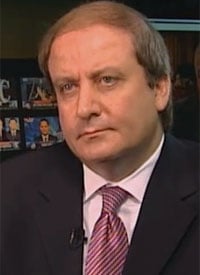
Daniel Nassif, who has no previous television experience, replaced Larry Register as Alhurra's news director in June 2007. In addition to Alhurra's three 24-hour broadcasts, he also oversees Sawa's two radio services. (Photo courtesy of 60 Minutes)
Glassman, the Undersecretary of State who was chairman of the BBG for the last six months, said U.S. taxpayers are right to be concerned about Alhurra. “We’ve made mistakes and we will and have rectified them.”
However, he said Alhurra was delivering high-quality programming to a “part of the world that’s absolutely critical to American interests, that is not hearing and seeing this kind of broadcasting right now. And it makes the world safer, I believe, that we’re doing what we’re doing.”
Glassman, who was initially skeptical of Alhurra, added another thought.
“It wouldn’t be bad if we got put out of business. That is to say, if the Arab world’s own media became so good as, let’s say, the media in Poland did after the fall of the Iron Curtain. Now, is that going to happen in five years? I kind of doubt it. But it’s certainly possible.”
Robert Lewis contributed research to this story.
Tuesday, June 17, 2008
Wacko conspiracy theory no more -- Pakistani paper publishes account of 25 former military officers regarding 911
Twenty-five former U.S. military officers have severely criticized the official account of 9/11 and called for a new investigation. They include former commander of U.S. Army Intelligence, Major General Albert Stubblebine, former Deputy Assistant Secretary of Defense, Col. Ronald D. Ray, two former staff members of the Director of the National Security Agency; Lt. Col. Karen Kwiatkowski, PhD, and Major John M. Newman, PhD, and many others. They are among the rapidly growing number of military and intelligence service veterans, scientists, engineers, and architects challenging the government’s story. The officers’ statements appear below, listed alphabetically.
Lt. Col. Robert Bowman, PhD “A lot of these pieces of information, taken together, prove that the official story, the official conspiracy theory of 9/11 is a bunch of hogwash. It’s impossible,” said Lt. Col. Robert Bowman, PhD, U.S. Air Force (ret). With doctoral degrees in Aeronautics and Nuclear Engineering, Col. Bowman served as Director of Advanced Space Programs Development under Presidents Gerald Ford and Jimmy Carter.
“There’s a second group of facts having to do with the cover up,” continued Col. Bowman. “Taken together these things prove that high levels of our government don’t want us to know what happened and who’s responsible. Who gained from 9/11? Who covered up crucial information about 9/11? And who put out the patently false stories about 9/11 in the first place? When you take those three things together, I think the case is pretty clear that it’s highly placed individuals in the administration with all roads passing through Dick Cheney.”
Regarding the failure of NORAD to intercept the four hijacked planes on 9/11, Col. Bowman said, “I'm an old interceptor pilot. I know the drill. I've done it. I know how long it takes. I know the rules. … Critics of the government story on 9/11 have said: ‘Well, they knew about this, and they did nothing’. That's not true. If our government had done nothing that day and let normal procedure be followed, those planes, wherever they were, would have been intercepted, the Twin Towers would still be standing and thousands of dead Americans would still be alive.”
During his 22-year Air Force career, Col. Bowman also served as the Head of the Department of Aeronautical Engineering and Assistant Dean at the U.S. Air Force Institute of Technology. He also flew over 100 combat missions in Viet Nam as a fighter pilot.
Lt. Jeff Dahlstrom Former U.S. Air Force pilot Lt. Jeff Dahlstrom wrote in a 2007 statement to this author, “When 9/11 occurred I bought the entire government and mainstream media story line. I was a lifelong conservative Republican that voted for Bush/Cheney, twice. Curiosity about JFK’s death, after a late night TV re-run of Oliver Stone’s movie, got me started researching and digging for the truth about his assassins.
“My research led me to a much more important and timely question: the mystery of what really did happen on 9/11. Everything that seemed real, turned out to be false. The US government and the news media, once again, were lying to the world about the real terrorists and the public murder of 2,972 innocents on 9/11.
“The ‘Patriot Act’ was actually written prior to 9/11 with the intention of destroying the US Constitution and Bill of Rights. It was passed by Congress, based upon the government's myth of 9/11, which was in reality a staged hoax. 9/11 was scripted and executed by rogue elements of the military, FAA, intelligence, and private contractors working for the US government.
“In addition to severely curtailing fundamental rights of Americans, the 9/11 crime was then used by this administration, the one I originally voted for and supported, to justify waging two preemptive wars (and most likely a third war), killing over 4,500 American soldiers, and killing over one million innocent Afghan and Iraqi people.
“It was all premeditated. Treason, a false flag military operation, and betrayal of the trust of the American people were committed on 9/11 by the highest levels of the US government and not one person responsible for the crimes, or the cover-up, has been held accountable for the last six years.
“After reading fifteen well-researched books, studying eight or nine DVD documentaries, and devoting months of personal research and investigation, I have arrived at one ultimate conclusion: The American government and the US Constitution have been hijacked and subverted by a group of criminals that today are the real terrorists. They are in control of the US government and they have all violated their oaths of office and committed treason against their own citizens.”
Capt. Daniel Davis Capt. Daniel Davis is a former U.S. Army Air Defense Officer and NORAD Tac Director. After his military service, Capt. Davis served for 15 years as a Senior Manager at General Electric Turbine (jet) Engine Division and then devoted an additional 15 years as founder and CEO of Turbine Technology Services Corp., a turbine (jet engine) services and maintenance company.
In a statement to this author, Capt. Davis wrote, “As a former General Electric Turbine engineering specialist and manager and then CEO of a turbine engineering company, I can guarantee that none of the high tech, high temperature alloy engines on any of the four planes that crashed on 9/11 would be completely destroyed, burned, shattered or melted in any crash or fire. Wrecked, yes, but not destroyed. Where are all of those engines, particularly at the Pentagon? If jet powered aircraft crashed on 9/11, those engines, plus wings and tail assembly, would be there.”
Decorated with the Bronze Star and the Soldiers Medal for bravery under fire and the Purple Heart for injuries sustained in Viet Nam, Capt. Davis also served in the Army Air Defense Command as Nike Missile Battery Control Officer for the Chicago-Milwaukee Defense Area.
Capt. Davis continued, “Additionally, in my experience as an officer in NORAD as a Tactical Director for the Chicago-Milwaukee Air Defense and as a current private pilot, there is no way that an aircraft on instrument flight plans (all commercial flights are IFR) would not be intercepted when they deviate from their flight plan, turn off their transponders, or stop communication with Air Traffic Control. No way! With very bad luck, perhaps one could slip by, but no there's no way all four of them could!
“Finally, going over the hill and highway and crashing into the Pentagon right at the wall/ground interface is difficult for even a small slow single engine airplane and no way for a 757. Maybe the best pilot in the world could accomplish that but not these unskilled ‘terrorists’. Attempts to obscure facts by calling them a ‘Conspiracy Theory’ does not change the truth. It seems, ‘Something is rotten in the State’.”
Major Jon I. Fox is a former U.S. Marine Corps fighter pilot and a retired commercial airline pilot for Continental Airlines with a 35-year commercial aviation career. In 2007, in support of the Architects and Engineers[3] petition to reinvestigate 9/11, he wrote, “On hearing the military (NORAD/NEAD) excuses for no intercepts on 9/11/2001, I knew from personal experience that they were lying. I then began re-checking other evidence and found mostly more lies from the ‘official spokesmen’. Jet fuel fires at atmospheric pressure do not get hot enough to weaken steel. Structures do not collapse through themselves in free fall time with only gravity as the powering force.”
Commander Ralph Kolstad Retired U.S. Navy ‘Top Gun’ pilot Commander Ralph Kolstad started questioning the official account of 9/11 within days of the event. In a statement to this author, he wrote, “It just didn’t make any sense to me,” he said. And now six years after 9/11 he says, “When one starts using his own mind, and not what one was told, there is very little to believe in the official story.”
Commander Kolstad was a top-rated fighter pilot during his 20-year Navy career. Early in his career, he was accorded the honor of being selected to participate in the Navy’s ‘Top Gun’ air combat school, officially known as the U.S. Navy Fighter Weapons School. The Tom Cruise movie “Top Gun” reflects the experience of the young Navy pilots at the school. Eleven years later, Commander Kolstad was further honored by being selected to become a ‘Top Gun’ adversary instructor.
Commander Kolstad had a second career after his 20 years of Navy active and reserve service and served as a commercial airline pilot for 27 years, flying for American Airlines and other domestic and international careers. He flew Boeing 727, 757 and 767, McDonnell Douglas MD-80, and Fokker F-100 airliners. He has flown a total of over 23,000 hours in his career.
Commander Kolstad is especially critical of the account of American Airlines Flight 77 that allegedly crashed into the Pentagon. He says, “At the Pentagon, the pilot of the Boeing 757 did quite a feat of flying. I have 6,000 hours of flight time in Boeing 757’s and 767’s and I could not have flown it the way the flight path was described.”
Commander Kolstad adds, “I was also a Navy fighter pilot and Air Combat Instructor and have experience flying low altitude, high speed aircraft. I could not have done what these beginners did. Something stinks to high heaven!”
He points to the physical evidence at the Pentagon impact site and asks in exasperation, “Where is the damage to the wall of the Pentagon from the wings? Where are the big pieces that always break away in an accident? Where is all the luggage? Where are the miles and miles of wire, cable, and lines that are part and parcel of any large aircraft? Where are the steel engine parts? Where is the steel landing gear? Where is the tail section that would have broken into large pieces?”
But no major element of the official account of 9/11 is spared from Commander Kolstad’s criticism. Regarding the alleged impact site of United Airlines Flight 93 near Shanksville, PA, he asks, “Where is any of the wreckage? Of all the pictures I have seen, there is only a hole! Where is any piece of a crashed airplane? Why was the area cordoned off, and no inspection allowed by the normal accident personnel? Where is any evidence at all?”
Commander Kolstad also questions many aspects of the attack on the World Trade Center. “How could a steel and concrete building collapse after being hit by a Boeing 767? Didn’t the engineers design it to withstand a direct hit from a Boeing 707, approximately the same size and weight of the 767? The evidence just doesn’t add up.”
“Why did the second building collapse before the first one, which had been burning for 20 minutes longer after a direct hit, especially when the second one hit was just a glancing blow? If the fire was so hot, then why were people looking out the windows and in the destroyed areas? Why have so many members of the New York Fire Department reported seeing or hearing many ‘explosions’ before the buildings collapsed?”
Commander Kolstad summarized his frustration with the investigation and disbelief of the official account of 9/11, “If one were to act as an accident investigator, one would look at the evidence, and then construct a plausible scenario as to what led to the accident. In this case, we were told the story and then the evidence was built to support the story. What happened to any intelligent investigation? Every question leads to another question that has not been answered by anyone in authority. This is just the beginning as to why I don’t believe the official ‘story’ and why I want the truth to be told.”
Lt. Col. Karen Kwiatkowski A Pentagon eye-witness and a former member of the staff of the Director of the National Security Agency, Lt. Col. Karen Kwiatkowski, PhD, U.S. Air Force (ret), is a severe critic of the official account of 9/11. A contributing author to the 2006 book 9/11 and American Empire: Intellectuals Speak Out, she wrote, “I believe the [9/11] Commission failed to deeply examine the topic at hand, failed to apply scientific rigor to its assessment of events leading up to and including 9/11, failed to produce a believable and unbiased summary of what happened, failed to fully examine why it happened, and even failed to include a set of unanswered questions for future research.”
She continued, “It is as a scientist that I have the most trouble with the official government conspiracy theory, mainly because it does not satisfy the rules of probability or physics. The collapses of the World Trade Center buildings clearly violate the laws of probability and physics.”
Col. Kwiatkowski was working in the Pentagon on 9/11 in her capacity as Political-Military Affairs Officer in the Office of the Secretary of Defense when Flight 77 allegedly hit the Pentagon. She wrote, “There was a dearth of visible debris on the relatively unmarked lawn, where I stood only minutes after the impact. Beyond this strange absence of airliner debris, there was no sign of the kind of damage to the Pentagon structure one would expect from the impact of a large airliner. This visible evidence or lack thereof may also have been apparent to the Secretary of Defense [Donald Rumsfeld], who in an unfortunate slip of the tongue referred to the aircraft that slammed into the Pentagon as a ‘missile.’ [Secretary Rumsfeld also publicly referred to Flight 93 as the plane that was "shot down" over Pennsylvania.]
“I saw nothing of significance at the point of impact - no airplane metal or cargo debris was blowing on the lawn in front of the damaged building as smoke billowed from within the Pentagon. ... [A]ll of us staring at the Pentagon that morning were indeed looking for such debris, but what we expected to see was not evident.
“The same is true with regard to the kind of damage we expected. ... But I did not see this kind of damage. Rather, the facade had a rather small hole, no larger than 20 feet in diameter. Although this facade later collapsed, it remained standing for 30 or 40 minutes, with the roof line remaining relatively straight.
“The scene, in short, was not what I would have expected from a strike by a large jetliner. It was, however, exactly what one would expect if a missile had struck the Pentagon. ... More information is certainly needed regarding the events of 9/11 and the events leading up to that terrible day.”
The improbability of the collapse of World Trade Center Building 7 is a major concern of these officers and a growing number of scientists, engineers and architects. The building was 610 feet tall, 47 stories, and would have been the tallest building in 33 states. Although it was not hit by an airplane, it completely collapsed into a pile of rubble in less than 7 seconds at 5:20 p.m. on 9/11. In the 6 years since 9/11, the Federal government has failed to provide any explanation for the collapse. In addition to the failure to provide an explanation, absolutely no mention of Building 7’s collapse appears in the 9/11 Commission's “full and complete account of the circumstances surrounding the September 11, 2001 terrorist attacks.”
Lt. Col. Shelton Lankford Lt. Col. Shelton Lankford, U.S. Marine Corps (ret), an attack pilot with over 300 combat missions, wrote in 2007 to the Michigan Daily, “Our government has been hijacked by means of a ‘new Pearl Harbor’ and a lot of otherwise good and decent people who are gullible enough to think that the first three steel-framed buildings in history fall down because they have some fires that the fire fighter on the scene said could be knocked down with a couple of hoses and through which people walked before they were photographed looking out the holes where the plane hit. One of these, Building 7, was never hit by a plane and even NIST is ashamed to advance a reason for its collapse. And, miracle of miracles, these three buildings just happened to be leased and insured by the same guy who is on tape saying they decided to ‘PULL’ the last one to fall.”
During his 20 year military career, Col. Lankford's decorations include the Distinguished Flying Cross, and 32 awards of the Air Medal.
In a statement to this author, Col. Lankford wrote, “September 11, 2001 seems destined to be the watershed event of our lives and the greatest test for our democracy in our lifetimes. The evidence of government complicity in the lead-up to the events, the failure to respond during the event, and the astounding lack of any meaningful investigation afterwards, as well as the ignoring of evidence turned up by others that renders the official explanation impossible, may signal the end of the American experiment. It has been used to justify all manners of measures to legalize repression at home and as a pretext for behaving as an aggressive empire abroad. Until we demand an independent, honest, and thorough investigation and accountability for those whose action and inaction led to those events and the cover-up, our republic and our Constitution remain in the gravest danger.”
Lt. Col. Jeff Latas Another harsh critic of the official account of 9/11 is Lt. Col. Jeff Latas, U.S. Air Force (ret). A former combat fighter pilot, Col. Latas is currently a commercial airline pilot.
Col. Latas is a member of Pilots for 9/11 Truth. In 2007 he was interviewed by the group’s founder, commercial airline pilot, Rob Balsamo, regarding the group’s documentary video, Pandora's Black Box, Chapter 2, Flight of American 77, which focuses on the 9/11 Commission's account of the impact of Flight 77 at the Pentagon and discrepancies with the data from the Flight Data Recorder alleged by the NTSB to be from Flight 77.
In the interview, Col. Latas said, “After I did my own analysis of it, it's obvious that there's discrepancies between the two stories; between the 9/11 Commission and the flight data recorder information. And I think that's where we really need to focus a lot of our attention to get the help that we need in order to put pressure on government agencies to actually do a real investigation of 9/11. And not just from a security standpoint, but from even an aviation standpoint, like any accident investigation would actually help the aviators out by finding reasons for things happening.”
A highly decorated fighter pilot, Col. Latas was awarded the Distinguish Flying Cross for Heroism, four Air Medals, four Meritorious Service Medals, and nine Aerial Achievement Medals. His combat experience includes Desert Storm and four tours of duty in Northern and Southern Watch. During his 20-year Air Force career, he also served as Pentagon Weapons Requirement Officer, as a member of the Pentagon's Quadrennial Defense Review, and as President, U.S. Air Force Accident Investigation Board.
Col. Latas concluded, “And I think that we Americans need to demand further investigation just to clarify the discrepancies that you've [Pilots for 9/11 Truth] found. And I think that we need to be getting on the phone with our Congressmen and women and letting them know that we don't accept the excuses that we're hearing now, that we want true investigators to do a true investigation.”
Capt. Eric H. May, U.S. Army (ret), is a former Army Intelligence Officer who also served as an inspector and interpreter for the Intermediate Nuclear Forces Treaty team. He is one of many signers of a petition requesting a reinvestigation of 9/11. In 2005, he wrote: “As a former Army officer, my tendency immediately after 911 was to rally 'round the colors and defend the country against what I then thought was an insidious, malicious all-Arab entity called Al-Qaida. In fact, in April of 2002, I attempted to reactivate my then-retired commission to return to serve my country in its time of peril. ...
Now I view the 911 event as Professor David Griffin, author of The New Pearl Harbor, views it: as a matter that implies either
A) passive participation by the Bush White House through a deliberate stand-down of proper defense procedures that (if followed) would have led US air assets to a quick identification and confrontation of the passenger aircraft that impacted WTC 1 and WTC 2, or worse ...
B) active execution of a plot by rogue elements of government, starting with the White House itself, in creating a spectacle of destruction that would lead the United States into an invasion of the Middle East ...”
Commander Ted Muga, U.S. Navy (ret), is a Navy aviator, who, after retirement, had a second career as a commercial airline pilot for Pan-Am.
In a 2007 interview on the Alex Jones Show, Commander Muga stated, “The maneuver at the Pentagon was just a tight spiral coming down out of 7,000 feet. And a commercial aircraft, while they can in fact structurally somewhat handle that maneuver, they are very, very, very difficult. And it would take considerable training. In other words, commercial aircraft are designed for a particular purpose and that is for comfort and for passengers and it's not for military maneuvers. And while they are structurally capable of doing them, it takes some very, very talented pilots to do that. ... I just can't imagine an amateur even being able to come close to performing a maneuver of that nature.
“And as far as hijacking the airplanes, once again getting back to the nature of pilots and airplanes, there is no way that a pilot would give up an airplane to hijackers. ... I mean, hell, a guy doesn't give up a TV remote control much less a complicated 757. And so to think that pilots would allow a plane to be taken over by a couple of 5 foot 7, 150 pound guys with a one-inch blade boxcutter is ridiculous.
“And also in all four planes, if you remember, none of the planes ever switched on their transponder to the hijack code. There's a very, very simple code that you put in if you suspect that your plane is being hijacked. It takes literally just a split-second for you to put your hand down on the center console and flip it over. And not one of the four planes ever transponded a hijack code, which is most, most unusual. ...
“Commercial airplanes are very, very complex pieces of machines. And they're designed for two pilots up there, not just two amateur pilots, but two qualified commercial pilots up there. And to think that you're going to get an amateur up into the cockpit and fly, much less navigate, it to a designated target, the probability is so low, that it's bordering on impossible.”
Col. George Nelson
“In all my years of direct and indirect participation, I never witnessed nor even heard of an aircraft loss, where the wreckage was accessible, that prevented investigators from finding enough hard evidence to positively identify the make, model, and specific registration number of the aircraft -- and in most cases the precise cause of the accident,” wrote Col. George Nelson, MBA, U.S. Air Force (ret), a former U.S. Air Force aircraft accident investigator and airplane parts authority.
“The government alleges that four wide-body airliners crashed on the morning of September 11 2001, resulting in the deaths of more than 3,000 human beings, yet not one piece of hard aircraft evidence has been produced in an attempt to positively identify any of the four aircraft. On the contrary, it seems only that all potential evidence was deliberately kept hidden from public view,” continued Col. Nelson, a graduate of the U.S. Air Force War College and a 34-year Air Force veteran.
“With all the evidence readily available at the Pentagon crash site, any unbiased rational investigator could only conclude that a Boeing 757 did not fly into the Pentagon as alleged. Similarly, with all the evidence available at the Pennsylvania crash site, it was most doubtful that a passenger airliner caused the obvious hole in the ground and certainly not the Boeing 757 as alleged. …
“As painful and heartbreaking as was the loss of innocent lives and the lingering health problems of thousands more, a most troublesome and nightmarish probability remains that so many Americans appear to be involved in the most heinous conspiracy in our country's history.”
Col. Ronald D. Ray Maj. John M. Newman, PhD, U.S. Army (ret), is the former Executive Assistant to the Director of the National Security Agency. In testimony before a 2005 Congressional briefing, he said, “It falls to me this morning to bring to your attention the story of Saeed Sheikh, whose full name is Ahmed Omar Saeed Sheikh, and his astonishing rise to power in Al Qaeda, his crucial role in 9/11, which is completely, utterly, missing from the 9/11 Commission report…
“The 9/11 Commission which studied US intelligence and law enforcement community performance in great detail, (maybe not so much great detail, but they did), neglected to cover the community’s performance during the weeks following the attacks to determine who was responsible for them, not a word about that in the Report.
“The Report does discuss the immediate US responses but the immediate investigation is never addressed, and anyone who has closely studied the post-9/11 investigation knows that the first breakthrough came two weeks into the investigation when the money transfers from the United Arab Emirates to the hijackers were uncovered.
“Furthermore, if you have studied that investigation, you know there is no disputing that while investigators may have struggled with the identity of the paymaster, they were clear about one thing, he was Al Qaeda’s finance chief. For this reason alone you have to ask why the 9/11 Commission Report never mentions the finance chief’s role as the 9/11 paymaster.”
Capt. Omar Pradhan, U.S. Air Force, is a former AWACS command pilot and Flight Instructor at the U.S. Air Force Academy. In a 2007 statement to this author, Capt. Pradhan wrote, “As a proud American, as a distinguished USAF E-3 AWACS Aircraft Commander (with 350+ hours of combat time logged over Afghanistan and Iraq), and as a former U.S. Air Force Academy Flight Instructor, I warmly endorse the professional inquiry and pursuit of comprehensive truth sought by the Pilots for 911 Truth organization and the PatriotsQuestion911 website.”
Another senior officer questioning the official account of 9/11 is Col. Ronald D. Ray, U.S. Marine Corps (ret), Deputy Assistant Secretary of Defense under President Ronald Reagan. A highly decorated Vietnam veteran (two Silver Stars, a Bronze Star and a Purple Heart), he was appointed by President George H. W. Bush to serve on the American Battle Monuments Commission (1990 – 1994), and the 1992 Presidential Commission on the Assignment of Women in the Armed Forces. He was Military Historian and Deputy Director of Field Operations for the U.S. Marine Corps Historical Center, Washington, D.C. (1990 – 1994).
In an interview on Alex Jones’ radio show on June 30, 2006, Col. Ray described the official account of 9/11 as “the dog that doesn’t hunt”, meaning it doesn’t stand up to scrutiny. In response to Alex Jones’ question, “Is it safe to say or is the statement accurate that you smell something rotten in the state of Denmark when it comes to 9/11?” Col. Ray replied,“I'm astounded that the conspiracy theory advanced by the administration could in fact be true and the evidence does not seem to suggest that that's accurate. That's true.”
“After 4+ years of research since retirement in 2002, I am 100% convinced that the attacks of September 11, 2001 were planned, organized, and committed by treasonous perpetrators that have infiltrated the highest levels of our government. It is now time to take our country back,” wrote Lt. Col. Guy S. Razer, MS, U.S. Air Force (ret), in a statement to this author.
A retired fighter pilot, Col. Razer served as an instructor at the U.S. Air Force Fighter Weapons School and NATO’s Tactical Leadership Program and flew combat missions over Iraq. He continued, “The ‘collapse’ of WTC Building 7 shows beyond any doubt that the demolitions were pre-planned. There is simply no way to demolish a 47-story building (on fire) over a coffee break. It is also impossible to report the building’s collapse before it happened, as BBC News did, unless it was pre-planned. Further damning evidence is Larry Silverstein's video taped confession in which he states ‘they made that decision to pull [WTC 7] and we watched the building collapse.’
“We cannot let the pursuit of justice fail. Those of us in the military took an oath to ‘support and defend the Constitution of the United States against all enemies, foreign and domestic’. Just because we have retired does not make that oath invalid, so it is not just our responsibility, it is our duty to expose the real perpetrators of 9/11 and bring them to justice, no matter how hard it is, how long it takes, or how much we have to suffer to do it,” he concluded.
Maj. Scott Ritter
Maj. Douglas Rokke, PhD
Lt. Col. Anthony Shaffer
Maj. Scott Ritter, U.S. Marine Corps, is a former Marine Corps Intelligence Officer who also served as Chief Weapons Inspector for the United Nations Special Commission in Iraq 1991 - 1998. In 2005, he said: “I, like the others, are frustrated by the 9/11 Commission Report, by the lack of transparency on the part of the United States government, both in terms of the executive branch and the legislative branch when it comes to putting out on the table all facts known to the 9/11 case.”
Maj. Douglas Rokke, PhD, U.S. Army (ret), former Director of the U.S. Army Depleted Uranium Project and 30-year veteran, had this to say about the explosion at the Pentagon on 9/11, “When you look at the whole thing, especially the crash site void of airplane parts, the size of the hole left in the building and the fact the projectile's impact penetrated numerous concrete walls, it looks like the work of a missile. And when you look at the damage, it was obviously a missile.”
The 9/11 Commission Report asserts that only three of the alleged hijackers were known to U.S. intelligence agencies prior to 9/11: Nawaf al-Hazmi, Salem al-Hazmi, and Khalid al-Mihdar. There is no mention in the Report that the names and photographs of alleged hijacker Marwan al-Shehhi and alleged ring-leader Mohamed Atta had been identified by the Department of Defense anti-terrorist program known as Able Danger more than a year prior to 9/11 and that they were known to be affiliates of al-Qaida. Able Danger also identified Nawaf al-Hazmi and Khalid al-Mihdar.
In testimony before the House Armed Services Committee in 2006, Lt. Col. Anthony Shaffer, U.S. Army Reserve, former Chief of the Army’s Controlled HUMINT (Human Intelligence) Program, overseeing Army Intelligence and Security Command’s global controlled HUMINT efforts, stated: “[B]asic law enforcement investigative techniques, with 21st Century data mining and analytical tools ... resulted in the establishment of a new form of intelligence collection – and the identification of Mohammed Atta and several other of the 9-11 terrorists as having links to Al Qaeda leadership a full year in advance of the attacks. ...
“After contact by two separate members of the ABLE DANGER team, … the 9-11 [Commission] staff refused to perform any in-depth review or investigation of the issues that were identified to them. … It was their job to do a thorough investigation of these claims – to not simply dismiss them based on what many now believe was a ‘preconceived’ conclusion to the 9-11 story they wished to tell. … I consider this a failure of the 9-11 staff – a failure that the 9-11 Commissioners themselves were victimized by – and continue to have perpetrated on them by the staff as is evidenced by their recent, groundless conclusion that ABLE DANGER’s findings were ‘urban legend’.”
A 23-year military intelligence veteran, Col. Shaffer was recently awarded the Bronze Star for bravery in Afghanistan. In a 2005 interview on Fox News, Col Shaffer asked, “Why did this operation, which was created in '99 to target Al Qaeda globally, offensively, why was that turned off in the Spring of 2001, four months before we were attacked? I can't answer that, either. I can tell you I was ordered out of the operation directly by a two-star general.”
Supporting Col. Shaffer’s statement, Capt. Scott J. Phillpott, U.S. Navy, currently Commanding Officer of the guided-missile cruiser USS Leyte Gulf and former head of the Able Danger data mining program, stated in 2005: “I will not discuss this outside of my chain of command. I have briefed the Department of the Army, the Special Operations Command and the office of (Undersecretary of Defense for Intelligence) Dr. Cambone as well as the 9/11 Commission. My story has remained consistent. Atta was identified by Able Danger in January/February 2000.” Capt. Phillpott is a U.S. Naval Academy graduate, who during his 23 years of Navy service has been awarded the Legion of Merit, Defense Meritorious Service Medal, three Meritorious Service Medals, the Joint Service Commendation Medal, two Navy Commendation Medals, and the Navy Achievement Medal.
Joel Skousen
Gen. Albert Stubblebine Former U.S. Marine Corps fighter pilot Joel M. Skousen also questions the official account of 9/11. After his military service, Mr. Skousen served as Chairman of the Conservative National Committee in Washington DC and Executive Editor of Conservative Digest.
“In the March 2005 issue, PM [Popular Mechanics] magazine singled out 16 issues or claims of the 9/11 skeptics that point to government collusion and systematically attempted to debunk each one. Of the 16, most missed the mark and almost half were straw men arguments - either ridiculous arguments that few conspiracists believed or restatements of the arguments that were highly distorted so as to make them look weaker than they really were. ...
“I am one of those who claim there are factual arguments pointing to conspiracy, and that truth is not served by taking cheap shots at those who see gaping flaws in the government story ... There is significant evidence that the aircraft impacts did not cause the collapse [of the Twin Towers] ...
The issues of the penetration hole [at the Pentagon] and the lack of large pieces of debris simply do not jive with the official story, but they are explainable if you include the parking lot video evidence that shows a huge white explosion at impact. This cannot happen with an aircraft laden only with fuel. It can only happen in the presence of high explosives.”
Major General Albert Stubblebine, U.S. Army (ret), former Commanding General of U.S. Army Intelligence and Security Command (INSCOM), is a strong critic of the official account of 9/11. In a 2006 video documentary he said, “One of my experiences in the Army was being in charge of the Army’s Imagery Interpretation for Scientific and Technical Intelligence during the Cold War. I measured pieces of Soviet equipment from photographs. It was my job. I look at the hole in the Pentagon and I look at the size of an airplane that was supposed to have hit the Pentagon. And I said, ‘The plane does not fit in that hole’. So what did hit the Pentagon? What hit it? Where is it? What's going on?”
During his 32-year Army career, Gen. Stubblebine also commanded the U.S. Army’s Electronic Research and Development Command and the U.S. Army’s Intelligence School and Center. Gen. Stubblebine is one of the inductees into the Military Intelligence Hall of Fame.
“There is a well-organized cover-up of the events of 11 Sep 2001. The 9/11 Commission was a white-washed farce. There is evidence that US Government officials had advance knowledge of and are probably implicated in the events of 9/11,” wrote retired military physician, Col. James R. Uhl, MD, U.S. Army (ret), in a statement to this author.
“A huge body of physical evidence has been ignored, suppressed, and ridiculed by the media and by our Government. Why did WTC 7 collapse? It was never hit by an airplane and was apparently brought down by explosives. How could Al-Qaida terrorists have had access and time to plant bombs in a top secret installation? Why did the 9/11 Commission fail to seek the reason for the WTC 7 collapse?” continued Col. Uhl, a 38-year Army veteran, who served in several theaters of operations, from Viet Nam through Iraq.
Capt. Russ Wittenberg Capt. Russ Wittenberg, U.S. Air Force, is a former U.S. Air Force fighter pilot with over 100 combat missions and a retired commercial pilot, who flew for Pan Am and United Airlines for 35 years.
According to Capt. Wittenberg, “The government story they handed us about 9/11 is total B.S., plain and simple.
In the 2007 documentary video, 9/11 Ripple Effect,he said “I flew the two actual aircraft which were involved in 9/11; the Fight number 175 and Flight 93, the 757 that allegedly went down in Shanksville and Flight 175 is the aircraft that's alleged to have hit the South Tower.
“I don't believe it's possible for, like I said, for a terrorist, a so-called terrorist, to train on a [Cessna] 172, then jump in a cockpit of a 757-767 class cockpit, and vertical navigate the aircraft, lateral navigate the aircraft, and fly the airplane at speeds exceeding its design limit speed by well over 100 knots, make high-speed high-banked turns, exceeding -- pulling probably 5, 6, 7 G's. And the aircraft would literally fall out of the sky. I couldn't do it and I'm absolutely positive they couldn't do it.” Regarding Flight 77, which allegedly hit the Pentagon, Capt. Wittenberg said, ”The airplane could not have flown at those speeds which they said it did without going into what they call a high speed stall. The airplane won’t go that fast if you start pulling those high G maneuvers at those bank angles. … To expect this alleged airplane to run these maneuvers with a total amateur at the controls is simply ludicrous ... It’s roughly a 100 ton airplane. And an airplane that weighs 100 tons all assembled is still going to have 100 tons of disassembled trash and parts after it hits a building. There was no wreckage from a 757 at the Pentagon. … The vehicle that hit the Pentagon was not Flight 77. We think, as you may have heard before, it was a cruise missile.”
Col. Ann Wright
Capt. Gregory Zeigler Another senior officer questioning the official account of 9/11 is Col. Ann Wright, U.S. Army (ret), who said in a 2007 interview with Richard Greene on the Air America Radio Network, “It's incredible some of these things that still are unanswered. The 9/11 Report -- that was totally inadequate. I mean the questions that anybody has after reading that.”
Col. Wright is one of three U.S. State Department officials to publicly resign in direct protest of the invasion of Iraq in March, 2003. She served for 13 years on active duty and 16 additional years on reserve duty in the U.S. Army. She joined the Foreign Service in 1987 and served for 16 years as a U.S. Diplomat. She served as Deputy Chief of Mission of U.S. Embassies in Sierra Leone, Micronesia and Afghanistan and she helped reopen the U.S. Embassy in Kabul in December, 2001.
She continued in her interview: “How could our national intelligence and defense operations be so inept that they could not communicate; that they could not scramble jets; that they could not take defensive action? And I totally agree. I always thought the Pentagon had all sorts of air defense sort of equipment around it; that they could take out anything that was coming at it. And for a plane to be able to just fly low right over Washington and slam into that thing is just -- I mean, you still just shake your head. How in the world could that happen?”
Capt. Gregory M. Zeigler, PhD, is a former U.S. Army Intelligence Officer. In a 2006 statement to this author, Capt. Zeigler wrote, “I knew from September 18, 2001, that the official story about 9/11 was false. That was when I realized that the perpetrators had made a colossal blunder in collapsing the South Tower first, rather than the North Tower, which had been hit more directly and earlier.
“Other anomalies poured in rapidly: the hijackers' names appearing in none of the published flight passenger lists, BBC reports of stolen identities of the alleged hijackers or the alleged hijackers being found alive, the obvious demolitions of WTC 1 and 2 and WTC 7, the lack of identifiable Boeing 757 wreckage at the Pentagon, the impossibility of ordinary cell phone (as opposed to Airfone) calls being made consistently from passenger aircraft at cruising altitude, etc., etc., etc.”
Shortly after the release of the 9/11 Commission Report, a group of over 100 prominent Americans signed a petition urging Congress to immediately reinvestigate 9/11. In addition to two former senior CIA officials and several U.S. State Department veterans, the signers included Lt. Col. Robert Bowman and Capt. Eric H. May, both mentioned above.
The petition stated, in part, “We want truthful answers to questions such as:
1. Why were standard operating procedures for dealing with hijacked airliners not followed that day?
2. Why were the extensive missile batteries and air defenses reportedly deployed around the Pentagon not activated during the attack?
3. Why did the Secret Service allow Bush to complete his elementary school visit, apparently unconcerned about his safety or that of the schoolchildren?
4. Why hasn't a single person been fired, penalized, or reprimanded for the gross incompetence we witnessed that day?
5. Why haven't authorities in the U.S. and abroad published the results of multiple investigations into trading that strongly suggested foreknowledge of specific details of the 9/11 attacks, resulting in tens of millions of dollars of traceable gains?”
These questions and many others still remain unanswered three years after the petition was submitted and six years after the terrible events of 9/11. As the statements of these twenty-five former U.S. military officers demonstrate, the need for a new thorough, and independent investigation of 9/11 is not a matter of partisan politics, nor the demand of irresponsible, deranged, or disloyal Americans. It is instead a matter of the utmost importance for America’s security and the future of the entire world.
Original article posted here.