Showing posts with label global warming. Show all posts

Sunday, June 29, 2008

Our rapidly changing world

North Pole could be ice-free this summer, scientists say

By Alan Duke

(CNN) -- The North Pole may be briefly ice-free by September as global warming melts away Arctic sea ice, according to scientists from the National Snow and Ice Data Center in Boulder, Colorado.
Scientists say it's a 50-50 bet that the thin Arctic sea ice will completely melt away at the geographic North Pole.

Scientists say it's a 50-50 bet that the thin Arctic sea ice will completely melt away at the geographic North Pole.

"We kind of have an informal betting pool going around in our center and that betting pool is 'does the North Pole melt out this summer?' and it may well," said the center's senior research scientist, Mark Serreze.

It's a 50-50 bet that the thin Arctic sea ice, which was frozen in autumn, will completely melt away at the geographic North Pole, Serreze said.

The ice retreated to a record level in September when the Northwest Passage, the sea route through the Arctic Ocean, opened briefly for the first time in recorded history.

"What we've seen through the past few decades is the Arctic sea ice cover is becoming thinner and thinner as the system warms up," Serreze said.

Specific weather patterns will determine whether the North Pole's ice cover melts completely this summer, he said.

"Last year, we had sort of a perfect weather pattern to get rid of ice to open up that Northwest Passage," Serreze said. "This year, a different pattern can set up. so maybe we'll preserve some ice there. We're in a wait-and-see mode right now. We'll see what happens."

The brief lack of ice at the top of the globe will not bring any immediate consequences, he said.

"From the viewpoint of the science, the North Pole is just another point in the globe, but it does have this symbolic meaning," Serreze said. "There's supposed to be ice at the North Pole. The fact that we may not have any by the end of this summer could be quite a symbolic change."

Serreze said it's "just another indicator of the disappearing Arctic sea ice cover" but that it is happening so soon is "just astounding to me."

"Five years ago, to think that we'd even be talking about the possibility of the North Pole melting out in the summer, I would have never thought it," he said.

The melting, however, has been long seen as inevitable, he said.

"If you talked to me or other scientists just a few years ago, we were saying that we might lose all or most of the summer sea ice cover by anywhere from 2050 to 2100," Serreze said. "Then, recently, we kind of revised those estimates, maybe as early as 2030. Now, there's people out there saying it might be even before that. So, things are happening pretty quick up there."

Serreze said those who suggest that the Arctic meltdown is just part of a historic cycle are wrong.

"It's not cyclical at this point. I think we understand the physics behind this pretty well," he said. "We've known for at least 30 years, from our earliest climate models, that it's the Arctic where we'd see the first signs of global warming.

"It's a situation where we hate to say we told you so, but we told you so," he said.

Serreze said the Arctic sea ice will not be the same for decades.

"If we had a few cold years in a row, we could put sort of a temporary damper on it, but I think at this point going to an ice-free Arctic Ocean is inevitable," he said. "I don't think we can stop that now."

Reduced greenhouse gas emissions could "cool things down a bit," he said.

"It would recover fairly quickly, but it's just not going to happen for a while," he said. "I think we're committed at this point."

There are some positive aspects to the ice melting, he said. Ships could use the Northwest Passage to save time and energy by no longer having to travel through the Panama Canal or around Cape Horn.

"There's also, or course, oil at the bottom of the Arctic Ocean," he said. "Now, the irony of that is kind of clear, but the fact that we are opening up the Arctic Ocean does make it more accessible."

The U.S. National Snow and Ice Data Center Web site, NSIDC.org, publishes a near-real-time image of the Arctic sea ice cover.

Original article posted here.

Friday, June 20, 2008

Just in case you care that our world is melting . . .

Arctic sea ice melt 'even faster'
By Richard Black


Seal. Image: Getty
A widespread Arctic melt would have major impacts on wildlife

Arctic sea ice is melting even faster than last year, despite a cold winter.

Data from the US National Snow and Ice Data Center (NSIDC) shows that the year began with ice covering a larger area than at the beginning of 2007.

But now it is down to levels seen last June, at the beginning of a summer that broke records for sea ice loss.

Scientists on the project say much of the ice is so thin as to melt easily, and the Arctic seas may be ice-free in summer within five to 10 years.

I think we're going to beat last year's record, though I'd love to be wrong
Julienne Stroeve
"We had a bit more ice in the winter, although we were still way below the long-term average," said Julienne Stroeve from NSIDC in Boulder, Colorado.

"So we had a partial recovery. But the real issue is that most of the pack ice has become really thin, and if we have a regular summer now, it can just melt away," she told BBC News.

In March, Nasa reported that the area covered by sea ice was slightly larger than in 2007, but much of it consisted of thin floes that had formed during the previous winter. These are much less robust than thicker, less saline floes that have already survived for several years.

Graph
After a colder winter, ice has been melting even faster than last year

A few years ago, scientists were predicting that Arctic waters would be ice-free in summers by about 2080.

Then computer models started projecting earlier dates, around 2030 to 2050.

Then came the 2007 summer that saw Arctic sea ice shrink to the smallest extent ever recorded, down to 4.2 million sq km from 7.8 million sq km in 1980.

By the end of last year, one research group was forecasting ice-free summers by 2013.

"I think we're going to beat last year's record melt, though I'd love to be wrong," said Dr Stroeve.

"If we do, then I don't think 2013 is far off any more. If what we think is going to happen does happen, then it'll be within a decade anyway."

Rising tide

Countries surrounding the Arctic are eyeing the economic opportunities that melting ice might bring.

Canada and Russia are exploring sovereignty claims over tracts of Arctic seafloor, while just this week US President George Bush has urged more oil exploration in US waters - which could point the way to exploitation of reserves off the Alaskan coast.

But from a climate point of view, the melt could bring global impacts accelerating the rate of warming and of sea level rise.

"This is a positive feedback process," commented Dr Ian Willis, from the Scott Polar Research Institute in Cambridge.

"Sea ice has a higher albedo (reflectivity) than ocean water; so as the ice melts, the water absorbs more of the Sun's energy and warms up more, and that in turn warms the atmosphere more - including the atmosphere over the Greenland ice sheet."

Greenland is already losing ice to the oceans, contributing to the gradual rise in sea levels. The ice cap holds enough water to lift sea levels globally by about seven metres (22ft) if it all melted.

Natural climatic cycles such as the Arctic Oscillation play a role in year-to-year variations in ice cover. But Julienne Stroeve believes the sea ice is now so thin that there is little chance of the melting trend turning round.

"If the ice were as thick as it was in the 1970s, last year's conditions would have brought a dip in cover, but nothing exceptional.

"But now it's so thin that you would have to have an exceptional sequence of cold winters and cold summers in order for it to rebuild."

Original article posted here.

Monday, May 19, 2008

Not an optimistic message

I give up, says Brazilian minister who fought to save the rainforest

By Daniel Howden,

Brazil has been accused of turning its back on its duty to protect the Amazon after the resignation of its award-winning Environment Minister fuelled fresh fears over the fate of the forest. The departure of Marina Silva, who admitted she was losing the battle to get green voices heard amidst the rush for economic development, has been greeted with dismay by conservationists.

"She was the environment's guardian angel," said Frank Guggenheim, executive director for Greenpeace in Brazil. "Now Brazil's environment is orphaned."

In a letter to President Luiz Inacio Lula da Silva, Ms Silva said that her efforts to protect the rainforest acknowledged as the "lungs of the planet" were being thwarted by powerful business lobbies. "Your Excellency was a witness to the growing resistance found by our team in important sectors of the government and society," she wrote.

The decision by Ms Silva to walk away five years on from her triumphant unveiling as a minister in President Lula's first term has underlined just how far the former trade union hero's administration has drifted from the promises made in its green heyday.

"Her resignation is a disaster for the Lula administration," said Jose Maria Cardoso da Silva, of Conservation International. "If the government had any global credibility in environmental issues, it was because of minister Marina."

The Latin American giant's supposed progress on environmental protection has unravelled in the past year as revelations of record levels of deforestation, violent land disputes and runaway forest fires have followed in quick succession. The worldwide boom in agricultural commodities has created an unparalleled thirst for land and energy in Brazil, and the result has been a potentially catastrophic land grab into the world's largest remaining rainforest. The Amazon basin is home to one in 10 of the world's mammals and 15 per cent of its land-based plant species. It holds more than half of the world's fresh water and its vast forests act as the largest carbon sink on the planet, providing a vital check on the greenhouse effect.

Since President Lula won a second term Ms Silva found herself a lone voice in a government acutely aware that its own political future depended on the vast agribusiness interests she was trying to rein in. The final breakdown in her relationship with the President came after he gave the green light to massive road and dam-building projects in the Amazon basin, and a plan she drafted for the sustainable management of the region was taken from her and handed to a business-friendly fellow minister.

Marcelo Furtado, the campaign director for Greenpeace Brazil, said the resignation was "disastrous" and blamed it on the government's Amazon policy and pressure to ease environmental regulations on factories.

"Although Lula has adopted the environmental talk, the practice is development at whatever cost," he said. Next week, the Amazonian city of Alta Mira will host the largest ever gathering of indigenous leaders in a bid to stop a massive hydroelectric dam being built on the Xingu river, a tributary of the Amazon. Although the government claims no decision has been made on the Bel Monte project it's believed to have already committed itself to the construction despite experts warning of potentially dire environmental consequences.

The resignation brings a sad close to Ms Silva's relationship with President Lula, whose personal story closely mirrors her own remarkable journey as the daughter of an impoverished rubber tapper who rose to be a government minister and internationally recognised environmental champion. Ms Silva spent her childhood drawing rubber sap from trees and hunting and fishing to help support her large family in the Amazonian state of Acre. It was only heavy metal poisoning from polluted water and the contraction of tropical diseases that brought her to the city as an illiterate 16-year-old. Working as a maid, she taught herself to read and put herself through university, emerging as a vocal figure in the rubber tappers' union and a close ally to Chico Mendes, the movement's inspirational leader whose brutal murder would cause an international outcry.

Together the pair led a campaign to halt the disastrous deforestation and rampant eviction of forest-dwelling communities to make way for the logging and ranching that still threaten the Amazon.

The tappers' idea of creating sustainable reserves where forest people can make a livelihood from extractive industries has become a global model for managing forests and Acre now has a two-million-hectare reserve.

Health problems Ms Silva inherited from her youth have led to long periods in hospital but in 1994 she became the first rubber tapper elected to Brazil's senate. The winner of inter-national awards, including the Goldman prize, she has also provided credibility on environmental issues for her former boss.

Roberto Smeraldi, head of Friends of the Earth Brazil, said her greatest legacy may be her decision to walk away. "The emperor is naked now: Lula no longer has a smokescreen to show a policy and implement the opposite of it. He will have a problem, since Marina was perfect for him: she accepted anything he imposed and at the same time acted as a green seal for the Brazilian government."

Andrew Mitchell, a leading forests expert and director of the Global Canopy Programme, said: "The Amazon provides the vital rainfall on which Brazil's crops and hydropower depend, as well as regulating the global climate for the rest of us; losing all that is too big a price to pay."

Enemies of the Amazon rainforest

RANCHING

The explosion of cattle ranching exactly mirrors the dramatic increase in deforestation. The world's leading beef exporter has ignored the link and pumped more money into slaughter houses with the help of the World Bank.

MINING

The soaring price of gold and minerals has revived old mines and spurred the creation of hundreds of new ones. Major mining projects not only require large clearings in the forest, they also leave a toxic legacy of pollution.

DAMS AND ROADS

Every study shows that more roads bring more people and destroy more forest. But the cycle continues. There is noevidence that massive hydroelectric dams deliver benefits to communities or cheap electricity.

SOYA

The worldwide boom in agricultural commodities has bitten enormous chunks out of the rainforest. Vast soy plantations supply the demand for livestock feed and bio-fuels, and make a fortune for agribusiness giants.

Original article posted here.

Wednesday, May 14, 2008

Whatever is exactly causing it, there is definitely a problem

Huge study documents changes from climate warming

A series of four photos from 1940, 1982, 1996 and 2005 shows the dramatic retreat of the Chacaltaya glacier in Bolivia.
Intergovernmental Panel on Climate Change
A series of four photos from 1940, 1982, 1996 and 2005 shows the dramatic retreat of the Chacaltaya glacier in Bolivia.
WARMING WORLD
http://www.usatoday.com/news/graphics/warming_world_va.gif

A landmark new climate study released today reports that global warming is already changing the life cycles of thousands of animals and plants — as well as hundreds of physical systems — worldwide.

It documents rapid glacier melts in North America, South America and Europe; trees and plants sprouting leaves much earlier in the spring in Europe, Asia and North America; permafrost melting in Asia; and changes in bird migration patterns across Europe, North America and Australia, all in response to rising global temperatures.

While previous studies have looked at single phenomena or smaller areas, this is a new analysis on a continental scale looking at data that had not been previously assembled together in one spot, says lead author Cynthia Rosenzweig, a scientist at NASA's Goddard Institute for Space Studies in New York.

By analyzing data from each of the Earth's seven continents and the oceans, the study paints a clear picture of a world that's been undergoing rapid transformation in just the past few decades due to climate change.

"Humans are influencing climate through increasing greenhouse gas emissions, and the warming world is causing impacts on physical and biological systems attributable at the global scale," Rosenzweig says. "These are things that are happening now, not projections of future changes."

The study appears in this week's British scientific journal Nature.

Rosenzweig and her colleagues compiled data on about 28,800 plant and animal systems and 829 physical systems, all of which showed documented changes over the past few decades.

The study found that 95% of the observed physical changes, and 90% of the biological changes, are consistent with what would be expected from warming temperatures.

Some of the physical changes include:

•Melting glaciers on all continents, specifically in Alaska, Peru, and the Alps.

•Earlier break-up and thinning of river and lake ice in Mongolia.

•Declining mountain snowpack in western North America.

•Earlier spring runoff in North America.

Some of the observed effects on living things include:

•Movements of species to higher latitudes and altitudes throughout the Northern Hemisphere.

•Population of emperor penguins has declined by 50% on Antarctic Peninsula.

•Rapid advance of spring arrival of long-distance migratory birds in Europe.

"It was a real challenge to separate the influence of human-caused temperature increases from natural climate variations or other confounding factors, such as land-use changes or pollution," says study co-author David Karoly, a climate scientist at the University of Melbourne in Victoria, Australia. However, scientists reported in the study that "these temperature increases at continental scales cannot be explained by natural climate variations alone."

Rosenzweig says that the 1970 — 2004 time period was selected because it coincides with the rapid recent warming of the planet. During that time, the Earth's temperature rose by about 0.6 degrees F. She points out that a global temperature rise of 3 to 7 degrees by 2100 — as predicted by the Intergovernmental Panel on Climate Change in 2007 — only "heightens the concern of what's happening now."

The data show that changes are most notable in North America, Asia and Europe — mainly because many more studies have been done there, says Rosenzweig.

On the other continents, including South America, Australia and Africa, documentation of changes in physical and biological systems is sparse, although there is strong evidence there of human-influenced warming itself.

The study builds upon the consensus of the IPCC, which in 2007 declared manmade climate warming "likely" to have discernible effects on biological and physical systems.

Original article posted here.

Original article posted here.

Wednesday, April 23, 2008

Weazl is no scientist, but it is clear that the global warming debate is NOT over. And it is hard to know who or what to believe on this issue.

World might be heading towards Ice Age

CANBERRA: Scientists have warned that the world might once again be heading towards an Ice Age, with global warming approaching a possible end.

Evidence in support of this theory has come from pictures obtained from the US Solar and Heliospheric Observatory, which showed no spots on the sun, thus determining that sunspot activity has not resumed after hitting an 11-year low in March last year.

A sunspot is a region on the sun that is cooler than the rest and appears dark.

Some scientists believe a strong solar magnetic field, when there is plenty of sunspot activity, protects the earth from cosmic rays, cutting cloud formation, but that when the field is weak - during low sunspot activity - the rays can penetrate into the lower atmosphere and cloud cover increases, cooling the surface.

According to Australian astronaut and geophysicist Phil Chapman, this might have caused the world to cool quickly between January last year and January this year, by about 0.7C.

"This is the fastest temperature change in the instrumental record, and it puts us back to where we were in 1930," said Dr Chapman.

"If the temperature does not soon recover, we will have to conclude that global warming is over," he added.

Dr Chapman has proposed preventive, or delaying, moves to slow the cooling, such as bulldozing Siberian and Canadian snow to make it dirty and less reflective.

"My guess is that the odds are now at least 50:50 that we will see significant cooling rather than warming in coming decades," he said

Original article posted here.

Wednesday, March 26, 2008

Get ready for massively rising sea levels

Massive ice shelf on verge of breakup

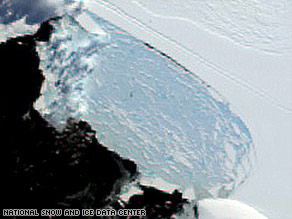
(CNN) -- Some 220 square miles of ice has collapsed in Antarctica and an ice shelf about seven times the size of Manhattan is "hanging by a thread," the British Antarctic Survey said Tuesday, blaming global warming.

art.wilkins.collapse.jpg

Scientists say the size of the threatened shelf is about 5,282 square miles.

"We are in for a lot more events like this," said professor Ted Scambos, a glaciologist at the National Snow and Ice Data Center at the University of Colorado at Boulder.

Scambos alerted the British Antarctic Survey after he noticed part of the Wilkins ice shelf disintegrating on February 28, when he was looking at NASA satellite images.

Late February marks the end of summer at the South Pole and is the time when such events are most likely, he said. Video Watch aerial footage of the area »

"The amazing thing was, we saw it within hours of it beginning, in between the morning and the afternoon pictures of that day," Scambos said of the large chunk that broke away on February 28.

The Wilkins ice shelf lost about 6 percent of its surface a decade ago, the British Antarctic Survey said in a statement on its Web site

Another 220 square miles -- including the chunk that Scambos spotted -- had splintered from the ice shelf as of March 8, the group said.

"As of mid-March, only a narrow strip of shelf ice was protecting several thousand kilometers of potential further breakup," the group said.

Scambos' center put the size of the threatened shelf at about 5,282 square miles, comparable to the state of Connecticut, or about half the area of Scotland. See a map and photos as the collapse progressed »

Once Scambos called the British Antarctic Survey, the group sent an aircraft on a reconnaissance mission to examine the extent of the breakout.

"We flew along the main crack and observed the sheer scale of movement from the breakage," said Jim Elliott, according to the group's Web site.

"Big hefty chunks of ice, the size of small houses, look as though they've been thrown around like rubble -- it's like an explosion," he said.

"Wilkins is the largest ice shelf on the Antarctic Peninsula yet to be threatened," David Vaughan of the British Antarctic Survey said, according to the Web site.

"I didn't expect to see things happen this quickly. The ice shelf is hanging by a thread -- we'll know in the next few days or weeks what its fate will be."

But with Antarctica's summer ending, Scambos said the "unusual show is over for this season."

Ice shelves are floating ice sheets attached to the coast. Because they are already floating, their collapse does not have any effect on sea levels, according to the Cambridge-based British Antarctic Survey.

Scambos said the ice shelf is not currently on the path of the increasingly popular tourist ships that travel from South America to Antarctica. But some plants and animals may have to adapt to the collapse.

"Wildlife will be impacted, but they are pretty adept at dealing with a topsy-turvy world," he said. "The ecosystem is pretty resilient."

Several ice shelves -- Prince Gustav Channel, Larsen Inlet, Larsen A, Larsen B, Wordie, Muller and Jones -- have collapsed in the past three decades, the British Antarctic Survey said.

Larsen B, a 1,254-square-mile ice shelf, comparable in size to the U.S. state of Rhode Island, collapsed in 2002, the group said.

Scientists say the western Antarctic peninsula -- the piece of the continent that stretches toward South America -- has warmed more than any other place on Earth over the past 50 years, rising by 0.9 degrees Fahrenheit each decade.

Scambos said the poles will be the leading edge of what's happening in the rest of the world as global warming continues.

"Even though they seem far away, changes in the polar regions could have an impact on both hemispheres, with sea level rise and changes in climate patterns," he said.

News of the Wilkins ice shelf's impending breakup came less than two weeks after the United Nations Environment Program reported that the world's glaciers are melting away and that they show "record" losses.

"Data from close to 30 reference glaciers in nine mountain ranges indicate that between the years 2004-2005 and 2005-2006 the average rate of melting and thinning more than doubled," the UNEP said March 16.

The most severe glacial shrinking occurred in Europe, with Norway's Breidalblikkbrea glacier, UNEP said. That glacier thinned by about 10 feet in 2006, compared with less than a foot the year before, it said.

Original article posted here.

Tuesday, December 11, 2007

Yes, the world is getting hotter, but what exactly is the cure?

Consensus Shattered As Major Scientific Study Says Global Warming Is Natural

Attempts to reduce CO2 emissions "pointless" as sun is cited as climate change culprit

Paul Joseph Watson

The so-called scientific consensus that global warming is man-made has been shattered with the release of a major new study backed by three universities which concludes that climate change over the past thirty years is explained by natural factors and that attempts to reduce carbon dioxide emissions are irrelevant.

Climate scientists at the University of Rochester, the University of Alabama, and the University of Virginia report that temperature fluctuations over the past three decades are not consistent with greenhouse model predictions and more closely correlate with solar activity.

The report dismisses attempts to reverse global warming by reducing carbon emissions as ineffective and pointless.

Authored by Prof. David H. Douglass (Univ. of Rochester), Prof. John R. Christy (Univ. of Alabama), Benjamin D. Pearson (graduate student), and Prof. S. Fred Singer (Univ. of Virginia), the study appears in this month's International Journal of Climatology of the Royal Meteorological Society.

“The observed pattern of warming, comparing surface and atmospheric temperature trends, does not show the characteristic fingerprint associated with greenhouse warming. The inescapable conclusion is that the human contribution is not significant and that observed increases in carbon dioxide and other greenhouse gases make only a negligible contribution to climate warming," said lead author David H. Douglass.

Co-author John Christy said: “Satellite data and independent balloon data agree that atmospheric warming trends do not exceed those of the surface. Greenhouse models, on the other hand, demand that atmospheric trend values be 2-3 times greater. We have good reason, therefore, to believe that current climate models greatly overestimate the effects of greenhouse gases. Satellite observations suggest that GH models ignore negative feedbacks, produced by clouds and by water vapor, that diminish the warming effects of carbon dioxide.”

Co-author S. Fred Singer said: “The current warming trend is simply part of a natural cycle of climate warming and cooling that has been seen in ice cores, deep-sea sediments, stalagmites, etc., and published in hundreds of papers in peer-reviewed journals. The mechanism for producing such cyclical climate changes is still under discussion; but they are most likely caused by variations in the solar wind and associated magnetic fields that affect the flux of cosmic rays incident on the earth’s atmosphere. In turn, such cosmic rays are believed to influence cloudiness and thereby control the amount of sunlight reaching the earth’s surface and thus the climate. Our research demonstrates that the ongoing rise of atmospheric CO2 has only a minor influence on climate change. We must conclude, therefore, that attempts to control CO2 emissions are ineffective and pointless – but very costly."

The findings of the report help to explain why we are witnessing climate change in almost every corner of our solar system, from Mars to Pluto, to Jupiter and to the moons of Neptune - and clearly identify the sun as the main culprit and not CO2 emissions - which are being used as a pretext for control freaks to completely dominate every aspect of our lives.

Man-made global warming advocates have often made their case by claiming that the scientific consensus is fully behind CO2 emissions as the main driver of climate change, when in fact the UN's own IPCC report was disputed by the very scientists that the UN claimed were behind it.

In reality, a significant number of prominent experts dispute the global warming mantra, but many have been intimidated into silence and had their careers threatened simply for stating an opposing view.

Original article posted here.

Tuesday, December 04, 2007

Yes, we may have to geo-engineer the climate, but NOT with chemtrails

With cracks and holes in the Greenland ice sheet, we may well have to 'geo-engineer' the climate

From Saturday's Globe and Mail

Next week, policy makers, scientists and activists from around the world will gather in Bali, Indonesia, to try to produce a climate-change agreement that will take us beyond the 2012 expiration of the Kyoto Accord. This meeting will take place in an atmosphere of sharply heightened unease among leading climate scientists.

A few years ago, these scientists regarded global warming as a matter of serious concern; now many appear to think that it's a matter of grave urgency — that we may be running out of time. The recent Intergovernmental Panel on Climate Change (IPCC) reports are increasingly viewed as out of date.

Because the IPCC reports incorporate only scientific findings published up to about mid-2005, they don't reflect almost two years of extraordinarily important results from multiple streams of research. Immediately after the Working Group 1 report was released (last February), many scientists said it significantly underestimated sea-level rise this century.

Since then, we've seen sharply higher global carbon dioxide emissions than the IPCC expected (2006 emissions were almost half a billion tonnes above the worst-case IPCC prediction), while the absorptive capacity of ocean and land-based carbon sinks appears to be decreasing more rapidly than predicted.

Two issues particularly exercise climate scientists: positive feedbacks and ice-sheet dynamics.

Water is not white, like ice

A positive feedback is a causal cycle — essentially a vicious circle — in which warming causes a series of changes that reinforces warming. One feedback of special importance to Canada is the ice-albedo feedback in the Arctic. The sea ice floating on the Arctic Ocean is white, so it reflects a large proportion of the sun's radiation back into space. As this ice melts from global warming, it leaves behind open water that absorbs about 80 per cent more of the sun's radiation. This ocean water becomes warmer. Then, after the summer passes and fall comes, the water releases its heat back into the atmosphere, which impedes refreezing. So winter generates thinner ice, which melts more easily the next summer.

This feedback is one of the reasons why the planet is warming, and will continue to do so, much more rapidly in its northern reaches. The IPCC predicts about 3 C average warming by 2100, and in the neighbourhood of 6 C to 7 C across much of Canada. Some people say we will benefit. Well, we may have lower heating bills in the winter for a few years, but because we're a northern country, warming here will be about twice as fast and the ultimate magnitude will be twice as great as the planet's average.

The consequences will be immense for our flora and fauna, for our forests that can't adapt and die en masse, for our grain-growing regions that could turn to desert, for the Great Lakes as their levels fall, for transportation in the St. Lawrence Seaway and for northern permafrost that melts.

This summer, melting of Arctic sea ice sharply diverged from the trend of the past decade — which suggests feedbacks in the north are gaining enormous force. By mid-September, we'd lost about a third of the Arctic ice cap compared to the 1979-2000 average and about 50 per cent compared to the 1950s. Scientists now expect a completely ice-free Arctic Ocean in summer by the end of the next decade, perhaps as early as 2013.

The ice-albedo feedback is an example of one of two main kinds of positive feedback: the kind that operates more or less directly on energy flows and temperature. Feedbacks of this kind are reasonably well built into current climate models. But there's another kind that operates on the carbon cycle.

In these cases, warming produces a change in the amount of carbon in the atmosphere. Carbon cycle feedbacks are not so well understood, but it's becoming increasingly clear that they could literally be deal-breakers for humanity. We may be quite close to creating circumstances in which the biosphere releases huge quantities of carbon into the atmosphere.

At that point, warming could become its own cause; it would no longer really matter what we do to mitigate our emissions of carbon dioxide. The global ecosystem would take over.

One worrying carbon feedback involves the permafrost in Siberia, Alaska and northern Canada. As the permafrost melts, it emits large quantities of methane, a very powerful greenhouse gas that, in turn, causes more warming.

And then there's the matter of pine bark beetles. As the climate warms, they reproduce through two generations during the summer, and their mortality is lower during the winter. Both these changes mean that beetle populations become much larger overall. We've already lost swaths of pine forest in British Columbia and Alaska to bark-beetle infestation. If they cross the Rockies into the boreal forest that stretches from Alberta to Newfoundland, and kill much of it, the forest will be susceptible to fire that could release astounding quantities of carbon dioxide. When I asked Stephen Schneider, a leading climate scientist at Stanford, about the implications, he just shrugged and said, "Well, we're talking about billions of tonnes of carbon."

Our climate has many positive and negative feedbacks. The positive ones are self-reinforcing, while the negative ones counteract the warming tendency. The big question for climate scientists then is: What is the balance is between the positive and negative feedbacks? A consensus appears to have emerged over the past two years — not yet reflected in the recent IPCC reports — that the positive feedbacks are much stronger and more numerous than the negative ones.

Melting that outpaces warming

The second issue that particularly concerns climate scientists is ice-sheet dynamics. The Greenland ice sheet is the second largest mass of ice in the world, after Antarctica's. If we melt Greenland entirely, the sea level rises by seven metres. The recent IPCC estimate of sea-level rise by 2100 was only 20 to 60 centimetres, because the report assumed Greenland's melting would take many centuries.

In the past two years, though, two studies using very different methods have suggested that the ice sheet is now melting much faster than expected — at a rate of 200 to 250 cubic kilometres a year. According to the most recent study, which used satellite measurements of Earth's gravity to estimate changes in Greenland's mass of ice, that rate has doubled in the past 10 years.

Climate scientists now recognize that the ice-sheet melting models in the IPCC reports were radically inadequate. These models were "static"; they assumed that atmospheric warming melts the ice, and the resulting water then runs off the surface of the ice sheet into the ocean.

Scientists now know that these ice sheets have cracks in them. In the summer, melt water runs down the cracks, and as these expand into wide gaps, millions more tonnes flow downward. This water takes heat to the bottom of the ice sheets and also lubricates the movement of glaciers into the ocean.

Commenting on the Ilulissat glacier in northwest Greenland just a few weeks ago, Robert Corell, chairman of the Arctic Climate Impact Assessment, said, "We have seen a massive acceleration of the speed with which these glaciers are moving into the sea. The ice is moving at two metres an hour on a front five kilometres long and 1,500 metres deep." He had flown over the glacier and seen "gigantic holes in it through which swirling masses of melt water were falling. I first looked at this glacier in the 1960s and there were no holes. These so-called moulins, 10 to 15 metres across, have opened up all over the place. There are hundreds of them."

The consensus now emerging is that oceans will rise by a metre this century and perhaps even two. A two-metre rise would have enormous effects on coastal areas of Canada — on places where people live in Victoria and Vancouver (especially on Delta and Richmond in the Lower Mainland) and on the ports of Vancouver, St John's and Halifax. With such a rise, concerns about rebuilding infrastructure and moving people inland will — in a few decades — become real, even urgent.

In light of these two trends, climate scientists are now beginning to discuss a topic that only two years ago many fervently hoped they'd never have to discuss: geoengineering, or the intentional human modification of the planet's climate to arrest or slow global warming. Geoengineering would involve, for example, putting sulphate aerosols into the atmosphere or putting mirrors into space to try to block a fraction of incoming solar radiation.

An idea no longer at the margins

Today the topic is at the margins of the public-policy dialogue about climate change, but I expect it will be at the centre of public discussion within five years. In 10 years, we will see demands from some segments of the public and many opinion leaders that we carry out geoengineering. And we'll probably start doing it within 20 years, likely when it becomes apparent that the Greenland ice sheet is starting to collapse.

We will do it, because by then we'll be experiencing major socio-economic impacts of climate change — for instance, shortfalls in global food supply, as droughts and heat waves affect grain-growing regions. At that point, we will wonder about what kind of world we've created for our children and grandchildren. We'll recognize that we're facing an emergency unlike anything humankind has ever faced before, and we will demand that our leaders and experts do something, anything, to stop the slide.

Thomas Homer-Dixon is a political scientist at the University of Toronto.

This essay is adapted from a chapter in a book to be released this month by several authors, "Globally Integrated Climate Policy for Canada" (University of Toronto Press).

Original article posted here.

Thursday, October 04, 2007

Very Interesting Science article that suggests that we may be in trouble upon the earth's magnetic inversion, just like the Mayas predicted.

Solar wind warming up Earth?


Paleoclimate research shows that the chillier periods of the Earth's history have always given way to warmer times, and vice versa.

But it is not quite clear what causes this change. This is what makes predicting climate change so difficult. Although everyone agrees that the climate is changing very fast, hardly anyone can say whether it will be warmer or colder in the next 100 years. At the moment it is getting warmer. The majority attribute this change to human impact on the environment. But are they right?

Lev Zeleny, director of the Institute of Space Research at the Russian Academy of Sciences and an Academy corresponding member, believes that before making Kyoto Protocol-like decisions, we should thoroughly study the influence of all factors and receive more or less unequivocal results. In order to treat an illness, we must diagnose it first, he insists.

Yury Leonov, director of the Institute of Geology at the Russian Academy of Sciences, thinks that the human impact on nature is so small that it can be dismissed as a statistical mistake.

Until quite recently, experts primarily attributed global warming to greenhouse gas emissions, with carbon dioxide singled out as the chief culprit. But it transpires that water vapor is just as bad.

Paleoclimate studies have revealed that during the ice ages the climate became much less damp, because the North Atlantic produced little moisture. The increase in temperature in turn increased humidity, and as a result rivers became fuller and more fresh water flowed into the Arctic and the North Atlantic. This fresh water covered the ocean's surface with a thin film, thereby decreasing evaporation. Another chilly period set in, and the flow of the rivers slowed down, marking the beginning of a new cycle. This is not a linear process - the higher the average temperature, the more steam gets into the air.

"Judging by Venus, a planet, which is similar to the Earth in all respects, we can see how far this can go. The temperature on its surface is about 500° C (mostly due to a greenhouse effect). At one time, Venus did not have a layer of clouds, and this is probably when it was warmed up by the Sun, causing a greenhouse effect. What if the Sun is responsible for the warming of our climate?" queries Lev Zeleny.

"There are two channels of energy transfer from the Sun - electromagnetic and corpuscular radiation," he explains. "The bulk of it - about 1.37 kW per square meter of the Earth's surface - which equals the power of an electric kettle - comes via the electromagnetic channel. This flow of energy primarily fits into the visible and infrared range of the spectrum and its amount is virtually immune to change - it alters by no more than a few fractions of a percent. It is called the 'solar constant.' The flow of energy reaches the Earth in eight minutes and is largely absorbed by its atmosphere and surface. It has decisive influence on the shaping of our climate."

The second channel is corpuscular radiation, consisting of solar wind and space rays. Although transferring much less energy, it plays a key role in forming "space weather" - changeable conditions in space which depend on solar activity. Until recently, it was believed that "space weather" had nothing to do with ours, but that idea has been proved wrong.

"Solar wind becomes more intense when the Sun is active. It sweeps space rays out of the solar system like a broom," Zeleny points out. "This affects cloud formation, which cools off both the atmosphere and the whole planet. We know from historic records that it was quite cold in 1350-1380. The Sun was very active during this time."

Solar wind is also the main transmitter of energy for geomagnetic phenomena in the Earth's magnetosphere, which is formed as a result of the solar wind streamlining the Earth's magnetic field. If the influx of energy exceeds its dissipation, energy accumulates in the magnetosphere. If a certain level of energy is exceeded, any disturbance outside or inside the magnetosphere may release excess energy and cause a magnetic storm. But it may also have no consequences at all.

A statistical analysis of solar and geomagnetic disturbances shows a rather low correlation between them. It transpires that most solar bursts do not trigger magnetic storms. It would be interesting to know why this correlation is so low.

Nevertheless, other Sun-related phenomena have fairly regular and predictable consequences on the Earth. Of course, they exert influence on humans and other species and, to some extent, on the environment, altering atmospheric pressure and temperature. But they are not likely to contribute much to climate change. This is a global process and is the result of global causes. For the time being, we are far from understanding them fully.

"Some dangers are much less discussed today, for instance, the inversion of the Earth's magnetic field," Zeleny warns. "It is gradually changing its polarity; the poles are crawling to the equator at increasing speed. There were whole epochs in the Earth's history when the magnetic field all but disappeared. Such oscillations have taken place throughout almost its entire geological history."

Paleomagnetic data show that last time the magnetic field disappeared was several hundred thousand years ago. It is possible that the Earth will lose it again in the 21st and 22nd centuries. The "magnetic umbrella," which protects us from deadly space radiation, will disappear, exposing humankind to a heavy "rainfall" of solar particles and space rays. Our descendants will have to understand how a weaker magnetic field will affect the climate and what protection they will need.

Yury Zaitsev is an expert from the Institute of Space Studies.

Original article posted here.

Wednesday, October 03, 2007

What is that cracking sound? It's the sound of the world as you've known breaking

Record 22C temperatures in Arctic heatwave

By Steve Connor, Science Editor

Parts of the Arctic have experienced an unprecedented heatwave this summer, with one research station in the Canadian High Arctic recording temperatures above 20C, about 15C higher than the long-term average. The high temperatures were accompanied by a dramatic melting of Arctic sea ice in September to the lowest levels ever recorded, a further indication of how sensitive this region of the world is to global warming. Scientists from Queen's University in Ontario watched with amazement as their thermometers touched 22C during their July field expedition at the High Arctic camp on Melville Island, usually one of the coldest places in North America.

"This was exceptional for a place where the normal average temperatures are about 5C. This year we frequently recorded daytime temperatures of between 10C and 15C and on some days it went as high as 22C," said Scott Lamoureux, a professor of geography at Queen's.

"Even temperatures of 15C are higher than we'd expect and yet we recorded them for between 10 and 12 days during July. We won't know the August and September recordings until next year when we go back there but it appears the region has continued to be warm through the summer."

The high temperatures on the island caused catastrophic mudslides as the permafrost on hillsides melted, Professor Lamoureux said. "The landscape was being torn to pieces, literally before our eyes."

Other parts of the Arctic also experienced higher-than-normal temperatures, which indicate that the wider polar region may have experienced its hottest summer on record, according to Walt Meir of the US National Snow and Ice Data Centre in Colorado.

"It's been warm, with temperatures about 3C or 4C above normal for June, July and August, particularly to the north of Siberia where the temperatures have reached between 4C and 5C above average," Dr Meir said.

Unusually clear skies over the Arctic this summer have caused temperatures to rise. More sunlight has exacerbated the loss of sea ice, which fell to a record low of 4.28 million square kilometres (1.65 million square miles), some 39 per cent below the long-term average for the period 1979 to 2000. Dr Meir said: "While the decline of the ice started out fairly slowly in spring and early summer, it accelerated rapidly in July. By mid-August, we had already shattered all previous records for ice extent."

An international team of scientists on board the Polar Stern, a research ship operated by the Alfred Wegener Institute in Germany, also felt the effects of an exceptionally warm Arctic summer. The scientists had anticipated that large areas of the Arctic would be covered by ice with a thickness of about two metres, but found that it had thinned to just one metre.

Instead of breaking through thicker ice at an expected speed of between 1 and 2 knots, the Polar Stern managed to cruise at 6 knots through thin ice and sometimes open water.

"We are in the midst of a phase of dramatic change in the Arctic," said Ursula Schauer, the chief scientist at the Alfred Wegener Institute, who was on board the Polar Stern expedition. "The ice cover of the North Polar Sea is dwindling, the ocean and the atmosphere are becoming steadily warmer, the ocean currents are changing," she said.

One scientist came back from the North Pole and reported that it was raining there, said David Carlson, the director of International Polar Year, the effort to highlight the climate issues of the Arctic and Antarctic. "It makes you wonder whether anyone has ever reported rain at the North Pole before."

Another team of scientists monitoring the movements of Ayles Ice Island off northern Canada reported that it had broken in two far earlier than expected, a further indication of warmer temperatures. And this summer, for the first time, an American sailing boat managed to traverse the North-west Passage from Nova Scotia to Alaska, a voyage usually made by icebreakers. Never before has a sail-powered vessel managed to get straight through the usually ice-blocked sea passage.

Inhabitants of the region are also noticing a significant change as a result of warmer summers, according to Shari Gearheard, a research scientist at the National Snow and Ice Data Centre. "People who live in the region are noticing changes in sea ice. The earlier break-up and later freeze-up affect when and where people can go hunting, as well as safety for travel," she said.

Mark Serreze of the National Snow and Ice Data Centre, said: "We may see an ice-free Arctic Ocean in summer within our lifetimes. The implications... are disturbing."

The North-west Passage: an ominous sign

The idea of a North-west Passage was born in 1493, when Pope Alexander VI divided the discovered world between Spain and Portugal, blocking England, France and Holland from a sea route to Asia. As it became clear a passage across Europe was impossible, the ambitious plan was hatched to seek out a route through north-western waters, and nations sent out explorers. When, in the 18th century, James Cook reported that Antarctic icebergs produced fresh water, the view that northern waters were not impossibly frozen was encouraged. In 1776 Cook himself was dispatched by the Admiralty with an Act promising a £20,000 prize, but he failed to push through a route north of Canada. His attempt preceded several British expeditions including a famous Victorian one by Sir John Franklin in 1845. Finally, in 1906 Roald Amundsen led the first trip across the passage to Alaska, and since then a number of fortified ships have followed. On 21 August this year, the North-west Passage was opened to ships not armed with icebreakers for the first time since records began.

Original article posted here.

Saturday, September 29, 2007

The world burning while politicians mumble, bumble and stumble

Arctic Heat Wave Stuns Climate Change Researchers

Undergraduate Geography student Joshua See, a member of Queen's International Polar Year project surveys the shifting terrain on Melville Island caused by this summer's record high temperatures in the Arctic. Courtesy of Scott Lamoureux

by Staff Writers

Unprecedented warm temperatures in the High Arctic this past summer were so extreme that researchers with a Queen's University-led climate change project have begun revising their forecasts. "Everything has changed dramatically in the watershed we observed," reports Geography professor Scott Lamoureux, the leader of an International Polar Year project announced yesterday in Nunavut by Indian and Northern Affairs Minister Chuck Strahl. "It's something we'd envisioned for the future - but to see it happening now is quite remarkable."

One of 44 Canadian research initiatives to receive a total of $100 million (IPY) research funding from the federal government, Dr. Lamoureux's new four-year project on remote Melville Island in the northwest Arctic brings together scientists and educators from three Canadian universities and the territory of Nunavut. They are studying how the amount of water will vary as climate changes, and how that affects the water quality and ecosystem sustainability of plants and animals that depend on it.

The information will be key to improving models for predicting future climate change in the High Arctic, which is critical to the everyday living conditions of people living there, especially through the lakes and rivers where they obtain their drinking water.

Other members of the research team include, from the Queen's Geography Department: Paul Treitz, Melissa Lafreniere and Neal Scott; Myrna Simpson and Andre Simpson from U of T; and Pierre Francus from INRS-ETE, Quebec. Linda Lamoureux of Kingston's Martello School will work with the scientists to develop learning tools for schools in the north.

From their camp on Melville Island last July, where they recorded air temperatures over 20C (in an area with July temperatures that average 5C), the team watched in amazement as water from melting permafrost a metre below ground lubricated the topsoil, causing it to slide down slopes, clearing everything in its path and thrusting up ridges at the valley bottom "that piled up like a rug," says Dr. Lamoureux, an expert in hydro-climatic variability and landscape processes. "The landscape was being torn to pieces, literally before our eyes. A major river was dammed by a slide along a 200-metre length of the channel. River flow will be changed for years, if not decades to come."

Comparing this summer's observations against aerial photos dating back to the 1950s, and the team's monitoring of the area for the past five years, the research leader calls the present conditions "unprecedented" in scope and activity. What's most interesting, he says, is that their findings represent the impact of just one exceptional summer.

"A considerable amount of vegetation has been disturbed and we observed a sharp rise in erosion and a change in sediment load in the river," Dr. Lamoureux notes. "With warmer conditions and greater thaw depth predicted, the cumulative effect of this happening year after year could create huge problems for both the aquatic and land populations. This kind of disturbance also has important consequences for existing and future infrastructure in the region, like roads, pipelines and air strips."

If this were to occur in more inhabited parts of Canada, it would be "catastrophic" in terms of land use and resources, he continues. "It would be like taking an area the size of Kingston and having 15 per cent of it disappear into Lake Ontario."

The Queen's-led project is working with other IPY research groups including: Arctic HYDRA, an international group investigating the impact of climate change on water in the Arctic; Science Pub, a Norwegian group working on broad research from science to public education about the impacts of global warming; and CiCAT, a University of British Columbia-led group of 48 researchers investigating the impacts of climate change on tundra vegetation.

International Polar Year (IPY) is the largest-ever international program of coordinated scientific research focused on the Arctic and Antarctic regions and the first in 50 years.

Original article posted here.

Saturday, September 08, 2007

It's happening quickly

Melting ice cap triggering earthquakes

· Estimates of sea-level rise out of date, say scientists
· Religious leaders pray for planet at Greenland glacier

The Greenland ice cap is melting so quickly that it is triggering earthquakes as pieces of ice several cubic kilometres in size break off.

Scientists monitoring events this summer say the acceleration could be catastrophic in terms of sea-level rise and make predictions this February by the Intergovernmental Panel on Climate Change far too low.

The glacier at Ilulissat, which supposedly spawned the iceberg that sank the Titantic, is now flowing three times faster into the sea than it was 10 years ago.

Robert Corell, chairman of the Arctic Climate Impact Assessment, said in Ilulissat yesterday: "We have seen a massive acceleration of the speed with which these glaciers are moving into the sea. The ice is moving at 2 metres an hour on a front 5km [3 miles] long and 1,500 metres deep. That means that this one glacier puts enough fresh water into the sea in one year to provide drinking water for a city the size of London for a year."

He is visiting Greenland as part of a symposium of religious, scientific, and political leaders to look at the problems of the island, which has an ice cap 3km thick containing enough water to raise worldwide sea levels by seven metres.

Yesterday Christian, Shia, Sunni, Hindu, Shinto, Buddhist and Jewish religious leaders took a boat to the tongue of the glacier for a silent prayer for the planet. They were invited by Bartholomew I, the spiritual leader of 250 million Orthodox Christians worldwide.

Dr Corell, director of the global change programme at the Heinz Centre in Washington, said the estimates of sea level rise in the IPCC report were based on data two years old. The predicted rise this century was 20-60cm (about 8-24ins) , but it would be at the upper end of this range at a minimum, he said, and some believed it could be two metres. This would be catastrophic for European coastlines.

He had flown over the Ilulissat glacier and "seen gigantic holes in it through which swirling masses of melt water were falling. I first looked at this glacier in the 1960s and there were no holes. These so-called moulins, 10 to 15 metres across, have opened up all over the place. There are hundreds of them."

This melt water was pouring through to the bottom of the glacier creating a lake 500 metres deep which was causing the glacier "to float on land. These melt-water rivers are lubricating the glacier, like applying oil to a surface and causing it to slide into the sea. It is causing a massive acceleration which could be catastrophic."

The glacier is now moving at 15km a year into the sea although in surges it moves even faster. He measured one surge at 5km in 90 minutes - an extraordinary event.

Veli Kallio, a Finnish scientist, said the quakes were triggered because ice had broken away after being fused to the rock for hundreds of years. The quakes were not vast - on a magnitude of 1 to 3 - but had never happened before in north-west Greenland and showed potential for the entire ice sheet to collapse.

Dr Corell said: "These earthquakes are not dangerous in themselves but the fact that they are happening shows that events are happening far faster than we ever anticipated."

Original article posted here.

Thursday, September 06, 2007

The end of the world that we have known

Ice-Free Arctic Could Be Here in 23 Years

by David Adam

The Arctic ice cap has collapsed at an unprecedented rate this summer and levels of sea ice in the region now stand at a record low, scientists said last night. Experts said they were “stunned” by the loss of ice, with an area almost twice as big as Britain disappearing in the last week alone. So much ice has melted this summer that the north-west passage across the top of Canada is fully navigable, and observers say the north-east passage along Russia’s Arctic coast could open later this month. If the increased rate of melting continues, the summertime Arctic could be totally free of ice by 2030.

Mark Serreze, an Arctic specialist at the US National Snow and Ice Data Centre at Colorado University in Denver which released the figures, said: “It’s amazing. It’s simply fallen off a cliff and we’re still losing ice.” The Arctic has now lost about a third of its ice since satellite measurements began 30 years ago, and the rate of loss has accelerated sharply since 2002.0905 03 1 2

Dr Serreze said: “If you asked me a couple of years ago when the Arctic could lose all of its ice, then I would have said 2100, or 2070 maybe. But now I think that 2030 is a reasonable estimate. It seems that the Arctic is going to be a very different place within our lifetimes, and certainly within our children’s lifetimes.”

The new figures show that sea ice extent is currently down to 4.4m square kilometres (1.7m square miles) and still falling. The previous record low was 5.3m square kilometres in September 2005. From 1979 to 2000 the average sea ice extent was 7.7m square kilometres. The minimum extent of sea ice usually occurs late in September each year, as the freezing Arctic winter begins to bite.

The sea ice usually then begins to freeze again over the winter. But Dr Serreze said that would be difficult this year. “This summer we’ve got all this open water and added heat going into the ocean. That is going to make it much harder for the ice to grow back. What we’ve seen this year sets us up for an even worse year next year.” The winter ice has already failed to make up for increased losses in the summer in each of the last two years.

Changes in wind and ocean circulation patterns can help reduce sea ice extent, but Dr Serreze said the main culprit was man-made global warming. “The rules are starting to change and what’s changing the rules is the input of greenhouse gases. This year puts the exclamation mark on a series of record lows that tell us something is happening.”

The dramatic loss is further bad news for the region’s wildlife which relies on the sea ice, such as polar bears. The animals use its coastal fringes to find food, and as the summer ice retreats to the north, they must swim further to hunt for seals. Some colonies of bears have already showed signs of malnutrition and biologists say there could be a severe drop in their population within a few decades, though they may not go extinct.

Yesterday’s announcement will also increase political interest in the Arctic, with a number of countries currently jostling to exploit the oil and gas reserves believed to lie under the ocean, which could become more accessible as the icy cover retreats. Last month Russia claimed a huge area around the north pole, and Denmark and Canada are preparing similar claims, which rely on showing that a chain of underwater mountains that runs across the region are connected to their respective continental shelves.

Original article posted here.

Tuesday, August 21, 2007

A record that will not last long

Arctic Sea Ice Extent Hits Record Low

Arctic sea ice fell below all previous records for the lowest absolute minimum extent ever measured by satellite on Thursday and Friday, said scientists at the National Snow and Ice Data Center. Sea ice extent has fallen below the 2005 record low absolute minimum and is still melting, said researcher Walt Meier.

A rapid disintegration of Arctic sea ice during July has prompted scientists to warn there is a 92 percent chance that Arctic sea ice extent will hit an annual record low. Sea ice extent, the area of an ocean covered by at least 15 percent of ice, has been shrinking since the late 1970s, when satellite measurements began. The decline is believed by many researchers to be due to higher temperatures due to global warming from a buildup of greenhouse gas emissions in the Earth's atmosphere. In April, scientists at the University of Colorado-Boulder forecast a 33 percent chance that the September minimum of sea ice would set a new annual low record, but after observing what happened to the ice in July, they drastically revised that prediction.

Satellite images of the coast of eastern Siberia and the New Siberian Islands, 1,200 miles northwest of Alaska, show sea ice retreat over 42 days this summer. (Images courtesy NASA) "During the first week in July, the Arctic sea ice started to disappear at rates we had never seen before," said Sheldon Drobot, who leads the Arctic Regional Ice Forecasting System group at the Colorado Center for Astrodynamics Research, CCAR.

The group at the University of Colorado-Boulder's aerospace engineering sciences department is the only group in the world making seasonal Arctic sea ice forecasts based on probability. Arctic sea ice researchers pay particular attention to the months of September and March because they generally mark the annual minimum and maximum sea ice extents respectively, said Drobot. The record low September minimum for sea ice, set in 2005, is 2.15 million square miles, Drobot said.

For 2007, the most likely minimum extent is 1.96 million square miles, he said. But there is a 25 percent chance the September sea ice extent will shrink even more - to 1.88 million square miles - said Drobot, and even a five percent chance it will fall to 1.75 million square miles, he said. Arctic sea ice is "one of the better predictors of climate change on Earth," Drobot said. "There will probably be about two-thirds as much sea this September as there was 25 years ago, a good indication that something significant is happening with the climate."

The factors triggering the unusually strong July sea-ice decline appear to be a combination of less multi-year ice and more cloud-free days, which accelerated the melting effects of solar radiation on the ice, Drobot said. "Things can really change fast, which is why we continually update our forecasts," he said. The sea ice research by the CCAR group is funded by the National Science Foundation and NASA. "We have been seeing a sharp decline in thicker, multi-year ice that has survived more than one melt season," said CCAR scientist James Maslanik. "This has been replaced in many areas by a thin, first-year layer of ice as well as by younger, thinner types of multi-year ice. The thinner ice just does not have the mass to withstand the effects of warming climate," Maslanik explained. The CCAR researchers used satellite data from the U.S. Department of Defense and temperature records from the National Oceanic and Atmospheric Administration for the forecasts, which they have been producing for five years.

Melting sea ice, Blackhead, Newfoundland, Canada. June 2007 (Photo by Diana Cardoso) Currently, sea ice extent is particularly low in the East Siberian side of the Arctic and the Beaufort Sea north of Alaska. Ice in the Canadian Archipelago is also quite low, the scientists said. Along the Atlantic side of the Arctic Ocean, sea ice extent is not as strikingly low, but is still less than normal.

Over the past few years, the Arctic sea ice decline has been sharpest in the western Arctic, said Drobot. Such regional variation is of interest to the maritime industry, including government agencies, international shipping companies, energy exploration corporations and tourism cruise lines active in the far North, he said. "This type of information is useful for ship operators trying to plan activities several months out," Drobot said. "It's also useful for short-term operational planning, including cruise ship excursions."

Assuming the sea ice decline continues in the Arctic, there probably will be intercontinental "Northwest Passage" type of transit from North America to places like Europe in the coming decades, Drobot projected. A seasonal or year-round, ice-free channel through Arctic waters would be shorter and cost less than shipping through the Panama Canal.

Original article posted here.

Wednesday, August 15, 2007

A familiar story that will become even more familiar

World's birds on death row: Race against time to save 189 species from extinction

The world's most ambitious bird conservation project will be launched this week amid evidence that hunting and loss of habitat has caused species to disappear at an unprecedented rate. David Randall reports
Published: 12 August 2007

The biggest and most wide-ranging bird conservation programme the world has ever seen will be launched next week with the aim of saving every one of the planet's critically endangered species from extinction.

The task is urgent. There are now no fewer than 189 birds in this most precipitous category – 51 more than there were just seven years ago. Scientists say that if no action is taken then all of them could be gone within the next 10 years; 15 are already classified as "possibly extinct ".

The death of bird species is now happening faster than at any time in history. Without human interference, the natural rate of loss would be one bird each century. But extinctions are accelerating and running at 50 times that rate. In the past 30 years alone, 21 have gone – three of them since 2000.

BirdLife International, which acts as a scientific and conservation " United Nations" for bird organisations worldwide, now aims to stop the rot. So next week at Birdfair, the three-day festival for British enthusiasts co-organised by the RSPB and the Wildlife Trusts, Birdlife will launch a project to pull each and every one of the 189 species back from the brink.

This danger list includes six owls, three albatrosses, 16 birds of prey, 10 hummingbirds, 17 parrots, four woodpeckers, six ducks and umpteen pigeons, plovers, wrens, warblers, finches, curlews and larks.

Their names are some of the most evocative in the bird world: the gorgeted wood-quail, sapphire-bellied hummingbird, Alagoas foliage-gleaner, Pernambuco pygmy-owl and Iquitos gnatcatcher (some of which have never been photographed), Bulo Burti boubou (a shrike, discovered in Somalia in 1988), the kakapo (the world's only flightless, nocturnal parrot), and the turquoise-throated puffleg, a hummingbird so rare no one has seen it since 1850. There are, happily, no British birds on the list.

BirdLife's project, called "Preventing Extinctions: Saving the World's Most Threatened Birds", will launch what are in effect 189 different races against time.

For each bird there will be a "species guardian", a local body that will work with BirdLife to carry out the conservation. And, for each of the 189 at risk, BirdLife is also seeking a "species champion" – a company, organisation or institution that will "adopt" a threatened bird and provide regular funding.

Donations from individuals are also, of course, very welcome. Some £20,000 is needed to kick-start a protection project for each species of bird, and, to save all 189, BirdLife calculates it will need to raise at least £19m over the next five years.

Dr Mike Rands, chief executive of BirdLife International, told The Independent on Sunday: "Through this innovative approach every single critically endangered bird can be saved from extinction. We know the priority conservation actions needed for each species – what we need now is the support of companies, organisations or even individuals. This is an enormous challenge, but one that we are fully committed to achieving."

TV's Springwatch presenter and wildlife film-maker Simon King said: " This is a exciting and ambitious project and deserves to be supported by every nature lover in the country."

Birdfair, which he, Bill Oddie and tens of thousands of other enthusiasts will attend at Rutland Water next weekend, has singled out four of the most pressing cases as the focus of its fund-raising. The birds' plight illustrates the desperately urgent work that needs to be done. There is the Bengal florican, the world's rarest bustard, now down to fewer than 1,000 in south-east Asia through loss of its wet grassland habitat; the Restinga antwren – a mere 10 square kilometres of its Brazilian beach-scrub habitat remains, and even that's under threat; Belding's yellowthroat, a warbler of Mexican wetlands, now confined through development to just a few marshes; and the Djibouti francolin, which is blighted by habitat loss, climate change and hunting.

Other emergency projects will try to save the long-billed apalis (a warbler of central east Africa suffering through destruction of woodland); the dwarf olive ibis (a forest dweller endemic to the west African island of São Tomé, suffering from tree-clearance); the Puerto Rican nightjar (confined to the south-west of the island, under pressure from development and feral cats); the Mindoro bleeding heart (a ground-living pigeon endemic to one Philippine island, it was once common but now nearly all of its wooded habitat is gone); and the white-shouldered ibis (a wetland species of south-east Asia, whose habitat has been wrecked through logging and intensive agriculture).

Some of the birds on the list, such as the black stilt, are now down to just a handful of individuals, while others, including the red-headed vulture, still number in the thousands but have lost nearly 90 per cent of their population in the past 10 years.

There is concern, too, about some long-lived species, such as the three albatrosses on the list and the Philippine eagle, whose young are not surviving to replace the adults who will die out in the next decade or so.

The task is to stop these birds following into oblivion the 72 species that were lost in the 20th century, the most costly era for extinctions in recorded history. Those that will fly no more include the slender-billed grackle, a songbird endemic to Mexico not seen since 1910; the thick-billed ground-dove (1927); robust white-eye (small Australian songbird, 1928); the Hawaiian oo (one of four honey-eaters that became extinct after Europeans arrived, 1934); the red-moustached fruit-dove (1950); laughing owl (1970); the Alaotra grebe (killed off in Madagascan waters by fishing and an introduced carnivorous fish, 1988); and the po'o-uli (a honeycreeper, presumed extinct in Hawaii through habitat destruction and disease-carrying mosquitoes, 2004).

What gives BirdLife hope is some recent successes. In the 10 years between 1994 and 2004, 16 species were saved from extinction, all as a result of targeted conservation. They include the Norfolk Island green parrot, which in the Nineties was down to just four females of breeding age, but which now can boast 200-300 and is rapidly increasing; the Bali starling, which poaching eradicated in the wild but which thanks to captive breeding is now thriving once more; and the Chatham Island taiko, a seabird from the petrel family – it was reduced to just four pairs in 1994 but control of predators has seen it start to recover, with 11 chicks hatching in 2006.

And, in a demonstration of how apparently insuperable obstacles can be overcome, only last week Timor-Leste, formerly the deeply troubled land of East Timor, announced its first national park just five years after gaining independence.

The Nino Konis Santana National Park covers 304,000 acres and includes the territory of the yellow-crested cockatoo, one of the species on BirdLife's list. It continues to be severely threatened by illegal trapping for the exotic bird trade, but the safeguarding of its home is a good omen for the work ahead with the other 188 critically endangered birds.

Original article posted here.