Showing posts with label Venezuela. Show all posts

Saturday, October 18, 2008

Venezuela beefing up against potential US aggression

Analysis: Venezuela buys Russian tanks


Russia to sell Venezuela rocket launchers: report
Moscow (AFP) Oct 15 - Russia plans to sell Venezuela armoured personnel carriers and multiple rocket launchers, the Russian arms export agency said Wednesday. "We are preparing to deliver a large number of BMP-3 armoured personnel carriers" and multiple rocket launchers, Igor Sevastyanov, deputy director of Rosoboronexport, was quoted as saying by Interfax news agency. Venezuela has already bought 24 Sukhoi fighter jets, 50 helicopters and 100,000 Kalashnikov assault rifles from Russia in contracts worth a total of 4.4 billion dollars signed between 2005 and 2007, officials said. During a visit by Venezuelan President Hugo Chavez to Moscow last month, Russia announced it was giving Venezuela a one-billion-dollar credit to buy Russian weapons and the two countries discussed nuclear energy cooperation. They are also planning joint naval exercises in the Caribbean in November. US military chiefs have said they are concerned about the military build-up in Venezuela and the US State Department has said it will be watching the Russian-Venezuelan naval exercises "very closely."
by Jack Sweeney

In 2006 and 2007 Venezuela's air force purchased 36 Russian-built Sukhoi Su-30 "Flanker-C" fighters, of which 24 already are in service and the remaining 12 will be delivered before the end of 2009. However, President Hugo Chavez has also placed an order for 24 state-of-the-art Russian Sukhoi Su-35 "Flanker-E" fighters with delivery starting by 2010.

After the U.S. State Department thwarted Venezuela's plans to buy Spanish military air transports in 2006, Chavez purchased from Russia 10 Ilyushin IL-76E -- NATO designation Candid -- troop/cargo transports and two Ilyushin IL-78 -- NATO designation Midas -- in-flight tankers with the capacity to refuel three aircraft simultaneously.

These transport aircraft will be delivered between the fourth quarter of 2008 and the end of 2009, giving Venezuela's armed forces the largest strategic air lift capacity in Latin America, defense procurement officials say.

However, the arms purchases Venezuela made between 2005 and 2008 are only the start of a bilateral military and security alliance between Caracas and Moscow potentially worth billions of dollars in future sales by Russian arms manufacturers.

During Chavez's latest visit to Moscow on Sept. 25 and 26, his third trip this year, Russian Prime Minister and former President Vladimir Putin agreed to expand Venezuelan-Russian military cooperation. Underscoring Venezuela's importance to Moscow as a major client for Russian weapons, Chavez was granted $1 billion in credit to finance more arms purchases.

The first item on Chavez's arms shopping list is between 20 and 30 TOR-M1 9M330 air defense missile systems. Venezuela's president also wants at least three diesel-powered Varshavyanka (Kilo)-class submarines.

Venezuelan defense sources say Chavez also wants to replace his army's obsolescent AMX-30 main battle tanks with between 50 and 100 Russian-built T-90 main battle tanks. The army also wants to buy at least 100 Russian-made light tanks and armored fighting vehicles, and up to 400 BMP-3 armored personnel carriers.

The Chavez government also is expanding defense and security ties with China. During his visit to Beijing on Sept. 24, Chavez signed an agreement to purchase 24 Chinese-made K-8 light attack aircraft, which Venezuelan air force officials say will be used for training purposes. The K-8s, which are scheduled to arrive in Venezuela during 2009, will operate from the Teniente Vicente Landaeta Gil Air Base near the city of Barquisimeto in Lara state.

China also is supplying Venezuela's air force with 10 long-range JYL-1 radars, three of which already are operating at Paraguana and Mene Mauroa in Falcon state near state-owned Petroleos de Venezuela's 940,000 bpd Paraguana refining complex and in Apure state near Venezuela's border with Colombia. The air force expects to achieve almost 100 percent radar coverage of Venezuela's national territory by 2013 when all 10 radars are installed and operational.

Spain's Navantia shipyard at Cadiz is building eight seagoing vessels for Venezuela's navy, including four coastal patrol boats -- 39 dwt -- equipped with a helicopter deck aft and Oerlikon Contraves DMN 0008 Millennium 35mm anti-aircraft guns. But navy officials say the patrol boats probably also could be armed with air and anti-ship missiles or heavier guns forward.

The other four vessels Navantia is building are missile-capable frigates that Venezuelan navy officials describe as "similar in design" to Venezuela's Italian-made Lupo frigates, which have been in use for about 30 years.

Original article posted here.

Friday, September 26, 2008

Looks like Venezuela may become to Russia what Israel is to the US

Russia offers Chavez $1 billion for weapons

By Michael Schwirtz

MOSCOW: The Kremlin has decided to offer a $1 billion loan for arms purchases to Venezuelan President Hugo Chavez, who is currently on a two-day swing through Russia aimed at bolstering an already solid relationship that has caused increasing discomfort in the West.

Following a meeting with Prime Minister Vladimir V. Putin on Thursday, Mr. Chavez, who is on his second visit to Russia in two months, traveled on Friday to the southern city of Orenburg near the border with Kazakhstan for a meeting with President Dmitry A. Medvedev. The two leaders held talks on enhancing economic cooperation and trade in both commercial goods and military technologies, according to a Kremlin statement.

The $1 billion dollar loan is to be allocated for programs related to military-technical cooperation, the statement said. A Kremlin spokesman would not elaborate on the details of the deal. Between 2005 and 2007 Venezuela has signed 12 contracts for weapons purchases from Russia for a total of more than $4.4 billion, the Kremlin statement said.

The move is the latest gesture of military friendship between Russia and Venezuela, two counties that have increasingly positioned themselves as mavericks vis-a-vis the West. The Kremlin says its economic and political stability have allowed it to broaden the scope of its military and economic cooperation beyond what it calls its traditional sphere of influence.

Moscow is also frustrated with what it considers aggressive military posturing from the West, particularly the United States. Washington's plans to deploy elements of a missile defense system in Poland and the Czech Republic, as well as its support of NATO membership for Georgia and Ukraine, have set Russia on edge.

Today in Americas

U.S. bailout plan stalls after day of talks

McCain's peril in postponing the debate

In a time of crisis, is Obama too cool?


In turn, Russia has sought to expand its military footprint in recent years, inching closer and closer to American shores. Russian bombers have flown sorties close to Alaska and its naval vessels have been pushing deeper into the Atlantic.

Latin America, and Venezuela in particular, has become has become a major theater for this expansion.

Earlier this month a pair of Russian Tu-160 long range bombers capable of carrying nuclear weapons received a warm welcome when they landed in Venezuela. Russia has also dispatched squadron from the Russian Navy's North Sea Fleet to the Caribbean to take part in joint naval exercises with the Venezuelan Navy sometime in November.

"Latin America, of course, is becoming an obvious link in the chain making up a multipolar world," Mr. Putin said during his meeting with Mr. Chavez. "We will allocate more and more attention to this vector of our economics and foreign policy." Russia has already delivered Sukhoi Su-30 fighters, Mi-17 transport helicopters, and thousands of Kalashnikov assault rifles to Venezuela. There are also plans to build a factory in the country that will manufacture these weapons under license.

Ties between the two countries appear to have been strengthened following Russia's five-day war with Georgia last month, which caused relations between Moscow and the West to plummet to their lowest point since the Cold War.

At his meeting with Mr. Medvedev on Friday, Mr. Chavez expressed "firm support" for Russia's unilateral recognition of independence for Abkhazia and South Ossetia, two Georgian separatist enclaves, Interfax reported. Only Nicaragua has officially followed Moscow's recognition, which prompted broad international criticism.

Mr. Chavez's remarks fell short of official recognition of the republics, despite speculation that he would use his visit to offer it.

Original article posted here.

Monday, September 15, 2008

Wayne Madsen deconstructs the neo-Cons' failing Latin American interference

Latin America uniting against neocons of Washington

By Wayne Madsen

(WMR) -- Antipathy and disgust for the Bush administration and its neocon ideological ilk, including the key players and advisers in the John McCain campaign, have long taken root in the Middle East and South Asia. Names like Cheney, Wolfowitz, Perle, Feith, and Ledeen are held in utmost contempt throughout the Middle East and Muslim worlds.

The same kind of hatred for the United States and its neocon Latin American policy is now sweeping through South and Central America. In Latin America, it is individuals with names like Goldberg, Levey, Shapiro, Mukasey, Berman, Brownfield, and Shannon who have rankled Latin American nerves by their meddlesome actions in not only grossly interfering in the domestic affairs of Latin American nations, including fomenting insurrection and acts of terrorism, but designating certain Latin American leaders and officials as aiding in drug trafficking and terrorism.

The lack of non-Cuban exile Hispanic surnames involved in crafting the U.S.’s Latin American policy is astounding considering the percentage of Hispanics in the United States.

Assistant Secretary of State for Western Hemisphere Affairs Thomas Shannon told Rep. Howard Berman’s (D-CA) House Foreign Affairs Committee in July that “several” Venezuelans were providing support to Hezbollah, a rather bizarre mixing of Middle East and Latin American neocon policies in an obvious effort to please Berman, one of Israel’s most ardent supporters in the U.S. Congress.

From Bolivia to Venezuela and Honduras to Argentina, Latin American governments are standing firm against the interference by the American administration, which has done everything possible to stoke the flames of insurrection and secession in energy-rich areas of Bolivia, Venezuela, and Ecuador.

Bolivia’s President Evo Morales, who faces CIA and U.S. Defense Intelligence Agency (DIA)-sponsored right-wing rebellions in the energy-rich provinces of Santa Cruz, Pando, Tarija, and Beni, expelled U.S. Ambassador Philip Goldberg for interfering in Bolivia’s domestic affairs and supporting the right-wing rebels.

The State Department’s spokesman Sean McCormack, whose snottiness is unprecedented for a spokesperson for America’s seat of foreign diplomacy, responded by expelling Bolivia’s ambassador. McCormack had earlier joked that Russia could send warships to Venezuela if it could find any that could make it that far.

In a side quarrel, Russian Foreign Minister Sergei Lavrov reportedly upbraided British neocon and pro-Israeli Foreign Secretary David Miliband by stating “who are you to fucking lecture me?”

Venezuela’s President Hugo Chavez, in solidarity with Morales and reacting to yet another CIA-planned coup against him, after an April 2002 coup organized by then-U.S. Ambassador Charles Shapiro failed, ordered U.S. Ambassador Patrick Duddy to leave Venezuela. The State Department responded by expelling Venezuela’s ambassador in Washington.

In an act coordinated between Treasury Undersecretary for Terrorism and Financial Intelligence Stuart Levey and the U.S. Treasury Department’s Office of Foreign Assets Control (OFAC), headed by Adam Szubin, the assets of two current and one former Venezuelan officials were frozen after accusations that they aided and abetted drug smuggling and the Revolutionary Armed Forces of Colombia (FARC), which is attempting to oust U.S. narco-fascist from power in Colombia.

Levey and Szubin named Hugo Armando Carvajal Barrios, the director of Venezuela’s Military Intelligence Directorate (DGIM); Henry de Jesus Rangel Silva, director of Venezuela’s Directorate of Intelligence and Prevention Services (DISIP); and Ramon Emilio Rodriguez Chacin, the recently-departed minister of Interior and Justice, in the freeze order. The three were named by the Bush regime after DGIM and DISIP uncovered a plot by CIA-based retired Venezuelan military officers to seize the Miraflores presidential palace in Caracas and blow up Chavez’s presidential aircraft, killing Chavez and his aides. The coup organization was identified as the “2-D Movement” or the “December 2 Movement.”

A spokesperson for the Venezuelan National Assembly described the plotters as some of the same military officers who participated in the CIA-backed 2002 coup against Chavez. The charges by Chavez came as Morales said the United States was behind the explosion of a natural gas pipeline from Bolivia to Brazil. The charges of American involvement in terrorist plans and attacks in Latin America came while Americans were being subjected to a gross use of another anniversary, the 9/11 terrorist attacks, to whip up nationalistic fervor.

Chavez also agreed with Argentina’s President Cristina Fernandez de Kirchner that the trial in Miami of Guido Antonini, who is accused of attempting to deliver a suitcase of cash from Venezuela to help the presidential campaign of Kirchner in Argentina, was an attempt to “trash” both he and Kirchner. The Venezuelan and Argentine leaders are both ardent critics of neocons, their international free trade and financial contrivances, and the Bush regime.

The Justice Department of Attorney General Michael Mukasey is using the Miami cash-for-Argentina trial to damage Chavez and his Interior minister, Tarek el-Aissami. El-Aissami’s only crime appears to be that his father was born in Syria, which, of course, for neocons in their myopic and archaic of the world, is tantamount to having a direct link to terrorism.

Argentina has shown solidarity with both Venezuela and Bolivia in their showdowns with the United States. However, disgust with neocon-occupied Washington does not end with Venezuela, Bolivia, and Argentina. Paraguayan President Fernando Lugo extended his full support to Morales in his confrontation with the right-wing provincial secessionists. Honduran President Manuel Zelaya refused to accept the credentials of the new U.S. ambassador to Tegucigalpa, in solidarity with Morales and Chavez. Zelaya announced solidarity with Nicaragua, Cuba, Bolivia, and Venezuela in their showdowns with the United States.

Nicaraguan President Daniel Ortega also supported Bolivia and Venezuela in expelling the American ambassadors and announced that Nicaragua, like Venezuela, was prepared to establish closer military links with Russia. Ortega particularly supported Bolivia sending Goldberg packing, saying the U.S. envoy had interfered in Bolivia’s internal affairs.

Nicaraguan Foreign Minister Samuel Santos also charged that Washington was trying to undermine Nicaragua’s government by pressuring international organizations to cancel aid packages to the country. Nicaragua also recognized the independence of South Ossetia and Abkhazia from the U.S.- and Israeli-backed Republic of Georgia.

After El Salvador presidential candidate for the progressive Farabundo Marti National Liberation Front (FMLN), Mauricio Funes, visited Argentina to meet with Kirchner, the neocon media began to claim that Funes was being funded by Chavez of Venezuela. The neocons, bereft of any hard evidence of “plots,” are always apt to concoct elaborate conspiracy theories that take in everyone whom they have targeted in their political sights.

The signs that the Bush regime and the neocons are on a major political offensive in Latin America are also demonstrated by the discovery in Guatemalan Vice President Rafael Espada’s office in Guatemala City of three hidden microphones -- one installed in a telephone, one in a calculator, and the third in a reception room. Guatemala’s progressive president, Alvaro Colom, has expressed solidarity with Bolivia and Venezuela. Ecuadoran President Rafael Correa, who has faced CIA-backed secessionists in the Guayaquil area, also stood in solidarity with Morales and Chavez. Correa has ordered the United States Air Force to vacate a military air base at Manta next year and he accused the United States military of assisting Colombia in cross-border raids into Ecuador. Correa said if any evidence emerged of U.S. diplomats violating Ecuador’s sovereignty, they would also be expelled.

Peruvian President Alan Garcia also backed Morales against the secessionists as did Uruguayan President Tabare Vazquez.

Latin America’s political, military, and economic powerhouse, Brazil, also warned against any attempt by secessionists in Bolivia to overthrow Morales. Earlier, Brazil and Argentina announced they were eliminating the U.S. dollar as an international monetary exchange medium. Brazilian president Luiz Inacio Lula da Silva’s foreign policy adviser, Marco Aurelio Garcia, told UPI that Brazil would oppose any rival or unconstitutional government in Bolivia. There are reports that U.S. “paramilitaries” are active in fomenting unrest in both Bolivia and Venezuela.

Washington has also revived the U.S. Navy’s Fourth Fleet, to be based in Jacksonville, Florida, a move that Cuba, Venezuela, and Bolivia claim is a return to U.S. “gunboat diplomacy.”

Original article posted here.

The refrain is growing: Yankee, go home.

Expulsion of US Ambassadors: Ecuador, Honduras support Bolivia & Venezuela

Ecuador, Honduras support Bolivia, Venezuela in expulsion of U.S. envoys

Ecuador and Honduras on Friday voiced support for Bolivia and Venezuela's decision to expel U.S. ambassadors in their countries in protest of Washington's intervention in their domestic affairs.

"The president of Bolivia, Evo Morales and the president of Venezuela, Hugo Chavez, have enough reasons to label (as "persona non gratas") the U.S. ambassador in La Paz, Philip Goldberg, and that in Caracas, Patrick Duddy. I respect those countries' decisions and I am sure that they had their concrete and verified reasons," Ecuadorian President Rafael Correa said during his visit to Peru.

"Ecuador will make its resolutions in a sovereign way," Correa noted.

"I have to acknowledge that former U.S. ambassador to Ecuador always respected my country," the president said, adding that "if any U.S. ambassador or of any place attempts to interfere in our internal affairs or affect the country's security, he will be immediately expelled."

Correa made the remarks at a press conference at the Andean Community of Nations (CAN) that groups Bolivia, Colombia, Ecuador and Peru.

The Ecuadorian president had previously met with his Peruvian counterpart Alan Garcia.

Meanwhile, reports monitored here said that Hondurian President Manuel Zelaya also voiced support for Bolivia's decision to expel the U.S. ambassador, saying he will not receive the new U.S. ambassador to Honduras for the moment, though he does not want to have problems with Washington.

In another development of the day, the Venezuelan government said it formalized the expulsion of U.S. ambassador to Venezuela, Patrick Duddy, after President Hugo Chavez announced the decision on Thursday to show solidarity with Bolivia.

The U.S. ambassador was asked to leave the country within 72 hours starting from 19:15 local time (2345 GMT) on Thursday.

In a communique, the government declared Duddy as "persona non grata" , saying it subjects the ties with the United States to an intense evaluation "to guarantee the respect to our homeland."

Bolivian Ambassador to Venezuela Jorge Alvarado said on Friday that he appreciates Venezuela's sympathy with La Paz, describing the words of President Chavez as a honor and an incentive for the Bolivian people.

"The Bolivians, Venezuelans and the Latin Americans should feel proud because our governments are dignifying us," Alvarado said.

Alvarado said Latin American nations could not react to the U.S. intervention before, because they lived with alleged help from it. "But we are now showing that we can expel a U.S. ambassador," Alvarado told local VTV channel.

Bolivian President Evo Morales on Wednesday requested U.S. Ambassador to Bolivia Philip Goldberg to leave the country immediately, accusing him of "heading the division" inside Bolivia by encouraging, together with the opposition, the protests agains this government.

Original article posted here
.

Wednesday, August 27, 2008

Obama's Georgia position: No change, same ole shit


Change? Regarding Georgia and South Ossetia the gibberish seems frighteningly familiar in positions taken yesterday regarding Georgia.

http://www.bloomberg.com/apps/news?pid=20601070&sid=ap___F.Vfsnk&refer=home

In an earlier statement regarding Kosovo, Obama had been particularly subtle. While he said that "Kosovo’s independence is a unique situation resulting from the irreparable rupture Slobodan Milosevic’s actions caused; it is in no way a precedent for anyone else in the region or around the world." it also seems to me that everyone can argue that their particular situation is unique.

http://2008central.net/2008/02/17/obama-and-clinton-statements-on-kosovo-independence/

And why would recognizing the right of self determination of people who want to be independent be abhorrent to Western values? Isn't this what concerning Tibet is all about?


The fact is that these positions are driven less by principled positions that by real-politic maneuvers in a geo-strategic fight of positions taken "to preserve US interests." The US has been promoting the breakup of both Bolivia and Venezuela, but, as is usual with the Bush Administration, has failed miserably. (Venezuela: oil rich Zania region http://notapundit.wordpress.com/2006/03/06/venezuela-chavez-says-us-encouraging-oil-region-to-secede/ and http://www.venezuelanalysis.com/news/3423 ) Bolivia: gas rich Santa Fe province. http://globalalternatives.org/node/86

As a result of Bush's meddling, Bolivian president Evo Morales was forced to issue a recall vote regarding his presidency after refusing to recognize the secessionist attempts. He won the recall vote easily, but it still seems that trouble is brewing, and it is quite likely that US money and advice spurs these efforts.

http://www.taipeitimes.com/News/editorials/archives/2008/08/27/2003421484

So when Obummer and McCain talk about the illegality of South Ossetia to be independent, and the unwise behavior of Russia to recognize autonomy, please do not believe a word of it. Rather it all comes down to friends, enemies and natural resources. And in this regard Obummer is singing much the same song as the front and center warmongers, Bush and McCain, filled with much the same hypocrisy and duplicity.

Sunday, August 24, 2008

What a legitimate government might do

$2.4 Billion in Spending Increases for Venezuelan Public Housing and Universities

August 14, 2008 (venezuelanalysis.com)-- The Venezuelan government approved US$1.1 billion in funding for universities, institutes, and university colleges, as part of the Bolivarian government’s increased support of the superior education system and another US$1.3 billion for public housing.

Tuesday, Chavez announced that a week ago it that his government decided to deliver 14 additional credits to the technology university colleges, which will be used for the hiring of teachers for the national programs of formation and information laboratories.

In an event in IUJO (University Institute Jesus Obrero) in the state of Petare, Chavez reported that the investment in the private sector of high level education had been increased as part of a policy designed to increase the number of enrolled students.

He indicated that such investments are in order to guarantee that people with less economic resources have access to higher education in private institutions, through scholarships or subsidies.

Then, on Wednesday, Venezuela’s recently appointed housing minister, Francisco “Farruco” Sesto, announced that the government also approved of additional spending for public housing, in the amount of $1.3 billion for now until the end of the year.

These funds would be used to construct 39,000 homes, which are to be completed sometime between late 2008 and early 2009.

Sesto estimated that Venezuela’s housing deficit, which experts believe is currently at 1.8 million homes, can be overcome in eight years by constructing 200,000 new public housing units per year.

Additional funds were also approved to increase to 100,000 the number of members of the mission, “Mothers of the Barrio,” which provides a basic income to poor housewives and single mothers.

Original article posted here.

Saturday, June 28, 2008

Chavez and Russia making more moves while the US formulates its desperate hopes for bombing Iran

Venezuela hails 'strategic partnership' with Russia

MOSCOW, June 27 (RIA Novosti) - Relations between Venezuela and Russia have developed into a strategic partnership, the country's vice president said Friday.

Venezuelan Vice President Ramon Carrizales was in Moscow at the end of a three-day official visit during which he met with Russian Prime Minister Vladimir Putin, Deputy Prime Minister Alexander Zhukov and other government officials.

"Russia has become our trusted partner and proved it at various international meetings and through cooperative efforts in various international organizations," Carrizales told a news conference in Moscow.

"I would say relations between our countries are strategic," he said. "We share exceptionally close ties."

The two countries have been prioritizing cooperation in the energy and mining sectors. Russian gas monopoly Gazprom, the country's largest independent oil producer LUKoil, Russian-British joint oil venture TNK-BP, aluminum giant RusAl and a number of other companies are active in the Venezuelan market.

Oil-rich Venezuela is also a major purchaser of Russian weapons and hardware. In 2005-2006, Venezuela ordered weaponry from Russia worth $3.4 billion, including 24 Su-30MK2V Flanker fighters, Tor-M1 air defense missile systems, Mi-17B multi-role helicopters, Mi-35 Hind E attack helicopters and Mi-26 Halo heavy transport helicopters.

However, Carrizales said military-technical cooperation between the two countries was not a priority, and Venezuela used military equipment purchased in Russia not only for defense but also to fight drug-trafficking and to deal with consequences of natural disasters.

He dismissed allegations made by some Western politicians and analysts that Venezuela had entered an arms race in pursuit of aggressive goals.

"We have a sovereign right to ensure the defense of our country and to strengthen our national security. But we are not an aggressor nation," he said.

Original article posted here.

Sunday, June 08, 2008

Chavez misstepping badly

Chavez revokes controversial law


Chavez says the law will be amended after
listening to public criticism [AFP]

Hugo Chavez, the Venezuelan president, has revoked a law he decreed last month creating four spy agencies and a Cuban-style national informants' network.
"I started listening to criticism and in the end, I think there are some mistakes there," Chavez said on Saturday during a function of the ruling United Socialist Party (PSUV) of Venezuela.


The law, which the government said was needed to block US interference in Venezuelan affairs, made it a crime to refuse to co-operate with intelligence agencies and to publish information deemed "secret or confidential".


The intelligence and counter-intelligence law was approved in the end of May but is now temporarily declared null and will be modified to correct "some mistakes".
"I have no problem acknowledging it, so I decided this morning to correct that law," Chavez said.
Criticism

The law had sparked outrage among opposition members and human rights groups.

Marino Alvarado of the Venezuelan Programme for Education and Action on Human Rights (Provea) said the law "amounts to what is known as a police state".
Chavez specially cited problems with the regulation requiring co-operation from any person or business, whether domestic or foreign, with intelligence services.
"This is a mistake and not a small one," Chavez said.
"I cannot force someone when an intelligence unit asks for co-operation, to become an informant, and then if they refuse we put them in jail."
While not immediately signalling when an amendment would take place, Chavez promised to "rewrite the law listening to the criticism".
Ramon Rodriguez, Venezuela's interior minister, said the law would help Venezuela stand up to "things like the US interference in [Venezuela] internal affairs".
For Chavez, "the law was not bad but it has some elements that the adversary uses to generate fear".
"The battle is political, not legal.

Original article posted here.

Wednesday, May 07, 2008

Washington still meddling on Latin America

South America: Leaders Warn of Autonomy Attempts in Venezuela, Ecuador

(IPS) - Presidents Hugo Chávez of Venezuela and Rafael Correa of Ecuador warned of possible "contagion" in their countries by the autonomy movement in the eastern Bolivian province of Santa Cruz.

"The central plan by the CIA (U.S. Central Intelligence Agency) and its lackeys in Venezuela is to take control of regional governments to carry out illegal referendums like the one held (Sunday in favour of autonomy) in Santa Cruz, Bolivia. But we will defeat that plan!" said Chávez.

He was referring to regional and local elections to be held in November in 23 states and 335 towns in Venezuela, which according to pollsters could bring advances for the opposition, which only holds two regional governments and a handful of municipalities.

On a map of Venezuela, Chávez pointed to half a dozen states in the west and southwest, along the border with Colombia, which he called Venezuela’s "half-moon" – an allusion to Bolivia’s eastern "half-moon" region, made up of the provinces of Beni, Pando, Santa Cruz and Tarija, where pro-autonomy rightwing political and business sectors opposed to the government of indigenous President Evo Morales hold power.

"Don't let yourselves be fooled," Correa said for his part, on his weekly radio programme. "What is happening in Bolivia is not an isolated development. It has the support of foreign countries that want to destabilise the region, and of the separatist elites from Guayaquil and Guayas (in Ecuador), and from Zulia in Venezuela."

Correa pointed out that an International Confederation for Regional Freedom and Autonomy (CONFILAR) was created in 2006 at a conference in the southwestern Ecuadorean city of Guayaquil, which was attended by pro-autonomy leaders from the province of Guayas (of which Guayaquil is the capital), the Venezuelan state of Zulia and the Bolivian province of Santa Cruz, as well as advocates of free enterprise from Guatemala and Peru.

Bolivian Ambassador to Ecuador Javier Zárate said opposition groups are coordinating autonomy referendums in several countries in the region. "We cannot believe or understand how there can be sectors or regions that want dismemberment, separation or disintegration at a time when Latin America and the world are seeking integration," he said.

But Carlos Romero, a professor of graduate studies in international affairs at Venezuela’s Central University, told IPS that "it is unfair to compare processes like the one Bolivia is experiencing to the situation in Venezuela or Ecuador."

Bolivia "has faced regional unity problems since it was founded by the independence hero (Simón Bolívar, 1783-1830), while in Venezuela democracy and unity are strong and the opposition respects the rule of law," said Romero.

The oil and cattle-rich state of Zulia, on Venezuela’s northwestern border with Colombia, was the country’s richest state in the 20th century, and stands out from the rest of the country because of its many distinct cultural expressions.

"We do not want a half-moon; we want a full moon, Venezuela as a whole, in order to take it down the route of progress and development," stated Zulia’s conservative Governor Manuel Rosales, who lost the 2006 presidential elections to Chávez by 61 to 38 percent.

In Ecuador, Carlos Baquerizo, president of the Civic Council that represents economic and political sectors in Guayas, said with respect to a possible referendum that he does not believe that a new one will be held, "because a decision here was already reached, and it must be respected."

He was talking about a vote on the matter held in 2000 in Guayaquil, considered a stronghold of the rightwing opposition to the left-leaning Correa.

Last January, thousands of people took to the streets of Guayaquil, Ecuador’s economic capital, to demand that the 2000 referendum be included in the new constitution being drafted by the constituent assembly, in which pro-Correa delegates hold a majority.

"A decision was already reached in favour of regional autonomy in the framework of development accompanied by national unity. What Guayaquil wants has nothing to do with independence" from the rest of the country, said Baquerizo.

In Peru, journalist César Hildebrandt, a columnist with the La Primera newspaper, criticised conservative sectors that support the "break-up" of Bolivia while criticising talk of federalism in the southern Peruvian province of Puno, on the Bolivian border.

Hildebrandt warned that "the lesson of this dismemberment" is for Chávez to be careful in the case of "his rich Zulia," for Brazilian President Luiz Inácio Lula da Silva to watch out, in the case of the state of Rio Grande do Sul, whose economic importance is growing and where the population is mainly of European descent, and for Correa to be on the alert with regard to the "rebellious and proudly coastal" Guayas.

Like other presidents in the region, Correa criticised Sunday’s autonomy referendum in Santa Cruz, Bolivia’s richest province, where voters expressed themselves overwhelmingly in favour of greater regional independence.

He referred to the vote as a "separatist attempt" by regional authorities who "represent the interests of economic elites, of whites who have never felt themselves to be part of the Bolivian people."

He also referred to "international meddling" and foreign financing "of these groups, to create problems for progressive governments, and to bring about the balkanisation of Latin America."

Chávez, meanwhile, said "there is a strong attempt by the U.S. empire and the Bolivian oligarchy to undermine the state of law and territorial integrity in that country. It is an attempt at Kosovisation (a reference to Kosovo’s declaration of independence) and a blow to all of the peoples of South America."

The governments of Argentina, Brazil and Colombia, which have acted as a group of "friends" of Bolivia to try to mediate in the crisis since the Santa Cruz referendum, issued a communiqué calling for "a broad, frank dialogue" among the main political actors in Bolivia, "with a view to the preservation of Bolivia’s democratic institutions and territorial integrity" and based on "an open, substantive agenda, without preconditions, and the establishment of a climate of peace, serenity and tolerance."

At a meeting Monday in Caracas preparatory to the May 23 summit of the Union of South American Nations (UNASUR) -- formerly the South American Community of Nations -- to take place in the Brazilian capital, the representatives of Bolivia and Venezuela said the new regional integration scheme "will be a cure against divisive and segregationist attempts" in the area.

In Venezuela, the state-run media, as well as the regional public TV network Telesur, provided heavy news coverage of the Santa Cruz referendum, which was portrayed as illegal, unconstitutional and destabilising.

Chávez’s right-hand man in the United Socialist Party of Venezuela (PSUV), political scientist Alberto Muller, who is a retired general, also said that "in Venezuela there is a plan similar to Bolivia’s."

Muller said the plan to push for autonomy for several regions, "with U.S. support…is promoted by the Venezuelan opposition, and would be carried out if the opposition won a few regional governments."

Original article posted here.

Thursday, April 10, 2008

An act that in other times would constitute signing your own death warrant

Venezuela nationalises steel firm


The Venezuelan government has ordered the nationalisation of a large foreign-owned steelmaker, extending a wave of state takeovers of private companies.

Caracas said on Wednesday that Ternium Sidor would be taken into state hands, sending the Argentinian-Italian controlled company's shares plummeting.

The action comes after months of difficult negotiations between the company and its workers, who have been demanding better salaries and benefits.

It also comes only days after Chavez announced a state takeover of leading cement companies.

Ramon Carrizalez, the Venezuelan vice-president, said the nationalisation was meant to protect workers' rights and complained that the company showed "great arrogance" in talks with unions.

"The president has instructed me to inform the company that the government is taking control of the business," Carrizalez said.

But he said the firm would be compensated and could even stay on as a minority partner.

He said the government tried to help Sidor and the workers reach a solution, but "there was no will on the company's part to settle the conflict".

He accused the firm of showing more concern for its plant machinery than its workers.

Workers at Sidor's steel complex about 500km southeast of Caracas said they welcomed the news after months of short strikes in the drawn-out dispute.

Jose Rodriguez, a workers leader at Sidor, said "it was high time the state got Sidor back from the claws of this miserable multinational".

Company offer

Hugo Chavez, the Venezuelan president, announced plans to nationalise major cement companies last week as part of what he says are plans to build a socialist economy.

Last year's nationalisations targeted US and European oil companies but the latest wave has also included companies from Latin America.

In a letter apparently written before the announcement, Paolo Rocca, the president of Ternium's parent company Techint, urged Chavez to help find a solution, saying the company had agreed to increase salaries and pension payments and hire 600 contractors as full employees.

"We advance this proposal to make possible an agreement, in spite of Sidor's financial limitations," Rocca said.

Ternium's shares fell 10.37 per cent to $34.67 on Wednesday.

The New York-listed company with a market capitalisation of about $7.7bn had annual sales of $2.4bn in Venezuela, according to Ricardo Prosperi, the company's president.

Original article posted here.

Wednesday, February 13, 2008

Venezuela steps up to be in the Bush Ruling Class Cross Hairs

Venezuela Halts Oil Sales to Exxon Mobil

By Fabiola Sanchez

CARACAS, Venezuela (AP) -- Venezuela's state oil company said Tuesday that it has stopped selling crude to Exxon Mobil Corp. in response to the U.S. oil company's drive to use the courts to seize billions of dollars in Venezuelan assets.

ADVERTISEMENT
Exxon Mobil is locked in a dispute over the nationalization of its oil ventures in Venezuela that has led President Hugo Chavez to threaten to cut off all Venezuelan oil supplies to the United States. Venezuela is the United States' fourth largest oil supplier.

Tuesday's announcement by state-run Petroleos de Venezuela SA, or PDVSA, was limited to Exxon Mobil, which PDVSA accused of "judicial-economic harassment" for its efforts in U.S. and European courts.

PDVSA said it "has paralyzed sales of crude to Exxon Mobil" and suspended commercial relations with the Irving, Texas-based company.

"The legal actions carried out by the U.S. transnational are unnecessary ... and hostile," PDVSA said in the statement. It said it will honor any existing contracts it has with Exxon Mobil for joint investments abroad, but reserved the right to terminate them if permitted by the terms of the contracts.

It was unclear how much oil PDVSA supplies to Exxon Mobil, the world's biggest publicly traded oil company. Both Chavez and Oil Minister Rafael Ramirez previously said the company is no longer welcome to do business in Venezuela.

Venezuela's decision leaves up in the air the situation of a refinery in Chalmette, La. -- a joint venture supplied by Venezuelan oil in which PDVSA and Exxon Mobil are equal partners.

Exxon Mobil spokeswoman Margaret Ross declined to comment on the move by Venezuela but added that "it is our long-standing practice to take appropriate steps to meet our customers' needs."

Exxon Mobil is challenging the Chavez government's nationalization of one of four heavy oil projects in the Orinoco River basin, one of the world's richest oil deposits.

A British court issued an injunction last month temporarily freezing up to $12 billion of PDVSA's assets. Exxon Mobil also has secured an "order of attachment" from U.S. District Court in Manhattan on about $300 million in cash held by PDVSA. A hearing to confirm the order is scheduled for Wednesday.

Other oil companies including Chevron Corp., France's Total, Britain's BP PLC and Norway's StatoilHydro ASA have negotiated deals with Venezuela to continue as minority partners in the nationalized projects. ConocoPhillips and Exxon Mobil balked at the government's tougher terms and have been in compensation talks with PDVSA.

Earlier Tuesday at an energy conference in Houston, Exxon Mobil senior vice president Mark Albers declined comment on any court proceedings with Venezuela, though he said the company is eager to negotiate fair compensation for its assets.

Exxon Mobil is taking the dispute to international arbitration, to which Venezuela has agreed. Its legal actions essentially seek to corral Venezuelan assets ahead of any decision by the arbitration panel.

Venezuela's announcement came after Ramirez, the oil minister and PDVSA president, reiterated in a newspaper interview Tuesday that Venezuela is ready to cut off oil supplies to the United States if pressed into an "economic war."

"If they want this conflict to escalate, it's going to escalate. We have a way to make this conflict escalate," Ramirez was quoted as saying.

The White House on Tuesday declined to comment on Venezuela's threat. "When there's a litigation that's ongoing, different parties will say anything to try to win over on an argument," said White House press secretary Dana Perino.

Meanwhile, Venezuelan state television has begun airing short anti-Exxon segments, with a message appearing on the screen in red text reading: "Exxon Mobil turns oil into blood."

The U.S. remains the No. 1 buyer of Venezuelan oil, and Chavez relies largely on U.S. oil money to stimulate his economy and bankroll social programs that have traditionally boosted his popularity.

Some analysts say it would make little sense for Chavez to follow through on his broader threats to cut off oil sales to the U.S. because Venezuela owns refineries in the United States that are customized to handle the South American country's heavy crude.

Ramirez said Venezuela is selling the U.S. a daily average of 1.5 million barrels of crude and other products derived from oil.

Original article posted here.

Thursday, November 29, 2007

The CIA hasn't given up gangsterism yet

CIA Operation "Pliers" Uncovered in Venezuela

Psyop aims to destabilize Venezuela and overthrow President Chavez


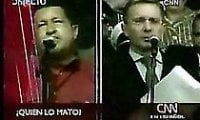
Last night CNN en Español aired the above image, which captions at the bottom "Who Killed him?" by "accident". The image of President Chavez with the caption about killing him below, which some could say subliminally incites to assassination, was a "production error" mistakenly made in the CNN en Español newsroom. The news anchor had been narrarating a story about the situation between Colombia and Venezuela and then switched to a story about an unsolved homicide but - oops - someone forgot to change the screen image and President Chavez was left with the killing statement below. Today they apologized and admitted it was a rather "unfortunate" and "regrettable" mistake. Yes, it was.

On a scarier note, an internal CIA memorandum has been obtained by Venezuelan counterintelligence from the US Embassy in Caracas that reveals a very sinister - almost fantastical, were it not true - plan to destabilize Venezuela during the coming days. The plan, titled "OPERATION PLIERS" was authored by CIA Officer Michael Middleton Steere and was addressed to CIA Director General Michael Hayden in Washington. Steere is stationed at the US Embassy in Caracas under the guise of a Regional Affairs Officer. The internal memorandum, dated November 20, 2007, references the "Advances of the Final Stage of Operation Pliers", and confirms that the operation is coordinated by the team of Human Intelligence (HUMINT) in Venezuela. The memo summarizes the different scenarios that the CIA has been working on in Venezuela for the upcoming referendum vote on December 2nd. The Electoral Scenario, as it's phrased, confirms that the voting tendencies will not change substantially before Sunday, December 2nd, and that the SI (YES) vote in favor of the constitutional reform has an advantage of about 10-13 points over the NO vote. The CIA estimates abstention around 60% and states in the memo that this voting tendency is irreversible before the elections.

Officer Steere emphasizes the importance and success of the public relations and propaganda campaign that the CIA has been funding with more than $8 million during the past month - funds that the CIA confirms are transfered through the USAID contracted company, Development Alternatives, Inc., which set up operations in June 2002 to run the USAID Office for Transition Initiatives that funds and advises opposition NGOs and political parties in Venezuela. The CIA memo specifically refers to these propaganda initiatives as "psychological operations" (PSYOPS), that include contracting polling companies to create fraudulent polls that show the NO vote with an advantage over the SI vote, which is false. The CIA also confirms in the memo that it is working with international press agencies to distort the data and information about the referendum, and that it coordinates in Venezuela with a team of journalists and media organized and directed by the President of Globovision, Alberto Federico Ravell.

CIA Officer Michael Steere recommends to General Michael Hayden two different strategies to work simultaneously: Impede the referendum and refuse to recognize the results once the SI vote wins. Though these strategies appear contradictory, Steere claims that they must be implemented together precisely to encourage activities that aim toward impeding the referendum and at the same time prepare the conditions for a rejection of the results.

How is this to be done?

In the memo, the CIA proposes the following tactics and actions:

  • Take the streets and protest with violent, disruptive actions across the nation
  • Generate a climate of ungovernability
  • Provoke a general uprising in a substantial part of the population
  • Engage in a "plan to implode" the voting centers on election day by encouraging opposition voters to "VOTE and REMAIN" in their centers to agitate others
  • Start to release data during the early hours of the afternoon on Sunday that favor the NO vote (in clear violation of election regulations)
  • Coordinate these activities with Ravell & Globovision and international press agencies
  • Coordinate with ex-militar officers and coupsters Pena Esclusa and Guyon Cellis - this will be done by the Military Attache for Defense and Army at the US Embassy in Caracas, Office of Defense, Attack and Operations (DAO)
To encourage rejection of the results, the CIA proposes:
  • Creating an acceptance in the public opinion that the NO vote will win for sure
  • Using polling companies contracted by the CIA
  • Criticize and discredit the National Elections Council
  • Generate a sensation of fraud
  • Use a team of experts from the universities that will talk about how the data from the Electoral Registry has been manipulated and will build distrust in the voting system
The CIA memo also talks about:
  • Isolating Chavez in the international community
  • Trying to achieve unity amongst the opposition
  • Seek an aliance between those abstentionists and those who will vote "NO"
  • Sustain firmly the propaganda against Chavez
  • Execute military actions to support the opposition mobilizations and propagandistic occupations
  • Finalize the operative preparations on the US military bases in Curacao and Colombia to provide support to actions in Venezuela
  • Control a part of the country during the next 72-120 hours
  • Encourage a military rebellion inside the National Guard forces and other components
Those involved in these actions as detailed in the CIA memo are:
  • The CIA Office in Venezuela - Office of Regional Affairs, and Officer Michael Steere
  • US Embassy in Venezuela, Ambassador Patrick Duddy
  • Office of Defense, Attack and Operations (DAO) at the US Embassy in Caracas and Military Attache Richard Nazario
Venezuelan Political Parties:
  • Comando Nacional de la Resistencia
  • Accion Democratica
  • Primero Justicia
  • Bandera Roja
Media:
  • Alberto Federico Ravell & Globovision
  • Interamerican Press Society (IAPA) or SIP in Spanish
  • International Press Agencies
Venezuelans:
  • Pena Esclusa
  • Guyon Cellis
  • Dean of the Simon Bolivar University, Rudolph Benjamin Podolski
  • Dean of the Andres Bello Catholic University, Ugalde
  • Students: Yon Goicochea, Juan Mejias, Ronel Gaglio, Gabriel Gallo, Ricardo Sanchez

Operation Tenaza has the objective of encouraging an armed insurrection in Venezuela against the government of President Chavez that will justify an intervention of US forces, stationed on the military bases nearby in Curacao and Colombia. The Operation mentions two countries in code: as Blue and Green. These refer to Curacao and Colombia, where the US has operative, active and equipped bases that have been reinforced over the past year and a half in anticipation of a conflict with Venezuela.

The document confirms that psychological operations are the CIA's best and most effective weapon to date against Venezuela, and it will continue its efforts to influence international public opinion regarding President Chavez and the situation in the country.

Operation Tenaza is a very alarming plan that aims to destabilize Venezuela and overthrow (again) its legitimate and democratic (and very popularly support) president. The plan will fail, primarily because it has been discovered, but it must be denounced around the world as an unacceptable violation of Venezuela's sovereignty.

The original document in English will be available in the public sphere soon for viewing and authenticating purposes. And it also contains more information than has been revealed here.

For the full text in Spanish, see: Operación Tenaza: Informe confidencial de la CIA devela plan de saboteo al referéndum del 2 de diciembre

Original article posted here.

Monday, November 19, 2007

Attacks on the crumbling dollar from Bush's best friends

Ahmadinejad: OPEC members considering non-dollar reserves
RIYADH, Saudi Arabia (AP) -- Iranian President Mahmoud Ahmadinejad said Sunday that OPEC's members have expressed interest in converting their cash reserves into a currency other than the depreciating U.S. dollar, which he called a "worthless piece of paper."

art.iran.president.afp.gi.jpg

Iranian President Mahmoud Ahmadinejad attends the OPEC meeting in Riyadh.

His comments at the end of a rare summit of OPEC heads of state exposed fissures within the 13-member cartel -- especially after U.S. ally Saudi Arabia was reluctant to mention concerns about the falling dollar in the summit's final declaration.

The hardline Iranian leader's comments also highlighted the growing challenge that Saudi Arabia, the world's largest oil producer, faces from Iran and its ally Venezuela within the Organization of Petroleum Exporting Countries (OPEC).

"They get our oil and give us a worthless piece of paper," Ahmadinejad told reporters after the close of the summit in the Saudi capital of Riyadh. He blamed U.S. President George W. Bush's policies for the decline of the dollar and its negative effect on other countries.

Oil is priced in U.S. dollars on the world market, and the currency's depreciation has concerned oil producers because it has contributed to rising crude prices and has eroded the value of their dollar reserves.

"All participating leaders showed an interest in changing their hard currency reserves to a credible hard currency," Ahmadinejad said. "Some said producing countries should designate a single hard currency aside from the U.S. dollar ... to form the basis of our oil trade."

Venezuelan President Hugo Chavez echoed this sentiment Sunday on the sidelines of the summit, saying "the empire of the dollar has to end."

"Don't you see how the dollar has been in free-fall without a parachute?" Chavez said, calling the euro a better option.

Saudi Arabia's King Abdullah had tried to direct the focus of the summit toward studying the effect of the oil industry on the environment, but he continuously faced challenges from Ahmadinejad and Chavez.

Iran and Venezuela have proposed trading oil in a basket of currencies to replace the historic link to the dollar, but they had not been able to generate support from enough fellow OPEC members -- many of whom, including Saudi Arabia, are staunch U.S. allies.

Both Iran and Venezuela have antagonistic relationships with the U.S., suggesting their proposals may have a political motivation as well. While Tehran has been in a standoff with Washington over its nuclear program, left-wing Chavez is a bitter antagonist of Bush. U.S. sanctions on Iran have also made it increasingly difficult for the country to do business in dollars.

During Chavez's opening address to the summit on Saturday, the Venezuelan leader said OPEC should "assert itself as an active political agent." But Abdullah appeared to distance himself from Chavez's comments, saying OPEC always acted moderately and wisely.

A day earlier, Saudi Arabia opposed a move by Iran on Friday to have OPEC include concerns over the falling dollar included in the summit's closing statement after the weekend meeting. Saudi Arabia's foreign minister warned that even talking publicly about the currency's decline could further hurt its value.

But by Sunday, it appeared that Saudi Arabia had compromised. Though the final declaration delivered Sunday did not specifically mention concern over the weak dollar, the organization directed its finance ministers to study the issue.

OPEC will "study ways and means of enhancing financial cooperation among OPEC ... including proposals by some of the heads of state and governments in their statements to the summit," OPEC Secretary General Abdalla Salem el-Badri said, reading the statement.

Iran's oil minister went a step further and said OPEC will form a committee to study the dollar's affect on oil prices and investigate the possibility of a currency basket.

"We have agreed to set up a committee consisting of oil and finance ministers from OPEC countries to study the impact of the dollar on oil prices," Gholam Hussein Nozari told Dow Jones Newswires.

Iraqi Oil Minister Hussein al-Shahristani said the committee would "submit to OPEC its recommendation on a basket of currencies that OPEC members will deal with." He did not give a timeline for the recommendation.

The meeting in Riyadh, with heads of states and delegates from 13 of the world's biggest oil-producing nations, was the third full OPEC summit since the organization was created in 1960.

Abdullah tried to take the focus off the dollar debate, announcing the donation of $300 million to set up a program to study the effect of the oil industry on the environment. Kuwait, Qatar and the United Arab Emirates also agreed to donate $150 million each to the fund, Prince Saud Al-Faisal, Saudi Arabia's foreign minister, said Sunday.

The run-up to the meeting was dominated by speculation over whether OPEC would raise production following recent oil price increases that have approached $100. But cartel officials have resisted pressure to increase oil production and said they will hold off any decision until the group meets next month in Abu Dhabi, United Arab Emirates.

They have also cast doubt on the effect any output hike would have on oil prices, saying the recent rise has been driven by the falling dollar and financial speculation by investment funds rather than any supply shortage.

During his final remarks, el-Badri stressed he was committed to supply -- but did not mention changing oil outputs.

"We affirm our commitment ... to continue providing adequate, timely, efficient, economic and reliable petroleum supplies to the world market," he said.

Original article posted here.

Tuesday, November 06, 2007

Tyranny by any name is still tyranny. Weazl likes Chavez, but not these changes

Top former general breaks with Chavez over constitutional changes

CARACAS, Venezuela (CNN) -- An ex-general who helped President Hugo Chavez through an abortive coup against his leadership in 2002 publically broke with the president Monday over proposed constitutional changes.

art.venezuela.constitution.ap.jpg

Baduel holds a copy of Venezuela's national constitution during a news conference in Caracas on Monday.

Approval of the proposed changes "would in effect finalize a coup d'etat, brazenly violating the constitution," former Defense Minister Raul Baduel said at a news conference. "The Venezuelan people should categorically reject this fraud."

Venezuela's pro-Chavez National Assembly on Friday overwhelmingly approved a package of 69 changes to the 1999 Constitution. The changes would institutionalize Chavez's bid to implant a new model of development -- called "Socialism for the 21st Century" -- in the country while strengthening the power of the executive to rule by decree. It would also change electoral rules and allow a sitting president to seek unlimited re-election -- grandfathering Chavez into that system.

Opposition and human rights groups have been particularly critical of how the changes would give the president greater latitude to impose a state of emergency and suspend individual rights, as well as how they would place further restrictions on the news media. Protesters and security forces have clashed repeatedly in recent weeks as opposition to the changes moved into the streets. Video Watch protesters in Venezuela »

Baduel, who was Chavez's defense minister and military general in chief until July, became the highest-profile former military official to criticize Chavez's constitutional designs. He targeted his stinging criticism on how the changes would concentrate power in the executive.

"Constitutions are born precisely to limit the power of governments and to protect citizens from the abusive exercise of power, guaranteeing their rights and liberties," Baduel said. "They shouldn't do the opposite."

"Any Constitution that removes the limits on power should be viewed with suspicion," he continued, calling on "on all Venezuelans to vote 'No'" when the changes are put to a public referendum in December.

Baduel's harsh criticism -- and the public nature of his break with his former comrade in arms -- was a sharp counterpoint to their previous relationship.

The two came up through the officer corps together as both military and philosophical brothers in arms: Baduel participated with Chavez in his 1992 coup attempt against President Carlos Andres Perez, but escaped being cashiered from the army because his role in the plot didn't come to light.

Then, as commander of the 42nd Airborne Brigade in Maracay, Baduel's support was critical in helping overturn the abortive coup d'etat in 2002 that briefly unseated Chavez -- and opened the way for Chavez to strengthen his grip on power by moving to clear dissident officers from the military and put the opposition on the defensive.

Baduel was soon promoted up the chain of command, first being put in overall command of the army's main garrison at Maracay and then, in 2006, taking over as general-in-chief and, in July 2006, as defense minister. In all of those roles, he was seen as a right-hand man to Chavez as Chavez reshaped the military from a traditional institutional military into a politicized arm of his "Bolivarian Revolution," and worked to reshape Venezuela as a whole.

However, when he was replaced in July by Gen. Gustavo Rangel Briceno of the Military Reserve and National Mobilization forces, Baduel gave a broad hint of the break to come, using the bulk of his retirement speech to critique the idea of "Socialism for the 21st Century."

"A socialist regime is not incompatible with a democratic system of checks and balances and division of powers," he said. "We must separate ourselves from Marxist orthodoxy."

Original article posted here.

Sunday, November 04, 2007

Wargaming futility

Oil crisis exercise bares US 'impotence'


It's August 2009, oil prices have topped 150 dollars a barrel and a secret uranium plant has been detected in Iran.

Tehran and Caracas are slashing oil exports by 700,000 barrels to punish the west for sanctions, and the US military is ready to move its entire Pacific fleet into the Middle East to counter threats.

It may be tomorrow's headlines, but on Thursday a high-powered panel of Washington insiders acting as the US president's national security council found they would face almost impossible choices and be powerless in such a case, baring the United States' growing inability to lead in global crises.

"In this kind of hostile environment (Iran and Iraq) would have the upper hand," said Gene Sperling, who played the treasury secretary in the exercise.

It "would make us look impotent," he added.

"This scenario could start tomorrow," said retired general John Abizaid, the former US Central Command chief.

Put on by the Securing America's Future Energy and the Bipartisan Policy Center, the unscripted one-day simulation sought to emphasize the danger of the narrow gap between world oil production capacity and demand, and the heavy US dependence on oil imports.

But it exposed the strained US military's incapacity to project its power over multiple regions, and the ability of even small countries to provoke a world political and economic crisis.

To play a White House team reacting to the news in real time, SAFE brought together nine former top presidential advisors and officials with intimate knowledge of national security affairs.

The "council" included former treasury secretary Robert Rubin playing the president's national security advisor, former deputy secretary of state Richard Armitage as secretary of state, former navy secretary John Lehman as secretary of defense, and former national security council official Philip Zelikow as national intelligence director.

The scenario they woke up to on May 4, 2009 was the loss to world markets of one million barrels a day in oil supplies when saboteurs in Azerbaijan caused the shutdown of the Baku-Tbilisi-Ceyhan pipeline.

The action heightened geopolitical tensions in the region and sent oil prices from the mid-90 dollar range to 115 dollars a barrel.

With the stock markets plummeting, the council has to advise the president what to say and do, and finds its hands tied by the strains of the Iraq war and by domestic politics.

"Energy Secretary" Carol Browner -- head of the US Environmental Protection Agency in the 1990s -- says the president can release oil from the strategic reserve to alleviate gasoline prices, or call for conservation with lower speed limits, a Sunday driving ban, and other measures.

Looking at possible Russian or Iran involvement in the Azerbaijan blast, "joint chiefs chairman" Abizaid says the strategic reserve has to be kept for military needs.

Others say the public and Congress would not accept forced conservation.

With no information on who made the Azerbaijan attack -- Armenians? pro-Russian elements? Iran? -- the defense and intelligence officials say they have to be on alert but do not know what else to do.

"Our ability to project power into this area is very limited. We are strung out all over the globe," said Lehman, noting the military hasn't begun to rebuild after years in Afghanistan and Iraq.

Rubin points out that with global production capacity almost maxed out, there is little possibility of replacing the lost oil flow.

"It shows how weak our hand is," he says, as the group falters on urging the president to do more than assuage US consumers.

Three months later, the situation has drastically worsened. A secret uranium enrichment plant was discovered in Iran, confirming its nuclear weapon ambitions, and oil production in Nigeria has been curtailed by rebel attacks.

As the council meets, Iran has just replied to threatened new Western sanctions by cutting back its oil production and Venezuela follows suit, sending prices past 150 dollars.

The president's advisors say there are no short-term measures to soften the economic or political blow. They also admit sanctions on Iran have little effect, that high oil prices and short supply actually encourage producer cutbacks.

Militarily, with Israel threatening to take action on Iran itself, the Pentagon says the US has to project force in the region. But doing so means moving the entire Pacific fleet to the Middle East, ceding power in the Pacific -- and Taiwan -- to China.

After failing to demand sacrifices from the American public in the years following the 9/11 attacks, the new crisis has brought things to a head, Lehman said, as he suggests reviving the draft.

"We are facing a mortal threat to our way of life here," he said.

Original article posted here.

Tuesday, August 21, 2007

Taking the Chavez revolution to the First World

Chávez deal to aid low-income Londoners

Lee Glendinning
Tuesday August 21, 2007
The Guardian


Up to a million people on income support will be eligible for half fares on London's buses under Ken Livingstone's oil deal with Hugo Chávez, Venezuela's president.

Single parents, carers, the long-term sick and disabled people will benefit from the plan, first mooted during Mr Chávez's visit to the UK last year, paying 50p for a single journey if they use an Oystercard.

In exchange for a 20% oil discount to fuel London buses, an office will be set up in Caracas, Venezuela's capital, where London officials will offer expertise in town planning, tourism, public transport and environmental protection.

Under the scheme applicants must take proof of their income support status to a post office to get a special photocard for a discounted Oystercard.

Mr Livingstone, London's mayor, said London and Venezuela had exchanged "those things in which they are rich to the mutual benefit of both".

"This will make it cheaper and easier for people to go about their lives and get the most out of London," he said. "The agreement which makes this possible will also benefit the people of Venezuela, by providing expertise in areas of city management in which London is a world leader."

Angie Bray, the Conservative leader in the London assembly, said Mr Livingstone should rather have appealed to the Treasury if he needed financial support. "The spectacle of our mayor ... going cap in hand to a dictator ... is morally indefensible," she added.

From September 30, a 10% a fare cut will also be introduced, meaning a single bus journey will be reduced to 45p for those on income support.

Original article posted here.

Sunday, August 12, 2007

Still making moves south of the border

Slaying Vampires: Chavez Proposes South American Energy Treaties

Written by April Howard

Image''Argentina is freeing itself from Dracula, breaking the chains of the International Monetary Fund,'' Venezuelan president Hugo Chávez said from Buenos Aires. During a current tour of Latin America, Chavez named regional strength as his goal for a new “energy security treaty” with Argentina.

Hugo Chavez announced in Buenos Aires on August 8th that he had signed an "energy security treaty" with Argentina. Currently, Argentina is experiencing an unusually cold winter and a lack of fuel, due to increased energy needs. Building new industries in Venezuela and supplying Venezuelan gas to Argentina, he said, are actions meant to diversify economies and increase national sovereignty and regional integration across the continent.

Chavez also announced plans to make similar agreements to guarantee an energy supply to the countries of Uruguay, Bolivia and Ecuador, which are the next stops on his current tour of the region. The agreement calls for "ample and sustained co-operation" on energy initiatives, including "the distribution of natural gas through pipelines, joint oil refining projects and coordinated efforts on distributing power and alternative fuels."

Mercosur Melancholy

During the visit, Argentine President Kirchner said he supports Chavez's effort to make Venezuela a full member of the Mercosur, the South American trade bloc. Members Argentina and Uruguay have approved Venezuela as a new member, but members Paraguay and Brazil haven’t agreed. Brazilian President Luiz Inacio Lula da Silva is currently on a tour of Mexico and Central America, making biofuel agreements along with other deals. Brazil is on a political and economic upswing, based mainly on the booming agrofuel industry.

Some Brazilian politicians have claimed that Venezuela hasn’t complied with Mercosur's commitment to democracy, due to Chavez's decision last May not to renew Radio Caracas Television’s (RCTV) broadcast license. The Chavez administration says that RCTV played a role in a failed coup in 2002.

Repackaged Debt

The treaty’s announcement on Monday was prefaced by Chavez’s confirmation of Venezuela’s commitment to buy up to $1 billion in Argentine bonds, to help Argentina free itself from "Dracula:" the International Monetary Fund (IMF). In 2001, Argentina defaulted on $100 billion in debt to the IMF, later paying creditors less than a third of that amount. In the beginning of 2006, Argentine President Nestor Kirchner initiated a repay of the remaining $9.6 billion to the IMF, in an attempt to achieve greater economic independence.

The Chavez administration, one of the main sources of financing for the Argentinean government since 2005, is expected "to repackage the Argentine debt with Venezuelan bonds for sale in the domestic market to soak up excess liquidity in the economy and serve pent-up demand for foreign exchange." The first half of the purchased bonds will be made into a part of the third release of the joint Argentine-Venezuelan Bono del Sur (Bonds of the South). According to the AP, "the Venezuelan government has profited by reselling Argentine debt, and has used such bond sales as a tool to beat back inflation, which last year reached 17 percent amid heavy government spending."

Chavez described the bond purchase as a step towards the creation of an alternative financial system in Latin America. Chavez sees this project as symbolized by the Bank of the South, which he said will bring the region "toward our financial independence, freeing us from the perverse chains of the International Monetary Fund."

Regional Integration

While the concept of the "energy security treaties" follows Chavez’s trend of gaining allies through "petro-diplomacy," based on Venezuela’s large oil and gas reserves, but Chavez stressed the idea of energy cooperation as a mutually beneficial act.

Kirchner and Chavez also agreed to unite companies from both nations in a South American oil company. The company, to be named Petrosuramerica, will develop joint projects to complement the two nations' economies. Chavez also made plans with Argentina’s National Institute of Industrial Technology (INTI) "to build 56 factories in Venezuela in 21 different sectors, from food . . . to the production of electric motors," and a separate cooperative project to produce milk.

With Argentina’s help, Chavez said, Venezuela could develop industry, diversify its own economy, and move away from "the oil sultanate economic model." During the visit, Chavez also confirmed that Venezuela will help Argentina by financing a $400-million gas plant.

According to the "energy treaty," the countries will work together in Argentina over the next two years to construct a liquid natural gas refinery to refine Venezuelan gas. In the near future, the gas will have to be transported to Argentina by sea, since the multinational Gas Pipeline of the South project is on hold. Chavez promised continued construction of the Pipeline, which is intended to bring Venezuelan gas to Brazil and Argentina.

Chavez sees regional integration as a tool for creating economic and political power. "With the advances of Argentina in petrochemicals, along with the Venezuelan material initiatives, we can convert South America into a world power in petrochemicals," he said.

Also while in Argentina, Chavez noted that "The United States has 5% of the world's population, but it consumes more than 20% of the energy used in the planet." He said that the US’s "insatiable voracity" for oil has led it to violently force its will on Latin America in the past.

Original article posted here.