


Attack on Iran Off the Table?
By Ray McGovern
On Sept. 23, the neoconservative chiefs of the Washington Post's editorial page mourned, in a tone much like what one hears on the death of a close friend, that "a military strike by the United States or Israel on Iran is not likely in the coming months." One could almost hear a wistful sigh, as they complained that efforts to stop Iran's nuclear program has "slipped down Washington's list of priorities … as Iran races toward accumulating enough uranium for a bomb."
We are spared, this go-round, from "mushroom clouds." But racing to a bomb? Never mind that the 16 agencies of the U.S. intelligence community concluded in a formal National Intelligence Estimate last November that work on the nuclear weapons-related part of Iran's nuclear program was halted in mid-2003. And never mind that Thomas Fingar, National Intelligence Director Mike McConnell's deputy for national estimates, reiterated that judgment as recently as Sept. 4. Never mind that the Post's own Walter Pincus reported on Sept. 10 that Fingar added that Iran has not restarted its nuclear weapons work. Hey, the editorial fellows know best.
The good news is that the bottom line of the Sept. 23 editorial marks one of those rare occasions when the Post's opinion editors have managed to reach a correct conclusion on the Middle East. It is true that the likelihood of an Israeli or U.S.-Israeli attack on Iran has receded in recent months. The more interesting questions are (1) why? And (2) under what circumstances might such an attack become likely again?
The Post attributes the stepping back by Israel and the U.S. to "the financial crisis and the worsening violence in Afghanistan and Pakistan." These are two contributing factors but, in my judgment, not the most important ones. Not surprisingly, the Post and other charter members of the Fawning Corporate Media (FCM) omit or play down factors they would prefer not to address.
Russia and Deterrence
More important than the bear market is the Russian bear that, after a 17-year hibernation, has awakened with loud growls commensurate with Russia's growing strength and assertiveness. The catalyst was the fiasco in Georgia, in which the Russians saw the hands of the neocons in Washington and their doppelgänger, the extreme Right in Israel.
You would hardly know it from FCM coverage, but the fiasco began when Georgian President Mikheil Saakashvili ordered his American- and Israeli-trained Georgian armed forces to launch an attack on the city of Tskhinvali, capital of South Ossetia, on the night of Aug. 6-7, killing not only many civilians but a number of Russian observers as well.
It may be true that our State Department officials had counseled Saakashvili against baiting the Russian bear, but it is abundantly clear to anyone paying attention to such things that State is regularly undercut/overruled by White House functionaries like arch-neocon Elliott F. Abrams (F. for Fiasco). His encomia include those earned for his key role in other major fiascoes like the one that brought about the unconscionable situation today in Gaza. (Would that the president's father had let Abrams sit in jail, rather than pardoning him after he was convicted for perjuring himself in testimony to Congress on the Iran-Contra fiasco.)
In any event, it is almost certainly true that Russian Prime Minister Vladimir Putin saw folks like Abrams, Vice President Dick Cheney, and their Israeli counterparts as being behind the attack on South Ossetia. For centuries the Russians have been concerned – call it paranoid – over threats coming from their soft southern underbelly, and their reaction could have come as no surprise to anyone familiar with Russian history – or, by analogy, those familiar with American history and the Monroe Doctrine, for example.
Even neocon Randy Scheunemann, foreign policy adviser to Sen. John McCain and former lobbyist for Georgia's Saakashvili, would have known that. And this lends credence to speculation that that is precisely why Scheunemann is said to have egged on the Georgian president. Russia's reaction was totally predictable, and it enabled McCain to "stand up to Russia" with very strong rhetoric and not-so-subtle suggestions that his foreign policy experience provides an important advantage over his opponent in meeting the growing danger of a resurgent Russia.
Russia's leaders are likely to have seen in Saakashvili's provocation, in the attempt to get NATO membership for Georgia and Ukraine, in the deployment of anti-missile defenses in Poland and the Czech Republic, and in hasty U.S. recognition of an independent Kosovo indignities that Russia should no longer tolerate.
I can visualize Russian generals telling Putin:
Enough! Look at the weakened Americans. They have destroyed what's left of their Army and Marine Corps, spreading them out and demoralizing them in two unwinnable wars. We know how bad it is with just one unwinnable war. It has not been that long since Afghanistan. But, Vladimir Vladimirovich, before we indulge ourselves with schadenfreude, consider what such actions betoken – total recklessness of a kind we have seen only rarely in Washington.
Who can assure us that "the crazies" – the Cheney-Abrams-Bush cabal – will not encourage the Israelis to precipitate the kind of armed provocation vis-à-vis Iran that would "justify" America's springing to the defense of its "ally" to bomb and missile-attack Iran? You are aware of the importance of the Israel lobby, and how American politicians vie with one another to prove themselves the most passionately in love with Israel.
Periodic attempts by Congress to require President Bush to seek congressional approval before ordering a strike on Iran have failed miserably. So his hands are free for another "preemptive war" before he leaves office. After all, Bush has publicly promised the Israelis he will deal with the "Iranian threat" before then. Besides, our political analysts suggest that Bush and Cheney might think that wider war would help the Republicans in the November election
No big bear likes to have its nose tweaked. But the Russian reaction to Georgia was not merely one of pique. It became a well-planned strategic move to disabuse Israel and the United States of the notion that Russia would sit still for an attack on Iran, a very important country in Russia's general neighborhood. After Georgia, the Russians were bent on sweeping such plans "off the table," so to speak, and seem to have succeeded.
The signs of new Russian assertiveness are in the public domain, although the FCM has not given them much prominence. What is more telling is the effect on Israel and the United States. Since early August there has been a sharp decline in the formulaic rhetoric against Iran's "path toward nuclear weapons," especially among U.S. policymakers and in American media following the conflict in Georgia and the expiration of the latest "ultimatum" served on Iran to stop its nuclear program.
The change in official Israeli statements was the most pronounced. After a consistently hawkish stance toward Iran, Israel's president, Shimon Peres told London's Sunday Times in early September:
"There are two ways to deal with Iran's nuclear threat; a military and a civilian way. I don't believe in the military option – any kind of military option … an attack can trigger a bigger war."
And then came the bombshell from Ehud Olmert in his valedictory interview appearing in the Israeli daily Yediot Ahronot on Sept. 29. Olmert argued that Israel had lost its "sense of proportion" in believing it could deal with Iran militarily.
Not Russia Alone
It is a curious twist, but to their great credit, senior military officers Adm. William Fallon, who quit rather than let himself be on the receiving end of an order to attack Iran, and Adm. Mike Mullen, chairman of the Joint Chiefs of Staff, fought and continue to fight a rearguard action against the dreams and plans of "the crazies" in the White House to attack Iran. Fallon famously declared that the U.S. military was not going to "do Iran on my watch" as commander of Centcom.
In addition to his outspoken opposition to opening a "third front" in the area of Iraq and Afghanistan, Mullen has done much behind the scenes to talk sense into the Israelis. From the Israeli press we know that Mullen went so far as to warn his Israeli counterparts not to even think about another incident like the one on June 8, 1967, when Israeli jets and torpedo boats deliberately did their utmost to sink the intelligence collector USS Liberty off the Sinai coast.
A gutsy move. The Israelis know that Mullen knows that that attack was deliberate – not some sort of unfortunate mistake. Mullen could have raised no more neuralgic an issue in taking a shot across any Israeli bow that might be thinking of a provocation of some sort in the Persian Gulf.
Hats off to the new admirals… who outshine predecessor admirals who bowed to pressure from President Lyndon Johnson to portray the Israeli air and torpedo strikes on the USS Liberty, which took the lives of 34 U.S. sailors and wounded more than 170 others, as a mistake in the fog of war – despite unimpeachable evidence it was deliberate.
Hats off, too, to the grassroots movements that succeeded in quashing resolutions in both houses of Congress calling for the equivalent of a blockade of Iran. Several members actually withdrew their earlier sponsorship of the resolution in the wake of public pressure. Many of them came to realize that facilitating a new war might make them vulnerable to charges of poor judgment – the kind of charges that sabotaged Sen. Hillary Clinton, who, ironically, thought she had done the politically smart thing in voting to give the president authority to attack Iraq.
Not Completely Out of the Woods
There remain as many "crazies" among the Israeli leadership as there are here in Washington – crazies who continue to believe that Iran must be attacked while the going is good. And it will never be as good as it is with Bush and Cheney in the White House. If the Randy Scheunemanns of this world are capable of goading the likes of Saakashvili into irresponsible action, they can try to do the same with a wink and a nod to the crazies in Tel Aviv.
The fact that the McCain/Palin campaign seems to be in serious jeopardy provides still more incentive for recklessness. If, as all seem to agree, a terrorist event of some kind might give the edge to McCain, many could argue that the same result could be achieved by a wider war including Iran, requiring the senior, seasoned leadership of one who has "worn the uniform."
And there is still more incentive for Bush and Cheney to look with favor on an attack on Iran… very personal incentive. It is a safe bet that if John McCain loses, Bush and Cheney and others will be plagued by various legal actions against them for the war crimes for which they are clearly responsible. Such would also be possible under a President McCain or Palin – but much less likely.
But attacking Iran would be crazy, you say. Not for nothing have many of the folks around Bush and Cheney been referred to as "the crazies" since the early Eighties. Some are still there; and they do things.
In April 2006, one of my Veteran Intelligence Professionals for Sanity (VIPS) colleagues, in a conversation with Marine Gen. Anthony Zinni, asked the general if he thought the U.S. or the U.S.-cum-Israel would attack Iran. Zinni shook his head vigorously, saying, "That would be crazy." Then he stopped and quickly added that we are dealing with "the crazies."
Ray McGovern was chief of the Soviet Foreign Policy Branch at the beginning of his 27-year career as a CIA analyst. He is co-founder of VIPS, and now works with Tell the Word, the publishing arm of the ecumenical Church of the Saviour in inner-city Washington.
Original article posted here.
Showing posts with label Broken Military. Show all posts
Showing posts with label Broken Military. Show all posts
Wednesday, October 22, 2008


Thursday, August 21, 2008
Never too broke for more killing machines
Boeing Awarded Contract To Continue Developing Mobile Laser Weapon
by Staff Writers
Boeing has been awarded a U.S. Army contract valued at approximately $36 million to continue developing a truck-mounted, high-energy laser weapon system that will destroy rockets, artillery shells and mortar rounds.
 The objective of the HEL TD program is to demonstrate that a mobile, solid-state laser weapon system can effectively counter rocket, artillery and mortar projectiles. The program will support the transition to a full-fledged Army acquisition program. |
by Staff Writers
Boeing has been awarded a U.S. Army contract valued at approximately $36 million to continue developing a truck-mounted, high-energy laser weapon system that will destroy rockets, artillery shells and mortar rounds.
Under the High Energy Laser Technology Demonstrator (HEL TD) Phase II contract, awarded Aug. 15, Boeing will complete the design of, then build, test and evaluate, a rugged beam control system on a Heavy Expanded Mobility Tactical Truck.
Boeing also will develop the system-engineering requirements for the entire HEL TD laser weapon system. Boeing successfully completed the preliminary design of the beam control system earlier this summer.
"This contract award is an important win for Boeing because it supports a cornerstone of the Army's high-energy laser program," said Scott Fancher, vice president and general manager of Boeing Missile Defense Systems.
"HEL TD will give warfighters a transformational capability to counter the difficult threats posed by rockets, artillery shells and mortar projectiles."
"Boeing spent the past year developing the preliminary design of the HEL TD beam control system, and we appreciate the confidence the Army has shown in our efforts by awarding us these contract options to continue working on the program," said Gary Fitzmire, vice president and program director of Boeing Directed Energy Systems.
The objective of the HEL TD program is to demonstrate that a mobile, solid-state laser weapon system can effectively counter rocket, artillery and mortar projectiles. The program will support the transition to a full-fledged Army acquisition program.
Boeing leads the way in developing high-energy laser systems for a variety of warfighter applications. These systems include the Airborne Laser, the Advanced Tactical Laser, the Tactical Relay Mirror System and Laser Avenger.
Friday, August 08, 2008
With a broken US military, Russia has officially "flexed," and the West can do nothing to stop it.
Georgia 'under attack' as Russian tanks roll in 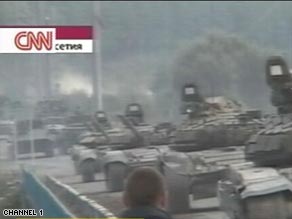


ru.
TBLISI, Georgia (CNN) -- Georgia's president said Friday that his country is under attack by Russian tanks and warplanes, and he accused Russia of targeting civilians as tensions over the breakaway Georgian region of South Ossetia appeared to boil over into full-blown conflict.
Russia's Channel 1 shows heavy tanks purported to be on their way to South Ossetia.
1 of 2
"All day today, they've been bombing Georgia from numerous warplanes and specifically targeting (the) civilian population, and we have scores of wounded and dead among (the) civilian population all around the country," President Mikhail Saakashvili told CNN in an exclusive interview.
"This is the worst nightmare one can encounter," he said.
Asked whether Georgia and Russia were now at war, he said, "My country is in self-defense against Russian aggression. Russian troops invaded Georgia."  Watch the interview with Saakashvili »
About 150 Russian armored vehicles have entered South Ossetia, Saakashvili said, and Georgian forces had shot down two Russian aircraft.
Russia's Defense Ministry said it sent "reinforcements" to South Ossetia to help the Russian peacekeepers already stationed there. Watch the Russian tanks moving into the area »
The events followed an emergency session of the U.N. Security Council to discuss a dramatic escalation of violence in Georgia and South Ossetia. The session ended Friday morning without a statement about the fighting.
The Organization for Security and Cooperation in Europe (OSCE) said it was sending an envoy to the region immediately.
NATO Secretary-General Jaap de Hoop Scheffer issued a statement Friday saying he was seriously concerned about the recent events in the region, and he called on all sides to end armed clashes and begin direct talks. Watch more about NATO's attempts to help Georgia »
Carmen Romero, a NATO spokeswoman speaking to CNN from Brussels, reiterated Scheffer's statement. She said NATO was in regular contact with Georgia's president and was talking to the Russian side.
Britain and the United States also urged all sides to bring an immediate end to the violence.
"The U.S. has been in discussions for many months with all parties to find a peaceful resolution," said White House spokesman Gordon Johndroe. "We urge all sides to refrain from violence and to begin direct talks."
Earlier Friday, Russian military aircraft dropped two bombs on Georgian territory, a Georgian official said, causing no casualties.
In a letter addressed to his "fellow citizens" Friday, Saakashvili said he had mobilized tens of thousands of reserve officers and that the mobilization continued.
"We must unite," Saakashvili wrote. "All of us, hundreds of thousands of Georgians here and abroad, should come together, unite, and fight to save Georgia. We are a freedom-loving people, and if our nation is united, no aggressor will be able to harm it."
Georgia declared a unilateral three-hour ceasefire at 3 p.m. to enable civilians to escape from the conflict zone, which so far was focused inside South Ossetia but included aerial targets inside Georgia, Saakashvili said.
"Clearly they don't really have boundaries in their activities," said Georgian Foreign Minister Eka Tkeshelashvili, in an interview with CNN. She said Russian aircraft had bombed "several villages" in Georgia outside of the South Ossetian territory.
Tkeshelashvili said Georgian authorities are still collecting information on casualties.
Georgia was appealing to the world for diplomatic intervention, she said, stressing that Georgia was not asking for military assistance.
Violence has been mounting in the region in recent days, with sporadic clashes between Georgian forces and South Ossetian separatists. South Ossetia declared its independence from Georgia in the early 1990s, but its independence is not internationally recognized.
Georgian troops launched new attacks in South Ossetia late Thursday after a top government official said a unilateral cease-fire offer was met with separatist artillery fire.
Alexander Lomaia, the secretary of Georgia's National Security Council, said Georgian troops were responding proportionately to separatist mortar and artillery attacks on two villages -- attacks he said followed the cease-fire and call for negotiations by Saakashvili.
Russia said a Georgian attack on a military barracks left a number of Russian peacekeepers dead.
"It's all very sad and alarming," Russian Prime Minister Vladimir Putin said earlier in the day. "And, of course, there will be a response."
Putin was at a meeting with U.S. President Bush in Beijing, where they attended a luncheon for world leaders hosted by the Chinese president ahead of the Olympics, which begin Friday.
"There are lots of volunteers being gathered in the region, and it's very hard to withhold them from taking part. A real war is going on," Putin said, according to his spokesman, Dmitry Peskov.
Russian peacekeepers are in South Ossetia under a 1992 agreement by Russian, Georgian, and South Ossetian authorities to maintain what has been a fragile peace. The mixed peacekeeping force also includes Georgian and South Ossetian troops.
"The Georgian leadership has launched a dirty adventure," said a statement from Russia's Defense Ministry on Friday. "We will not leave our peacekeepers and Russian citizens unprotected."
Saakashvili said the Russian invasion of South Ossetia was pre-planned.
"These troops that are in Georgia now -- they didn't come unexpectedly," the president told CNN. "They had been amassing at the border for the last few months. They claimed they were staging exercises there and as soon as a suitable pretext was found, they moved in."
Georgia, located on the Black Sea coast between Russia and Turkey, has been split by Russian-backed separatist movements in South Ossetia and another region, Abkhazia.ru.
Wednesday, August 06, 2008
More on your unhealthy economy (the only time this government would tell the truth would be by mistake)
How Washington is Fooling You: Manipulated Employment Data
By: Mike_Stathis
Shell Game - The government and related agencies are responsible for reporting the nation's economic data. Thus, they're in the driver's seat to manipulate this data, while dumping so much of it onto consumers that they can't possibly analyze what's really going on. Each day, “critical” economic numbers are released by one or more agencies connected to Washington . And consumers look to Wall Street and the media to make heads or tails of this data. Of course, Wall Street is always going to paint a rosier picture for its own benefit. Meanwhile, the mainstream media merely serves as a puppet for Wall Street.
The main problem is that by the time this data has been reported it's already been manipulated. And when Wall Street gets a hold of it they make matters worse, tugging and pulling on the meaning of the numbers as a way to create market volatility. And this generates a lot of trading commissions.
The media does its part as well, interviewing analysts, fund managers and pundits to analyze the data. Analysts gain more banking business for companies they tout, while the firm's market makers and hedge funds take the short side as the dumb money rushes in. Fund managers pump up their number one holdings through praises of “great buying opportunities.” Yet the SEC never investigates whether these funds dump the stock shortly thereafter. And corporations continue to advertise on radio and television networks that maintain a policy of remaining bullish indefinitely. Together, they all feast upon the money created from this propaganda bonanza. Unfortunately, much of this money comes from individual investors who have been fooled by the “experts.” Always keep in mind the manner by which broadcasting networks make money. Then look at who they are interviewing and you will see their agenda.
Discouraged by the Economy
A few decades ago Washington economists came up with a new designation known as the “discouraged worker.” Such a person is thought to have “thrown in the towel” after several unsuccessful months searching for work. What happened to these discouraged workers? Why aren't they counted? More important, what is it about the economy that has caused these “discouraged workers” to be unable to obtain a new job after an extended period?
Knowing the number of discouraged workers is vital to understanding trends in the overall competitive landscape of the U.S. economy. Yet, these individuals are simply dropped from the list as if they no longer exist. Why was there no such thing as a “discouraged worker” fifty years ago? Back then, Americans who were willing to work found stable jobs so there was no need to hide the truth because the economy was much better. It was fueled on a health balance of production and consumption, savings and investment. As a result, America was the world's largest creditor and leading importer of goods. Today we see dramatic differences. Ever since the 1980s, America has been in decline. Real median wages have barely moved, America is the world's leading debtor, and foreign nations have bought critical U.S. assets using their trade surpluses combined with the weak dollar.
If things really haven't improved for most Americans why don't they realize it? Washington encourages consumers to spend on credit which has helped many live beyond their means. As well, the inexpensive labor of illegal aliens has also helped soften the blow. Finally, the prevalence of two-income households has been a significant component masking declining living standards. If you were to remove these three elements – consumer credit, illegal aliens, and two-income households – most Americans would feel an immediate collapse in living standards. In contrast, these elements didn't exist in the 1950s – America 's booming period. Think about the price we are paying for:
Consumer credit – exploitation by the financial industry and now a huge taxpayer bailout
Illegal aliens – increased crime, exhaustion of educational, heath care and other facilities paid for by tax dollars
Two-income households – breakdown of the family unit resulting in a huge divorce rate and teens that are very troubled
The Big Surveys
The two sources of employment data – the Household Survey and the Establishment Survey (payroll survey) - come from the Bureau of Labor Statistics from the Department of Labor, released on the first Friday of each month covering the previous month. This data serves as a primary driving force of market volatility. In particular, the Establishment Survey is considered the most insightful and accurate by financial institutions. But each has significant differences in the way the data is collected, analyzed and reported. For instance, the Establishment Survey makes no distinctions between part-time and full time employment. Thus, if an individual has two part-time jobs, the Household Survey considers records the data as one employed person. In contrast, the Establishment Survey records it as two jobs. In addition, the Establishment Survey does not count self-employed jobs. With so many key differences between the two surveys, without a clear explanation and interpretation of the data, the real employment picture is easily confused.
What's the Underemployment Rate?
Similar to all other economic indicators, employment data has been altered by the government and its affiliated economic organizations for over three decades. I argue that this has occurred to distort the realities of America 's not-so “great” economic picture. For instance, when the Labor Department measures unemployment data, it only counts those who have searched for jobs within the past four weeks. Previously under President Lyndon Johnson this cut off was six weeks but was lowered to make the numbers look better. As well, the government makes no distinctions between part-time workers who want full-time work but cannot find it; they're considered “employed” which is assumed to mean fully employed.
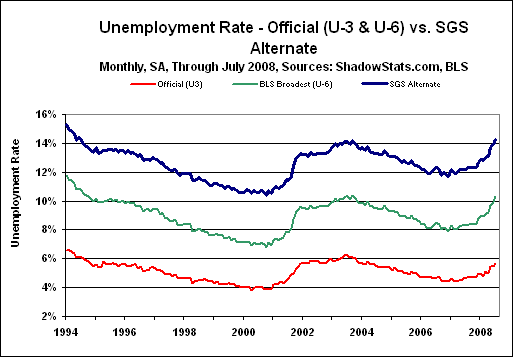
Courtesy of shadowstats.com
A much better measure of employment is to look at the underemployment rate , which is always much higher. While this data is available, you'll never hear about it from Washington because it demonstrates America 's declining job quality and competitiveness. Consider what would happen to consumer confidence if the real data was reported. Government employment figures also count workers employed in what are known as “non-standard jobs” with no distinctions. Typically, these jobs include temp workers, independent contractors, part-time workers and the self-employed. The main problem with counting these individuals as “employed” is that non-standard jobs rarely include critical employee benefits such as healthcare or retirement plans . And because America 's labor force depends upon a large percentage of employee benefits for total compensation (up to 42 percent of the median wage earners total compensation), a proper analysis of employment trends must consider non-standard employment data. However, this data is not included. Non-standard jobs are also much less secure than traditional jobs. Therefore they don't provide the assurance and benefits of a stable career, making it difficult for these workers to plan for the future. Consequently, the rapid growth of the non-standard employment labor market over the past two decades has added to the growing job insecurity within the traditional workplace.
In addition, employment data does not indicate how long workers have been with a particular employer. But this information is also a very important component towards understanding the financial security of workers. Because so many consumer costs are now annuitized in the form of financing agreements, contracts or mandatory fees (mortgages, auto loans, auto and health insurance, mobile phone contracts, cable, credit card payments, etc.), consumers are becoming increasingly dependent upon having a steady and reliable source of income to meet these committed future expenses. Yet, the average American worker has never seen a greater amount of job insecurity.
Even before the last recession (now in dispute as of 2004, See Part 2), estimates show that over 25 percent of America 's workforce was engaged in non-standard employment. There's little doubt that this percentage is significantly higher today due to the competitive effects of the free trade. Therefore, employment numbers, as reported by the government provide a false picture because they don't account for diminishing wages and total compensation.
The Birth/Death Fudge Factor
The BLS also uses a birth/death model which is thought to account for new jobs created by small businesses and jobs lost by companies facing problems – something typically not reported in the Establishment Survey. The problem with this adjustment is that it is based on past performance and contributes more to employment growth when the economy is contracting, while contributing less when it is expanding. As a result, the employment picture will look much better when Washington needs it most – during a recession. Perhaps this is why it has taken so long for mortgage, banking, and construction jobs to decline despite the fact that many of these jobs were lost in late 2007. This model has added an estimated 3 million jobs since 2006. I find it interesting that the model received significant changes during the Internet meltdown. Even more interesting, the BLS hides the assumptions of this model from the public eye.
When Illusion Meets Reality
Washington continuously comes up with new definitions and assumptions to fit its grand illusion of economic growth. But the real data speaks for itself. If you look at the real inflation rate, real employment data, wage growth, the debt and trade deficit levels, and the weakness of the dollar, it's clear that the illusion is being unmasked right before your very eyes.
In reality the current unemployment rate is likely to be above 8%, while the underemployed rate is much higher – perhaps 25%. As America slips deeper into economic reality, you aren't going to see a peak unemployment rate of 33% as we did during the Great Depression, just like we aren't going to see the banks close their doors. But that does not mean the effects won't be equally devastating. Rather than 33% unemployment, we are likely to see 12% unemployment in the coming years, and 40 or even 50% underemployment. But Washington will hide the data as much as it can by introducing new tricks and playing new games. And while the FDIC insures bank accounts up to $100,000, the real question won't be whether you'll be able to withdrawal your money, but what it will buy.
Tuesday, July 29, 2008
Book review that stands alone as a powerful indictment of the empire
The Military-Industrial Complex
It's much later than you think
It's much later than you think
By Chalmers Johnson
28/07/08 "Tom Dispatch" -- -Most Americans have a rough idea what the term "military-industrial complex" means when they come across it in a newspaper or hear a politician mention it. President Dwight D. Eisenhower introduced the idea to the public in his farewell address of January 17, 1961. "Our military organization today bears little relation to that known by any of my predecessors in peacetime," he said, "or indeed by the fighting men of World War II and Korea… We have been compelled to create a permanent armaments industry of vast proportions… We must not fail to comprehend its grave implications… We must guard against the acquisition of unwarranted influence, whether sought or unsought, by the military-industrial complex."
Although Eisenhower's reference to the military-industrial complex is, by now, well-known, his warning against its "unwarranted influence" has, I believe, largely been ignored. Since 1961, there has been too little serious study of, or discussion of, the origins of the military-industrial complex, how it has changed over time, how governmental secrecy has hidden it from oversight by members of Congress or attentive citizens, and how it degrades our Constitutional structure of checks and balances.
From its origins in the early 1940s, when President Franklin Delano Roosevelt was building up his "arsenal of democracy," down to the present moment, public opinion has usually assumed that it involved more or less equitable relations -- often termed a "partnership" -- between the high command and civilian overlords of the United States military and privately-owned, for-profit manufacturing and service enterprises. Unfortunately, the truth of the matter is that, from the time they first emerged, these relations were never equitable.
In the formative years of the military-industrial complex, the public still deeply distrusted privately owned industrial firms because of the way they had contributed to the Great Depression. Thus, the leading role in the newly emerging relationship was played by the official governmental sector. A deeply popular, charismatic president, FDR sponsored these public-private relationships. They gained further legitimacy because their purpose was to rearm the country, as well as allied nations around the world, against the gathering forces of fascism. The private sector was eager to go along with this largely as a way to regain public trust and disguise its wartime profit-making.
In the late 1930s and early 1940s, Roosevelt's use of public-private "partnerships" to build up the munitions industry, and thereby finally overcome the Great Depression, did not go entirely unchallenged. Although he was himself an implacable enemy of fascism, a few people thought that the president nonetheless was coming close to copying some of its key institutions. The leading Italian philosopher of fascism, the neo-Hegelian Giovanni Gentile, once argued that it should more appropriately be called "corporatism" because it was a merger of state and corporate power. (See Eugene Jarecki's The American Way of War, p. 69.)
Some critics were alarmed early on by the growing symbiotic relationship between government and corporate officials because each simultaneously sheltered and empowered the other, while greatly confusing the separation of powers. Since the activities of a corporation are less amenable to public or congressional scrutiny than those of a public institution, public-private collaborative relationships afford the private sector an added measure of security from such scrutiny. These concerns were ultimately swamped by enthusiasm for the war effort and the postwar era of prosperity that the war produced.
Beneath the surface, however, was a less well recognized movement by big business to replace democratic institutions with those representing the interests of capital. This movement is today ascendant. (See Thomas Frank's new book, The Wrecking Crew: How Conservatives Rule, for a superb analysis of Ronald Reagan's slogan "government is not a solution to our problem, government is the problem.") Its objectives have long been to discredit what it called "big government," while capturing for private interests the tremendous sums invested by the public sector in national defense. It may be understood as a slow-burning reaction to what American conservatives believed to be the socialism of the New Deal.
Perhaps the country's leading theorist of democracy, Sheldon S. Wolin, has written a new book, Democracy Incorporated, on what he calls "inverted totalitarianism" -- the rise in the U.S. of totalitarian institutions of conformity and regimentation shorn of the police repression of the earlier German, Italian, and Soviet forms. He warns of "the expansion of private (i.e., mainly corporate) power and the selective abdication of governmental responsibility for the well-being of the citizenry." He also decries the degree to which the so-called privatization of governmental activities has insidiously undercut our democracy, leaving us with the widespread belief that government is no longer needed and that, in any case, it is not capable of performing the functions we have entrusted to it.
Wolin writes:
"The privatization of public services and functions manifests the steady evolution of corporate power into a political form, into an integral, even dominant partner with the state. It marks the transformation of American politics and its political culture, from a system in which democratic practices and values were, if not defining, at least major contributory elements, to one where the remaining democratic elements of the state and its populist programs are being systematically dismantled." (p. 284)
Mercenaries at Work
The military-industrial complex has changed radically since World War II or even the height of the Cold War. The private sector is now fully ascendant. The uniformed air, land, and naval forces of the country as well as its intelligence agencies, including the CIA (Central Intelligence Agency), the NSA (National Security Agency), the DIA (Defense Intelligence Agency), and even clandestine networks entrusted with the dangerous work of penetrating and spying on terrorist organizations are all dependent on hordes of "private contractors." In the context of governmental national security functions, a better term for these might be "mercenaries" working in private for profit-making companies.
Tim Shorrock, an investigative journalist and the leading authority on this subject, sums up this situation devastatingly in his new book, Spies for Hire: The Secret World of Intelligence Outsourcing. The following quotes are a précis of some of his key findings:
"In 2006… the cost of America's spying and surveillance activities outsourced to contractors reached $42 billion, or about 70 percent of the estimated $60 billion the government spends each year on foreign and domestic intelligence… [The] number of contract employees now exceeds [the CIA's] full-time workforce of 17,500… Contractors make up more than half the workforce of the CIA's National Clandestine Service (formerly the Directorate of Operations), which conducts covert operations and recruits spies abroad…"To feed the NSA's insatiable demand for data and information technology, the industrial base of contractors seeking to do business with the agency grew from 144 companies in 2001 to more than 5,400 in 2006… At the National Reconnaissance Office (NRO), the agency in charge of launching and maintaining the nation's photoreconnaissance and eavesdropping satellites, almost the entire workforce is composed of contract employees working for [private] companies… With an estimated $8 billion annual budget, the largest in the IC [intelligence community], contractors control about $7 billion worth of business at the NRO, giving the spy satellite industry the distinction of being the most privatized part of the intelligence community…
"If there's one generalization to be made about the NSA's outsourced IT [information technology] programs, it is this: they haven't worked very well, and some have been spectacular failures… In 2006, the NSA was unable to analyze much of the information it was collecting… As a result, more than 90 percent of the information it was gathering was being discarded without being translated into a coherent and understandable format; only about 5 percent was translated from its digital form into text and then routed to the right division for analysis.
"The key phrase in the new counterterrorism lexicon is 'public-private partnerships'… In reality, 'partnerships' are a convenient cover for the perpetuation of corporate interests." (pp. 6, 13-14, 16, 214-15, 365)
Several inferences can be drawn from Shorrock's shocking exposé. One is that if a foreign espionage service wanted to penetrate American military and governmental secrets, its easiest path would not be to gain access to any official U.S. agencies, but simply to get its agents jobs at any of the large intelligence-oriented private companies on which the government has become remarkably dependent. These include Science Applications International Corporation (SAIC), with headquarters in San Diego, California, which typically pays its 42,000 employees higher salaries than if they worked at similar jobs in the government; Booz Allen Hamilton, one of the nation's oldest intelligence and clandestine-operations contractors, which, until January 2007, was the employer of Mike McConnell, the current director of national intelligence and the first private contractor to be named to lead the entire intelligence community; and CACI International, which, under two contracts for "information technology services," ended up supplying some two dozen interrogators to the Army at Iraq's already infamous Abu Ghraib prison in 2003. According to Major General Anthony Taguba, who investigated the Abu Ghraib torture and abuse scandal, four of CACI's interrogators were "either directly or indirectly responsible" for torturing prisoners. (Shorrock, p. 281)
Remarkably enough, SAIC has virtually replaced the National Security Agency as the primary collector of signals intelligence for the government. It is the NSA's largest contractor, and that agency is today the company's single largest customer.
There are literally thousands of other profit-making enterprises that work to supply the government with so-called intelligence needs, sometimes even bribing Congressmen to fund projects that no one in the executive branch actually wants. This was the case with Congressman Randy "Duke" Cunningham, Republican of California's 50th District, who, in 2006, was sentenced to eight-and-a-half years in federal prison for soliciting bribes from defense contractors. One of the bribers, Brent Wilkes, snagged a $9.7 million contract for his company, ADCS Inc. ("Automated Document Conversion Systems") to computerize the century-old records of the Panama Canal dig!
A Country Drowning in Euphemisms
The United States has long had a sorry record when it comes to protecting its intelligence from foreign infiltration, but the situation today seems particularly perilous. One is reminded of the case described in the 1979 book by Robert Lindsey, The Falcon and the Snowman (made into a 1985 film of the same name). It tells the true story of two young Southern Californians, one with a high security clearance working for the defense contractor TRW (dubbed "RTX" in the film), and the other a drug addict and minor smuggler. The TRW employee is motivated to act by his discovery of a misrouted CIA document describing plans to overthrow the prime minister of Australia, and the other by a need for money to pay for his addiction.
They decide to get even with the government by selling secrets to the Soviet Union and are exposed by their own bungling. Both are sentenced to prison for espionage. The message of the book (and film) lies in the ease with which they betrayed their country -- and how long it took before they were exposed and apprehended. Today, thanks to the staggering over-privatization of the collection and analysis of foreign intelligence, the opportunities for such breaches of security are widespread.
I applaud Shorrock for his extraordinary research into an almost impenetrable subject using only openly available sources. There is, however, one aspect of his analysis with which I differ. This is his contention that the wholesale takeover of official intelligence collection and analysis by private companies is a form of "outsourcing." This term is usually restricted to a business enterprise buying goods and services that it does not want to manufacture or supply in-house. When it is applied to a governmental agency that turns over many, if not all, of its key functions to a risk-averse company trying to make a return on its investment, "outsourcing" simply becomes a euphemism for mercenary activities.
As David Bromwich, a political critic and Yale professor of literature, observed in the New York Review of Books:
"The separate bookkeeping and accountability devised for Blackwater, DynCorp, Triple Canopy, and similar outfits was part of a careful displacement of oversight from Congress to the vice-president and the stewards of his policies in various departments and agencies. To have much of the work parceled out to private companies who are unaccountable to army rules or military justice, meant, among its other advantages, that the cost of the war could be concealed beyond all detection."
Euphemisms are words intended to deceive. The United States is already close to drowning in them, particularly new words and terms devised, or brought to bear, to justify the American invasion of Iraq -- coinages Bromwich highlights like "regime change," "enhanced interrogation techniques," "the global war on terrorism," "the birth pangs of a new Middle East," a "slight uptick in violence," "bringing torture within the law," "simulated drowning," and, of course, "collateral damage," meaning the slaughter of unarmed civilians by American troops and aircraft followed -- rarely -- by perfunctory apologies. It is important that the intrusion of unelected corporate officials with hidden profit motives into what are ostensibly public political activities not be confused with private businesses buying Scotch tape, paper clips, or hubcaps.
The wholesale transfer of military and intelligence functions to private, often anonymous, operatives took off under Ronald Reagan's presidency, and accelerated greatly after 9/11 under George W. Bush and Dick Cheney. Often not well understood, however, is this: The biggest private expansion into intelligence and other areas of government occurred under the presidency of Bill Clinton. He seems not to have had the same anti-governmental and neoconservative motives as the privatizers of both the Reagan and Bush II eras. His policies typically involved an indifference to -- perhaps even an ignorance of -- what was actually being done to democratic, accountable government in the name of cost-cutting and allegedly greater efficiency. It is one of the strengths of Shorrock's study that he goes into detail on Clinton's contributions to the wholesale privatization of our government, and of the intelligence agencies in particular.
Reagan launched his campaign to shrink the size of government and offer a large share of public expenditures to the private sector with the creation in 1982 of the "Private Sector Survey on Cost Control." In charge of the survey, which became known as the "Grace Commission," he named the conservative businessman, J. Peter Grace, Jr., chairman of the W.R. Grace Corporation, one of the world's largest chemical companies -- notorious for its production of asbestos and its involvement in numerous anti-pollution suits. The Grace Company also had a long history of investment in Latin America, and Peter Grace was deeply committed to undercutting what he saw as leftist unions, particularly because they often favored state-led economic development.
The Grace Commission's actual achievements were modest. Its biggest was undoubtedly the 1987 privatization of Conrail, the freight railroad for the northeastern states. Nothing much else happened on this front during the first Bush's administration, but Bill Clinton returned to privatization with a vengeance.
According to Shorrock:
"Bill Clinton… picked up the cudgel where the conservative Ronald Reagan left off and… took it deep into services once considered inherently governmental, including high-risk military operations and intelligence functions once reserved only for government agencies. By the end of [Clinton's first] term, more than 100,000 Pentagon jobs had been transferred to companies in the private sector -- among them thousands of jobs in intelligence… By the end of [his second] term in 2001, the administration had cut 360,000 jobs from the federal payroll and the government was spending 44 percent more on contractors than it had in 1993." (pp. 73, 86)
These activities were greatly abetted by the fact that the Republicans had gained control of the House of Representatives in 1994 for the first time in 43 years. One liberal journalist described "outsourcing as a virtual joint venture between [House Majority Leader Newt] Gingrich and Clinton." The right-wing Heritage Foundation aptly labeled Clinton's 1996 budget as the "boldest privatization agenda put forth by any president to date." (p. 87)
After 2001, Bush and Cheney added an ideological rationale to the process Clinton had already launched so efficiently. They were enthusiastic supporters of "a neoconservative drive to siphon U.S. spending on defense, national security, and social programs to large corporations friendly to the Bush administration." (pp. 72-3)
The Privatization -- and Loss -- of Institutional Memory
The end result is what we see today: a government hollowed out in terms of military and intelligence functions. The KBR Corporation, for example, supplies food, laundry, and other personal services to our troops in Iraq based on extremely lucrative no-bid contracts, while Blackwater Worldwide supplies security and analytical services to the CIA and the State Department in Baghdad. (Among other things, its armed mercenaries opened fire on, and killed, 17 unarmed civilians in Nisour Square, Baghdad, on September 16, 2007, without any provocation, according to U.S. military reports.) The costs -- both financial and personal -- of privatization in the armed services and the intelligence community far exceed any alleged savings, and some of the consequences for democratic governance may prove irreparable.
These consequences include: the sacrifice of professionalism within our intelligence services; the readiness of private contractors to engage in illegal activities without compunction and with impunity; the inability of Congress or citizens to carry out effective oversight of privately-managed intelligence activities because of the wall of secrecy that surrounds them; and, perhaps most serious of all, the loss of the most valuable asset any intelligence organization possesses -- its institutional memory.
Most of these consequences are obvious, even if almost never commented on by our politicians or paid much attention in the mainstream media. After all, the standards of a career CIA officer are very different from those of a corporate executive who must keep his eye on the contract he is fulfilling and future contracts that will determine the viability of his firm. The essence of professionalism for a career intelligence analyst is his integrity in laying out what the U.S. government should know about a foreign policy issue, regardless of the political interests of, or the costs to, the major players.
The loss of such professionalism within the CIA was starkly revealed in the 2002 National Intelligence Estimate on Iraq's possession of weapons of mass destruction. It still seems astonishing that no senior official, beginning with Secretary of State Colin Powell, saw fit to resign when the true dimensions of our intelligence failure became clear, least of all Director of Central Intelligence George Tenet.
A willingness to engage in activities ranging from the dubious to the outright felonious seems even more prevalent among our intelligence contractors than among the agencies themselves, and much harder for an outsider to detect. For example, following 9/11, Rear Admiral John Poindexter, then working for the Defense Advanced Research Projects Agency (DARPA) of the Department of Defense, got the bright idea that DARPA should start compiling dossiers on as many American citizens as possible in order to see whether "data-mining" procedures might reveal patterns of behavior associated with terrorist activities.
On November 14, 2002, the New York Times published a column by William Safire entitled "You Are a Suspect" in which he revealed that DARPA had been given a $200 million budget to compile dossiers on 300 million Americans. He wrote, "Every purchase you make with a credit card, every magazine subscription you buy and medical prescription you fill, every web site you visit and every e-mail you send or receive, every bank deposit you make, every trip you book, and every event you attend -- all these transactions and communications will go into what the Defense Department describes as a ‘virtual centralized grand database.'" This struck many members of Congress as too close to the practices of the Gestapo and the Stasi under German totalitarianism, and so, the following year, they voted to defund the project.
However, Congress's action did not end the "total information awareness" program. The National Security Agency secretly decided to continue it through its private contractors. The NSA easily persuaded SAIC and Booz Allen Hamilton to carry on with what Congress had declared to be a violation of the privacy rights of the American public -- for a price. As far as we know, Admiral Poindexter's "Total Information Awareness Program" is still going strong today.
The most serious immediate consequence of the privatization of official governmental activities is the loss of institutional memory by our government's most sensitive organizations and agencies. Shorrock concludes, "So many former intelligence officers joined the private sector [during the 1990s] that, by the turn of the century, the institutional memory of the United States intelligence community now resides in the private sector. That's pretty much where things stood on September 11, 2001." (p. 112)
This means that the CIA, the DIA, the NSA, and the other 13 agencies in the U.S. intelligence community cannot easily be reformed because their staffs have largely forgotten what they are supposed to do, or how to go about it. They have not been drilled and disciplined in the techniques, unexpected outcomes, and know-how of previous projects, successful and failed.
As numerous studies have, by now, made clear, the abject failure of the American occupation of Iraq came about in significant measure because the Department of Defense sent a remarkably privatized military filled with incompetent amateurs to Baghdad to administer the running of a defeated country. Defense Secretary Robert M. Gates (a former director of the CIA) has repeatedly warned that the United States is turning over far too many functions to the military because of its hollowing out of the Department of State and the Agency for International Development since the end of the Cold War. Gates believes that we are witnessing a "creeping militarization" of foreign policy -- and, though this generally goes unsaid, both the military and the intelligence services have turned over far too many of their tasks to private companies and mercenaries.
When even Robert Gates begins to sound like President Eisenhower, it is time for ordinary citizens to pay attention. In my 2006 book Nemesis: The Last Days of the American Republic, with an eye to bringing the imperial presidency under some modest control, I advocated that we Americans abolish the CIA altogether, along with other dangerous and redundant agencies in our alphabet soup of sixteen secret intelligence agencies, and replace them with the State Department's professional staff devoted to collecting and analyzing foreign intelligence. I still hold that position.
Nonetheless, the current situation represents the worst of all possible worlds. Successive administrations and Congresses have made no effort to alter the CIA's role as the president's private army, even as we have increased its incompetence by turning over many of its functions to the private sector. We have thereby heightened the risks of war by accident, or by presidential whim, as well as of surprise attack because our government is no longer capable of accurately assessing what is going on in the world and because its intelligence agencies are so open to pressure, penetration, and manipulation of every kind.
[Note to Readers: This essay focuses on the new book by Tim Shorrock, Spies for Hire: The Secret World of Intelligence Outsourcing, New York: Simon & Schuster, 2008.
Other books noted: Eugene Jarecki's The American Way of War: Guided Missiles, Misguided Men, and a Republic in Peril, New York: Free Press, 2008; Thomas Frank, The Wrecking Crew: How Conservatives Rule, New York: Metropolitan Books, 2008; Sheldon Wolin, Democracy Incorporated: Managed Democracy and the Specter of Inverted Totalitarianism, Princeton: Princeton University Press, 2008.]
Chalmers Johnson is the author of three linked books on the crises of American imperialism and militarism. They are Blowback (2000), The Sorrows of Empire (2004), and Nemesis: The Last Days of the American Republic (2006). All are available in paperback from Metropolitan Books.
Original article posted here.
Subscribe to:
Posts (Atom)