


Sunday, September 28, 2008


Monday, September 22, 2008
Monday, September 08, 2008
Fanning the Georgian flames
By Jim Lobe
WASHINGTON - As if the outgoing administration of US President George W Bush didn't already have enough on its plate, the question of whether and how to re-arm Georgia in the aftermath of its thrashing last month by Russia is moving steadily up an increasingly crowded foreign policy agenda.
Moscow has already signaled that any move to supply the government of President Mikheil Saakashvili with the advanced weapons that he has long sought - including the powerful hand-held anti-tank rockets and Stinger surface-to-air missiles which contributed heavily to Russia's defeat in Afghanistan - will significantly increase tensions with Washington, which soared to a post-Cold War high in the wake of the Russian intervention.
But besides pledging to continue its push for Georgia's admission to the North Atlantic Treaty Organization (NATO)- something with which Washington's European allies would have to go along with - the Bush administration has so far declined to make any promises in regard to military aid.
Indeed, even Vice President Dick Cheney, who had reportedly pushed hard for sending such advanced equipment to Georgia even before last month's war, refrained from making any promises last Thursday during his high-profile visit to the Georgian capital.
"Over time, I'm sure, people will look at what happened with the military here and what the needs are," an official who accompanied Cheney on his four-hour stay in Tbilisi told US reporters on the vice president's plane. "But I think the focus for the moment is on the humanitarian and long-term economic needs."
The issue is nonetheless likely to loom large in the coming months, particularly if foreign policy plays a key role in the ongoing presidential election campaign, which moved into high gear on Friday with the end of the Republican National Convention.
In his acceptance of the Republican presidential nomination on Thursday night, Senator John McCain called for "solidarity" with Georgia in a speech that was remarkably light on foreign policy issues. From the moment that hostilities between Georgia and Russia began, McCain, who considers Saakashvili a friend and who he spoke with frequently by phone during the crisis, has consistently called for stronger action against Russia than the administration has been willing to take, including expelling it from the Group of Eight (G-8) nations.
While McCain has not explicitly endorsed filling Saakashvili's wish list, some of his key neo-conservative advisers, such as Max Boot of the Council on Foreign Relations and Frederick Kagan of the American Enterprise Institute, have pressed the administration to take such a course. Their appeal has been supported by two of McCain's closest senate colleagues.
"Specifically, the Georgian military should be given the anti-aircraft and anti-armor systems necessary to deter any renewed Russian aggression," wrote independent Democrat Joe Lieberman and Lindsay Graham, in the Wall Street Journal late last month. "We avoided giving the types of security aid that could have been used to blunt Russia's conventional onslaught. It is time for that to change," according to the two senators.
Their advice was published just as Russian President Dmitry Medvedev formally recognized the two breakaway Georgian provinces of South Ossetia and Abkhazia as independent states, in defiance of a personal appeal by Bush for him not to do so.
While Bush and other top administration officials strongly denounced Medvedev's move - Cheney on September 4 called it "an illegitimate, unilateral attempt to change [Georgia's] borders by force". The administration has so far moved relatively cautiously, ignoring appeals for stepped-up military aid to rebuild Georgia's battered forces and upgrade its weaponry. The emphasis instead has been on the delivery of humanitarian and economic assistance.
"The first order of business should not be some sort of punishment," Assistant Secretary of State for European Affairs Daniel Fried told the Washington Times. "Russia has to decide how much it wants to isolate itself from the world. We don't want to have a bad relationship with Russia. We've never wanted that."
So far, US actions have been largely limited to its pledge to push Georgia's and Ukraine's membership in NATO, effectively shelving Russia ascension to the World Trade Organization, and to suspend a bilateral strategic dialogue and review a number of other bilateral military cooperation agreements.
In the immediate aftermath of the five-day war, Washington also quickly sealed a long-pending bilateral accord that would permit it to build missile defense systems in Poland. That move drew particularly harsh criticism from Moscow, which has also reiterated a vow to strongly oppose any efforts to admit Georgia and Ukraine to NATO - a military alliance which it sees as aimed at encircling and containing Russia.
Aside from those moves the administration has focused on supplying humanitarian and economic assistance to Georgia - albeit via military transport aircraft and warships in the Black Sea. In conjunction with the European Union (EU) it has also helped arrange a US$750 million line of credit to help Tbilisi finance the repair of the substantial infrastructural damages it incurred in the war.
In addition, Washington has pledged $1 billion in economic and reconstruction assistance, more than half of which will be sent over the next five months. That amount would make the Caucasian nation the fourth biggest US aid recipient after Israel, Iraq, and Egypt.
The administration's relative caution, particularly with respect to military aid, appears motivated by several factors.
Increasing tensions with Moscow further could seriously jeopardize other top foreign policy interests, according to senior officials and independent analysts, including Washington's hopes for applying additional pressure, particularly through the UN Security Council, on Iran to halt its nuclear program. It could prompt Russia to suspend an agreement that lets NATO use Russian and Central Asian bases and air space to supply its troops in Afghanistan.
A more aggressive stance could also harm relations with key European allies, such as Germany, France, and Italy, which are eager to ramp down tensions, in part due to their own heavy investments in Russia's economy and dependence on gas supplies.
US officials are also reluctant to address the question of additional military aid in light of the Georgian armed forces' poor performance during the war - the army retreated in chaos at the first contact, while all of its warships were destroyed in port - and what some of them describe as the recklessness of Saakashvili himself in ordering the attack on Tskhinvali that triggered Russia's offensive.
Jim Lobe's blog on US foreign policy, and particularly the neo-conservative influence in the Bush administration, can be read at http://www.ips.org/blog/jimlobe/.
Original article posted here.
Sunday, July 06, 2008
Hell bent on war, regardless of the excuse
By Gareth Porter
WASHINGTON - New arguments by analysts close to Israeli thinking in favor of United States strikes against Iran cite evidence of Iranian military weakness in relation to the US and Israel, and even raise doubts that Iran is rushing to obtain such weapons at all.
The new arguments contradict Israel's official argument that it faces an "existential threat" from an Islamic extremist Iranian regime determined to get nuclear weapons. They suggest that Israel, which already has as many as 200 nuclear weapons, views Iran from the position of the dominant power in the region rather than as the weaker state in the relationship.
The existence of a sharp imbalance of power in favor of Israel and the United States is the main premise of a recent analysis by Patrick Clawson and Michael Eisenstadt of the Washington Institute for Near East Policy (WINEP) suggesting that a US attack on Iranian nuclear facilities is feasible. Chuck Freilich, a senior fellow at Harvard University's Belfer Center on Science and International Affairs, has also urged war against Iran on such a power imbalance.
All three have close ties to the Israeli government. WINEP has long promoted policies favored by Israel, and its founding director, Martin Indyk, was previously research director of the leading pro-Israel lobby, the American Israel Public Affairs Committee. Freilich is a former Israeli deputy national security adviser.
These analysts, all of whom are pushing for a US, rather than an Israeli attack, argue that Iran's power to retaliate for a US attack on its nuclear facilities is quite limited. Equally significant, they also emphasize that Iran is a rational actor that would have to count the high costs of retaliation. That conclusion stands in sharp contrast to the official Israeli line that Iran cannot be deterred because of its alleged apocalyptic Islamic viewpoint on war with Israel.
Clawson summed up the argument for a US attack from Iranian weakness in an interview with Ha'aretz last week. "My assessment," he said, "is that contrary to the impression that has been formed, Iran's options for responding are limited and weak."
Freilich made a similar point in an article in the Jerusalem Post last week. "Instead of unwarranted, self-deterring risk aversion," he wrote, "let us not forget who wields the incalculably greater 'stick': Iran certainly will not."
A paper by Clawson and Eisenstadt published by WINEP this month not only acknowledges but bases its argument for aggressive war on the fact that Israel holds a decisive edge over Iran militarily. "A nuclear-armed Iran could dangerously alter the strategic balance in the region," write the WINEP authors, "handcuffing Israel's room to maneuver on the Palestinian and Lebanese fronts..."
The WINEP co-authors thus highlight the degree to which Israel now has virtually complete freedom to use military force in the region as long as it does not attack Iran directly. Israel's bombing and ground campaign against Hezbollah in Lebanon in 2006 and its destruction of an unidentified target in Syria - an ally of Iran - last September, evidently to make the point that Israeli warplanes could also hit targets in Iran, demonstrate how Israel has been able to use airpower at will without fear of an Iranian military response.
Israel has been accustomed to such an extreme disparity in military power for decades. Ray Close, who was US Central Intelligence Agency station chief in Saudi Arabia at the time, recalls that after the Yom Kippur war of 1973, the Israeli Air Force frequently made very low-level runs over Saudi airbases in northern Saudi Arabia. The Israeli warplanes would drop empty fuel tanks on the runways near Saudi fighter plains to remind the Saudis that they could have been just as easily dropping massive bombs on the Saudi planes, according to Close.
Clawson and Eisenstadt conclude that a military strike against Iran by the United States could be successful, but they acknowledge that such a strike "might cause Iran's leadership to conclude that the country needed nuclear weapons to deter and defend against the United States ..."
The authors contradict the official Israeli position that Iran is hell-bent on acquiring a nuclear weapon, observing that the Iranian nuclear program has not actually been pursued with the urgency that has been publicly attributed to it by Israel and the US. They write that Iran "has been engaged in less of a nuclear race than a nuclear saunter".
Contrary to the explicit anti-Israel objective attributed to the Iranian nuclear program by the Israeli government, moreover, they assess the motive of the Iranians as being "the desire for prestige and influence" - aspirations that could be fulfilled without having nuclear weapons, as other analysts have observed.
Clawson and Eisenstadt argue that Iranian threats of retaliation against a naval blockade should not be taken at face value, because Iran has demonstrated great caution in response to past attacks on its own population by foreign states.
They cite the US shoot-down of an Iranian passenger airliner in 1988, when Iran threatened retaliation but agreed to a ceasefire with then Iraqi president Saddam Hussein out of fear of a US entry into the Iran-Iraq war.
The pro-Israel analysts further minimize the threat that Hezbollah would unleash its thousands of rockets against cities in northern Israel, which has long been regarded by Israel as Iran's single-most important deterrent to a US attack on its nuclear program. In September 2006, after the Israeli war in Lebanon, Freilich wrote that Hezbollah's rocket arsenal had already "lost much of its deterrent value". The Israeli population, Freilich observed, had already borne the brunt of a Hezbollah rocket attack and had been "willing to pay the price".
Clawson and Eisenstadt suggest that the US could reduce the likelihood of Hezbollah rocket attacks on Israel in retaliation for an attack on its nuclear sites by "quietly indicating that, as in 2006, it would support a tough Israeli response to Hezbollah rocket attacks".
Clawson even contradicted the official Israeli and US line that Hezbollah is simply a proxy of Iran, asserting in his interview with Ha'aretz that there is "no guarantee" Hezbollah's leaders would "react automatically" to a US strike against Iran. Instead, he suggested, they would act on their own interests "as they understand them".
Hezbollah is "very aware of Israel's strength, and of the harsh reaction that may result if Hezbollah attacks", Clawson said.
As for the Iranian threat to attack US naval targets or otherwise use its navy to stop shipping through the Strait of Hormuz, Clawson and Eisenstadt express confidence that "the US response would almost certainly cripple or destroy Iran's navy". They clearly imply that Iran would have to weigh its options for such retaliation against that loss.
Their argument that Iran is too militarily weak to mount a significant retaliation reflects expert opinion within Israel. In a paper for the Institute for National Security Studies at Tel Aviv University last February, Ephraim Kam, widely regarded as the leading Israeli academic specialist on Iran, wrote, "Iran's retaliatory capability against Israel is yet limited."
In basing the case for aggressive war against Iran on the weakness of the target state rather than the threat of its military power and aggressiveness, the pro-Israeli analysts are following a familiar pattern in dominant power policymaking toward war on weaker states. The main argument made by advocates of US air attacks against North Vietnam within the US government in 1964 was that both North Vietnam and its socialist ally China were too weak to credibly threaten an aggressive military response.
Gareth Porter is an investigative historian and journalist specializing in US national security policy. The paperback edition of his latest book, Perils of Dominance: Imbalance of Power and the Road to War in Vietnam, was published in 2006.
Original article posted here.
Sunday, June 22, 2008
Tuesday, June 10, 2008
Warmongering continues, and comes from new source: Dick's spawn
By Jim Lobe
WASHINGTON - Once again, notably in the wake of last week's annual American Israel Public Affairs Committee (AIPAC) policy conference and the visit to the capital of Prime Minister Ehud Olmert, there's a lot of chatter about a possible attack by Israel and/or the United States on Iran.
Olmert appears to have left the White House after meeting with President George W Bush and an earlier dinner with Vice President Dick Cheney quite satisfied on this score, while rumors - most recently voiced by neo-conservative Daniel Pipes - that the administration plans to carry out a "massive" attack in the window between the November elections and Bush's departure from office, particularly if Democratic Senator Barack Obama is his successor, continue to swirl around the capital.
What to make of this? Is this real? Or is it psychological warfare designed to persuade Tehran that it really does face devastation if it doesn't freeze its uranium-enrichment program very, very soon and/or to warn Russia and China that they have to put more pressure on Tehran or deal with the consequences of such an attack?
As I mentioned in a previous post, I've generally been skeptical of the many reports over the past two years that an attack - either by Israeli or the US - was imminent, as those reports had often warned at the time of their publication. After the release of the December National Intelligence Estimate (NIE), I, like just about everyone else, became even more doubtful that Bush would order an attack before leaving office (and I didn't think the Israelis would mount an attack without a green light from Washington). This is in part because neo-conservatives, who had been and remain the most eager champions of military action, seemed to simply give up on Bush and, in any event, were not showing any signs of orchestrating a major new media campaign to mobilize public opinion in that direction, as they did in the run-up to the Iraq invasion.
Since the abrupt resignation of Admiral William Fallon as CENTCOM commander, which I saw as a major blow to the realist faction in the administration, and Cheney's subsequent visit to the region, however, I've been increasingly concerned about the possibility of an attack, and the past week's events have done nothing to allay that concern.
Let me just lay out a few items, other than those mentioned above, that I find disturbing.
First, there were Olmert's very confident comments about "vanquish[ing] the threat" after his meeting with Bush last Wednesday. "I left with a lot less question marks [than I had entered with] regarding the means, the timetable restrictions and America's resoluteness to deal with the problem," he said after the meeting.
This, of course, was the day after Olmert had told AIPAC, "The international community has a duty and responsibility to clarify to Iran, through drastic measures, that the repercussions of their continued pursuit of nuclear weapons will be devastating." (Emphasis mine). Now, this may just be the hawkishness of a politically besieged Israeli prime minister dishing up red meat for a hawkish AIPAC audience, but I don't think it can be so easily dismissed (in contrast to the even more bellicose remarks last week of Deputy Prime Minister Shaul Mofaz, whose domestic political motivations are much more clear and who is now being blamed for much of the historic jump in oil prices last Friday).
Second, there is the "Cheney" role which is becoming more prominent. I am referring not only to Olmert's dinner with Cheney last Wednesday evening in which the two men reportedly addressed "operational subjects", whatever that means. (Remember, it was Cheney's top Middle East aide, David Wurmser, who, during the spring of 2007 when the realists were clearly in the driver's seat, was shopping around to sympathetic think-tanks a scheme - from which the vice president's office was later forced to disassociate itself - for forcing Bush into war with Iran by getting Israel to launch a cruise missile attack on some Iranian nuclear facilities and counting on Tehran to retaliate against US forces.) In other words, Wednesday's dinner was not just a courtesy call; the Israelis clearly believe that Cheney is a player.
But I am also referring to another Cheney, namely Elizabeth, the former deputy assistant secretary of state for Near Eastern Affairs and Cheney's daughter, who, during the opening plenary session of the AIPAC conference last Monday, took every opportunity to attack the policies of her former boss, Secretary of State Condoleezza Rice. Liz was particularly harsh on Rice's pet project, the effort to gain at least a framework peace accord between Israel and the Palestinian Authority before Bush leaves office, arguing that the Annapolis Middle East peace process was a waste of time compared to the importance of dealing with Iran in what she called a "zero-sum game".
"When we focus on that kind of arrangement [Israeli-Palestinian peace talks], we don't have time to focus on Iran," she declared, suggesting as well that Tehran's leadership was not "rational" and that previous efforts to engage it had also been a waste of time, or worse. Iran needs to be convinced that if it doesn't heed United Nations Security Council demands to halt enrichment, "They will face military action. We do not have the luxury of time," she said to (surprisingly) scattered applause.
Third, Liz Cheney's remarks should be seen in the context of a more concerted attack by the hawks on Rice of which the recent hatchet job by the Weekly Standard's by Stephen Hayes, the vice president's favorite reporter, was perhaps the most important piece. Hayes accused Rice of betraying the Bush Doctrine and focused much of his essay on her backing for US Assistant Secretary of State Christopher Hill's negotiations over the past year with North Korea, on which the State Department has already been forced on the defensive.
Now comes Liz's top-to-bottom repudiation of Rice's Middle East policy - from favoring Palestinian elections in 2006, to initiating the Annapolis summit in Maryland last year and then inviting Syria to attend it, to welcoming last month's Doha agreement on Lebanon. All of which, she charged, had given Iran a "real choke-hold on the region".
Now, I don't think there can be any question that the views of both Hayes and Liz reflect those of the vice president. Moreover, because their closeness to the vice president is so clear and unmistakable, the fact that these views are so harsh and so public suggests to me that Cheney feels more confident than he has felt for some time. Moreover, the campaign to discredit Rice seems to have hit its mark.
Not only did she sound defensive in her own speech to AIPAC last Tuesday morning, but she assumed a more-hawkish tone on Iran than she had previously. And, as noted by the New York Times, she was also markedly more doubtful about achieving even a framework agreement between the Israelis and the Palestinians by the end of Bush's term than ever before.
(In fact, Bush and Olmert reportedly spent much more time during their meeting on Iran than on the Annapolis process, suggesting that the president, who has never been as committed to the process as Rice, had, in that meeting in any event, accepted Liz's notion of a "zero-sum game" in which Iran should take precedence over Israel-Palestine.) In other words, there appears to be a major battle over Bush's Middle East "legacy" (apart from Iraq) between Rice, who has hoped to redeem her own "legacy" by concluding some kind of a credible Palestinian-Israeli peace agreement, and the Cheneys, who believe confrontation with Iran is inevitable and, in Liz's words, "We do not have the luxury of time."
Judging from this past week's events, I would have to say the Cheneys have gained some ground.
That does not mean they will prevail. Again, all of the hawkishness on display last week - including the dire warnings coming from Israeli officials both in the US and in Israel - may simply be psychological warfare aimed at Europe (where former German Foreign Minister Joschka Fischer, for one, seems increasingly alarmed) and Iran.
Moreover, recent statements by Secretary of Defense Robert Gates about both gaining "leverage" with Iran and recognizing that "they [Tehran's leadership] need something, too" and warnings by the US Navy commander in the Gulf, Vice Admiral Kevin Cosgriff, that war with Iran would be "pretty disastrous" and that an "incidents-at-sea" agreement with Tehran was highly desirable (reprising Fallon's efforts over the previous year) suggest that the Pentagon remains as opposed to an attack as ever.
And, despite Bush's own effective repudiation of last December's NIE, which said Iran had given up efforts to build a nuclear weapon, the intelligence community is sticking doggedly by it, if recent statements by the deputy Director of National Intelligence can be relied on.
Then there is the price of oil, whose record jump on Friday following Mofaz's bellicose warnings offered some idea of what the US (and global) economy will face if the Cheney faction prevails on Bush to either greenlight an Israeli attack or launch one himself.
So, even if Cheney neutralizes Rice in the battle for Bush's mind - or gut - he still faces some formidable obstacles. But I think he has made some progress.
This article is reproduced from the blog of Jim Lobe, best known for his coverage of US foreign policy, particularly the neo-conservative influence in the Bush administration. He is the Washington bureau chief of the international news agency Inter Press Service.
Original article posted here.
Monday, June 09, 2008
A stones throw away from escalating war and mayhem
Pentagon blocked Cheney's attack on Iran
By Gareth Porter
WASHINGTON - Pentagon officials firmly opposed a proposal by Vice President Dick Cheney last summer for airstrikes against the Iranian Revolutionary Guards Corps (IRGC) bases by insisting that the administration would have to make clear decisions about how far the United States would go in escalating the conflict with Iran, according to a former George W Bush administration official.
J Scott Carpenter, who was then deputy assistant secretary of state in the State Department's Bureau of Near Eastern Affairs, recalled in an interview that senior Defense Department (DoD) officials and the Joint Chiefs used the escalation issue as the main argument against the Cheney proposal.
McClatchy newspapers reported last August that Cheney had proposal several weeks earlier "launching airstrikes at suspected training camps in Iran", citing two officials involved in Iran policy.
According to Carpenter, who is now at the Washington Institute on Near East Policy, a strongly pro-Israel think-tank, Pentagon officials argued that no decision should be made about the limited airstrike on Iran without a thorough discussion of the sequence of events that would follow an Iranian retaliation for such an attack. Carpenter said the DoD officials insisted that the Bush administration had to make "a policy decision about how far the administration would go - what would happen after the Iranians would go after our folks".
The question of escalation posed by DoD officials involved not only the potential of Muqtada al-Sadr's Mahdi Army in Iraq to attack, Carpenter said, but possible responses by Hezbollah and by Iran itself across the Middle East.
Carpenter suggested that DoD officials were shifting the debate on a limited strike from the Iraq-based rationale, which they were not contesting, to the much bigger issue of the threat of escalation to full-scale war with Iran, knowing that it would be politically easier to thwart the proposal on that basis.
The former State Department official said DoD "knew that it would be difficult to get interagency consensus on that question".
The Joint Chiefs were fully supportive of the position taken by Secretary of Defense Robert Gates on the Cheney proposal, according to Carpenter. "It's clear that the military leadership was being very conservative on this issue," he said.
At least some DoD and military officials suggested that Iran had more and better options for hitting back at the United States than the United States had for hitting Iran, according to one former Bush administration insider.
Former Bush speechwriter and senior policy adviser Michael Gerson, who had left the administration in 2006, wrote a column in the Washington Post on July 20, 2007, in which he gave no hint of Cheney's proposal, but referred to "options" for striking Iranian targets based on the Cheney line that Iran "smuggles in the advanced explosive devices that kill and maim American soldiers".
Gerson cited two possibilities: "Engaging in hot pursuit against weapon supply lines over the Iranian border or striking explosives factories and staging areas within Iran." But the Pentagon and the military leadership were opposing such options, he reported, because of the fear that Iran has "escalation dominance" in its conflict with the United States.
That meant, according to Gerson that, "in a broadened conflict, the Iranians could complicate our lives in Iraq and the region more than we complicate theirs".
Carpenter's account of the Pentagon's position on the Cheney proposal suggests, however, that civilian and military opponents were saying that Iran's ability to escalate posed the question of whether the United States was going to go to a full-scale air war against Iran.
Pentagon civilian and military opposition to such a strategic attack on Iran had become well-known during 2007. But this is the first evidence from an insider that Cheney's proposal was perceived as a ploy to provoke Iranian retaliation that could used to justify a strategic attack on Iran.
The option of attacking nuclear sites had been raised by Bush with the Joint Chiefs at a meeting in "the tank" at the Pentagon on December 13, 2006, and had been opposed by the Joint Chiefs, according to a report by Time magazine's Joe Klein last June.
After he become head of the Central Command (Centcom) in March 2007, Admiral William Fallon also made his opposition to such a massive attack on Iran known to the White House, according Middle East specialist Hillary Mann, who had developed close working relationships with Pentagon officials when she worked on the National Security Council staff.
It appeared in early 2007, therefore, that a strike at Iran's nuclear program and military power had been blocked by opposition from the Pentagon. Cheney's proposal for an attack on IRGC bases in June 2007, tied to the alleged Iranian role in providing both weapons - especially the highly lethal explosively formed projectiles (EFPs) - and training to Shi'ite militias appears to have been a strategy for getting around the firm resistance of military leaders to such an unprovoked attack.
Although the Pentagon bottled up the Cheney proposal in inter-agency discussions, Cheney had a strategic asset which could he could use to try to overcome that obstacle: his alliance with General David Petraeus.
As Inter Press Service reported earlier last week, Cheney had already used Petraeus' takeover as the top commander of US forces in Iraq in early February 2007 to do an end run about the Washington national security bureaucracy to establish the propaganda line that Iran was manufacturing EFPs and shipping them to the Mahdi Army militiamen.
Petraeus was also a supporter of Cheney's proposal for striking IRGC targets in Iran, going so far as to hint in an interview with Fox News last September that he had passed on to the White House his desire to do something about alleged Iranian assistance to Shi'ites that would require US forces beyond his control.
At that point, Fallon was in a position to deter any effort to go around DoD and military opposition to such a strike because he controlled all military access to the region as a whole. But Fallon's forced resignation in March and the subsequent promotion of Petraeus to become Centcom chief later this year gives Cheney a possible option to ignore the position of his opponents in Washington once more in the final months of the administration.
Gareth Porter is an investigative historian and journalist specializing in US national security policy. The paperback edition of his latest book, Perils of Dominance: Imbalance of Power and the Road to War in Vietnam, was published in 2006.
Original article posted here.
Thursday, May 08, 2008
Sunday, May 04, 2008
Saturday, April 26, 2008
Never ending warmongering
by Ann Scott Tyson
The nation's top military officer said today that the Pentagon is planning for "potential military courses of action" against Iran, criticizing what he called the Tehran government's "increasingly lethal and malign influence" in Iraq.
Adm. Michael Mullen, chairman of the Joint Chiefs of Staff, said a conflict with Iran would be "extremely stressing" but not impossible for U.S. forces, pointing specifically to reserve capabilities in the Navy and Air Force.
"It would be a mistake to think that we are out of combat capability," he said at a Pentagon news conference.
Still, Mullen made clear that he prefers a diplomatic solution to the tensions with Iran and does not foresee any imminent military action. "I have no expectations that we're going to get into a conflict with Iran in the immediate future," he said.
Mullen's statements and others by Defense Secretary Robert Gates recently signal a new rhetorical onslaught by the Bush administration against Iran, amid what officials say is increased Iranian provision of weapons, training, and financing to Iraqi groups that are attacking and killing Americans.
In a speech Monday at West Point, Gates said that Iran "is hell-bent on acquiring nuclear weapons." He said a war with Iran would be "disastrous on a number of levels. But the military option must be kept on the table given the destabilizing policies of the regime and the risks inherent in a future Iranian nuclear threat."
Gen. David Petraeus, the top U.S. commander in Iraq, who was nominated this week to head all U.S. forces in the Middle East, is preparing a briefing soon to lay out detailed evidence of increased Iranian involvement in Iraq, Mullen said. The briefing will detail, for example, the discovery in Iraq of weapons that were very recently manufactured in Iran, he said.
"The Iranian government pledged to halt such activities some months ago. It's plainly obvious they have not. Indeed, they seem to have gone the other way," Mullen said.
He said recent unrest in the southern Iraqi city of Basra had highlighted a "level of involvement" by Iran that had not been understood by the U.S. military previously. "It became very, very visible in ways that we hadn't seen before," he said.
But while Mullen and Gates have recently stated that the Tehran government certainly must know of Iranian actions in Iraq, which they say are led by Iran's Revolutionary Guard, or Quds Force, Mullen said he has "no smoking gun which could prove that the highest leadership [of Iran] is involved in this."
Original article posted here.
Tuesday, April 22, 2008
Sunday, April 13, 2008
Avoiding the Dick
Dick Cheney's belligerence and aggressive anti-Iran rhetoric is driving Arab nations into the arms of Russia
There is talk of new wars across the Middle East this summer - and there is nothing new about that. What is new is the reaction of America's closest allies in the Arab world to the latest outbreak of belligerent rhetoric. Led by Saudi Arabia, the Gulf states, and Egypt, they have indicated they don't like the war talk from Vice-President Cheney and his team.
Furthermore, they're hedging their bets. While not exactly cosying up to Moscow they have opened up new lines of diplomacy with the Russians on a range of issues from regional security to nuclear technology, and joining the World Trade Organisation.
Israel has been carrying out a series of emergency civil defence drills, with officials warning of possible simultaneous attacks from Syria, Lebanon and the Palestinian territories this summer.
On last month's tour of Middle Eastern capitals, Dick Cheney is reported to have blamed Iran and Syria as the primary sources for mischief in the Middle East. Both are seen as the sponsors of Hizbullah and Hamas. Damascus is the prime base for Sunni extremist groups now operating in Iraq, while Tehran is seen as the prime sponsor of trouble in the Shia communities.
And on top of all that there remain Iran's nuclear ambitions - with President Ahmadinejad announcing only a few days ago that the Iranian nuclear energy authority now has 6,000 more centrifuges up and running to enrich nuclear fuel.
The Cheney narrative of "not allowing Iran to go nuclear on my watch" has had its cover somewhat blown by recent revelations that the US has been talking quietly with Iran for some years.
One of the suggestions was that Iran would have fuel enriched outside the country, but a certain amount on enrichment could go in Iran itself, provided there is international supervision. The talks even looked at having an international approval and surveillance committee on which the Iranians said they would allow one American member.
Given the possibilities that some sort of dialogue between Washington and Tehran might bear fruit, the Arab powers were alarmed at the belligerence of Cheney's message and rhetoric on his recent tour. It sounded to them that he still very much wanted to attack Iran, or Syria, or both.
No sooner had Cheney departed than President Mubarak took off for Moscow to discuss cooperation on nuclear energy and programmes with the Russians. A few days after that Saudi Arabia and the Gulf Cooperation Council States said they would open talks with Russia about WTO membership.
The inference is clear: the conservative Arab states now believe that, in the short to medium term at least, Russia is as good a bet for containing the ambitions of Shia Iran as a Republican regime in Washington. It will not have escaped their attention that some of the leading Iran-bashers of the Washington thinktank circuit, notably John Bolton and Robert Kagan have quit team Bush to join team John McCain.
So Russia is back in the Middle East and Mediterranean security game in a big way. Moreover it is also back in the oil security game in a big way. Moscow has just struck a big gas export deal through an alliance of its own Gazprom and Italy's ENI for the export of gas from Libya. It seems a similar deal with Algeria involving Gazprom and ENI is now on the cards.
By their misguided belligerency, Dick Cheney and co appear to have undone the legacy of their hero Ronald Reagan in isolating Russia at the end of the Cold War. It is even being whispered that the princes in Riyhadh want to sign an arms deal and defence pact with Moscow.
So Russia appears to be riding high in the Arab Middle East in a way that it hasn't since the days of Gamal Abdul Nasser and his vision of Pan-Arab socialism. Interestingly, we haven't been hearing too much from Vice-President Cheney these past few weeks.
Sunday, April 06, 2008
Monday, March 31, 2008
Looks like the war criminals cannot help themselves but to go out with a BANG
MOSCOW, March 27 (RIA Novosti) - Russian military intelligence services are reporting a flurry of activity by U.S. Armed Forces near Iran's borders, a high-ranking security source said Tuesday.
"The latest military intelligence data point to heightened U.S. military preparations for both an air and ground operation against Iran," the official said, adding that the Pentagon has probably not yet made a final decision as to when an attack will be launched.
He said the Pentagon is looking for a way to deliver a strike against Iran "that would enable the Americans to bring the country to its knees at minimal cost."
He also said the U.S. Naval presence in the Persian Gulf has for the first time in the past four years reached the level that existed shortly before the invasion of Iraq in March 2003.
Col.-Gen. Leonid Ivashov, vice president of the Academy of Geopolitical Sciences, said last week that the Pentagon is planning to deliver a massive air strike on Iran's military infrastructure in the near future.
A new U.S. carrier battle group has been dispatched to the Gulf.
The USS John C. Stennis, with a crew of 3,200 and around 80 fixed-wing aircraft, including F/A-18 Hornet and Superhornet fighter-bombers, eight support ships and four nuclear submarines are heading for the Gulf, where a similar group led by the USS Dwight D. Eisenhower has been deployed since December 2006.
The U.S. is also sending Patriot anti-missile systems to the region.
Saturday, March 29, 2008
One step closer to midnight
by Richard Clark
Bush sends nuclear sub and more warships to the Gulf
According to Chris Floyd at the Empire Burlesque web site:
The Saudi government is now preparing plans to deal with "any sudden nuclear and radioactive hazards" that may arise from an attack on Iran's nuclear reactors. This was reported by a top Saudi newspaper, Okaz, and relayed by a leading German news service, DPA -- one day after Dick Cheney paid a visit to the kingdom. As we noted, no one knows exactly what was said at that confab of allied authoritarians -- but something sure lit a fire under the Saudis, and convinced them that urgent action is needed to brace for the lethal overspill from a strike on Iran.
Floyd points out that nothing in Saudi Arabia becomes the top news story without government approval. That such a story should be released the day after Cheney's visit, sends a message to everyone about what’s on Cheney's mind.
This, combined with the dismissal of Centcom chief, Admiral Fallon, Petreus' claim to have evidence (which he doesn't produce) that Iran was responsible for the recent shelling of the Green Zone,
. . and the Egyptian report that a nuclear sub has been ordered by Bush into the Gulf, the bleak picture in both Pakistan and Afghanistan (accelerating collapse of Musharraf's power and strategy, the coming spring offensive in the Taliban's announced drive for Kabu),
. . plus the oft-stated desire of Bush and Cheney to attack Iran, and, as noted by former mideast policy official William K. Polk at Juan Cole's site just a few days ago, the last time Cheney visited the nations he visited this time was right before the Iraq attack,
. . then only a moron would deny that Bush and Dick have nothing but contempt for the will of the people, congress and the courts, and that they crave war like a junkie craves his fix.
Original article posted here.
============
Cheney Visits them, and Saudis then Prepare for "Sudden Nuclear Hazards"
One Tick Closer to Midnight
Last Friday, Dick Cheney was in Saudi Arabia for high-level meetings with the Saudi king and his ministers. On Saturday, it was revealed that the Saudi Shura Council -- the elite group that implements the decisions of the autocratic inner circle -- is preparing "national plans to deal with any sudden nuclear and radioactive hazards that may affect the kingdom following experts' warnings of possible attacks on Iran's Bushehr nuclear reactors," one of the kingdom's leading newspapers, Okaz, reports. The German-based DPA news service relayed the paper's story.
Simple prudence -- or ominous timing? We noted here last week that an American attack on Iran was far more likely than most people suspect. We pointed to the mountain of evidence for this case gathered by scholar William R. Polk, one of the top aides to John Kennedy during the Cuban Missile Crisis, and to other indicators of impending war. The story by Okaz -- which would not have appeared in the tightly controlled dictatorship without approval from the top -- is yet another, very weighty piece of evidence laid on the scales, pointing toward a new, horrendous conflict.
We don't know what the Saudis told Cheney in private -- or even more to the point, what he told them. But the release of this story now, just after his departure, would seem to be a clear indication that the Saudis have good reason to fear a looming attack on Iran's nuclear facilities, and that they are actively preparing for it.
And they certainly should be bracing themselves. A U.S. attack on Iran will come suddenly, and if it is indeed aimed at destroying Iran's nuclear capabilities -- a "threat" being talked up again with new urgency by both Cheney and Bush lately -- it has the potential for unimaginable consequences.
click here
Original article posted here.
Saturday, March 22, 2008
Bad day for warmongering Dick
 US Vice President Dick Cheney in Saudi Arabia |
King Abdullah in a meeting with the US vice president is against any US military strike against Iran, Saudi official sources say.
Cheney who arrived in Saudi Arabia on Friday discussed Iran's nuclear program and its increasing influence in the Middle East with senior Saudi officials, DPA reported.
Saudi Arabia, along with other Persian Gulf Arab countries, sees negotiations as the best way to resolve the standoff between the US and Iran.
The king also told Cheney that the Middle East should be free of nuclear weapons and other weapons of mass destruction.
The Saudis say any nuclear non-proliferation efforts should include Israel, which is widely believed to be the only nuclear power in the Middle East with around 200 nuclear warheads.
The US vice president's efforts to drum up support for Washington's war mongering policies against Iran comes as a recent NIE report declared that Tehran is not pursuing any nuclear weapons program.
The Islamic Republic says, as a signatory to the non-proliferation treaty (NPT), the country is entitled to use the nuclear energy for peaceful purposes.
Original article posted here.
Saturday, March 01, 2008
The seeds of Dick Cheney's warmongering hawkishness
The Making of the Cheney Regional Defense Strategy, 1991-1992
Declassified Studies from Cheney Pentagon Show Push for U.S. Military Predominance and a Strategy to "Prevent the Reemergence of a New Rival"
For more information contact:
William Burr - 202/994-7032
wburr@gwu.edu
 | |
|
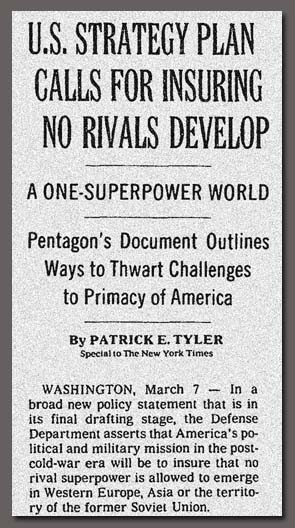
Washington, D.C., February 26, 2008 - The United States should use its power to "prevent the reemergence of a new rival" either on former Soviet territory or elsewhere, declared a controversial draft of the Defense Planning Guidance (DPG) prepared by then Secretary of Defense Richard Cheney's Pentagon and leaked to The New York Times in March 1992. Published in declassified form for the first time on the National Security Archive Web site, this draft, along with related working papers, shows how defense officials during the administration of George H. W. Bush, under the direction of Principal Deputy Under Secretary of Defense for Strategy and Resources I. Lewis "Scooter" Libby tried to develop a strategy for maintaining U.S. preponderance in the new post-Cold War, post-Soviet era.
Remarkably, these new releases censor a half dozen large sections of text that The New York Times printed on March 8, 1992, as well as a number of phrases that were officially published by the Pentagon in January 1993. "On close inspection none of those deleted passages actually meet the standards for classification because embarrassment is not a legal basis for secrecy," remarked Tom Blanton, director of the Archive." The language that the Times publicized can be seen side-by-side with the relevant portions of the February 18, 1992 draft (see document 3 below) that was the subject of the leak.
In its initial response to the Archive's mandatory review request, the Department of Defense exempted from declassification all of the documents in this case on the grounds that they were "pre-decisional" in nature. When the Archive appealed the denials, we sent copies of The New York Times coverage of the leaked DPG, including the extensive excerpts from the February 18, 1992 draft. The appeal was successful because the Defense Department released considerable material on the Defense Planning Guidance; nevertheless Pentagon officials blacked out information that the Times had already published. (see sidebar).
The documents recently declassified by the Defense Department in response to the Archive's appeal provide an inside view of the making of the Defense Planning Guidance from September 1991 to May 1992, when Joint Chiefs of Staff Chairman Colin Powell and Under Secretary of Defense for Policy Paul Wolfowitz approved it. Writing in the wake of the Soviet Union's collapse, the group of Republican-oriented officials that produced the Guidance wanted to preserve the unique position of American predominance that was emerging. With the leak of a draft in March 1992 and the resulting public controversy over the language about preventing a "new rival," "Scooter" Libby and his colleagues recast the document so that it would pass public scrutiny while meeting Richard Cheney's requirements for a strategy of military supremacy. Believing that military spending at Cold War levels was no longer possible, Cheney and his advisers wanted to develop lower-cost strategies and plans to prevent future global threats to American power and interests. To protect U.S. territory, citizens, and military forces from attack, to back up security guarantees to allies, and to "preclude any hostile power from dominating a region critical to our interests," the authors of the Guidance argued that the United States had to:
▪ Pursue the "military-technological revolution" to preserve its superiority in the latest weapons systems (e.g., smart munitions)
▪ Sustain the "forward" presence of U.S. ground, air, and naval forces in strategically important areas, to validate commitments, and to provide a capability to respond to crises affecting significant interests, such as freedom of the seas and access to markets and energy supplies
▪ Preserve a smaller but diverse "mix" of survivable nuclear forces to support a global role, validate security guarantees, and deter Russian nuclear forces
▪ Field a missile defense system as a shield against accidental missile launches or limited missile strikes by "international outlaws"
▪ Maintain a capability to reconstitute military forces in the event a regional hegemon threatens to become a global threat
▪ Find ways to integrate the "new democracies" of the former Soviet bloc into the U.S.-led system
▪ Work with allies in NATO Europe and elsewhere but be ready to act unilaterally or with only a few other nations when multilateral and cooperative action proves too "sluggish" to protect vital interests.
The word "preempt" does not appear in the declassified language, but Document 10 includes wording about "disarming capabilities to destroy" which is followed by several excised words. This suggests that some of the heavily excised pages in the still-classified DPG drafts may include some discussion of preventive action against threatening nuclear and other WMD programs. The excisions are currently under appeal at the Interagency Security Classification Appeals Panel (ISCAP).
The drafts of the Defense Planning Guidance released by the Defense Department show the involvement of a number of senior and mid-level officials in the preparation of the document, some of whom have become well-known as figures in the "neo-conservative" movement. (Note 1) As mentioned earlier, I. Lewis "Scooter" Libby played a significant role in the writing process, especially in the final stages. One of the drafters in the early stages was Abram N. Shulsky, a career Pentagon intelligence official, who later became notorious for his association with the Office of Special Plans during the run-up to the Iraq War. Although his name appears rarely in the recent release, a major figure in the writing was Zalmay Khalilzad, director of the Policy Planning Staff in Libby's office. Finally, Under Secretary of Defense for Policy Paul Wolfowitz was less involved in preparing the DPG, but had to approve its contents. Nevertheless, the DPG was written for a Secretary of Defense, Richard Cheney, who was more nationalist than "neo-con," although his thinking dovetails with elements of the neo-conservative outlook. In particular, the documents show (see Documents 6a and 6b) that he was closely involved in overseeing the process, and that Wolfowitz and Libby were careful to ensure that the language, such as on unilateral options, reflected his preferences.
Those who produced the DPG believed it would eventually become a public document that could be used to develop support for the Bush administration's military policy. Bill Clinton's victory in 1992 prevented that discussion. Despite the heavy excisions of these drafts, enough has been declassified to fuel a broader discussion of their meaning—for example, the relationship between the Guidance and neo-conservative ideology, or the extent to which ideas in the documents show continuity with U.S. national security policy, past and present. With respect to the continuity issue, some may argue that the pursuit of military superiority crystallized in the DPG resonates with the concept of national security which developed during the 1940s and which assumed the need for a "preponderance" of American power. (Note 2) Others may argue that the Clinton administration tacitly followed the thrust of the Cheney strategy, and that the emphasis on precluding rivals presages the preemptive doctrine that George W. Bush has tried to turn into an axiom of U.S. policy. According to James Mann, the Guidance helped provide the "rationale" for the policies that the Bush administration has followed since 2001. As Mann wrote in March 2004, the Iraq war "was carried out in pursuit of a larger vision of using America's overwhelming military power to shape the future." (Note 3) The documents raise other questions worth exploring, such as over the role of independent or unilateral action, the relationship between military and political power, and the extent to which superpower status confers diplomatic influence. If ISCAP releases more information from the documents, even more questions may be raised.
Documents
Briefing slides prepared for Under Secretary of Defense for Policy Paul Wolfowitz to be used in a presentation to the Defense Planning Resources Board, chaired by Deputy Secretary Donald J. Atwood, provide an overview of the process for preparing the DPG for fiscal years 1994-1998. Designed to take into account the lessons of the 1991 Gulf War, developments in the Soviet Union, and other "regional security challenges," and the implications of the "military-technological revolution" (e.g., emergence of "smart munitions"), the DPG would explain policy goals and military spending priorities for the years ahead. The slides optimistically forecast the completion of the Guidance in December 1991.
Retired Army general Dale A. Vesser, who served as Assistant to Principle Deputy Under Secretary of Defense (Strategy and Resources) "Scooter" Libby, played a key role in coordinating the DPG writing. As Vesser suggested, the first draft was "uneven," somewhat of a cut and paste job. It included contributions from a variety of working level defense officials, including an overview section prepared by Abram N. Shulsky. Paul Kozemchak, a career official at the Defense Advanced Research Projects Agency (DARPA) was another major contributor. Andrew R. Hoehn, a staffer at Wolfowitz's office (and more recently a vice-president at the RAND Corporation), prepared the section on "The New Defense Strategy" at the end.
Composed in a world where the Soviet Union still existed, although not for long, the opening pages prepared by Shulsky declared that, with the Soviet Union's "internal economic crisis and political collapse," the United States "may be said to be the world's sole superpower." As such, it could not be the policeman of the world, but it would have "preeminent responsibility for addressing those wrongs which threaten not only its interests, but those of its allies and friends, or which could seriously unsettle international relations." To preserve its preponderant position, the United States would have to curb regional challenges that—although not as dangerous as the former Soviet threat—could become "more likely." Above all, the United States would have to maintain technological superiority by staying a "generation ahead" in new weapons technology. According to Shulsky, that could mean reduced reliance on nuclear weapons by "developing new, more effective, conventional weapons systems."
The new policy would support alliances and multilateralism, but unilateral action remained a possibility. While the United States would continue to value alliances and working with allies, crises could "develop in areas outside of existing alliance commitments." Washington would try to work through the United Nations to the extent possible, but would retain "the responsibility to act on its own if the situation warrants."
The prospect that the Soviet Union or some other country could someday emerge as a global threat meant that the United States needed to maintain organizational and material resources to reconstitute military forces to "designated level of … capabilities." It was this requirement that led Andrew Hoehn to name the new strategy: "Crisis Response/Reconstitution Strategy." So that regional threats did not become global problems, Hoehn emphasized the importance of strategic nuclear deterrence based on a "diverse mix of survivable forces," a U.S. "forward" military presence at "reduced levels," and a capability to respond to regional crises "on very short notice."
As in the other draft DPGs included in this release, the sections on regional situations, such as Western Europe, Asia and the Pacific, and Latin America, are heavily excised.
[Excerpts from the leaked Defense Planning Guidance that The New York Times published on March 8, 1992, can be compared here with the excised version recently released by the Department of Defense through the National Security Archive’s mandatory review request.]
Drafting continued, but it was not until mid-February that the DPG had reached the point where Vesser was ready to distribute it to senior civilian and military officials at the Pentagon. Although the draft does not credit anyone for writing it, so far Khazilzad has received the most credit, although plainly his draft drew on the earlier work of Shulsky and Kozemchak, among others. While the draft was tighter and shorter, it was in the same conceptual universe. Now, however, it was called a "regional defense strategy" instead of a "Crisis/Response/Reconstitution Strategy." Like the earlier drafts, the possibility of "regional challenges" and the need for strategic deterrence, forward presence, crisis response, technological superiority, and reconstitution were central concepts. The draft, however, put more emphasis on the danger of WMD proliferation.
With the disappearance of the Soviet Union and the emergence of a "fundamentally new situation," the drafters were preoccupied with identifying and articulating the mix of policies that would preserve the U.S.'s status as the sole superpower. In this respect, the Guidance posited two major policy goals. The first was "to prevent the reemergence of a new rival" for world power, which meant that Washington had to develop a "new order" that met the security, political, and economic interests of potential competitors, including Japan and Western Europe, so they would not feel the need to challenge U.S. "leadership." Moreover, the United States had to develop "mechanisms," such as a reconstitution capability, to deter potential competitors for military predominance. The second objective was to "address sources of regional conflict and instability" that could "unsettle international relations" by threatening U.S. interests or those of allies. The United States would have "preeminent responsibility" in checking threats that could involve proliferation, terrorism, or energy and raw materials sources. While Washington alliances would remain central to U.S. policy, the "United States should be postured to act independently when collective action cannot be orchestrated" or when a larger collective response needs jump-starting by an "immediate" U.S. response.
A long section of the document, beginning on page 30, details the "minimum military capabilities" that would be needed to support the regional strategy, including appropriate readiness levels, prepositioned supplies, war reserve inventories, strategic deterrence forces, and high priority areas for critical investments in conventional forces.
It was this draft that one of the recipients leaked to New York Times reporter Patrick Tyler sometime before March 7. The next day the Times ran a front-page story, "U.S. Strategy Plan Calls for Insuring No Rivals Develop." (Note 4) According to Tyler's account, the leaker "believes that this post-Cold War debate should be carried out in the public domain." Because Tyler had the entire document, his story in the Times and an accompanying side-bar included quotations and long passages which the Defense Department has excised in the recent release. Some examples: U.S. nuclear strategy must target "those assets and capabilities that current – and future – Russian leaders or other nuclear adversaries value most." Moreover, "to buttress the vital political and economic relationships we have along the Pacific rim, we must maintain our status as a military power of the first magnitude there." "While the United States supports the goal of European integration, we must seek to prevent the emergence of European-only security arrangements which would undermine NATO."
Document 4: "Defense Planning Guidance, FY 1994-1999," February 29, 1992, Revised Draft for Scooter Libby, Secret, Excised Copy
This annotated but incomplete draft shows the impact of more editing, but the basic objectives and method, e.g., no "new rival" and the regional strategy, remained the same. This draft, however, introduced language about "strategic depth" that would survive further re-writing. The United States' success in pushing back former global threats, such as the Soviet Union, meant that a new strategic relationship with Eastern Europe and Eurasia was possible. That Washington faced no hostile alliances and that "no region of the world critical to our interests is under hostile non-democratic domination" meant that the United States had "great depth for our strategic position." Through a regional defense strategy, the United States could "take advantage of this position and preserve capabilities needed to keep threats small."
Document 5: Dale A. Vesser to Mr. Libby, "Comments Received on Draft DPG – Potential Issues," March 17, 1992, Secret, Excised Copy
This post-leak draft, with comments from a variety of Pentagon offices, showed the impact of disclosure and controversy, which had unfolded during the previous nine days. White House and State Department officials had called the DPG "dumb," Pentagon spokesperson Pete Williams disavowed some of the language, Senator Joseph Biden (D-DE) criticized its "Pax Americana" thinking, and some foreign policy analysts observed that the report's "chauvinistic tone" might encourage other powers to try to catch up by procuring advanced weapons systems. (Note 5) Under the weight of the criticism, the wording about preventing a "new rival" disappeared, but, as James Mann has noted, the version worked out by Libby and his associates "contained most of the same ideas as the original" by coming up with "euphemisms in order to make the wording sound less confrontational." For example, instead of "preeminent responsibility," the new version used terms like "U.S. leadership," and "hostile power" instead of "rival."
The section on nuclear deterrence continued to focus on the need for a "hedge" against the emergence of a major threat, but it had a new emphasis on the necessity of missile defenses against the threat of global missile proliferation and the danger of an "accidental or unauthorized missile launch." Broaching the possibility of junking the ABM treaty, Libby's draft raised the prospect of a "day when defenses will protect the community of nations embracing liberal democratic values from international outlaws armed with ballistic missiles."
The draft Guidance that was under discussion during March 1992 was getting closer to the version that would ultimately be released by the Defense Department, with the section on minimum military capabilities shorn off. As Libby explained to Cheney in a detailed cover memorandum on March 20, the draft was as "near to an unclassified text as possible in this stage of drafting." According to the memorandum, "Tab A" was the latest draft of the DPG, while Tabs "B" and "C" were unclassified and classified versions of the secret programming guidance. Neither was attached in the version received by the Archive; instead, Tab "B" was the material sent by Libby to Cheney on March 26 (see "6b" above).
In Libby's personal cover memo to Cheney (see 6a above) he alluded to the criticism that the February 18 draft stood for unilateralism. To counter this, he and Wolfowitz had come up with "more defensible" language found on page 12: "America must plan forces for major contingencies that would enable us to act where prudent and practical even ‘where very few others are with us,' and ‘with only limited additional help.'" Libby argued that there were "no major contingencies" where "we would not have at least political support from some limited number of countries."
The DPG draft that Libby sent Cheney on March 26 responded "more fully" to the Secretary's "guidance," including making the opening pages "sharper and tighter." Perhaps in response to Cheney's comments, the section on "Continued U.S. Leadership" included new wording about working with allies, but left open in explicit language the possibility of unilateral action (as earlier drafts had): "A future U.S. president will need to have options that will allow him to lead, and where the international reaction proves sluggish, or inadequate, to act to protect our critical interests." Further, "we will not ignore the need to be prepared to protect our critical interests and honor our commitments with only limited additional help, or even alone, if necessary." Such language would survive in later drafts.
Believing that despite the controversy some of the February 18 draft still had value, Vesser suggested, first, points that should be reconsidered for including in the final draft, and second, points that were "properly deleted" or recast. One subject that Vesser thought was important was the definition of a "critical region": one "whose resources [and population] could, under consolidated control, generate global power." According to Vesser, that wording is "as thorough and concise as any." Vessey also made suggestions about earlier language on arms control, forward basing, crisis response strategy, and NATO. For example, he recommended reinstatement of the section on arms control, which argued that arms control "will take on new forms in this post-Cold War era," such as "regionally focused initiatives," and other "innovations in approach" to address the problem of WMD proliferation.
Possibly used for briefing Cheney or some other senior official, this document provides some of the highlights of recent DPG drafts. Most of the language may be found in the versions cited above, but a few new points appear—for example, that a 7-
8 year "warning time" for the emergence of a major threat would kick in military reconstitution activities.
An important element in the DPG process was the development of a scenarios paper that envisioned a number of possible regional crises that posed security threats to the interests of the U.S. and its allies, and the possible U.S. military response to those contingencies. Prepared for "illustrative" purposes, they depicted "plausible future events illustrating the type of circumstances in which the application of U.S. military power might be required." While speculative in nature, the group of scenarios would be used as an "analytic tool for the formulation and assessment of defense programs" and the sizing of "appropriate levels of combat power, mobility, readiness, and sustainment [sic]."
This document is massively excised, but an earlier version was the subject of a leak to New York Times reporter Patrick Tyler, even before that of the February 18 DPG draft. On February 16, 1992, Tyler published a story that showed that there were seven scenarios, including regional wars against Iraq and North Korea and a major campaign in Europe against a "resurgent Russia." In addition, U.S. forces were to be ready to respond to possible coups and instability in countries such as Panama or the Philippines.
According to Tyler's story, the source of the leak "wished to call attention to what he considered vigorous attempts within the military establishment to invent a series of alarming scenarios that can be used by the Pentagon to prevent further reductions in forces or cancellations of new weapons systems." (Note 6)
Document 10: "Issues in the Policy and Strategy Section," April 14, 1992, Secret, Excised copy
Reflecting the contention over the DPG, this paper highlights some of the more controversial points, such as the balance between unilateral and multilateral action and the role of allies, as well as whether to extend alliances to Eastern Europe. An interesting point on the bottom of the first page is excised, but the surviving language on "disarming capabilities" probably relates to the controversial notion of "preemptive" action against weapons of mass destruction held by adversaries.
Document 11: Distribution Memos, Secret
By April 16, the drafting process had reached the point where the DPG could be distributed somewhat more widely inside the Pentagon for comment on an "eyes only" basis. Among the outside recipients were Admiral Donald Pilling of the National Security Council staff and State Department Policy Planning Staff director Dennis Ross.
The April 16 DPG draft was not part of the recent release, but a significant chunk of it appears here with the NSC's editorial suggestions. This version is close to what Cheney ultimately approved for public dissemination in the last weeks of the Bush administration. The language showed continued reworking from the drafts that Libby had sent Cheney in March. For example, the section on "Defense Policy Goals" included language about the importance of a reconstitution capability as a signal "that no potential rival could quickly or easily gain a predominant military position." Perhaps the drafters believed that, despite the controversy, it was permissible and necessary to use language about precluding new rivals, certainly in a classified version. It is worth noting that wording excised from this document—such as Korean peninsula, Taiwan, India and Pakistan—appears in the version that Cheney publicly released in January 1993 (see Document 15).
As Pilling noted in his memo, some of the editorial suggestions were language designed to conform to scheduled speeches by President Bush. Some wording suggestions add to the discussion of the relationship between U.S. leadership and multilateral action, while others touch upon the flow of oil and regional arms control. As indicated on Pilling's memo, copies of the changes went to others on Libby's staff, including Khazilzad and Vesser.
Declassification Anomalies: This document is a near-final draft of the April 16, 1992, Defense Planning Guidance that Secretary Cheney issued in January 1993 in declassified form as the "Regional Defense Strategy" (see Document 15). Much of the language in the two documents is identical or nearly so. Nevertheless, the version of the April 16 draft as released by the Defense Department included excised words and phrases—such as Israel, Japan, India, Pakistan, and North Korean nuclear program—that later appeared in the unclassified strategy document. To illustrate this, the Archive has produced an edited version of Document 12, with the excised language filled in. Not all of the words and phrases that we have added are exact matches to the excised portions, but they are very close. These examples demonstrate the subjectivity of the declassification review process; that the country names appeared in a classified document made it look like the information was still sensitive, even though it was not.
Document 13: Annex A "Illustrative Planning Scenarios," Secret, Excised copy
Drafting and redrafting work on the planning scenarios continued as is evident from the four versions of the preface—with marginal comments excised in their entirety—in which drafters tried to be more and more concise about the role of the scenarios as "yardsticks" for formulating military programs.
By around May 19, 1992, work on the Guidance was finished. Joint Chiefs of Staff Chairman Colin Powell signed off on it and Paul Wolfowitz sent the document to Cheney and Atwood. Earlier in the month, Wolfowitz had sent them memos transmitting the DPG and the annex on "Illustrative Planning Scenarios," highlighting the problems that remained under discussion. In both versions, Wolfowitz observed that the current draft of the DPG "is still a rather hard-hitting document which retains the substance you liked in the February 18th draft." The drafts that Secretary of Defense Cheney and Deputy Secretary of Defense Atwood received included footnotes indicating the concerns of various offices and individuals at the Pentagon on a number of issues, including missile defense, propositioning of supplies to help counter possible threats in Southwest Asia (SWA), and the extent to which a "major contingency in Europe" was plausible enough to be factored into the military planning. Wolfowitz's memorandum of May 13 mentions that he had received comments from David Addington, who was Cheney's special assistant and would work with him in the years to come (currently as Chief of Staff and Counsel to the Vice President).
Perhaps in light of George H. W. Bush's drive for re-election in the fall of 1992 and the need to avoid controversy, the thought of declassifying and publishing the Guidance must have become a low priority. Nevertheless, it happened in the administration's last month. The declassified version was not called the "Defense Planning Guidance," but it is very close to what is available of the April 16 version (see Document 12). As with the earlier drafts of the Guidance, Cheney's statement stressed strategic depth, technological superiority, strategic deterrence, forward presence, and reconstitution, all in the name of maintaining capabilities to check regional crises before they turned into more serious threats to U.S. security interests. While developing a "collective" response to threats had preference, as Libby had written before, "a future U.S. president will need options allowing him to lead and, where the international reaction proves sluggish or inadequate, to act independently to protect our critical interests." Moreover, the statement retained the language about the importance of a reconstitution capability to check a future "rival." The statement's release coincided with the approaching inauguration of the Clinton administration, which gave it no significant press coverage in January 1993, a stark contrast with the controversy over the DPG draft in March 1992.
Notes
1. For the most detailed account of how the DPG was prepared, see James Mann, The Rise of the Vulcans: The History of Bush's War Cabinet (New York: Viking, 2004), 208-215. For studies of neo-conservatism from different perspectives, see Anne Norton, Leo Strauss and the Politics of American Empire (New Haven, Yale University Press, 2004); Stefan Halper and Jonathan Clarke, America Alone: The Neo-Conservatives and the Global Order (New York: Cambridge University Press, 2004), and Jacob Heilbrunn, They Knew They Were Right: The Rise of the Neo-Cons (New York: Doubleday, 2008).
2. For "preponderance" and the Truman administration, see Melvyn P. Leffer, A Preponderance of Power: The Truman Administration and National Security Policy (Stanford, Stanford University Press, 1992).
3. James Mann, "The True Rationale: It's A Decade Old," The Washington Post, March 7, 2004. (Article used with the permission of the author and The Washington Post.)
4. Barton Gellman, another recipient of the leaked DPG, wrote a story a few days later: "Keeping U.S. First: Pentagon Would Preclude a Rival Superpower." The Washington Post, March 11, 1992.
5. "Senior U.S. Officials Assail Lone-Superpower Policy," and "Lone Superpower Plan: Ammunition for Critics," The New York Times, March 11 and 12, 1992. Patrick E. Tyler wrote both articles.
6. "Pentagon Imagines New Enemies to Fight in Post-Cold-War Era," The New York Times, February 17, 1992.
Monday, February 04, 2008
Be afraid, be very afraid

| U.S. Troops Asked If They Would Shoot American Citizens Iraq vet exposes how he was trained to round up Americans in martial law exercise, asked if he would kill his own friends and family |
Paul Joseph Watson
U.S. troops are being trained to conduct round-ups, confiscate guns and shoot American citizens, including their own friends and family members, as part of a long-standing program to prepare for the declaration of martial law, according to a soldier who recently returned from Iraq.
We received an e mail from "Scott", a member of a pipefitters union that runs an apprenticeship program called Helmets To Hard Hats, which according to its website, "Is a national program that connects National Guard, Reserve and transitioning active-duty military members with quality career training and employment opportunities within the construction industry."
Scott writes that his company hired a soldier who had recently returned from Iraq, who told him that U.S. troops were being quizzed on whether or not they would be prepared to shoot their own friends and family members during a national state of emergency in America.
"I have become very close to this young man and have gained his respect and trust," writes Scott. "I want you to know that he informed me about one particular training exercise his superiors made them perform. It was concerning the rounding up of American citizens that disobey any type of martial law or in other words any type of infringement on our freedoms."
"He was asked if he could shoot his friends or family members if ordered to do so. At the time he said he could," writes Scott.
Scott says that the soldier later "had time to clear his head" and realize the truth, recanting his vow to kill his own countrymen if ordered to do so.
The issue of whether U.S. troops would be prepared to round-up, disarm and if necessary shoot Americans who disobeyed orders during a state of martial law is a question that military chiefs have been attempting to answer for at least 15 years.
Its known origins can be traced back to an October 1994 Marine questionnaire out of the Twentynine Palms Marine Base in California. Recruits were asked 46 questions, including whether they would kill U.S. citizens who refused to surrender their firearms.
Documentary film maker Alex Jones brought to light similar training programs that were taking place across the country in the late 90's which revolved around U.S. Marines being trained to arrest American citizens and take them to internment camps.
During one such program in Oakland California, dubbed "Operation Urban Warrior," Marines refused to answer if they would target American citizens for gun confiscation if ordered to do so.
During hurricane Katrina, National Guard units were ordered to confiscate guns belonging to New Orleans residents.
As we first exposed in May 2006, Clergy Response Teams are being trained by the federal government and FEMA to "quell dissent" and pacify citizens to obey the government in the event of a declaration of martial law.
Pastors and other religious representatives are being taught to become secret police enforcers who teach their congregations to "obey the government" in preparation for the implementation of martial law, property and firearm seizures, mass vaccination programs and forced relocation.
Many scoffed at our original story, which was based on the testimony of a whistleblower who was asked to participate in the program. Claims that the story was a conspiracy theory soon evaporated when a mainstream KSLA news report confirmed the existence of the program.
The experiences of U.S. troops in the worst areas of Iraq, where soldiers are ordered to go door to door and arrest all men of military age as well as confiscate their weapons, is a mere portend of what is being planned for America if these training programs ever come to fruition.
Original article posted here.