Showing posts with label ecological disaster. Show all posts

Tuesday, November 25, 2008

Not a global warming scientist, but am open to the possibility that we are being scammed and scared a bit.

Stubborn glaciers fail to retreat, awkward polar bears continue to multiply

By Christopher Booker

Second only to the melting of the Arctic ice and those "drowning" polar bears, there is no scare with which the global warmists, led by Al Gore, more like to chill our blood than the fast-vanishing glaciers of the Himalayas, which help to provide water for a sixth of mankind. Recently one newspaper published large pictures to illustrate the alarming retreat in the past 40 years of the Rongbuk glacier below Everest. Indian meteorologists, it was reported, were warning that, thanks to global warming, all the Himalayan glaciers could have disappeared by 2035.

Read more from Christopher Booker
Yet two days earlier a report by the UN Environment Program had claimed that the cause of the melting glaciers was not global warming but the local warming effect of a vast "atmospheric brown cloud" hanging over that region, made up of soot particles from Asia's dramatically increased burning of fossil fuels and deforestation.

Furthermore a British study published two years ago by the American Meteorological Society found that glaciers are only shrinking in the eastern Himalayas. Further west, in the Hindu Kush and the Karakoram, glaciers are "thickening and expanding".

Meanwhile, all last week, ITV News was running a series of wearisomely familiar scare stories on the disappearing Arctic ice and those "doomed" polar bears - without telling its viewers that satellite images now show ice cover above its 30-year average, or that polar bear numbers are at record level. But then "polar bears not drowning after all - as snow falls over large parts of Britain" doesn't really make a story.

Original article posted here.

As Obummer continues his fucked up policies of throwing money to the people who least need it, the middle class is getting crushed


76 percent of American middle-class households not financially secure


As the economy continues to reel, a new report finds that 4 million American households lost economic security between 2000 and 2006, and that a majority of America's middle class households are either borderline or at high risk of falling out of the middle class altogether. The new report, "From Middle to Shaky Ground: The Economic Decline of America's Middle Class, 2000-2006" was published by the policy center Demos and the Institute for Assets and Social Policy (IASP) at Brandeis University.


"From Middle to Shaky Ground" is based on the Middle Class Security Index, co-developed by Demos and IASP/Brandeis, which uses government data and measures the financial security of the middle class by rating household stability across five core economic factors: assets, educational achievement, housing costs, budget and healthcare. Based on how a family ranked in each of these factors, they were defined as financially "secure," "borderline" or "at risk". In addition to the report, Demos and IASP/Brandeis have published an "Economic Security Scorecard" that the average family can use to measure where they fall on the Middle Class Security Index.

"The increases we're witnessing in housing costs and the number of families who lack health insurance, coupled with the extreme volatility of the average household's savings, show that a large percentage of America's middle class are not well equipped to weather this current economic storm," said Jennifer Wheary, one the report's co-authors and a Senior Fellow at Demos.

"From Middle to Shaky Ground" shows some worrying trends in America's households, including:

-- The median financial assets held by middle-class families declined by 22 percent. This means that for every dollar in median assets that middle-class families held in 2000, they held just 78 cents in 2006. These figures do not include home equity and therefore do not reflect additional losses families may have experienced due a decline in their home values.

-- Monthly housing expenses for the middle class rose by 9 percent. As a result, the percentage of middle-class families who match the Department of Housing and Urban Development's definition of "housing burdened" rose from 31 percent in 2000 to 37 percent in 2006.

-- The number of middle-class families in which at least one member lacks health insurance grew from 18 percent in 2000 to 25 percent in 2006.

"Declines such as these in any one area are alarming," said Tom Shapiro, Professor of Law and Director of the Institute on Assets and Social Policy at Brandeis. "Bad news across a range of areas supporting financial stability means the middle class is confronting its greatest challenge since the Great Depression."

Original article posted here.

Friday, August 15, 2008

Killing the base of the food chain

Oceans On The Precipice Of Mass Extinctions And Rise Of Slime


During a recent research expedition to Kiritimati, or Christmas Island, Jeremy Jackson and other researchers documented a coral reef overtaken by algae, featuring murky waters and few fish. The researchers say pollution, overfishing, warming waters or some combination of the three are to blame. Photo credit: Jennifer E. Smith
by Staff Writers
San Diego CA (SPX) Aug 15, 2008
Human activities are cumulatively driving the health of the world's oceans down a rapid spiral, and only prompt and wholesale changes will slow or perhaps ultimately reverse the catastrophic problems they are facing.

Such is the prognosis of Jeremy Jackson, a professor of oceanography at Scripps Institution of Oceanography at UC San Diego, in a bold new assessment of the oceans and their ecological health.

Publishing his study in the online early edition of the Proceedings of the National Academy of Sciences (PNAS), Jackson believes that human impacts are laying the groundwork for mass extinctions in the oceans on par with vast ecological upheavals of the past.

He cites the synergistic effects of habitat destruction, overfishing, ocean warming, increased acidification and massive nutrient runoff as culprits in a grand transformation of once complex ocean ecosystems. Areas that had featured intricate marine food webs with large animals are being converted into simplistic ecosystems dominated by microbes, toxic algal blooms, jellyfish and disease.

Jackson, director of the Scripps Center for Marine Biodiversity and Conservation, has tagged the ongoing transformation as "the rise of slime." The new paper, "Ecological extinction and evolution in the brave new ocean," is a result of Jackson's presentation last December at a biodiversity and extinction colloquium convened by the National Academy of Sciences.

"The purpose of the talk and the paper is to make clear just how dire the situation is and how rapidly things are getting worse," said Jackson.

"It's a lot like the issue of climate change that we had ignored for so long. If anything, the situation in the oceans could be worse because we are so close to the precipice in many ways."

In the assessment, Jackson reviews and synthesizes a range of research studies on marine ecosystem health, and in particular key studies conducted since a seminal 2001 study he led analyzing the impacts of historical overfishing.

The new study includes overfishing, but expands to include threats from areas such as nutrient runoff that lead to so-called "dead zones" of low oxygen. He also incorporates increases in ocean warming and acidification resulting from greenhouse gas emissions.

Jackson describes the potently destructive effects when forces combine to degrade ocean health. For example, climate change can exacerbate stresses on the marine environment already brought by overfishing and pollution.

"All of the different kinds of data and methods of analysis point in the same direction of drastic and increasingly rapid degradation of marine ecosystems," Jackson writes in the paper.

Jackson furthers his analysis by constructing a chart of marine ecosystems and their "endangered" status.

Coral reefs, Jackson's primary area of research, are "critically endangered" and among the most threatened ecosystems; also critically endangered are estuaries and coastal seas, threatened by overfishing and runoff; continental shelves are "endangered" due to, among other things, losses of fishes and sharks; and the open ocean ecosystem is listed as "threatened" mainly through losses at the hands of overfishing.

"Just as we say that leatherback turtles are critically endangered, I looked at entire ecosystems as if they were a species," said Jackson. "The reality is that if we want to have coral reefs in the future, we're going to have to behave that way and recognize the magnitude of the response that's necessary to achieve it."

To stop the degradation of the oceans, Jackson identifies overexploitation, pollution and climate change as the three main "drivers" that must be addressed.

"The challenges of bringing these threats under control are enormously complex and will require fundamental changes in fisheries, agricultural practices and the ways we obtain energy for everything we do," he writes.

"So it's not a happy picture and the only way to deal with it is in segments; the only way to keep one's sanity and try to achieve real success is to carve out sectors of the problem that can be addressed in effective terms and get on it as quickly as possible."

The research described in the paper was supported by the William E. and Mary B. Ritter Chair of Scripps Institution of Oceanography.

Original article posted here.

Saturday, July 26, 2008

American genocide

Death Made In America

By: Mohammed Daud Miraki, MA, PhD

Wondering if your conscience is still anesthetized...


A LITTLE TERRORIST:
ENJOY YOUR HANDIWORK USA.

I took this photo on the last day of my journey: one of triplets.

Afghanistan is has become the disaster words could not describe, hence, I decided to illustrate this disaster via these photos of babies born deformed.

On many occasions, I pointed out that we need funds to build a research institute and the linked monitoring stations. Unfortunately, majority of you simply brushed off my request. I wonder if these photos could elevate your humanity that has been overwhelmed by your comfortable life and materials desires.

Again, it is up to you, to do whatever you think is human; that should not be too difficult. The funds for the research institute are very small price you have to pay after all your tax dollars have created this disaster. Whether you like it, admit or deny it, it does not absolve you from the indirect complicity in these war crimes.

If everyone visiting this web site pays the amount they spend on soft drinks in a month, we would have the funds to build our research facility:


AMERICAN DEMOCRACY IN ACTION-
"FREEDOM IS ON THE MOVE" RIGHT?
YOUR GOVERNMENT is CRIMINAL BUT
YOU ARE equally RESPONSIBLE.


YOU MIGHT SAY, "THAT'S LIFE WHAT COULD
I DO"PAY FOR THE RESEARCH FACILITY-A
TOTAL COST OF FIVE MILLION DOLLARS-
PEANUTS COMPARE TO THIS PAIN.


I HOPE YOU COULD EAT TONIGHT AND
LOOK AT YOUR CHILDREN AND SAY IT
IS OKAY TO REMAIN INDIFFERENT. I
WOULD NOT BE SURPRISED AFTER ALL
IT IS OKAY-YOU HAD NOTHING TO DO
WITH IT, RIGHT? You had everything
to do with it, your tax dollars
paid for their misery!!!


HOW WOULD YOU FEEL IF YOUR CHILDREN
WERE BORN LIKE THIS?


FROM THE AMERICAN GIFT (URANIUM
MUNITIONS) THAT KEEPS ON GIVING.


HORRORS UNLIMITED: MADE IN USA.
The parents of this child do not
give a damn about your freedom
BS or some other garbage.


OUR CHILDREN WOULD BE BORN THIS
WAY FOR EVER THANKS TO THE URANIUM
MUNITIONS USED BY YOUR ARMED FORCES
PAID FOR BY YOUR TAX DOLLARS.


SEE IF YOU COULD EXPLAIN
THIS TO HIS PARENTS

OH A FEW MINOR DETAILS ABOUT SITUATIONS IN AFGHANISTAN:

URANIUM MUNITIONS

Due to the use of massive amount of uranium munitions used by the US forces in the initial bombing and subsequently, massive amount of congenital deformities occur all over Afghanistan. The rate of various cancers has gone up significantly. Leukemia and esophageal cancers are very high among children. According to doctors at maternity and children hospitals in Kabul, the rate of various congenital deformities have increased by many folds since the US invasion. In fact, the magnitude of man made isotopes was established by the Uranium Medical Research Center after their investigators made to trips to Afghanistan and collected urine and soil samples. They established that the rate of man made isotopes was gone up 2000 times in some subjects located near the bombed areas.

Since uranium used in the weapons have a half-life of 4.5 billion years, the US forces ensured that generations of Afghans suffer from cancers and deformities. This is certainly not development. In fact, it is the biggest crime ever committed by anyone in the history of humanity.

RECONSTRUCTION

There has been a lot of talk of reconstruction and rebuilding, but this issue could only be understood if one compares the substance against the rhetoric and the large amount of money allocated for the so-called reconstruction. Of all the whooplas made of reconstruction, the US and its client regime has only inaugurated the truck route-highway-between Kabul and Kandahar. This hallmark of achievement that the US brags about was completed 40 percent during the Taliban government. While the highway is inaugurated, it still needs significantly additional work to remain intact. The inauguration of the highway was a political ploy aimed to convince the critiques that the reconstruction has been going smooth. It is hardly so.

When I entered Afghanistan from Pakistan, the lack of achievement was evident. For the past three years, there have been construction efforts underway to pave the road from Torkham, the entry point from Pakistan to Afghanistan, to the city of Jalalabad in eastern Afghanistan. Unfortunately, the Pakistani contractors are more interested to have their tea breaks rather than to do any rebuilding. I brought up this issue with the authorities in Kabul, but to avail.

After reaching Jalalabad, I was further surprised to see the roads in the city with massive potholes, unpaved roads, hence, tremendous amount of dust blown in every direction. The reason for the lack of work in Jalalabad, as is the case almost every where in Afghanistan, corrupt officials eager to make money than to worry about the welfare of the people.

If a Mayor is appointed to a town or city, the would be mayor has to pay $40,000 bribe since he would be making more than $400,000 in selling government land to the highest bidder.

The magnitude of corruption is not limited to a province, but rather officials in the central government in Kabul are equally complicit in massive corruption and inefficiency which I would discuss shortly. Since the main road to Kabul is under construction for the past three years-we had to take a mountain pass called Lataband, which is a very rugged mountain terrain with huge rocks and massive potholes widespread for miles on. Once I reached Kabul, I stopped complaining about the Lataband road-after all Lataband is a mountain pass-Kabul the capital city lacked paved roads with exception of very few. The government in Kabul has not done anything of substance whether it pertains to infrastructure, housing, sanitation or drinking water. These are the essential elements of survival in any city. There are several reasons for the lack of progress. Some of the reasons are fundamentally flawed while others are bureaucratic hurdles and corruption. The fundamental flaws are situated in the free market approach superimposed on Afghanistan. There are two aspects of the free market that impedes the reconstruction of basic infrastructure in Kabul, one is the idea that money spent has to be invested with a return in mind, second, basic development should be contracted to private sector. Both of these issues have impeded the rebuilding of infrastructure.

In the first half of the 20th century, the Afghan government asked for a loan from the US government to build basic infrastructure-paved roads in Kabul, the government and the bank refused the loan on the ground that building roads in Kabul is not profitable investment. The government in Kabul at that time, argued that for any profitable enterprise to succeed basic infrastructure has to be built. So there is very little amount allocated for rebuilding basic infrastructure. It is worth noting that part of the blame goes to the international reconstruction aid as it is dispersed in such a way that some amount is allocated to the government in Kabul while the rest goes to the countless NGOs. Since the first problem, namely investment with a profit in mind, does not materialize in the construction of roads, efforts are made to resolve that problem through contracting out construction of roads to private sector. Thus, contracting out roads to private sector would mean money for contractors, hence, compensate for the lack of profitability associated with paving roads. This created another problem.

Once a road is contracted out, the private contracting firm resort to delaying tactics associated with feasibility study and other related issues in order to fatten its return. This delayed tactic does not serve peoples' needs and the roads remain unpaved. For example, the road from Kabul's airport to the presidential palace was contracted out three years ago it was still not built. This practice of contracting out projects adds to unemployment. Had the government adopted a different method, perhaps by hiring local laborers and using machinery, the chronic unemployment would be reduced, thus, people would have some food on the table.

Three weeks ago, Karzai announced that the road in the Dasht-e-Barchi area repaired and built. The allocated funding is $10,000000 ten million dollars. This is an outrage. Ten million dollars could repair all the roads in the capital, Kabul if only the function is taken over by the ministry of public works.

The Free Market Nonsense:

In order to please the US administration, the regime in Kabul advocated the notion of 'free market' as if this would become a panacea for the national economy. On the contrary, the so-called free market scheme had been tried in the past-the 1930s-- that resulted in fruitless consumerism of imported goods, which otherwise would have been produced domestically. Moreover, the consumption of luxuries received more priority than investment in productive sectors of the economy. A handful of businessmen and investors became rich while the rest of the country remained poor and destitute. Today, in the post-Taliban Afghanistan, the consumption of goods such as television sets and satellite dishes are more important than worrying about clean water and proper schooling. After all, as long as capitalism had brought the culture of corruption and entertainment, other necessities become secondary. Meanwhile, people with money import these goods, pocket their profits and leave. The desire of the installed regime to collect custom duties contributes to the perpetuation of underdevelopment.

Corruption also plays a significant role in the continuation of import than investment in productive infrastructure. For example, for the past 2-3 years over 100,000 tons of cement is imported while the construction plans of four cement factories collect dust. The official reason is that the country does not have a mining law. This year alone 380,000 tons of cement is imported this year alone. The question is how long does it take to formulate a mining law; it has been three years. The profit margin for dealers has skyrocketed while the long-term development prospects have waned down with every imported bag of cement.

AMERICAN CRIMES AND ORGANIZED CRIMES

With the collapse of Taliban, a very profitable, yet nasty sector of the economy has risen to new heights. Organized crime is an extension of what used to be warlords and their armies of bandits. With the warlords and other officials of the Northern Alliance occupying official positions, their former foot soldiers are equipped with new weapons and Toyota trucks, Landcruisers, with only one aim to kidnap people from diverse backgrounds for large sums of money. Once the money is secured, the government officials, who are also leading these bandits, keep 80 percent for themselves and 20 percent for their men.

The Italian aid worker, who was kidnapped in Kabul in broad daylight, was a victim of these organized bandits. After she was released, the government claimed that it secured the release of the aid worker through negotiation, but the truth is otherwise. The kidnappers received 5 million dollars. Those poor souls that can not afford paying ransoms end up dead.

Other groups of criminals kidnap children for money as well as for their organs. This is an epidemic that people sought Talibans' assistance for in the mid-1990s, however, it appears that this is no longer an issue for the US occupation force and their puppets after all when it comes to crimes what could be more criminal that using WMD against civilian population. The US forces have used uranium weapons against the people of Afghanistan, and continue to commit crimes that dwarf what the organized criminals are doing. The followings are some of the examples of the brutality of the US forces in Afghanistan:

Rape and Murder by the US forces

In the Bagrami area of Kabul, the US forces assaulted a small enclave of nomads. The US forces flew over this enclave and saw nomad women near their tents. They landed their helicopter and kidnapped these women by gunpoint. Subsequently, the US soldiers flew away with these women to some location, where these women are gang-raped. After these women were raped and died in the process, the soldiers flew them back to the community from where they were kidnapped. However, this time the helicopter did not land, instead, the women were thrown down from the helicopter. This is not unique for the US forces since they committed similar crimes in Vietnam. American forces are too much of cowards to have landed because they knew they would be shot in revenge.

Another incident occurred when a US helicopter spotted an old shepherd grazing his animals. The shepherd was 70 years old but this did not appear to matter to the US forces. The helicopter landed and raped the old man. His relatives told me that on the one hand we are furious about the crime committed by these beasts, but on the other hand we are curious "what kind of rotten people Americans are."

In another incident, a truck driver was driving his truck north from the Kabul, passing the US base in Bagram when the US patrol stopped him. In the passenger seat of the truck a young boy was sitting. This young man wanted to learn driving a truck, but tragically for him, the Americans noticed him and asked him to step out. The young man stepped out and the soldiers took him away from the truck and gang raped him. When the boy returned to the truck, he was crying and furious. Later that day, he committed suicide. This is another gift of the US's democracy.

In the American military base Bagram, north of Kabul, 15 translators while working for the US forces were gang raped by the very forces for which they worked. Although I have no sympathy for those that work for the US forces, however, no one should be subjected to such extreme cruelty. One of the translators said,

"Around 25 to 30 American soldiers enter the area where we were sleeping and started raping us. I was conscious until to the third soldier started raping me and then lost consciousness." (Hamid-translator for the US forces, June 2005)

In Badakhshan province, the US soldiers had taken forty (40) women and extracted their teeth for oral sex. One member of the parliament, who is a close supporter of Karzai, said:

"The issue of these women treated in such a miserable way was about to get some publicity, however, the US officials made sure that this does not happen." (Parliament member--I can not reveal his name)

In another incident, the US forces were searching local houses between JalaAbad and Kabul, when they entered and tried to search the house, they came across the woman of the house, since she was very beautiful, the soldiers decided to take her to the US base. The husband was not at home. When he returned from Peshawar, he went to get his wife. He told his wife,

"To me you are now my mother and sister, I can not touch you any more, but tell me if they have violated your dignity? 'They raped me by force, I was conscious for the first three men, then lost consciousness'." (The husband whose name I can not reveal his name. He joined Taliban afterward and I do not blame him.)

A young man committed suicide in the Laic-e-Mariam in KairKhana area after the Americans in an NGO raped his sister.

These are some of the very few examples of the many crimes committed by the US forces in Afghanistan, but unfortunately, the coward officials of the puppet regime call it reconstruction. To add insult to injury, the two American soldiers, who murdered two detainees at Bagram airbase, received only 2 and 3 months in jail for crime ruled homicide by the US medical examiners. The two detainees were beaten at their legs while hanging from the ceiling until their legs "pulverized". The term "pulverized" was used by the medical examiner to articulate the magnitude of the fatal injury and the inhumane way of murdering. When one of the victims asked for water, the soldier poured water over his face; subsequently, the poor man died. This is American reconstruction of Afghanistan.

Life for Ordinary People

There is absolutely no hope for the Afghans. The billions of dollars of development aid did not benefit ordinary Afghans. Abject poverty is the rule of the day. Orphans and widows roam the streets to make a living. The NGOs and foreign advisors enjoy life to the fullest. They are paid hundreds of thousands of dollars, enjoy luxury vehicles and houses, while ordinary Afghans die from homelessness, hunger and disease.

In light of the London donor conference, which would amount to nothing considering the legacy of so-called reconstruction in Afghanistan; it is prudent to make some points.

It is a tragedy of immense proportion that no one even dare to address the abomination that is called life with inevitable demise at every corner resulting from the massive amount of uranium munitions used by the American forces and their allies. Our so-called Afghans self-sold surrogates are more than happy to jump on the bandwagon and express their gratitude for the token thrown at our people when in fact their entire existence is put in question by the massive use of weapons of mass destruction. Let the progress of the Bonn agreement tell the children of Tora Bora and Shah-e-Kot suffering from Leukemia and Esophageal cancers, or the massive number of sudden abortions occurring among women and animals in those areas.

Another legacy is the corruption of bribery and sheer robbery by the officials of this puppet regime eager to make dollars. Unfortunately, they do not even accept Afghan currency but rather demand dollars. According to an Afghan commission, the amount of bribes paid in Afghanistan ranges from 20 Afghani to 15,000000 Dollars. In a country where an experience medical technologist is paid $40/month, the millions of dollars paid in bribe point to the magnitude of profit individuals and companies expected to enjoy.

Abject poverty is every where and hopes of revival are no where. The billions of dollars donated went into the pockets of NGOs and powerful government officials, while the poor remains poor.

Another problem is Americanization of the system, namely whole sale firing of professionals with decades of experience under the pretext of making hospitals and offices efficient. The truth is the US wants to implement capitalism in Afghanistan and bring open market when in fact no has food to eat or money to pay for healthcare. The shortage of physicians and health technicians is ignored for the sake of this garbage called free market. Now there are no private companies to hire these professionals with decades of experience. It would have been nice if other opportunities existed, but there are none.
Today in Afghanistan, there are a few very rich and the rest extremely poor thanks to the United States of America.

Afghan Resistance and US losses:

The Afghan resistance fighters consist of Pashtuns, entirely. The East, Southeast, South and Southwest, West and part of Central area of Afghanistan are the most volatile. The US forces have lost a lot of soldiers there. In fact, ordinary Afghans used to wondered about the US losses and started to believe a myth that the soldiers that are killed in Afghanistan must come from orphanages in the US, hence, their death is not missed by anyone. To the Afghans, it does not make sense when so many soldiers lose their lives and yet there has not been any outrage on the part of the families of those soldiers. Thus, ordinary Afghans started this myth that the soldiers that are killed in Afghanistan are from orphanages since this was the only rational explanation they could find.

Before going to Afghanistan, different sources claimed that American dead were kept refrigerated on board ships in the Arabian Sea and at US bases in the Middle East. When I went to Afghanistan, many people within the Afghan Ministry of Defense told me similar stories that American dead are stored in refrigerated containers on board ships and at the US bases in the Middle East. In fact, one translator, who was working with the US forces, told me that he had seen refrigerated containers filled with dead US soldiers. The following two incidents should give a glimpse into the US losses and lies about those losses there.

Around June 12, 2005, an Afghan resistance fighter rammed an explosives laden vehicle into the US military convey in Kandahar. The result was severe losses for the US military. Initially, the media reported that five American soldiers were killed, then later that figure was abandoned and replaced with only four wounded. However, the truth was completely different. An eyewitness, Haji Habib told us an entirely different account of the losses:

"A suicide bomber slammed his vehicle into the US convey. The vehicle must have been full of powerful explosives because the explosion was really loud and shattering. After the dust and smoked settled, I counted the charred bodies. There were 39 charred bodies. The American cleanup team came with cranes and picked the destroyed armored vehicles and dead bodies before anyone could take photographs." (Haji Habib: June 14, 2005-my first trip)

In another incident around the 22nd of May 2005, the US forces lost 75 soldiers along with three tanks and three armored vehicles in Helmand province in Southwestern Afghanistan. This occurred when the US unit went to the province and arrested a former Mujahideen commander. The eyewitness, a translator, who witnessed and counted the dead bodies at Kandahar airport after being transported from Helmand described the operation as follows:

"The Americans went to Helamd to arrest a former commander. When they arrested him, his villagers and former Mujahideen fighters blocked the retreat of the US forces. The US forces fired at the men standing in their way, killing six of them. Since the rest of the fighters had already taken positions, the Americans were bombarded with RPG-7 grenade-launchers and heavy machinegun fire. In the firefight, the arrested commander was also martyred but also 75 American soldiers were killed, three of their tanks and three armored vehicles were also destroyed. When the American reinforcement arrived, all the Mujahideen fighters were long gone. Instead, the US helicopters bombed civilian areas." (Abdul Ali-eyewitness to the fight)

At the end of February 2006, in Uruzgan province an American convey was ambushed and 29 American soldiers were killed, while officially they admitted only four. These are just few of the many unreported losses of the US soldiers in Afghanistan.

FINAL NOTE

For those of you who would make the argument that we were attacked by Bin Laden and the Taliban refused to hand him over even though we refused to show his involvement, here is a piece of information revealed by Vice President Cheney. His answer to a question from the Tony Snow Show via telephone, and the link below is that of the White House:

http://www.whitehouse.gov/news/releases/2006/03/20060329-2.html

Q: I want to be clear because I've heard you say this, and I've heard the President say it, but I want you to say it for my listeners, which is that the White House has never argued that Saddam was directly involved in September 11th, correct?

THE VICE PRESIDENT: That's correct. We had one report early on from another intelligence service that suggested that the lead hijacker, Mohamed Atta, had met with Iraqi intelligence officials in Prague, Czechoslovakia. And that reporting waxed and waned where the degree of confidence in it, and so forth, has been pretty well knocked down now at this stage, that that meeting ever took place. So we've never made the case, or argued the case that somehow Osama bin Laden [sic] was directly involved in 9/11. That evidence has never been forthcoming. But there -- that's a separate proposition from the question of whether or not there was some kind of a relationship between the Iraqi government, Iraqi intelligence services and the al Qaeda organization.

So the US bombed Afghanistan and killed tens of thousands of people and turned the country into a uranium hellhole on a hunch?

Obviously so, and that is why, they could never produce an ounce of proof of his complicity in the attacks.

Original article posted here.

Monday, July 07, 2008

Food crisis, and the new divide between powerful and weak

G8 leaders to call for stockpiling basic grains

Toyko -Leaders of the Group of Eight (G8) industrialized nations will agree during their summit in Hokkaido to stockpile grains to better cope with future food crises, sources said.

The proposal would require each G8 nation to store specific amounts of grains and release them into the market in a coordinated effort to stabilize grain prices when necessary.

The plan will be included in a special document on the global food crisis to be adopted during the G8 summit at Lake Toyako scheduled to start Monday, diplomatic sources said.

The creation of the food stockpile system was agreed upon at a meeting of top officials of G8 nations preparing for the summit meeting.

The system is modeled after the International Energy Agency's program for stockpiling crude oil in preparation for an energy crisis.

Some grains, such as wheat, which cannot be stored for a long time, will be replenished to maintain the allocated stockpile amounts, according to the plan.

Currently, Japan and Germany are the only G8 nations that have surplus grains in stock.

The G8 nations will set up a council of experts to discuss details of the plan, including quotas for each participating nation, an inventory management system and the channels through which the grains will be released into the market.

However, uncertainty remains over how effective the system will be in stabilizing food prices. Many other variables have led to soaring prices and food shortages that have sparked unrest in some countries.

Export restrictions, for example, contribute to surging food prices. The special document will say that such export controls should be based on strict disciplinary rules, the sources said.

The document will also express concerns about excessive inflows of speculative funds into food markets, which has also pushed up prices. It will say that the markets should be open and efficient.

Referring to the growing use of grain-derived biofuel to power vehicles, the document will call for a balanced approach between production and use of grains in line with food security.

The Japanese government has planned its own countermeasures, totaling 1.1 billion dollars, to deal with food problems, including an additional 50 million dollars in emergency aid for struggling nations by October, through the UN World Food Program and bilateral channels.

Original article posted here.

Sunday, June 29, 2008

My country went to the Middle East, and all I got was this glowing sand . . .

Army Shipping Contaminated Kuwait Sand to Idaho Landfill

By Jill Kuraitis, 4-30-08

The U.S. Army is shipping 6,700 tons of contaminated sand to Idaho from Kuwait. It will arrive at American Ecology in Grandview, Idaho, sometime in May.

Grandview, population 470, is 42 miles south of Boise in Owyhee County.

The sand is from Camp Doha in Kuwait, a former Army warehouse complex used by Army Forces Central Command. The sand absorbed depleted uranium when some spent ammunition was caught in a fire (addition May 1:during the first Gulf War.)

It’s also contaminated with hazardous levels of lead, according to the two military guys who told me the story, whose branch and names won’t be used for obvious reasons. However, it’s no secret, since the story had already been written by Erik Olson in the Longview, Washington Daily News.

Chad Hyslop, spokesperson for American Ecology, did not return New West’s phone calls, but he told Olson that all the sand will be at the disposal site in Grandview sometime in May.

It will take 76 rail cars to run half the sand to Idaho, and then a second trip will be required for the rest. 152 of the smallest size rail cars would build a four-story structure about the size of half a football field.

Andrea Shipley, the executive director of the Snake River Alliance, an Idaho-based grassroots group with a mission to watchdog the energy industry and energy-related government departments, doesn’t like the idea of the sand coming to Idaho. She told New West that “this is a major concern. Depleted uranium is both a toxic heavy metal and a radioactive substance creating health risks that may be far more varied than is recognized in federal regulations today. Safe and responsible clean-up is critical to safeguard the health of Idahoans and our environment.”

The lead contamination, which the Army discovered before the ship carrying the sand to the Port of Longview arrived there, was nearly four times higher than the EPA standard for designating it “hazardous.”

According to the Centers for Disease Control, even very low levels of exposure to lead in children can cause learning disabilities, and may increase the risk of Alzheimer’s disease, strokes or heart attacks. Lead is also associated with impaired visual and motor function, growth abnormality, neurological and organ damage, hearing loss, hypertension and reproductive complications.

Whether or not humans might be exposed to the contaminated sand, either during transport, unloading, or processing at American Ecology’s Grandview landfill is not clear. No Army official returned calls. Follow-ups to this story will be posted.

Addition May 1: The full post about depleted uranium on Wikipedia can be found here, but here are two relevant paragraphs.

Depleted uranium (DU) is uranium primarily composed of the isotope uranium-238 (U-238). Natural uranium is about 99.27 percent U-238, 0.72 percent U-235, and 0.0055 percent U-234. Because U-235 is used for fission in nuclear reactors and nuclear weapons, natural uranium is enriched in U-235 by separating the isotopes by mass. The byproduct of enrichment, called depleted uranium or DU, contains less than one third as much U-235 and U-234 as natural uranium, making it less radioactive due to the longer 4.5 billion year half-life of U-238. The external radiation dose from DU is about 60 percent of that from the same mass of natural uranium.

Depleted uranium munitions are controversial because of numerous unanswered questions about the long-term health effects. DU is less toxic than other heavy metals such as arsenic and mercury, and is only very weakly radioactive because of its long half life. While any radiation exposure has risks, no conclusive epidemiological data have correlated DU exposure to specific human health effects such as cancer. However, the UK government has attributed birth defect claims from a 1991 Gulf War combat veteran to DU poisoning, and studies using cultured cells and laboratory rodents continue to suggest the possibility of leukemogenic, genetic, reproductive, and neurological effects from chronic exposure. Until such issues are resolved with further research, the use of DU by the military will continue to be controversial.

Updates to this story will continue to be posted.

Update May 1: NewWest blogger Irwin Horowitz of 6degrees - named because of his six college degrees including a B.S. From MIT in physics, an M.S. In astronomy and another M.S. In electrical engineering, has a strong interest in nuclear issues and follows them regularly. He told New West that the primary issue with the sand from Kuwait is the heavy-metal toxicity more than the U-238, and the radiation, in the form of alpha particles, doesn’t penetrate skin. Lead, said Horowitz, gets into the soft tissues of the body. “Depleted uranium could enter the body from ingesting it, breathing it in, or through surface skin cuts, so you’d almost have to play in the sand.”

More calls to American Ecology have not been returned.

Original article posted here.

Our rapidly changing world

North Pole could be ice-free this summer, scientists say

By Alan Duke

(CNN) -- The North Pole may be briefly ice-free by September as global warming melts away Arctic sea ice, according to scientists from the National Snow and Ice Data Center in Boulder, Colorado.
Scientists say it's a 50-50 bet that the thin Arctic sea ice will completely melt away at the geographic North Pole.

Scientists say it's a 50-50 bet that the thin Arctic sea ice will completely melt away at the geographic North Pole.

"We kind of have an informal betting pool going around in our center and that betting pool is 'does the North Pole melt out this summer?' and it may well," said the center's senior research scientist, Mark Serreze.

It's a 50-50 bet that the thin Arctic sea ice, which was frozen in autumn, will completely melt away at the geographic North Pole, Serreze said.

The ice retreated to a record level in September when the Northwest Passage, the sea route through the Arctic Ocean, opened briefly for the first time in recorded history.

"What we've seen through the past few decades is the Arctic sea ice cover is becoming thinner and thinner as the system warms up," Serreze said.

Specific weather patterns will determine whether the North Pole's ice cover melts completely this summer, he said.

"Last year, we had sort of a perfect weather pattern to get rid of ice to open up that Northwest Passage," Serreze said. "This year, a different pattern can set up. so maybe we'll preserve some ice there. We're in a wait-and-see mode right now. We'll see what happens."

The brief lack of ice at the top of the globe will not bring any immediate consequences, he said.

"From the viewpoint of the science, the North Pole is just another point in the globe, but it does have this symbolic meaning," Serreze said. "There's supposed to be ice at the North Pole. The fact that we may not have any by the end of this summer could be quite a symbolic change."

Serreze said it's "just another indicator of the disappearing Arctic sea ice cover" but that it is happening so soon is "just astounding to me."

"Five years ago, to think that we'd even be talking about the possibility of the North Pole melting out in the summer, I would have never thought it," he said.

The melting, however, has been long seen as inevitable, he said.

"If you talked to me or other scientists just a few years ago, we were saying that we might lose all or most of the summer sea ice cover by anywhere from 2050 to 2100," Serreze said. "Then, recently, we kind of revised those estimates, maybe as early as 2030. Now, there's people out there saying it might be even before that. So, things are happening pretty quick up there."

Serreze said those who suggest that the Arctic meltdown is just part of a historic cycle are wrong.

"It's not cyclical at this point. I think we understand the physics behind this pretty well," he said. "We've known for at least 30 years, from our earliest climate models, that it's the Arctic where we'd see the first signs of global warming.

"It's a situation where we hate to say we told you so, but we told you so," he said.

Serreze said the Arctic sea ice will not be the same for decades.

"If we had a few cold years in a row, we could put sort of a temporary damper on it, but I think at this point going to an ice-free Arctic Ocean is inevitable," he said. "I don't think we can stop that now."

Reduced greenhouse gas emissions could "cool things down a bit," he said.

"It would recover fairly quickly, but it's just not going to happen for a while," he said. "I think we're committed at this point."

There are some positive aspects to the ice melting, he said. Ships could use the Northwest Passage to save time and energy by no longer having to travel through the Panama Canal or around Cape Horn.

"There's also, or course, oil at the bottom of the Arctic Ocean," he said. "Now, the irony of that is kind of clear, but the fact that we are opening up the Arctic Ocean does make it more accessible."

The U.S. National Snow and Ice Data Center Web site, NSIDC.org, publishes a near-real-time image of the Arctic sea ice cover.

Original article posted here.

Friday, June 20, 2008

Just in case you care that our world is melting . . .

Arctic sea ice melt 'even faster'
By Richard Black


Seal. Image: Getty
A widespread Arctic melt would have major impacts on wildlife

Arctic sea ice is melting even faster than last year, despite a cold winter.

Data from the US National Snow and Ice Data Center (NSIDC) shows that the year began with ice covering a larger area than at the beginning of 2007.

But now it is down to levels seen last June, at the beginning of a summer that broke records for sea ice loss.

Scientists on the project say much of the ice is so thin as to melt easily, and the Arctic seas may be ice-free in summer within five to 10 years.

I think we're going to beat last year's record, though I'd love to be wrong
Julienne Stroeve
"We had a bit more ice in the winter, although we were still way below the long-term average," said Julienne Stroeve from NSIDC in Boulder, Colorado.

"So we had a partial recovery. But the real issue is that most of the pack ice has become really thin, and if we have a regular summer now, it can just melt away," she told BBC News.

In March, Nasa reported that the area covered by sea ice was slightly larger than in 2007, but much of it consisted of thin floes that had formed during the previous winter. These are much less robust than thicker, less saline floes that have already survived for several years.

Graph
After a colder winter, ice has been melting even faster than last year

A few years ago, scientists were predicting that Arctic waters would be ice-free in summers by about 2080.

Then computer models started projecting earlier dates, around 2030 to 2050.

Then came the 2007 summer that saw Arctic sea ice shrink to the smallest extent ever recorded, down to 4.2 million sq km from 7.8 million sq km in 1980.

By the end of last year, one research group was forecasting ice-free summers by 2013.

"I think we're going to beat last year's record melt, though I'd love to be wrong," said Dr Stroeve.

"If we do, then I don't think 2013 is far off any more. If what we think is going to happen does happen, then it'll be within a decade anyway."

Rising tide

Countries surrounding the Arctic are eyeing the economic opportunities that melting ice might bring.

Canada and Russia are exploring sovereignty claims over tracts of Arctic seafloor, while just this week US President George Bush has urged more oil exploration in US waters - which could point the way to exploitation of reserves off the Alaskan coast.

But from a climate point of view, the melt could bring global impacts accelerating the rate of warming and of sea level rise.

"This is a positive feedback process," commented Dr Ian Willis, from the Scott Polar Research Institute in Cambridge.

"Sea ice has a higher albedo (reflectivity) than ocean water; so as the ice melts, the water absorbs more of the Sun's energy and warms up more, and that in turn warms the atmosphere more - including the atmosphere over the Greenland ice sheet."

Greenland is already losing ice to the oceans, contributing to the gradual rise in sea levels. The ice cap holds enough water to lift sea levels globally by about seven metres (22ft) if it all melted.

Natural climatic cycles such as the Arctic Oscillation play a role in year-to-year variations in ice cover. But Julienne Stroeve believes the sea ice is now so thin that there is little chance of the melting trend turning round.

"If the ice were as thick as it was in the 1970s, last year's conditions would have brought a dip in cover, but nothing exceptional.

"But now it's so thin that you would have to have an exceptional sequence of cold winters and cold summers in order for it to rebuild."

Original article posted here.

Monday, June 16, 2008

The environmental rape of Africa

Nature laid waste: The destruction of Africa

The massive scale of environmental devastation across the continent has been fully revealed for the first time in an atlas compiled by UN geographers. Michael McCarthy reports


Independent Graphics

    Monday, May 19, 2008

    Not an optimistic message

    I give up, says Brazilian minister who fought to save the rainforest

    By Daniel Howden,

    Brazil has been accused of turning its back on its duty to protect the Amazon after the resignation of its award-winning Environment Minister fuelled fresh fears over the fate of the forest. The departure of Marina Silva, who admitted she was losing the battle to get green voices heard amidst the rush for economic development, has been greeted with dismay by conservationists.

    "She was the environment's guardian angel," said Frank Guggenheim, executive director for Greenpeace in Brazil. "Now Brazil's environment is orphaned."

    In a letter to President Luiz Inacio Lula da Silva, Ms Silva said that her efforts to protect the rainforest acknowledged as the "lungs of the planet" were being thwarted by powerful business lobbies. "Your Excellency was a witness to the growing resistance found by our team in important sectors of the government and society," she wrote.

    The decision by Ms Silva to walk away five years on from her triumphant unveiling as a minister in President Lula's first term has underlined just how far the former trade union hero's administration has drifted from the promises made in its green heyday.

    "Her resignation is a disaster for the Lula administration," said Jose Maria Cardoso da Silva, of Conservation International. "If the government had any global credibility in environmental issues, it was because of minister Marina."

    The Latin American giant's supposed progress on environmental protection has unravelled in the past year as revelations of record levels of deforestation, violent land disputes and runaway forest fires have followed in quick succession. The worldwide boom in agricultural commodities has created an unparalleled thirst for land and energy in Brazil, and the result has been a potentially catastrophic land grab into the world's largest remaining rainforest. The Amazon basin is home to one in 10 of the world's mammals and 15 per cent of its land-based plant species. It holds more than half of the world's fresh water and its vast forests act as the largest carbon sink on the planet, providing a vital check on the greenhouse effect.

    Since President Lula won a second term Ms Silva found herself a lone voice in a government acutely aware that its own political future depended on the vast agribusiness interests she was trying to rein in. The final breakdown in her relationship with the President came after he gave the green light to massive road and dam-building projects in the Amazon basin, and a plan she drafted for the sustainable management of the region was taken from her and handed to a business-friendly fellow minister.

    Marcelo Furtado, the campaign director for Greenpeace Brazil, said the resignation was "disastrous" and blamed it on the government's Amazon policy and pressure to ease environmental regulations on factories.

    "Although Lula has adopted the environmental talk, the practice is development at whatever cost," he said. Next week, the Amazonian city of Alta Mira will host the largest ever gathering of indigenous leaders in a bid to stop a massive hydroelectric dam being built on the Xingu river, a tributary of the Amazon. Although the government claims no decision has been made on the Bel Monte project it's believed to have already committed itself to the construction despite experts warning of potentially dire environmental consequences.

    The resignation brings a sad close to Ms Silva's relationship with President Lula, whose personal story closely mirrors her own remarkable journey as the daughter of an impoverished rubber tapper who rose to be a government minister and internationally recognised environmental champion. Ms Silva spent her childhood drawing rubber sap from trees and hunting and fishing to help support her large family in the Amazonian state of Acre. It was only heavy metal poisoning from polluted water and the contraction of tropical diseases that brought her to the city as an illiterate 16-year-old. Working as a maid, she taught herself to read and put herself through university, emerging as a vocal figure in the rubber tappers' union and a close ally to Chico Mendes, the movement's inspirational leader whose brutal murder would cause an international outcry.

    Together the pair led a campaign to halt the disastrous deforestation and rampant eviction of forest-dwelling communities to make way for the logging and ranching that still threaten the Amazon.

    The tappers' idea of creating sustainable reserves where forest people can make a livelihood from extractive industries has become a global model for managing forests and Acre now has a two-million-hectare reserve.

    Health problems Ms Silva inherited from her youth have led to long periods in hospital but in 1994 she became the first rubber tapper elected to Brazil's senate. The winner of inter-national awards, including the Goldman prize, she has also provided credibility on environmental issues for her former boss.

    Roberto Smeraldi, head of Friends of the Earth Brazil, said her greatest legacy may be her decision to walk away. "The emperor is naked now: Lula no longer has a smokescreen to show a policy and implement the opposite of it. He will have a problem, since Marina was perfect for him: she accepted anything he imposed and at the same time acted as a green seal for the Brazilian government."

    Andrew Mitchell, a leading forests expert and director of the Global Canopy Programme, said: "The Amazon provides the vital rainfall on which Brazil's crops and hydropower depend, as well as regulating the global climate for the rest of us; losing all that is too big a price to pay."

    Enemies of the Amazon rainforest

    RANCHING

    The explosion of cattle ranching exactly mirrors the dramatic increase in deforestation. The world's leading beef exporter has ignored the link and pumped more money into slaughter houses with the help of the World Bank.

    MINING

    The soaring price of gold and minerals has revived old mines and spurred the creation of hundreds of new ones. Major mining projects not only require large clearings in the forest, they also leave a toxic legacy of pollution.

    DAMS AND ROADS

    Every study shows that more roads bring more people and destroy more forest. But the cycle continues. There is noevidence that massive hydroelectric dams deliver benefits to communities or cheap electricity.

    SOYA

    The worldwide boom in agricultural commodities has bitten enormous chunks out of the rainforest. Vast soy plantations supply the demand for livestock feed and bio-fuels, and make a fortune for agribusiness giants.

    Original article posted here.

    Wednesday, May 14, 2008

    Whatever is exactly causing it, there is definitely a problem

    Huge study documents changes from climate warming

    A series of four photos from 1940, 1982, 1996 and 2005 shows the dramatic retreat of the Chacaltaya glacier in Bolivia.
    Intergovernmental Panel on Climate Change
    A series of four photos from 1940, 1982, 1996 and 2005 shows the dramatic retreat of the Chacaltaya glacier in Bolivia.
    WARMING WORLD
    http://www.usatoday.com/news/graphics/warming_world_va.gif

    A landmark new climate study released today reports that global warming is already changing the life cycles of thousands of animals and plants — as well as hundreds of physical systems — worldwide.

    It documents rapid glacier melts in North America, South America and Europe; trees and plants sprouting leaves much earlier in the spring in Europe, Asia and North America; permafrost melting in Asia; and changes in bird migration patterns across Europe, North America and Australia, all in response to rising global temperatures.

    While previous studies have looked at single phenomena or smaller areas, this is a new analysis on a continental scale looking at data that had not been previously assembled together in one spot, says lead author Cynthia Rosenzweig, a scientist at NASA's Goddard Institute for Space Studies in New York.

    By analyzing data from each of the Earth's seven continents and the oceans, the study paints a clear picture of a world that's been undergoing rapid transformation in just the past few decades due to climate change.

    "Humans are influencing climate through increasing greenhouse gas emissions, and the warming world is causing impacts on physical and biological systems attributable at the global scale," Rosenzweig says. "These are things that are happening now, not projections of future changes."

    The study appears in this week's British scientific journal Nature.

    Rosenzweig and her colleagues compiled data on about 28,800 plant and animal systems and 829 physical systems, all of which showed documented changes over the past few decades.

    The study found that 95% of the observed physical changes, and 90% of the biological changes, are consistent with what would be expected from warming temperatures.

    Some of the physical changes include:

    •Melting glaciers on all continents, specifically in Alaska, Peru, and the Alps.

    •Earlier break-up and thinning of river and lake ice in Mongolia.

    •Declining mountain snowpack in western North America.

    •Earlier spring runoff in North America.

    Some of the observed effects on living things include:

    •Movements of species to higher latitudes and altitudes throughout the Northern Hemisphere.

    •Population of emperor penguins has declined by 50% on Antarctic Peninsula.

    •Rapid advance of spring arrival of long-distance migratory birds in Europe.

    "It was a real challenge to separate the influence of human-caused temperature increases from natural climate variations or other confounding factors, such as land-use changes or pollution," says study co-author David Karoly, a climate scientist at the University of Melbourne in Victoria, Australia. However, scientists reported in the study that "these temperature increases at continental scales cannot be explained by natural climate variations alone."

    Rosenzweig says that the 1970 — 2004 time period was selected because it coincides with the rapid recent warming of the planet. During that time, the Earth's temperature rose by about 0.6 degrees F. She points out that a global temperature rise of 3 to 7 degrees by 2100 — as predicted by the Intergovernmental Panel on Climate Change in 2007 — only "heightens the concern of what's happening now."

    The data show that changes are most notable in North America, Asia and Europe — mainly because many more studies have been done there, says Rosenzweig.

    On the other continents, including South America, Australia and Africa, documentation of changes in physical and biological systems is sparse, although there is strong evidence there of human-influenced warming itself.

    The study builds upon the consensus of the IPCC, which in 2007 declared manmade climate warming "likely" to have discernible effects on biological and physical systems.

    Original article posted here.

    Original article posted here.

    Thursday, April 24, 2008

    Add food crisis to the list of global ailments

    Shops ration sales of rice as US buyers panic

    The global food crisis reached the United States yesterday as big retailers began to ration sales of rice in response to bulk purchases by customers alarmed by rocketing prices of staples.

    Wal-Mart's cash and carry division, Sam's Club, announced it would sell a maximum of four bags of rice per person to prevent supplies from running short. Its decision followed sporadic caps placed on purchases of rice and flour by some store managers at a rival bulk chain, Costco, in parts of California.

    The world price of rice has risen 68% since the start of 2008, but in some US shops the price has doubled in weeks.

    Retail experts said there was little evidence of panic hoarding by the public but that restaurants and smaller retailers were buying up stocks at wholesalers in the expectation that the cost would go even higher. Shops said Filipino residents in the US were also making large purchases to send to relatives in the Philippines, where a shortage of supplies is causing concern.

    "What you're seeing is people who buy in larger quantities, who have a restaurant or a corner store, stocking up because of media reports that prices could go higher," said Dave Heylen, a spokesman for the California Grocers Association.

    The price of staple foods has been rising at an accelerating rate across the world, driven by what the United Nations has called a "perfect storm" of rising demand from developing countries such as China and India, the impact of climate change and policy responses by governments.

    Since the beginning of the year, rice-producing countries including China, India, Vietnam and Egypt have imposed limits on exports to keep domestic prices down. This week, a top World Bank official predicted that Thailand, the world's largest rice exporter, might follow in restricting shipments.

    The EU trade commissioner, Peter Mandelson, yesterday called on the World Trade Organisation to put pressure on food-producing countries to maintain exports. "If we restrict trade, we're simply going to add food scarcity to the already large problems of food shortages that exist in different countries," he told Reuters news agency.

    The director of the UN's Food and Agriculture Organisation, Jacques Diouf, said the crisis had been building for decades. "The situation we are in is the result of inappropriate policies over the past 20 years," Diouf told journalists in Paris, pointing to a halving of aid to agriculture in developing countries between 1990 and 2000, while the industrialised world maintained generous farm subsidies.

    British officials say they hope the food price shock will provide impetus for a long-delayed deal on liberalising world trade, known as the Doha round. They predict a possible breakthrough in the next few weeks. They also point out that the price rise could bring much-needed income to rural areas in Africa and elsewhere in the developing world if farmers are given enough support to respond.

    Diouf said: "This is not Greek tragedy where fate is decided by the gods and humans can do nothing about it. No, we have the ability to influence our futures."

    In Venezuela, President Hugo Chávez yesterday announced a $100m "food security fund", at a regional summit to agree policy as the crisis spreads instability across Latin America and the Caribbean.

    Looting and riots in Haiti left at least six dead and forced the resignation of the prime minister this month, leaving the hemisphere's poorest country tense and edgy. In Guyana an 80% rise in the price of rice and 50% in the cost of chicken triggered protests and a strike by sugarcane workers. The government promised to issue seeds and urged people to cultivate idle land. Surinam set up an emergency cabinet committee to seek ways to dampen food prices.

    Original article posted here.

    Wednesday, April 23, 2008

    Weazl is no scientist, but it is clear that the global warming debate is NOT over. And it is hard to know who or what to believe on this issue.

    World might be heading towards Ice Age

    CANBERRA: Scientists have warned that the world might once again be heading towards an Ice Age, with global warming approaching a possible end.

    Evidence in support of this theory has come from pictures obtained from the US Solar and Heliospheric Observatory, which showed no spots on the sun, thus determining that sunspot activity has not resumed after hitting an 11-year low in March last year.

    A sunspot is a region on the sun that is cooler than the rest and appears dark.

    Some scientists believe a strong solar magnetic field, when there is plenty of sunspot activity, protects the earth from cosmic rays, cutting cloud formation, but that when the field is weak - during low sunspot activity - the rays can penetrate into the lower atmosphere and cloud cover increases, cooling the surface.

    According to Australian astronaut and geophysicist Phil Chapman, this might have caused the world to cool quickly between January last year and January this year, by about 0.7C.

    "This is the fastest temperature change in the instrumental record, and it puts us back to where we were in 1930," said Dr Chapman.

    "If the temperature does not soon recover, we will have to conclude that global warming is over," he added.

    Dr Chapman has proposed preventive, or delaying, moves to slow the cooling, such as bulldozing Siberian and Canadian snow to make it dirty and less reflective.

    "My guess is that the odds are now at least 50:50 that we will see significant cooling rather than warming in coming decades," he said

    Original article posted here.

    Tuesday, April 15, 2008

    Nuclear holocaust for environmental health? First, Chernobyl's Zone of Alienation, now Bikini

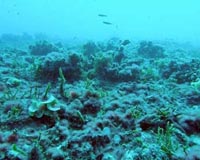
    Coral flourishing at Bikini Atoll atomic test site

    Photo


    By Rob Taylor

    CANBERRA (Reuters) - Coral is again flourishing in the crater left by the largest nuclear weapon ever detonated by the United States, 54 years after the blast on Bikini Atoll, marine scientists said on Tuesday.

    A team of research divers visited Bravo crater, ground zero for the test of a thermonuclear weapon in the remote Marshall Islands on March 1, 1954, and found large numbers of fish and coral growing, although some species appeared locally extinct. "I didn't know what to expect, some kind of moonscape perhaps. But it was incredible," Zoe Richards, from Australia's James Cook University, told Reuters about the team's trip to the atoll in the south Pacific.

    "We saw communities not too far from any coral reef, with plenty of fish, corals and action going on, some really striking individual colonies," she said.

    The 15 megatonne hydrogen bomb was 1,000 times more powerful than the blast which destroyed Hiroshima, vaporizing islands with temperatures hitting 99,000 Fahrenheit, and shaking islands even up to 124 miles away.

    The resulting 4 mile-wide fireball left a crater 1 mile across and 80 yards deep, while the mushroom cloud rose 62 miles over the South Pacific and radioactive fallout reached Australia and Japan.

    Richards, from the Australian government-backed Centre of Excellence for Coral Reef Studies, said the research team from Germany, Italy, Hawaii, Australia and the Marshall Islands found corals up to 9 yards high and some with 12 inch-thick trunks.

    "It was fascinating. I've never seen corals growing like trees outside of the Marshall Islands," Richards said.

    While above-water areas remained contaminated and unfit for human habitation, healthy sub-sea species probably traveled on strong winds and currents from nearby Rongelap Atoll, which was not bombed in a series of 23 tests between 1946-58.

    "It is absolutely pristine for another tragic reason. It received fallout and was evacuated of people, so now underwater it's really healthy and prevailing winds have probably been seeding Bikini Atoll's recovery," Richards said.

    Compared with a study made before the atomic tests, the team established that 42 species were missing compared to the early 1950s, with at least 28 of those locally extinct.

    The team was asked by Marshall Islands authorities to investigate Bikini for the first time since the tests, in part to see if a small diving industry could safely be expanded.

    The waters around Bikini are littered with wrecks of old , decommissioned ships sunk during the atomic tests, including the aircraft carrier USS Saratoga and the former Japanese flagship HIJMS Nagato, from which Admiral Yamoto gave the order to attack Pearl Harbour.

    Richards said the ability of Bikini's corals to bounce back from "a single huge destructive event" was proof of their resilience, although that did not mean the threat to corals from climate change had been overestimated.

    "Climate change is an ongoing struggle to survive with coral, with no reprieve in sight," she said. "After the atomic blasts they had 50 years undisturbed to recover."

    Original article posted here.