


Goodbye, GOPThe neocons killed the Republican Party. Will they stay for the funeral? |
| by Justin Raimondo |
| Barring a catastrophe – a terrorist attack on American soil, a calamitous gaffe, or the documented revelation that he really is a Muslim after all – it looks like Barack Obama is going to be the 44th president of these United States. Not only that, but I'd bet the farm we'll have a Democratic Congress, one with a working majority that relegates the Republicans to the role of back bench naysayers whose dissent barely registers. Last year, Paul Craig Roberts expressed the hopes of many American voters when he wrote: "If we are fortunate, Republicans will complete their self-destruction before they extinguish the Constitution and destroy America." It looks like he's going to get his wish. What killed the GOP was the war and its inevitable aftermath – the economic blowback that is even now whipping across the landscape and downing Wall Street's mightiest edifices. Not only that, but the general air of uncertainty and fear generated by the war and its economic and psychological ripple effects have created a crisis of confidence, one that threatens our well-being in an immediate way. Entrepreneurs don't like uncertainty, because business relations require regularity, or at least some degree of predictability. They also assume a degree of honesty, but truth has been in short supply lately, as the history of the Iraq war, from conception to inception, sadly demonstrates. After the American people found out they'd been deceived – that there were no "weapons of mass destruction," that we never had a chance of being greeted as "liberators," and that, far from paying for itself, as Paul Wolfowitz infamously averred, we'd be stuck with a $3 trillion bill – they cut the GOP loose and haven't yet looked back. This has always been the Republicans' war, no matter how enthusiastically most of the Democratic leadership initially supported it. The war we're supposedly "winning" has been the overarching theme of the McCain campaign, and he doesn't seem comfortable talking about anything else – unless it's why we must guarantee the borders of every obscure ex-Soviet "republic" for all time. The prime-time speakers at the Republican convention echoed the party line on the war, ad nauseam, and the entire event was one long paean to militarism and the glory of war. There were more uniforms in that convention hall than at the graduating ceremonies of West Point and Annapolis combined, and all the talk was of valor on the battlefield. Perhaps they should change their name to the Praetorian Party. They put all their eggs in one basket, and those eggs were hatched by the cowbirds of conservatism, the fabled neoconservatives. The history of this crew is too well-known to go into here in any detail: indeed, their narcissism has provided researchers with an overabundance of material that documents their hegira from far Left to far Right. Suffice to say that this vexatious faction entered the bloodstream of the conservative movement during the Cold War years, when pro-war (that's the Vietnam War) Democrats jumped ship and joined the GOP in protest over "McGovernism," i.e., a Democratic Party that rejected the politics of LBJ, Hubert Humphrey, and the neocons' favorite Democratic politician, Sen. Henry "Scoop" Jackson (D-Boeing). The sudden infusion of a bunch of highbrow leftist intellectuals into the conservative movement was welcomed by the organs of respectable conservative opinion, such as National Review. A few dissenters, such as Russell Kirk, Pat Buchanan, and the editors of Chronicles magazine, warned their fellows of trouble to come, but they were ignored. The neocons were bringing not only intellectual respectability and attention from liberal redoubts in the media and academia, but also hauling in plenty of dough. The big conservative foundations poured money into neocon projects and subsidized their up-and-coming intellectual dromedaries, driving out dissenters and imprinting the movement with their peculiar obsessions – first and foremost, an unmitigated militarism. Whatever else the neocons believed in – and this often seemed to change with the political seasons – the one constant was and is a firm belief in the efficacy of U.S. military intervention around the world. The leading neocon magazine, the Weekly Standard, once published a screed by Max Boot entitled "The Case for American Empire" – a title that seems curiously archaic today. However, back in the neocons' heyday, when the Iraq war was still a "cakewalk," the big disagreement among Those in the Know was whether America should formally acknowledge being an empire (Niall Ferguson) or not (Robert Kagan). This intra-neocon fight was just a strategic dispute: no one disputed the wisdom of global intervention. When Ron Paul warned his fellow Republicans that the empire is unsustainable, he was vilified by the neocons and the party establishment, derided as a kook, and practically drummed out of the party by the arbiters of political correctness, neocon style. They didn't even let him on the convention floor during McCain's coronation, and they refused to count his votes. Now that the disaster Paul predicted has befallen them, one can only stand and watch their spectacular implosion with the utmost satisfaction. What's particularly entertaining is the speed with which the neocons are now deserting the sinking ship of the GOP, like those small mammalian creatures they resemble in mien and spirit. Charles Krauthammer, David Brooks, David Frum – having destroyed the GOP and the conservative movement, they leave it a dried-up husk and move on to their next unwitting host. It's in somewhat dubious taste to say "I told you so," but that hasn't stopped me yet, so I'll say it again, as I did in February of last year: "We are in for some very dramatic times. With the leading figures in Congress and among the presidential candidates so far from the popular will on the major question of the day – the war – and with major economic problems on the horizon (if Alan Greenspan is right, Tuesday's huge drop in the stock market may be a hint of things to come), this country could be headed for some major turmoil. … "The consequences of our foreign policy do not just redound overseas: the political and cultural 'blowback' of the Iraq war, and whatever other wars come out of our initial intervention, is already straining the limits of our constitutional form of government, as well as putting tremendous economic pressure on a system that could break down at any moment. We have borrowed our children into penury, and now we're working on their children, who are going to inherit much less than we had to start with. "With all these rising crises looming, the American Empire promises to be the shortest-lived imperial expansion in world history. After a long and brilliant record as a successful ongoing project in limited government and representative democracy, will the American experiment end in a flashy display of military prowess punctuated by a noisy economic and political implosion?" The events of the past few weeks have definitively answered that question in the affirmative. I predict it won't be long before we're hearing the rhetoric of war employed by the re-designers of our economy: instead of a "war on terrorism," we'll soon be fighting a "war on recession" – and it will be considered close to treasonous if anyone so much as mentions the D-word in this regard. In any case, the new reality – or, rather, the newly realized reality – imposes radical restraints on us that rule out foreign wars of aggression, or "liberation," and require a concentration of our resources at home. Yet such a sudden change is going to take some getting used to by the lords of Washington, who are accustomed to thinking of the world as their playground. In the wake of such a sea-change, very often people go right on acting as if absolutely nothing had occurred, oblivious to the new reality until they run right into it, head first. That's what's happened, so far: the imperial pretensions of our presidential candidates, for example, show no signs of abating. They're still talking about bailing out the Georgian economy (the one in the Caucasus), when people right here in this country are being foreclosed out of their homes. They don't understand the full implications of what's happening to their beloved empire, but they will soon enough. The first politician to grasp the new reality, and successfully adapt to it, will go far. It's a pity that none of the current crop seem to get it. ~ Justin RaimondoOriginal article posted here. |
Thursday, October 16, 2008
The dying Rethugs


Tuesday, October 07, 2008
Saturday, September 27, 2008
Tuesday, September 16, 2008
The proof of US involvement in Georgia
August 1, 2008
Tea Kerdzevadze, Georgia Today
The International Training “Immediate Response 2008” conducted with the joint efforts of the USA and Georgian Armed Forces was held at Vaziani Military Base on July 15-31. The mission of the training was to improve combined capabilities and strengthen regional cooperation.
The exercise involved the conduction of a combined brigade-level CPX exercise with Georgian Armed Forces to develop a common understanding of coalition staff planning procedures; combined live-fire FTX/STX to train on tactics, techniques and procedures for the conduct of coalition security and stability operations and to deploy the 21st TSC EECP and exercise limited theater opening capabilities.
In total, 1,630 servicemen participated, including representatives of the Joint Staff, Land Forces Staff, IV Brigade, the 41st and 42nd Battalions and Engineer Battalion Company from Georgia. From the USA, 1,000 military servicemen took part in the exercise including the United States Army Europe, 3rd Battalion, 25th Marine Expeditionary Unit, 1st Battalion 121 Infantry Regiment Georgian National Guard (Atlanta, Georgia) and 5045th General Support Unit. As well as Georgian and American participants, 10 servicemen each from Azerbaijan, Armenia and the Ukraine took part.
The exercise consisted of two stages. First of all, the practical and theoretical parts of the CPX exercises, situational and field trainings were held. The second stage comprised staff and command training. IV Brigade Staff participated in the first stage which underwent the training with modern computer equipment. Within the JKT Program, the I Brigade by which it streamlined decision making process, took direct participation in the planning process and elaborated the action plan. After approving the plan, the operations were carried out via computers.
Preparation for the military training “Immediate Response” started in summer 2007. Since then, planning conferences were held from time to time to discuss and arrange all kinds of issues concerning the exercises, including logistical and medical support and equipment transportation. Georgia provided 90 percent of the logistical support for the exercise with local resources, including railway, customs clearance and security issues. In the framework of the logistical support, Georgia also modernized Vaziani Military Base as well. The rest of the equipment - basic field gear, tents, power generators, logistical vehicles and two HH-60 Blackhawk medical evacuation helicopters - were shipped from the United States, Germany and Italy.
The opening ceremony of Immediate Response 2008 was held at Vaziani Military Base on July 15. The ceremony was opened accompanied with the national anthems of five countries. The Deputy Chief of the Joint Staff of the Georgian Armed Forces LTC Alexander Osepaishvili and SETAF Brigadier General William B. Garrett delivered speeches. BG Garrett stated that he welcomed the exercise Immediate Response 2008 saying it was an honor and a privilege to be in Georgia. “Over the next several weeks, we will live together, work together and train together. This is an invaluable opportunity to get to know and understand one another, to learn about different cultures and to build enduring relationships between professional militaries,” said the Brigadier General. He also expressed particular gratitude towards the Georgian Armed Forces for the strong support not only for the exercise but also for continuing service with the American forces, allies and partners.
The training scenario envisaged a peacekeeping operation in Iraq. This training helped the IV Brigade with its preparations to be deployed in Iraq. The US Marine Corps and the American National Guard Company carried out the field operations with the IV Brigade Staff. The joint training took place on Vaziani firing ground and Vaziani airport. Settlement models were arranged on Vaziani airport where the soldiers were trained how to battle within inhabited areas. Their main purpose was to create and implement a full range of operational tasks; to set up check-points, seize settled areas, convey information, patrol, etc.
The scenario of the training was the following: the situation was held within a built-up, inhabited area. As the terrorists carried out sudden attack over the inhabitants, the Georgian and American militaries patrolled and evacuated and rescued the citizens. If any of the inhabitants were wounded the soldiers administered medical assistance and transported them to the appropriate facilities. After this the military servicemen implemented the clearance operation from the terrorists within the inhabited area.
On July 21, President Mikheil Saakashvili, Minister of Defense David Kezerashvili, the Chief of the Joint Staff of GAF Brigadier General Zaza Gogava and the Deputy Chief of JS LTC Alexander Osepaishvili attended this training and became acquainted with the joint Georgian-American training. At first, they visited the tactical operations center and command post of the US division. Then they went to Vaziani Airport to see the demonstrated training. After the end of the demonstrated exercise, the President of Georgia delivered a speech to the Georgian military servicemen who had participated in the training, saying: “The main task of Georgian officers and soldiers is training. This international exercise is a unique case as we have the possibility to hold trainings along with the representatives of the best army in the world for a month. I think that we have created a new military school in Georgia in recent years. Believe that what all of you have learned now will remain in our country and will be shared with the future generations. That is why we have to train theoretically and practically as this is a precondition of victory. The main thing is to get acquainted with independent decision-making and free thinking.”
On July 28, a demonstration day for media representatives was held in the framework of the international training “Immediate Response”. The event was attended by the Chief of Joint Staff of GAF Brigadier General Zaza Gogava, his deputies LTC Grigol Tatishvili and LTC Alexander Osepaishvili and Head of the US South European Forces Brigadier General William B. Garrett. The event was opened by the Officer of J-3 Operational Planning Department of Joint Forces Col. Erick Nantz who introduced the training presentation. The second stage of the exercise continued at Vaziani Airdrome where Georgian and American military servicemen carried out demonstrative training for the guests.
The scenario was set in one of the small urban areas of Iraq.
The main duty of the peacekeeping forces was to seize the terrorist who was hiding in one of the houses. The terrorist tried to escape when the coalition forces appeared but the troops did their best to detain him. After this, the platoon performed a humanitarian operation and transferred wounded people to hospital by military helicopters.
The Ambassador Extraordinary and Plenipotentiary of the USA H.E. John Tefft also attended the exercise. After the demonstrative training he outlined the importance of the training, saying: “It is in a spirit of Partnership for Peace, part of the NATO program. It was very rewarding for me to see the joint work of soldiers from different countries. The command post trainings also went successfully. Ukrainian, Azeri, Armenian and Georgian soldiers participated in the exercise jointly. I believe that the exercise fulfilled its main purpose.”
Immediate Response is an annual, bilateral security cooperation exercise conducted between US and coalition partners. Approximately 1,600 military personnel consisting of US soldiers, airmen, marines and army civilian employees; and Georgian military personnel make up Task Force Immediate Response 2008. The training is designed to exercise combined interoperability, conduct combined arms live fire, conduct training on responsive medical aid in a combat environment and bilateral training with Georgian and other multinational defense forces. This is the first time that Immediate Response is conducted in Georgia. Poland and Bulgaria has commonly hosted this exercise in years past.
The SETAF Brigadier General William B. Garrett commanded the exercise from American side. We asked him for his thoughts and comments on Immediate Response.
What is the primary aim of the exercise “Immediate Response 2008”? What are the objectives of the exercise?
We are conducting this exercise to enhance interoperability with a key coalition partner. Georgia has provided consistent support to ongoing operations in Iraq. Georgia is the third largest force contributor to Operation Iraqi Freedom and that means a lot to the United States.
What do you expect from “Immediate Response 2008”?
The combined approach – active participation from all the countries involved – provided an invaluable opportunity to learn about different cultures, and to promote understanding and cooperation between our forces and strengthen our partnerships for the future.
What benefits will this exercise bring for the Georgian Armed Forces?
The Georgian Armed Forces will gain greater tactical proficiency as well as improving their ability to work with coalition partners. But the benefits gained from this exercise are not limited to Georgian Soldiers. American, Armenian, Azeri and Ukrainian service members all benefited from this exercise. I might also point out that the Georgian 4th Infantry Brigade is scheduled to deploy to Iraq next year. The tough, realistic training provided during Immediate Response 2008 will certainly help them prepare for that deployment.
How do you estimate the preparation level of Georgian military servicemen?
The Georgian Soldiers we trained with the last few weeks from the 4th Brigade are fit, motivated, and disciplined. They are eager to learn. They interact well with their coalition partners. American soldiers are very proud to serve alongside Georgian soldiers.
As you are informed the IV Brigade is preparing to carry out peacekeeping mission in Iraq? What recommendations would you give our soldiers in this regard?
Continue to train hard for the mission in Iraq, incorporate the experiences of those who are currently serving in Iraq, and build on those things you learned during Exercise Immediate Response 08.
What obstacles do you see in the process of implementation of “Immediate Response 2008”? What is the most challenging of this exercise?
We don’t see obstacles, only challenges. There were several aspects to this exercise that were critical to success; I can not name one in particular. Our Georgian counterparts really went the extra mile to accommodate this exercise and provided excellent support. They were fantastic hosts and we look forward to working with them in the future.
On July 15, First Deputy Defence Minister Batu Kutelia and Chief of the Joint Staff of Georgian Armed Forces, Brigadier General Zaza Gogava, went on an official visit to Iraq.
They visited the 1st Infantry Brigade stationed in FOB Delta, Basra Base and Cop Cleary. The Battalion commanders briefed the MoD officials about operations and tasks provided by Georgian military contingent in Vassit Province.
In the framework of this visit, Minister Batu Kutelia and BG Zaza Gogava met with the following multi-national forces: Iraq Commanding General, General David Petraeus, Multi-National Corps- Iraq Deputy Commanding General for the Coalition, Brigadier General Nicholas Matern and the 10th Mountain CG, Major General Michael Oates. During the meetings with the multi-national forces, the commanders evaluated the Georgian peacekeeping mission very positively.
Currently in Iraq, the Georgian military contingent is represented by the 1st Infantry Brigade that rotated with the 3rd Infantry Brigade in January 2008. The Georgian contingent in Iraq counts 2000 personnel. The main base which is under Georgians’ control is FOB Delta, located in city of Al Kut, Vassit Province. The main tasks for Georgian military are to set up roadblocks, stationary and mobile checkpoints, provide security in Vassit Province and to control of the checkpoint located at the Iran –Iraq border.
The part of Iranian border that is now controlled by Georgian peacekeepers was the place where smuggled arms once passed. During operations provided by Georgian troops, there were 110,000 vehicles and 560,958 people checked, and 1,500 Iraqi civilians were provided with medical services by the Georgian military doctors.
The Georgian troops actively participate with their American counterparts in Civil-Military Co-operation (CIMIC) where the military cooperates with civilian agencies and institutions in order to bring peace and stability and foster better relations. “We have a very good relationship with the local inhabitants,” said Captain Zaur Makaradze, CIMIC group commander, from the 1st Infantry Brigade. On the question how dangerous it is Captain Makharidze answered with smile “It’s quite dangerous, but we are not afraid…We help Iraqi people.”
Deputy Defence Minister Batu Kutelia commented on the visit: “We have discussed the success of Georgian Military in Iraq and General Petraeus evaluates our mission very highly. He thanked us for our decision to continue our contingent here in Iraq until the end of year.”
According to BG Gogava: “General Petraeus estimated very positively the Georgian troops… He has once more underlined the high level of preparedness of the Georgian soldiers. There were a lot of thankful words said about Georgian Armed Forces. Afterwards there was a detailed conversation about the present situation in Vassit Province, and what a positive role has been played by the Georgian soldiers. These were the main subjects which were discussed by us. Then after we talked about the future plans, and the role of Georgian military in future operations in Vassit Province.”
Internal Minister of de facto South Ossetia Mikheil Mindzaev, has confirmed the information over equipment of the fortification structures. According to Mindzaev, the ministry is obliged to conduct engineering works and reinforce the posts in such a manner.
He added that there was not alternative and they were only acted in response to the same kind of activity on the part of the Georgians.
Moreover, the minister stated that the Georgian side intends to implement provocations and these actions will be directed towards peaceful population in the breakaway region. “We are aware that Tskhinvali is violating the agreement by such steps, but it is worth noting that Georgia has taken the first steps in violation and we only responded,” Mikhail Mindzaev stated.
The launching of fortifying activities on the part of Ossetian separatists has been evaluated as grave violation of the agreement by OSCE (Organization for Security and Cooperation in Europe.
Original article posted here.
Thursday, August 21, 2008
More Neo Con (warmongering) infestations
By Jason Leopold
August 21, 2008
Randy Scheunemann, one of John McCain’s top foreign policy advisers, represents a key link in neoconservative strategy that seeks simultaneously to remove hostile regimes in the Middle East and to box in Russia through an expanded NATO that incorporates former Soviet bloc countries.
Scheunemann has come under scrutiny in recent weeks for his past lobbying work on behalf of the government of Georgia, even while he was advising McCain who vowed to bar lobbyists from his campaign.
Scheunemann’s company, Orion Strategies, has received about $750,000 from Georgia, with payments as recently as May.
After the Aug. 7 outbreak of fighting between Georgia and Russia over Georgia’s breakaway province of South Ossetia, McCain – advised by Scheunemann – led a crescendo of tough rhetoric warning of a possible new Cold War and demanding harsh penalties against Moscow.
But Scheunemann's advice on the Russia-Georgia conflict only captures part of his role in shaping McCain ’s neoconservative foreign policy.
Scheunemann merges two key prongs of a neocon global strategy for permanent U.S. military dominance: the simultaneous projection of U.S. power into the Middle East and the elimination of Russia’s dream of reestablishing itself as a major international player.
Operating mostly behind the scenes, Scheunemann has long worked to unify former East Bloc states into an anti-Moscow alliance and to apply regime-change tactics against U.S. adversaries in the Middle East, such as Saddam Hussein’s Iraq and the mullahs in neighboring Iran.
In that regard, Scheunemann was one of the neocon operatives who helped promote bogus intelligence about Iraq in the run-up to the U.S.-led invasion. He also has said the U.S. government has not been tough enough in dealing with other “rogue” nations, such as Iran.
For instance, Scheunemann believes one area of U.S. foreign policy that needs change is the ban on assassinating leaders of foreign governments.
“It makes no sense to regularly target command and control nodes with precision-guided munitions, while denying highly capable sniper teams the ability to attack individual targets,” Scheunemann told conservative author Bill Gertz in the 2002 book Breakdown.
According to the book, Scheunemann believed the CIA should have been given the authority to assassinate Saddam Hussein during the first Persian Gulf War.
“The messy business of back-alley tradecraft has taken a back seat to the much simpler business of ‘liaison’ with foreign intelligence services,” Scheunemann told Gertz, adding that he would seek to change that approach if and when he returned to the U.S. government.
A director of the neocon Project for the New American Century, Scheunemann worked on McCain’s failed bid for the White House in 2000 and became a top adviser to former Defense Secretary Donald Rumsfeld in 2001.
Foreign Contacts
But Scheunemann’s primary service to the Bush administration has come in his private capacity as a contact to Eastern European states as well as his association with Iraqi exiles.
In fall 2002, Scheunemann got a green light from the White House to launch the Committee for the Liberation of Iraq, an organization whose mission was to promote regime change in the region and to gather European support for a preemptive strike on Iraq.
“The Committee for the Liberation of Iraq was the brainchild of the Bush administration,” the Financial Times reported on Dec. 16, 2002. “It is said that, once the Saddam regime has been overthrown, the CLI will act as a ‘shadow government’ for Baghdad.
“But it will limit itself to policy matters and will not deal with details. It will, eventually, press for a ‘competitive petroleum production-sharing regime’ which could make OPEC irrelevant to Iraq's oil output or supply decisions.”
Scheunemann had been an early supporter of Ahmad Chalabi and his Iraqi National Congress, which supplied false intelligence to the CIA about Hussein’s alleged WMD and his supposed ties to Osama bin Laden.
In 1998, while an adviser to Republican Senators Bob Dole and Trent Lott, Scheunemann drafted the Iraq Liberation Act and got the federal government to funnel $98 million to Iraqi exiles associated with Chalabi’s INC.
Later, the Committee for the Liberation of Iraq housed its offices at the same address as Chalabi’s INC.
Scheunemann worked closely, too, with the White House Iraq Group, which was headed by George W. Bush’s Chief of Staff Andrew Card. The so-called WHIG was charged with selling the war to the American public.
In November 2002, the Washington Post reported that Scheunemann’s group would push for regime change in Iraq through “sessions with opinion makers, contacts for journalists and mass marketing when the time is ripe.
On Jan. 28, 2003, the same day that President Bush delivered his State of the Union address that included the now-debunked claim that Iraq had sought yellowcake uranium from Niger, Scheunemann tapped McCain and his close ally, Sen. Joseph Lieberman, as honorary co-chairmen of the Committee for the Liberation of Iraq.
“By joining our efforts, Senators McCain and Lieberman highlight their commitment to ending the threat posed by Saddam Hussein and freeing the Iraqi people," Scheunemann said in a statement issued by his committee.
McCain and Lieberman aggressively promoted the CLI’s goal of Iraqi regime change via a preemptive military strike, which was launched on March 19, 2003, toppling Hussein’s government in three weeks.
In an April 13, 2003, op-ed in the Los Angeles Times, Scheunemann wrote how a “democratic Iraq” would help remake the Middle East, an argument that remains a focal point of McCain’s presidential campaign.
‘New Europe’
But Scheunemann also personifies another part of the neocon agenda. He is a key bridge between an aggressive U.S. policy in the Middle East and the projection of U.S. influence into the former East Bloc nations which were long dominated by the Soviet Union.
In October 2002, during the run-up to the invasion of Iraq, President Bush considered naming Scheunemann as a special envoy to the Iraqi opposition. But Scheunemann was judged to have more value enlisting Eastern European nations into the "Coalition of the Willing.”
So, Scheunemann pulled together the “Vilnius 10” group of East European nations – Slovenia, Slovakia, Romania, Bulgaria, Lithuania, Latvia, Estonia, Albania, Croatia and Macedonia – in support of Bush’s war policy.
At the time, some foreign policy analysts recognized this collaboration as part of the neoconservative desire to build up NATO to circumvent the United Nations Charter, which bars military attacks without UN sanction.
“With NATO now set to enlarge from 19 members to take on seven East European nations including the three Baltic states, it is said that both the Bush team and the [Committee for the Liberation of Iraq] want the political mechanism of the Atlantic alliance to replace the UN Security Council in giving multilateral legitimacy to any major U.S. action outside North America,” the Financial Times reported on Dec. 16, 2002.
“This is because, unlike the UN Security Council where the French or Russians might block American action, NATO's political decisions do not require consensus. Only NATO's military decisions require consensus.”
For actual military operations, President Bush made clear he would rely on ad hoc alliances, such as the Iraq War’s “Coalition of the Willing.”
The reward for the “willing” Eastern European countries, which the Bush administration called “New Europe,” was future inclusion in NATO with the umbrella of its mutual security guarantee that treats an attack on one as an attack on all.
“Considering the nations - including the Baltic states - signed on the group at the expense of creating a schism in the European Union, the Scheunemann initiative was unanimously regarded as a diplomatic triumph for Washington and a coup d’etat in Brussels,” the Baltic Times reported in August 2003.
Scheunemann’s crossover between his work on the Iraq invasion and his connections to former East Bloc countries proved lucrative, too. He advised them that their collaboration on the Iraq War could get them Iraqi reconstruction contracts as well as U.S. support for their entry into NATO.
He earned hundreds of thousands of dollars from countries, such as Romania which paid him $175,000 for providing advice on Iraqi reconstruction deals.
For another lobbying client, Latvia, Scheunemann made himself even more valuable. He helped form the Latvian Builders Strategic Partnership, a consortium for parlaying Latvia’s support for the Iraq invasion into a cut of the multimillion-dollar reconstruction spending.
Five months after the U.S.-led invasion, Scheunemann met with Peteris Elferts, Latvia’s parliamentary secretary in the Foreign Ministry and ambassador-at-large for Iraqi policy, and Valdis Birkavs, chairman of the Latvian Builders Strategic Partnership, about constructing an information technology system in Baghdad.
Georgia, another of Scheunemann’s lobbying clients, also backed the Iraq invasion, contributed troops, and thus counted on Washington’s support to bring it into NATO. [For more on McCain-Scheunemann-Georgia ties, see Washington Post, Aug. 13, 2008]
Though other NATO members, especially “Old Europe” nations like France, blocked Georgia’s admission, Georgia’s pro-U.S. president Mikheil Saakashvili apparently believed he would have Western backing on Aug. 7 when he launched an offensive against the breakaway province of South Ossetia.
Instead, the Russian military intervened to drive back the Georgian army and then took up security positions inside Georgian territory. McCain joined with leading neoconservative voices in denouncing the Russian attack.
McCain’s tough talk about Russia and his insistence that he will only tolerate “victory” in Iraq offer an important insight into what his foreign policy would look like if he wins the presidency.
Surrounded by hardcore neoconservatives, like Scheunemann, there is every reason to believe that a McCain administration would continue using force to impose Washington’s will in the Middle East while engaging in geopolitical brinkmanship against old rivals like Moscow.
Jason Leopold has launched a new Web site, The Public Record, at www.pubrecord.org.
Original article posted here.
Wednesday, August 20, 2008
More prescient analysis by PaulCraig Roberts
Paul Craig Roberts
The success of the Bush Regime's propaganda, lies, and deception with gullible and inattentive Americans since 9/11 has made it difficult for intelligent, aware people to be optimistic about the future of the United States. For almost 8 years the US media has served as Ministry of Propaganda for a war criminal regime. Americans incapable of thinking for themselves, reading between the lines, or accessing foreign media on the Internet have been brainwashed.
As the Nazi propagandist, Joseph Goebbels, said, it is easy to deceive a people. You just tell them they have been attacked and wave the flag.
It certainly worked with Americans.
The gullibility and unconcern of the American people has had many victims. There are 1.25 million dead Iraqis. There are 4 million displaced Iraqis. No one knows how many are maimed and orphaned.
Iraq is in ruins, its infrastructure destroyed by American bombs, missiles, and helicopter gunships.
We do not know the death toll in Afghanistan, but even the American puppet regime protests the repeated killings of women and children by US and NATO troops.
We don't know what the death toll would be in Iran if Darth Cheney and the neocons succeed in their plot with Israel to bomb Iran, perhaps with nuclear weapons.
What we do know is that all this murder and destruction has no justification and is evil. It is the work of evil men who have no qualms about lying and deceiving in order to kill innocent people to achieve their undeclared agenda.
That such evil people have control over the United States government and media damns the American public for eternity.
America will never recover from the shame and dishonor heaped upon her by the neoconned Bush Regime.
The success of the neocon propaganda has been so great that the opposition party has not lifted a finger to rein in the Bush Regime's criminal actions. Even Obama, who promises "change" is too intimidated by the neocon's success in brainwashing the American population to do what his supporters hoped he would do and lead us out of the shame in which the neoconned Bush Regime has imprisoned us.
This about sums up the pessimistic state in which I existed prior to the go-ahead given by the Bush Regime to its puppet in Georgia to ethnically cleanse South Ossetia of Russians in order to defuse the separatist movement. The American media, aka, the Ministry of Lies and Deceit, again accommodated the criminal Bush Regime and proclaimed "Russian invasion" to cover up the ethnic cleansing of Russians in South Ossetia by the Georgian military assault.
Only this time, the rest of the world didn't buy it. The many years of lies--9/11, Iraqi weapons of mass destruction, al Qaeda connections, yellowcake, anthrax attack, Iranian nukes, "the United States doesn't torture," the bombings of weddings, funerals, and children's soccer games, Abu Ghraib, renditions, Guantanamo, various fabricated "terrorist plots," the determined assault on civil liberties--have taken their toll on American credibility. No one outside America any longer believes the US media or the US government.
The rest of the world reported the facts--an assault on Russian civilians by American and Israeli trained and equipped Georgian troops.
The Bush Regime, overcome by hubris, expected Russia to accept this act of American hegemony. But the Russians did not, and the Georgian military was sent fleeing for its life.
The neoconned Republican response to the Russian failure to follow the script and to be intimidated by the "unipower" was so imbecilic that it shattered the brainwashing to which Americans had succumbed.
McCain declared: "In the 21st century nations don't invade other nations." Imagine the laughs Jon Stewart will get out of this on the Daily Show. In the early years of the 21st century the United States has already invaded two countries and has been beating the drums for attacking a third. President Bush, the chief invader of the 21st century, echoed McCain's claim that nations don't invade other nations. http://news.bbc.co.uk/2/hi/europe/7556857.stm
This dissonant claim shocked even brainwashed Americans, as readers' emails reveal. If in the 21st century countries don't invade other countries, what is Bush doing in Iraq and Afghanistan, and what are the naval armadas and propaganda arrayed against Iran about?
Have two of the worst warmongers of modern times--Bush and McCain--called off the US/Israeli attack on Iran? If McCain is elected president, is he going to pull US troops out of Iraq and Afghanistan as "nations don't invade other nations," or is President Bush going to beat him to it?
We all know the answer.
The two stooges are astonished that the Americans have taught hegemony to Russians, who were previously operating, naively perhaps, on the basis of good will.
Suddenly the Western Europeans have realized that being allied with the United States is like holding a tiger by the tail. No European country wants to be hurled into war with Russia. Germany, France, and Italy must be thanking God they blocked Georgia's membership in NATO.
The Ukraine, where a sick nationalism has taken hold funded by the neocon National Endowment for Democracy, will be the next conflict between American pretensions and Russia. Russia is being taught by the neocons that freeing the constituent parts of its empire has not resulted in their independence but in their absorption into the American Empire.
Unless enough Americans can overcome their brainwashed state and the rigged Diebold voting machines, turn out the imbecilic Republicans and hold the neoconservatives accountable for their crimes against humanity, a crazed neocon US government will provoke nuclear war with Russia.
The neoconservatives represent the greatest danger ever faced by the United States and the world. Humanity has no greater enemy.
Paul Craig Roberts was Assistant Secretary of the Treasury in the Reagan administration. He was Associate Editor of the Wall Street Journal editorial page and Contributing Editor of National Review. He is coauthor of The Tyranny of Good Intentions.He can be reached at:
Original article posted here.
Thursday, July 17, 2008
Bush doctrine dead again. First, North Korea. Now Iran. Warmongers blinked!
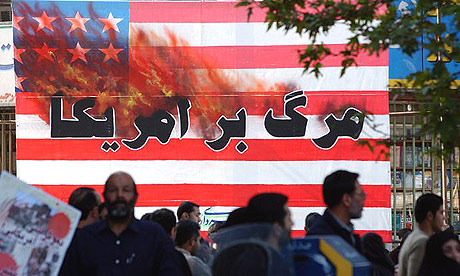
Iranians pass a US flag with a sign reading 'Death to America' as they attend a rally in Tehran, in 2004. Photograph: Hasan Sarbakhshian/AP
The US plans to establish a diplomatic presence in Tehran for the first time in 30 years as part of a remarkable turnaround in policy by President George Bush.
The Guardian has learned that an announcement will be made in the next month to establish a US interests section - a halfway house to setting up a full embassy. The move will see US diplomats stationed in the country.
The news of the shift by Bush who has pursued a hawkish approach to Iran throughout his tenure comes at a critical time in US-Iranian relations. After weeks that have seen tensions rise with Israel conducting war games and Tehran carrying out long-range missile tests, a thaw appears to be under way.
The White House announced yesterday that William Burns, a senior state department official, is to be sent to Switzerland on Saturday to hear Tehran's response to a European offer aimed at resolving the nuclear standoff.
Burns is to sit at the table with Iranian officials despite Bush repeatedly ruling out direct talks on the nuclear issue until Iran suspends its uranium enrichment programme, which is a possible first step on the way to a nuclear weapon capability.
A frequent complaint of the Iranians is that they want to deal directly with the Americans instead of its surrogates, Britain, France and Germany.
Bush has taken a hard line with Iran throughout the last seven years but, in the dying days of his administration, it is believed he is keen to have a positive legacy that he can point to.
The return of US diplomats to Iran is dependent on agreement by Tehran. But President Mahmoud Ahmadinejad indicated earlier this week that he was not against the opening of a US mission. Iran would consider favourably any request aimed at boosting relations between the two countries, he said.
US interests in the country at present are looked after by the Swiss embassy. The British government restored its embassy in Tehran after Labour's 1997 general election victory as part of a policy of constructive diplomacy with countries that had previously been branded rogue states.
The creation of a US interest section would see diplomats stationed in Tehran for the first time since the hostage crisis that began when hundreds of students, as part of the Iranian revolution that led to fall of the Shah, stormed the US embassy in 1979 and held the occupants until 1981.
The special interests section would be similar to the one in Havana, Cuba. The US broke off relations with Cuba in 1961 after Castro's takeover but US diplomats returned in 1977.
The special interests section carries out all the functions of an embassy. It is, in terms of protocol, part of the Swiss embassy but otherwise is staffed by Americans and independent of the Swiss.
There has been an intense debate within the Bush administration over Iran, with the vice-president, Dick Cheney, in favour of a military strike against Iranian nuclear plants and the state department in favour of diplomacy.
The state department has been pressing the White House for the last two years to re-establish diplomatic relations with Tehran by setting up an interest section.
The state department is keen that the move should not be interpreted as a sign of weakness.
Sending Burns, who left Washington last night, to Geneva and the establishment of an interests section undercuts one of the main planks of foreign policy advocated by the Democratic presidential candidate, Barack Obama, who argues for direct negotiations with Iran.
The White House has been working in tandem over the last month with Obama's Republican rival, John McCain.
The US has had to rely on British diplomats based in Tehran, as well as other diplomats, for information about the inner workings of Iranian politics. Having its own staff would give them access to students, dissidents and others. The staff would also process visa applications, at present handled by a small office in Dubai, which is difficult for Iranians to get to.
Ahmadinejad told a reporter earlier this week, in response to a question about a possible US interests section: "We will receive favourably any action which will help to reinforce relations between the peoples." He added: "We have not received any official request but we think that the development of relations between the two peoples is something correct."
That sentiment was echoed last month by secretary of state, Condoleezza Rice, who told reporters: "We want more Iranians visiting the United States ... We are determined to reach out to the Iranian people."
Iran has an interests section in Washington, which would make it harder for Tehran to deny the Americans a similar arrangement.
Rice set up a group to study the feasibility of re-establishing a presence after the idea cropped up repeatedly in discussions among Washington thinktanks.
Asked last month about the idea, she would not confirm or deny it.
But she indicated that the present arrangement where there is an American visa office for Iranians in Dubai was inadequate.
"We know that it's difficult for Iranians sometimes to get to Dubai," she said.
Tuesday, July 15, 2008
LOCK THE BASTARDS UP!
Worries About War Crimes Heat up in the White House
By Frank Rich, The New York Times
We know what a criminal White House looks like from "The Final Days," Bob Woodward and Carl Bernstein's classic account of Richard Nixon's unraveling. The cauldron of lies, paranoia and illegal surveillance boiled over, until it was finally every man for himself as desperate courtiers scrambled to save their reputations and, in a few patriotic instances, their country.
"The Final Days" was published in 1976, two years after Nixon abdicated in disgrace. With the Bush presidency, no journalist (or turncoat White House memoirist) is waiting for the corpse to be carted away. The latest and perhaps most chilling example arrives this week from Jane Mayer of The New Yorker, long a relentless journalist on the war-on-terror torture beat. Her book "The Dark Side" connects the dots of her own past reporting and that of her top-tier colleagues (including James Risen and Scott Shane of The New York Times) to portray a White House that, like its prototype, savaged its enemies within almost as ferociously as it did the Constitution.
Some of "The Dark Side" seems right out of "The Final Days," minus Nixon's operatic boozing and weeping. We learn, for instance, that in 2004 two conservative Republican Justice Department officials had become "so paranoid" that "they actually thought they might be in physical danger." The fear of being wiretapped by their own peers drove them to speak in code.
The men were John Ashcroft's deputy attorney general, James Comey, and an assistant attorney general, Jack Goldsmith. Their sin was to challenge the White House's don, Dick Cheney, and his consigliere, his chief of staff David Addington, when they circumvented the Geneva Conventions to make torture the covert law of the land. Mr. Comey and Mr. Goldsmith failed to stop the "torture memos" and are long gone from the White House. But Vice President Cheney and Mr. Addington remain enabled by a president, attorney general (Michael Mukasey) and C.I.A. director (Michael Hayden) who won't shut the door firmly on torture even now.
Nixon parallels take us only so far, however. "The Dark Side" is scarier than "The Final Days" because these final days aren't over yet and because the stakes are much higher. Watergate was all about a paranoid president's narcissistic determination to cling to power at any cost. In Ms. Mayer's portrayal of the Bush White House, the president is a secondary, even passive, figure, and the motives invoked by Mr. Cheney to restore Nixon-style executive powers are theoretically selfless. Possessed by the ticking-bomb scenarios of television's "24," all they want to do is protect America from further terrorist strikes.
So what if they cut corners, the administration's last defenders argue. While prissy lawyers insist on habeas corpus and court-issued wiretap warrants, the rest of us are being kept safe by the Cheney posse.
But are we safe? As Al Qaeda and the Taliban surge this summer, that single question is even more urgent than the moral and legal issues attending torture.
On those larger issues, the evidence is in, merely awaiting adjudication. Mr. Bush's 2005 proclamation that "we do not torture" was long ago revealed as a lie. Antonio Taguba, the retired major general who investigated detainee abuse for the Army, concluded that "there is no longer any doubt" that "war crimes were committed." Ms. Mayer uncovered another damning verdict: Red Cross investigators flatly told the C.I.A. last year that America was practicing torture and vulnerable to war-crimes charges.
Top Bush hands are starting to get sweaty about where they left their fingerprints. Scapegoating the rotten apples at the bottom of the military's barrel may not be a slam-dunk escape route from accountability anymore.
No wonder the former Rumsfeld capo, Douglas Feith, is trying to discredit a damaging interview he gave to the British lawyer Philippe Sands for another recent and essential book on what happened, "Torture Team." After Mr. Sands previewed his findings in the May issue of Vanity Fair, Mr. Feith protested he had been misquoted -- apparently forgetting that Mr. Sands had taped the interview. Mr. Feith and Mr. Sands are scheduled to square off in a House hearing this Tuesday.
So hot is the speculation that war-crimes trials will eventually follow in foreign or international courts that Lawrence Wilkerson, Colin Powell's former chief of staff, has publicly advised Mr. Feith, Mr. Addington and Alberto Gonzales, among others, to "never travel outside the U.S., except perhaps to Saudi Arabia and Israel." But while we wait for the wheels of justice to grind slowly, there are immediate fears to tend. Ms. Mayer's book helps cement the case that America's use of torture has betrayed not just American values but our national security, right to the present day.
In her telling, a major incentive for Mr. Cheney's descent into the dark side was to cover up for the Bush White House's failure to heed the Qaeda threat in 2001. Jack Cloonan, a special agent for the F.B.I.'s Osama bin Laden unit until 2002, told Ms. Mayer that Sept. 11 was "all preventable." By March 2000, according to the C.I.A.'s inspector general, "50 or 60 individuals" in the agency knew that two Al Qaeda suspects -- soon to be hijackers -- were in America. But there was no urgency at the top. Thomas Pickard, the acting F.B.I. director that summer, told Ms. Mayer that when he expressed his fears about the Qaeda threat to Mr. Ashcroft, the attorney general snapped, "I don't want to hear about that anymore!"
After 9/11, our government emphasized "interrogation over due process," Ms. Mayer writes, "to pre-empt future attacks before they materialized." But in reality torture may well be enabling future attacks. This is not just because Abu Ghraib snapshots have been used as recruitment tools by jihadists. No less destructive are the false confessions inevitably elicited from tortured detainees. The avalanche of misinformation since 9/11 has compromised prosecutions, allowed other culprits to escape and sent the American military on wild-goose chases. The coerced "confession" to the murder of the Wall Street Journal reporter Daniel Pearl by Khalid Sheikh Mohammed, to take one horrific example, may have been invented to protect the real murderer.
The biggest torture-fueled wild-goose chase, of course, is the war in Iraq. Exhibit A, revisited in "The Dark Side," is Ibn al-Shaykh al-Libi, an accused Qaeda commander whose torture was outsourced by the C.I.A. to Egypt. His fabricated tales of Saddam's biological and chemical W.M.D. -- and of nonexistent links between Iraq and Al Qaeda -- were cited by President Bush in his fateful Oct. 7, 2002, Cincinnati speech ginning up the war and by Mr. Powell in his subsequent United Nations presentation on Iraqi weaponry. Two F.B.I. officials told Ms. Mayer that Mr. al-Libi later explained his lies by saying: "They were killing me. I had to tell them something."
That "something" was crucial in sending us into the quagmire that, five years later, has empowered Iran and compromised our ability to counter the very terrorists that torture was supposed to thwart. As The Times reported two weeks ago, Iraq has monopolized our military and intelligence resources to the point where we don't have enough predator drones or expert C.I.A. field agents to survey the tribal areas where terrorists are amassing in Pakistan. Meanwhile, the threat to America from Al Qaeda is "comparable to what it faced on Sept. 11, 2001," said Seth Jones, a RAND Corporation terrorism expert and Pentagon consultant. The difference between now and then is simply that the base of operations has moved, "roughly the difference from New York to Philadelphia."
Yet once again terrorism has fallen off America's map, landing at or near the bottom of voters' concerns in recent polls. There were major attacks in rapid succession last week in Pakistan, Afghanistan (the deadliest in Kabul since we "defeated" the Taliban in 2001) and at the American consulate in Turkey. Who listened to this ticking time bomb? It's reminiscent of July 2001, when few noticed that the Algerian convicted of trying to bomb Los Angeles International Airport on the eve of the millennium testified that he had been trained in bin Laden's Afghanistan camps as part of a larger plot against America.
In last Sunday's Washington Post, the national security expert Daniel Benjamin sounded an alarm about the "chronic" indecisiveness and poor execution of Bush national security policy as well as the continuing inadequacies of the Department of Homeland Security. Mr. Benjamin must feel a sinking sense of dj vu. Exactly seven years ago in the same newspaper, just two months before 9/11, he co-wrote an article headlined "Defusing a Time Bomb" imploring the Bush administration in vain to pay attention to Afghanistan because that country's terrorists "continue to pose the most dangerous threat to American lives."
And so we're back where we started in the summer of 2001, with even shark attacks and Chandra Levy's murder (courtesy of a new Washington Post investigation) returning to the news. We are once again distracted and unprepared while the Taliban and bin Laden's minions multiply in Afghanistan and Pakistan. This, no less than the defiling of the Constitution, is the legacy of an administration that not merely rationalized the immorality of torture but shackled our national security to the absurdity that torture could easily fix the terrorist threat.
That's why the Bush White House's corruption in the end surpasses Nixon's. We can no longer take cold comfort in the Watergate maxim that the cover-up was worse than the crime. This time the crime is worse than the cover-up, and the punishment could rain down on us all.
Original article posted here.Monday, July 07, 2008
A million reasons not to attack Iran versus the madness of King George
Blowback from a Strike on Iran
By PATRICK COCKBURN
Iraq will be plunged into a new war if Israel or the US launches an attack on Iran, Iraqi leaders have warned. Iranian retaliation would take place in Iraq, said Dr Mahmoud Othman, the influential Iraqi MP.
The Iraqi government's main allies are the US and Iran, whose governments openly detest each other. The Iraqi government may be militarily dependent on the 140,000 US troops in the country, but its Shia and Kurdish leaders have long been allied to Iran. Iraqi leaders have to continually perform a balancing act in which they seek to avoid alienating either country.
The balancing act has become more difficult for Iraq since George Bush successfully requested $400m (£200m) from Congress last year to fund covert operations aimed at destabilising the Iranian leadership. Some of these operations are likely to be launched from Iraqi territory with the help of Iranian militants opposed to Tehran. The most effective of these opponent groups is the  Mujahedin-e-Khalq (MEK), which enraged the Iraqi government by staging a conference last month at Camp Ashraf, north-east of Baghdad. It demanded the closure of the Iranian embassy and the expulsion of all Iranian agents in Iraq. "It was a huge meeting" said Dr Othman. "All the tribes and political leaders who are against Iran, but are also against the Iraqi government, were there." He said the anti-Iranian meeting could not have taken place without US permission.
The Americans disarmed the 3,700 MEK militants, who had long been allied to Saddam Hussein, at Camp Ashraf in 2003, but they remain well-organized and well-financed. The extent of their support within Iran remains unknown, but they are extremely effective as an intelligence and propaganda organization.
Though the MEK is on the State Department's list of terrorist groups, the Pentagon and other US institutions have been periodically friendly to it. The US task force charged by Mr Bush with destabilizing the Iranian government is likely to co-operate with it.
In reaction to the conference, the Iraqi government, the US and the International Committee of the Red Cross (ICRC) have started secret talks on the future of the MEK with the Iraqi government pressing for their expulsion from Iraq. Dr Othman, who speaks to the MEK frequently by phone, said: "I pressed them to get out of Iraq voluntarily because they are a card in the hands of the Americans."
An embarrassing aspect of the American pin-prick war against Iran is that many of its instruments were previously on the payroll of Saddam Hussein. The MEK even played a role in 1991 in helping to crush the uprising against the Baathist regime at the end of the Gulf war. The dissidents from Arab districts in southern Iran around Ahwaz were funded by Saddam Hussein's intelligence organisations, which orchestrated the seizure of the Iranian embassy in London in 1980 which was supposedly carried out by Arab nationalists from Iran.
The one community in Iran most likely to oppose the Tehran government is the Iranian Kurds. There have been an increasing number of attacks by PJAK, the Iranian wing of the Turkish PKK, which claims to be a separate party. Based in the Kandil mountains in Iraqi Kurdistan, PJAK has carried out frequent raids into Iran and has reportedly been able to win local support. But it would be extremely dangerous for the US to be seen as a supporter of PJAK as this would offend the Turks who have a military co-operation agreement with Iran against terrorism.
Patrick Cockburn is the the author of "Muqtada: Muqtada Al-Sadr, the Shia Revival, and the Struggle for Iraq."
Thursday, July 03, 2008
Tuesday, June 24, 2008
The cat is out of the bag about what Bush's Democratic Revolutions really mean
| |
| Explosively False Propaganda Bush's Middle East legacy |
| by Muhammad Sahimi |
| No part of the world, not even the United States, has been more deeply affected by George W. Bush's presidency than the Middle East. From the lofty goals of starting a "democratic revolution," making a "new Middle East," and helping the Palestinians to have their own independent state, to the bogus "war on terror," invasions of Iraq and Afghanistan, and meddling in Lebanon, Bush's Middle East policy has been simply one disaster after another. The reality is that the Middle East is of utmost strategic importance to the U.S. U.S. involvement in that region will not end after Bush leaves office in January 2009. Therefore, as the president's second term is coming to an end, it is important to consider the results of his Middle East policy, with the hope the next president will learn valuable lessons from Bush's many blunders and devise a more constructive Middle East policy. So let us consider his legacy. Iraq If there is one minor positive outcome of Bush's Middle East policy, it has to be the removal of Saddam Hussein and his Ba'ath Party from power. But at what price?
As if the price that the Iraqis have paid so far is not enough, the Bush-Cheney administration has demanded the following in secret "negotiations" with Iraq's government :
The last one the U.S. also demanded of Iran in the early 1960s, which sparked the June 5, 1963, uprising in Iran, which eventually led to the Iranian Revolution of 1979. As Ayatollah Khomeini said at that time: "Capitulation means if we kill the dogs that the Americans bring to Iran, we will be jailed, but if they kill us, our spouse, or our children, or destroy our homes, they will not be even prosecuted in Iran." Bush's Iraq legacy? A destroyed country, only nominally unified, and probably a quasi-colony of the U.S. for the foreseeable future. Afghanistan After the 9/11 terrorist attacks, there was an ocean of good will toward the U.S., and great support for destroying al-Qaeda. What happened? Afghanistan was attacked, even though the U.S. knew that the al-Qaeda leadership had already escaped to the border region with Pakistan, and Donald Rumsfeld reportedly said that "there aren't any good targets in Afghanistan." The Taliban were overthrown. But where is Afghanistan now?
Bush's Afghanistan legacy? An economic basket case that needs vast amounts of international aid to barely survive and will not be a viable state for decades, if ever. Pakistan Since 9/11, the U.S. has given Pakistan $11 billion in aid, in addition to forgiving its previous debts. Eighty percent of this aid has gone to the military to supposedly fight al-Qaeda. What has happened?
Bush's Pakistan legacy? An unstable nuclear nation with a large number of radicals in its military intelligence (the ISI) who support the Taliban. Lebanon After the assassination of Lebanon's former prime minister Rafik Hariri on Feb. 14, 2005, and the subsequent Cedar Revolution, Bush pushed for democratic elections in Lebanon. These were held in spring 2005, but the results were not to Bush's liking. Not only did Hezbollah receive a significant fraction of the votes and send 14 representative to the parliament, but its partners in the March 8 coalition also received significant votes, and Hezbollah joined the government of Prime Minister Fouad Siniora in July 2005. Condoleezza Rice's "directed democracy" project was a failure. But Bush did not stop meddling in Lebanon's affairs. He constantly provoked Siniora against Hezbollah and its allies, notably Michel Aoun, the Maronite ex-general. The result: Complete paralysis of the government. Then came the summer 2006 war between Hezbollah and Israel. Hezbollah began the war, and was rightfully condemned by the world. But Hezbollah had carried out several such small operations in the past, and each time there was a quick cease-fire. Not this time. With strong support by Bush and Cheney, Israel started a full scale war. Meanwhile, the U.S. prevented the United Nations Security Council from reaching any consensus regarding a cease-fire, buying time for Israel to supposedly crush Hezbollah. Condi Rice promised a "new Middle East," one in which Hezbollah would be defeated and Iran would be attacked. Twelve hundred Lebanese (1,000 of them civilians) and over 150 Israelis (40 of them civilians) were killed, and the infrastructure of Lebanon was greatly damaged by Israel's bombing. Hezbollah, however, won the war. Although a U.S. official told Seymour Hersh that the Israelis viewed Lebanon as "a demo for Iran," the Pentagon had to revise its plans for attacking Iran. After seeing the types of weapons used by Hezbollah, Gen. John Abizaid, then the Centcom commander, said the Iranians "have given us a hint about things to come." Hezbollah remained intact, its popularity in the Arab world greater than ever before. This was the second time it had won a war with Israel. The first time was in 2000 when, after fighting with Israel for 15 years, Hezbollah forced Israel to withdraw from southern Lebanon, which it had occupied since 1982. Bush, however, continued his meddling. He provoked Siniora to sack the security chief of Beirut's airport, allegedly a Hezbollah member, and shut down Hezbollah's optical communication network, which had played a crucial role in its victory over Israel. The result: Hezbollah swiftly took over West Beirut and routed forces loyal to Siniora. It demanded restoration of its communication network, giving the security chief his job back and veto power over all the government's decisions. Siniora had taken action against Hezbollah, counting on U. S. aid. The aid never came. Bush blinked. Siniora blinked. The result: Hezbollah got all of its demands and more. Michel Suleiman, a general with whom Hezbollah has good relations, is now the president. Hezbollah is more powerful than ever. Bush's Lebanon legacy? An organization that the U.S. has labeled as terrorist has won impressive strategic victories over both the U.S. and Israel and is in the driving seat. Iran Iran provided significant help to U.S. forces when it attacked Afghanistan in the fall of 2001. It opened its airspace to U.S. aircraft and provided intelligence on the Taliban forces. The opposition forces that it had been supporting for years, the Northern Alliance, were the first to reach Kabul and overthrow the Taliban government. Then, during the UN talks on the future of Afghanistan, after the Taliban's ouster, in Bonn, Germany, in December 2001, Iranian representative Mohammad Javad Zarif met daily with U.S. envoy James Dobbins, who praised Zarif for preventing the conference from collapsing because of last-minute demands by the Northern Alliance [.pdf]. Thus, the National Unity government led by Karzai could not have come to power without Iran's help. How was Iran rewarded? Two months later, President Bush made Iran a charter member of his imaginary "axis of evil." Then, in early May 2003 Iran made a comprehensive proposal to the U.S., offering to negotiate on all important issues, recognizing Israel within its pre-1967 war borders, and cutting off material support to Hamas and Hezbollah. The proposal was never taken seriously. What have been the results of Bush's belligerence toward Iran and his constant demonizing of that nation?
Bush's Iran legacy? A nation on the verge of achieving uranium enrichment and becoming a regional power. Palestine/Israel When Bill Clinton left the White House in 2001, the Israelis and the Palestinians were tantalizingly close to a peace agreement. Today, the probability of peace is practically nil. No other U.S. president has supported Israel as blindly and one-sidedly. He is also the first U.S. president who actually recognized Israel's policy of building and annexing settlements in the West Bank, giving Israel a secret letter committing the U.S. to such a policy. With Bush's support, Israel "evacuated" Gaza but created the largest jail on Earth: Gaza's land, sea, and air borders are all controlled by Israel. It attacks Gaza at will, and when it kills innocent women, children, and old men, what does Bush say? "Israel must defend itself." Bush and Rice pushed for democratic elections among Palestinians. The radicals actually wanted such elections too! What happened? The elections were held and certified as democratic by Jimmy Carter, but Hamas won. It received more votes than any other group, including Fatah, and took control of the Palestinian parliament. As usual, Rice was shocked. "Nobody saw it coming," she declared. (No secretary of state has made more trips to Israel and Palestine than Rice without having anything to show for it.) So what happened? Instead of trying to work with Hamas, which has never been a threat to the U.S., Bush began punishing the Palestinians by cutting off all aid and pressuring others to follow the U.S. lead. Hamas responded to this by routing the Fatah forces in Gaza, taking full control there. Bush has paid lip service to the establishment of an independent Palestinian state. In his recent speech before the Knesset, Israel's parliament, Bush promised the Palestinians that they would have a state of their own "over the next 60 years." Some promise. Bush's Israel/Palestine legacy? Peace between Israel and the Palestinians is more farfetched than ever. The Middle East In addition to all the above, here is the rest of Bush's legacy in the Middle East:
Bush still refuses to face the realities of the mess that he has created in the Middle East. His overall Middle East legacy is EFP, explosively false propaganda, through which he still tries to sell his fantasies to the public. Yes, Mr. President, contrary to what you said recently, there is such a thing as "objective short-term history," and you have failed its test miserably. |
Saturday, May 24, 2008
It will go down an a textbook example of assymetrical warfare
By Michael Schwartz
On February 15, 2003, ordinary citizens around the world poured into the streets to protest President George W Bush's onrushing invasion of Iraq. Demonstrations took place in large cities and small towns globally, including a small but spirited protest at the McMurdo Station in Antarctica. Up to 30 million people, who sensed impending catastrophe, participated in what Rebecca Solnit, that apostle of popular hope, has called "the biggest and most widespread collective protest the world has ever seen".
The first glancing assessment of history branded this remarkable planetary protest a record-breaking failure, since the Bush administration, less than one month later, ordered US troops across the Kuwaiti border and on to Baghdad.
And it has since largely been forgotten, or perhaps better put, obliterated from official and media memory. Yet popular protest is more like a river than a storm; it keeps flowing into new areas, carrying pieces of its earlier life into other realms. We rarely know its consequences until many years afterward, when, if we're lucky, we finally sort out its meandering path. Speaking for the protesters back in May 2003, only a month after US troops entered the Iraqi capital, Solnit offered the following:
We will likely never know, but it seems that the Bush administration decided against the "shock and awe" saturation bombing of Baghdad because we made it clear that the cost in world opinion and civil unrest would be too high. We millions may have saved a few thousand or a few tens of thousand of lives. The global debate about the war delayed it for months, months that perhaps gave many Iraqis time to lay in stores, evacuate, brace for the onslaught.Whatever history ultimately concludes about that unexpected moment of protest, once the war began, other forms of resistance arose - mainly in Iraq itself - that were equally unexpected. And their effects on the larger goals of Bush administration planners can be more easily traced. Think of it this way: in a land the size of California with but 26 million people, a ragtag collection of Ba'athists, fundamentalists, former military men, union organizers, democratic secularists, local tribal leaders and politically active clerics - often at each other's throats (quite literally) - nonetheless managed to thwart the plans of the self-proclaimed New Rome, the "hyperpower" and "global sheriff" of planet Earth. And that, even in the first glancing assessment of history, may indeed prove historic.
New American century goes missing in action
It's hard now even to recall the original vision Bush and his top officials had of how the conquest of Iraq would unfold as an episode in the president's "war on terror". In their minds, the invasion was sure to yield a quick victory, to be followed by the creation of a client state that would house crucial "enduring" US military bases from which Washington would project power throughout what they liked to term "the Greater Middle East".
In addition, Iraq was quickly going to become a free-market paradise, replete with privatized oil flowing at record rates onto the world market. Like falling dominos, Syria and Iran, cowed by such a demonstration of American might, would follow suit, either from additional military thrusts or because their regimes - and those of up to 60 countries worldwide - would appreciate the futility of resisting Washington's demands. Eventually, the "unipolar moment" of US global hegemony that the collapse of the Soviet Union had initiated would be extended into a "New American century" (along with a generational Pax Republicana at home).
This vision is now, of course, long gone, largely thanks to unexpected and tenacious resistance of every sort within Iraq. This resistance consisted of far more than the initial Sunni insurgency that tied down what former defense secretary Donald Rumsfeld pridefully labeled "the greatest military force on the face of the Earth". It is already none too rash a statement to suggest that, at all levels of society, usually at great sacrifice, the Iraqi people frustrated the imperial designs of a superpower.
Consider, for example, the myriad ways in which the Iraqi Sunnis resisted the occupation of their country from almost the moment the Bush administration's intention to fully dismantle Saddam Hussein's Ba'athist regime became clear. The largely Sunni city of Fallujah, like most other communities around the country, spontaneously formed a new government based on local clerical and tribal structures.
Like many of these cities, it avoided the worst of the post-invasion looting by encouraging the formation of local militias to police the community. Ironically, the orgy of looting that took place in Baghdad was, at least in part, a consequence of the US military presence, which delayed the creation of such militias there. Eventually, however, sectarian militias brought a modicum of order even to Baghdad.
In Fallujah and elsewhere, these same militias soon became effective instruments for reducing, and - for a time - eliminating, the presence of the US military. For the better part of a year, faced with improvised explosive devices and ambushes from insurgents, the US military declared Fallujah a "no-go" zone, withdrew to bases outside the city, and discontinued violent incursions into hostile neighborhoods. This retreat was matched in many other cities and towns. The absence of patrols by occupation forces saved tens of thousands of "suspected insurgents" from the often deadly violence of home invasions, and their relatives from wrecked homes and detained family members.
Even the most successful of US military adventures in that period, the second battle of Fallujah in November 2004, could also be seen, from quite a different perspective, as a successful act of resistance. Because the United States was required to mass a significant proportion of its combat brigades for the offensive (even transferring British troops from the south to perform logistical duties), most other cities were left alone. Many of these cities used this respite from the US military to establish, or consolidate, autonomous governments or quasi-governments and defensive militias, making it all the more difficult for the occupation to control them.
Fallujah itself was, of course, destroyed, with 70% of its buildings turned to rubble, and tens of thousands of its residents permanently displaced an extreme sacrifice that had the unexpected effect of taking pressure off other Iraqi cities for a while. In fact, the ferocity of the resistance in the predominantly Sunni areas of Iraq forced the American military to wait almost four years before renewing their initial 2004 efforts to pacify the well-organized Sadrist-led resistance in the predominantly Shi'ite areas of the country.
Rebellion of oil workers
In another arena entirely, consider the Bush administration's dreams of harnessing Iraqi oil production to its foreign policy ambitions. The immediate goals, as American planners saw it, were to double pre-war output and begin the process of transferring control of production from state ownership to foreign companies.
Three major energy initiatives designed to accomplish these goals have so far been frustrated by resistance from virtually every segment of Iraqi society. Iraq's well-organized oil workers played a key role in this by using their ability to bring production to a virtual standstill to abort the transfer - only a few months after the US toppled Saddam's regime - of the operation of the southern oil port of Basra to the management of then-Halliburton subsidiary KBR.
This and other early acts of labor defiance turned back the initial assault on the Iraqi government-controlled system of oil production. Such acts also laid a foundation for successful efforts to prevent the passage of oil policies shaped in Washington that were designed to transfer control of energy exploration and production to foreign companies. In these efforts, the oil workers were joined by both Sunni and Shi'ite resistance groups, local governments, and finally the new national parliament.
This same sort of resistance extended to the whole roster of neo-liberal reforms sponsored by the US-controlled Coalition Provisional Authority (CPA). From the beginning of the occupation, for instance, there were protests against mass unemployment caused by the dismantling of the Ba'athist state and the shuttering of state-owned factories. Much of the armed resistance was a response to the occupation's early violent suppression of these protests.
Even more significant were local efforts to replace the government services discontinued by the CPA. The same local quasi-governments that had nurtured the militias sought to sustain or replace Ba'athist social programs, often by siphoning off oil destined for export onto the black-market to pay for local services, and hoarding local resources such as electrical generation. The result would be the creation of virtual city-states wherever US troops were not present, leading to the inability of the occupation to "pacify" any substantial portion of the country.
The Sadrist movement and the Mahdi Army militia of cleric Muqtada al-Sadr was probably the most successful - and most anti-occupation - of the Shi'ite political parties-cum-militias that systematically sought to develop quasi-government organizations.
They tried to meet, however minimally, some of the basic needs of their communities, supplying food baskets, housing services, and serving a host of other functions previously promised by the Ba'athist government, but forsworn by the US occupation and the Iraqi government that the US installed when "handing over" sovereignty in June 2004.
The American occupationaires expected that their plans for the rapid privatization and transformation of the state-driven economy would indeed generate resistance, but they were convinced that this would subside quickly once the new economy kicked into gear. Instead, as the occupation wore on, demands for relief grew more strident and insistent, while the country itself, in chaos and near collapse, became visible evidence of the failure of the Bush administration's "free market" policies.
An Iraqi agenda for withdrawal
Occupation officials faced the same dilemma in the political realm. The original goal of the Bush administration was a stable, pro-Washington government, stripped of its economic and political dominance over Iraqi society, but a bastion of resistance to Iranian regional power. This vision, like its military and economic cousins, has long since disappeared under the weight of Iraqi resistance.
Take, for example, the two high-profile Iraqi elections, celebrated in the mainstream American media as a unique Bush administration accomplishment in the otherwise relentlessly autocratic Middle East. Inside Iraq, however, they had quite a different look.
It is important to remember that the US initially planned to sustain its direct rule - the CPA - until the country was fully pacified and its economic reforms completed. When the CPA became a hated symbol of an unwanted occupation, planning shifted to the idea of installing an appointed Iraqi government, based on community meetings that only supporters of the occupation could attend. Full-scale elections would be postponed until winners fully supportive of the Bush agenda were assured. An outpouring of protest from the predominantly Shi'ite areas of the country, led by Grand Ayatollah Ali al-Sistani, forced CPA administrators to move on to an election-based strategy.
The first election in January 2005 delivered a sizeable parliamentary majority voted in on platforms calling for strict timetables for a full US military withdrawal from the country. American representatives then forcefully pressured the newly installed cabinet to abandon this position.
The second parliamentary election in December 2005 followed a similar pattern. This time, the backroom bargaining was only partially effective. The newly installed prime minister, Nuri al-Maliki, reneged on his campaign promises by publicly supporting an ongoing American military presence, which caused deep fissures in the ruling coalition.
After a year of unproductive negotiations, the 30 Sadrists in parliament, originally a key part of Maliki's ruling coalition, withdrew from both that coalition and the cabinet in protest over the prime minister's refusal to set a date for the end of the occupation. Subsequent parliamentary demands for a date certain for withdrawal were ignored by both the government and US officials. While Maliki continued in office without a parliamentary majority, the controversy contributed to the soaring popularity of the Sadrists and waning support for the other Shi'ite governing parties.
By early 2008, with provincial elections looming in November, there was little doubt that the Sadrists would sweep to power in many predominantly Shi'ite provinces, most critically Basra, Iraq's second-largest city and southern oil hub. To prevent this debacle, Iraqi government troops, supported and advised by the US military, sought to expel the Sadrists from key areas of Basra.
This use of military force to prevent electoral defeat was only one of many indications that the Iraqi government was feeling the pressure of public opinion. Another was the reluctance of Maliki to maintain an antagonistic stance toward Iran. Despite fervent Bush administration efforts, his government has promoted social, religious and economic relationships between Iraqis and Iranians.
These included facilitating visits to the holy cities of Karbala and Najaf by hundreds of thousands of Iranian Shi'ite pilgrims, as well as supporting extensive oil transactions between Basra and Iranian firms, including distribution and refining services that promised to integrate the two energy economies. A formal military relationship between the two countries was vetoed by US authorities, but this did not reverse the tide of cooperation.
The river of resistance
As the occupation wore on, the Bush administration found itself swimming against a tide of resistance of a previously unimaginable sort, and ever further from its goals. Today, cities and towns around the country are largely under the sway of Shi'ite or Sunni militias which, even when trained or paid by the occupation, remain militantly opposed to the US presence. Moreover, though the prostrate Iraqi economy has been formally privatized, these local militias - and the political leaders they worked with - continue to raise demands for vast government-funded reconstruction and economic development programs.
The formal political leadership of Iraq, locked inside the heavily fortified, US-controlled Green Zone in Baghdad, remains publicly compliant when it comes to Bush administration plans to transform Iraq into a Middle Eastern outpost - including the continued presence of American troops on a series of mega-bases in the heart of the country. The rest of the government bureaucracy and the bulk of Iraq's grass roots are increasingly insistent on an early American departure date and a full-scale reversal of the economic policies first introduced by the occupation.
In Washington, for Democratic as well as Republican politicians, the outpost idea remains at the heart of the policy agenda for Iraq in this election year, along with a neo-liberal economy featuring a modernized oil sector in which multinational firms are to use state-of-the-art technology to maximize the country's lagging oil production.
Iraqi resistance of every kind and on every level has, however, prevented this vision from becoming reality. Because of the Iraqis, the glorious sounding "war on terror" has been transformed into an endless, hopeless actual war.
But the Iraqis have paid a terrible price for resisting. The invasion and the social and economic policies that accompanied it have destroyed Iraq, leaving its people essentially destitute. In the first five years of this endless war, Iraqis have suffered more for resisting than if they had accepted and endured American military and economic dominance. Whether consciously or not, they have sacrificed themselves to halt Washington's projected military and economic march through the oil-rich Middle East on the path to a new American century that now will never be.
It is past time for the rest of the world to shoulder at least a small share of the burden of resistance. Just as the worldwide protests before the war were among the upstream sources of the Iraqi resistance-to-come, so now others, especially Americans, should resist the very idea that Iraq could ever become the headquarters for a permanent US presence that would, in the words of Bush speechwriter David Frum, "Put America more wholly in charge of the region than any power since the Ottomans, or maybe even the Romans." Unlike the Iraqis, after all, the citizens of the United States are uniquely positioned to bury this imperial dream for all time.
Michael Schwartz, professor of sociology at Stony Brook University, has written extensively on popular protest and insurgency. His forthcoming Tomdispatch book, War Without End: The Iraq Debacle in Context (Haymarket, June 2008) explores how the militarized geopolitics of oil led the US to dismantle the Iraqi state and economy while fueling a sectarian civil war. His email address is Ms42@optonline.net.
Original article posted here.