Showing posts with label Nicolas Sarkozy. Show all posts

Tuesday, August 19, 2008

Meanwhile NATO is threatening Russia . . .

Sarkozy Heads to Afghanistan Following French Troop Deaths


Bryant report - Download (MP3) audio clip
Bryant report - Listen (MP3) audio clip

French President Nicolas Sarkozy traveled to Afghanistan Tuesday, after 10 French troops were killed and 21 wounded in the deadliest attack in several years on French forces deployed abroad. From Paris, Lisa Bryant reports for VOA.

The French troops were killed in a battle with Taliban insurgents, who, officials say, attacked NATO forces on Monday about 50 kilometers east of the Afghan capital, Kabul.

French President Nicolas Sarkozy addresses the media in Tbilisi, Georgia, 13 Aug 2008
French President Nicolas Sarkozy (file)
Before heading to Afghanistan to honor the troops, French President Sarkozy reiterated his country's commitment to fighting terrorism. France is expected to complete a deployment of 2,600 soldiers in eastern Afghanistan by the end of the month.

Daniel Korski, a London-based defense specialist for the European Council on Foreign Relations, says the attack is the latest example of resurgent violence in Afghanistan.

"It's an incredibly dangerous mission that both French and other NATO allies are on, and what we've seen since 2007 is an increasingly capable Taliban insurgency - able to hit not just at civilian targets and the reconstruction efforts, but also against NATO soldiers," he said.

Korski says the French government is serious about its commitment in Afghanistan. But the troop deaths may fan doubts on the part of ordinary French about putting their soldiers in the line of fire - doubts that have been voiced in other European countries with troops in Afghanistan.

"The bigger problem is going to be with the French public," he said. "The mission in Afghanistan hasn't received much publicity - perhaps deliberately. And I think to a large extent, the number of deaths we're now talking about may spark the debate that has taken place in Germany, in Britain, in many other European countries - but hasn't really taken place in France yet."

The killings in Afghanistan amount to the deadliest attack on French forces since 2004, when nine French troops were killed in northern Ivory Coast, during the civil war in that West African country.

Original article posted here.

Tuesday, August 12, 2008

Medvedev falls for West's bluff, then immediately made to look like a fool with presidents from Ukraine, Poliand, Latvia and Lithuania laughing

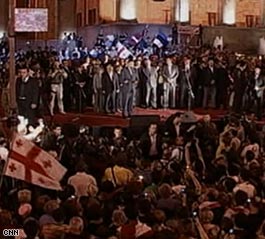
Presidents attend Georgia rally after cease-fire deal


Presidents attend Georgia rally after cease-fire deal

The presidents of Ukraine, Lithuania, Latvia and Poland showed support for Georgia by appearing on stage with Georgia's president in front of a large crowd in Tbilisi. Earlier, the Russian and French presidents announced a six-point plan for settling the conflict in Georgia.

MOSCOW, Russia (CNN) -- The Russian and French presidents announced Tuesday a six-point plan of principles for settling the immediate conflict in Georgia but stopped short of tackling the issues that sparked the violence.

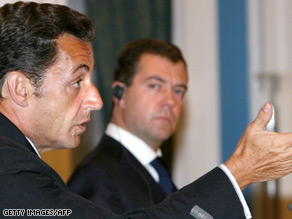
Nicolas Sarkozy, left, and Dmitry Medvedev outline the deal and the problems ahead.

Nicolas Sarkozy, left, and Dmitry Medvedev outline the deal and the problems ahead.

"We have not achieved peace yet, but we have achieved a provisional cease-fire of hostilities," French President Nicolas Sarkozy said.

The points include Russian agreements to conclude all military operations, return Russian armed forces to the line preceding the beginning of operations and not use force again in Georgia.

In return, Georgia would return its armed forces to their normal and permanent locations.

Both sides would provide free access for humanitarian assistance; and international consideration of the issues of South Ossetia and Abkhazia would be undertaken.

"All we need to do now is to stop suffering, stop the death of people," Sarkozy said. Stopping the fighting "is the most important objective."

He emphasized that the meeting with Russia's President Dmitry Medvedev was not intended to solve all of the issues, such as Georgia's territorial integrity and South Ossetia's desire for independence.

"There are bigger problems relating to South Ossetia that we cannot resolve here," Sarkozy said, who arrived in Moscow as current head of the European Union.

Sarkozy said he and Medvedev agreed that Georgia is an independent country and that Russia has no intention of annexing it. But Medvedev also said "sovereignty is based on the will of the people" and "territorial integrity can be demonstrated by the actual facts on the ground."

Medvedev said, "I think that these are some very good principles in order to resolve the problem which has arisen from this very dramatic situation and these principles can be used by Georgia and South Ossetia."

Medvedev said he had ordered an end to military operations against Georgia, but Tbilisi reported more attacks after the statement was made. Video Watch Georgia's reaction to halt in fighting »

Medvedev said, "the aggressor has been punished and has incurred very significant losses. Its armed forces are disorganized."

Tens of thousands of Georgians converged on the capital, Tbilisi, for a day of rallies. In the evening they waved French, U.S. and Georgian flags at a rally where President Mikhail Saakashvili was joined by the leaders of Ukraine, Poland, Lithuania and Lativia. Video Watch the rally »

U.S. Secretary of State Condoleeza Rice said, "I wanted to make very clear that the United States stands for the territorial integrity of Georgia, for the sovereignty of Georgia; that we support its democratically elected government and people, and are reviewing options for humanitarian and reconstruction assistance to Georgia. But the most important thing right now is that these military operations need to stop."

U.S. officials said they were considering flying aid from bases in Germany to Georgia. There was also consideration being given to sending U.S. Navy ships into the Black Sea to conduct humanitarian relief missions.

Violence has raged since Thursday, when Georgia launched a crackdown on separatist fighters in autonomous South Ossetia, where most people have long supported independence.

Russia, which supports the separatists, responded Friday, sending tanks across its border into South Ossetia. The conflict quickly spread to parts of Georgia and to Abkhazia, another separatist region.

Russia said it wanted to stop Georgian military actions against its peacekeepers in the breakaway regions.

The Georgian government said that despite Medvedev's announcement, Russian warplanes struck two Georgian villages and bombed an ambulance outside the breakaway province of South Ossetia. Video Watch more on the fighting in South Ossetia »

Medvedev warned in his announcement that "when pockets of resistance and other aggressive actions occur," a decision concerning destruction had to be made.

Earlier, a Georgian Interior Ministry official said Russian bombs had hit one of the three pipelines carrying oil to the Black Sea port of Poti. There was no oil in the pipeline at the time. Interactive map: See how far the Russians have advanced »

UK-based energy giant BP later said it had shut down three oil pipelines in the region as a "precautionary measure" linked to the security situation. None of its pipelines had been attacked.

A Dutch cameraman was killed Tuesday morning in an incident in Gori, the Dutch Foreign Ministry confirmed. He was identified as Stan Storimans of RTL TV. The correspondent who accompanied him was also injured.

One Russian diplomat said that up to 2,000 people had died in the conflict. Up to 100,000 people are thought to have been displaced by the violence, which has left South Ossetia's capital of Tskhinvali in ruins.

Russian Foreign Minister Sergey Lavrov said Tuesday that his country wanted a demilitarized zone to be created in Georgian territory before a cease-fire could take effect. Video Watch Lavrov speak about Georgia »

Lavrov said that it would be best if Saakashvili stepped down as Georgia's president, something he has not offered to do, but that Russia was not demanding his resignation.

Original article posted here.

Wednesday, July 16, 2008

EU "democracy": Vote our way or we'll shove it down your fucking throats anyway

Nicolas Sarkozy: Ireland must vote again on EU Lisbon treaty


President Nicolas Sarkozy of France angered politicians in Ireland by declaring that the country will have to hold a second referendum on the Lisbon treaty.

"The Irish will have to vote again," Mr Sarkozy told deputies from his UMP party in a meeting in his office, several of those present confirmed.

He also said he would "veto any enlargement" until a new treaty had been pushed through.

Mr Sarkozy, whose country holds the EU's rotating six-month presidency, is due to travel to Ireland next week to "listen" to why the Irish rejected the Lisbon treaty on June 12.

Last week he said he hoped to find a solution to the Irish issue by the end of the year saying time was running out, but stopped short of suggesting they vote again.

Ireland's minister for foreign affairs Micheál Martin said he couldn't comment on Mr Sarkozy's reported comments, but that the government was examining "all the options" following the rejection of the Lisbon treaty.

However, Labour Party leader Eamon Gilmore said that if Mr Sarkozy's comments were confirmed, he "has seriously put his foot in it".

"We were given to understand that one of the principal reasons for the president's visit to Ireland next week was to allow him to hear the views of Irish people as to what should now be done. However, if he has already made his mind up on this issue, it will be a rather hollow listening."

Mr Gilmore added: "We need that time and space and President Sarkozy should be told that in blunt terms."

"It would be extraordinary if Irish voters were made to vote twice on this EU Treaty before British voters got to vote once", said Britain's shadow foreign secretary William Hague, who said getting countries to vote twice in the hope of them changing their minds was not "very democratic".

"The best thing for EU leaders to do is simply to respect the Irish people's verdict, drop this deeply unpopular Treaty and get on with delivering what matters to people, like healthier European economies", he said.

Mr Sarkozy's trip next week may not be helped by the presence – confirmed yesterday - of his foreign minister, Bernard Kouchner, who some in Ireland blame for the No vote. Before it, the outspoken left-winger had reportedly suggested that it would be bad form for Ireland to vote no given the amount of EU aid it has received over the years.

The leader of the Socialist group in the European parliament, Martin Schulz last week urged Mr Sarkozy to leave him at home.

Mr Sarkozy's office yesterday sought to put a more diplomatic spin on the President's unequivocal comment, insisting that he would not go to Dublin with an action plan to present to Taoiseach Brian Cowen, despite reports that a ready-made plan is being drawn up.

"The president is coming to listen to the Irish, to listen to what Brian Cowen tells him. He is not coming to make proposals," one Sarkozy aide said.

"It is not up to us to make proposals," he added. "It is up to the Irish to tell us what the problem is and what they need to resolve it."

Newspaper Le Monde said one possible sweetener to convince the Irish to ratify the treaty would be to reverse the planned streamlining of the European Commission, retaining the current system of one commissioner per country. Ireland would thus keep a seat.

But the Elysée said that such an idea was "in the air rather than on the table".

Other options include offering Ireland guarantees on neutrality, taxation and abortion, the paper said.

European Commission President José Manuel Barroso said yesterday he did not expect any more countries to reject the Lisbon treaty after the Irish No vote, following assurances from the presidents of Poland and the Czech Republic that they would not try and block ratification.

Mr Sarkozy has championed the Lisbon treaty and is adamant that it be pushed through before France's European presidency runs out at the end of the year.


Thursday, February 28, 2008

France starting to wake up and realize that they have a fascist as president

Former Prime Minister de Villepin signs appeal directed against French President Sarkozy

By François Duval

With French President Nicolas Sarkozy facing growing opposition from within the political establishment as well as the population at large, the political weekly magazine Marianne has published an appeal by leading French politicians of various parties calling for “republican vigilance.”

The appeal, dated February 15, is the first open manifestation of opposition by a significant section of the media and political establishment to the way Sarkozy and his government are handling attacks against the working class and reacting to the economic and political crisis internationally. It comes during the run-up to municipal elections to be held next month.

The list of 17 signatories brings together leading figures of Sarozy’s own UMP (Union for a Popular Movement) with the leaders of the major opposition parties. Heading the list is 86-year-old Pierre Lefranc, former head of General de Gaulle’s cabinet, followed by Dominique de Villepin, UMP prime minister until 2007, Ségolène Royal, the 2007 presidential candidate of the Socialist Party, and François Bayrou, head of the Democratic Movement (MoDem), a remnant of ex-president Giscard d’Estaing’s Union for French Democracy (UDF).

Also on the list are Jean-Pierre Chevènement of the Citizens Movement and Noël Mamère, a former presidential candidate of the Greens.

The appeal does not directly mention Sarkozy. Instead, the signatories stress that, despite “different sensibilities and very different positions on a number of important political issues, they share a number of common convictions and values they intend to reaffirm.”

These include opposition to personal rule, defence of a free press, defence of secularism, maintenance of cooperative relations among rival political parties, and fidelity to the main line of French foreign policy over the last 50 years.

Marianne has published the appeal with an introduction that leaves no doubt that it is meant as an attack on President Sarkozy. It reproaches him, amongst other things, for having marginalised the prime minister and his government by imposing decisions taken by his presidential “court” of councillors, and attempting to impose a personalist form of rule which, according to the appeal, “comes close to an elective monarchy.”

Marianne concludes: “If leading political personalities who normally clash on the public stage, and have done so for years, take the risk of placing their names below a common text, only days from an election which the president himself has said will be of critical political importance—an appeal, moreover, that includes the signatures of several men and women of the republican right—then it is because the political context created by eight months of Sarkozyism is a completely unprecedented one.”

The thrust of the appeal is an attack on Sarkozy from the standpoint of defending the traditional forms of rule and institutions of the Fifth Republic, particularly that of the presidency, which, they infer, he has abused.

The reaction of Sarkozy’s camp, which seemed to have been caught wrong-footed, was virulent and vindictive. Not answering the appeal on its content, the government instead called the signatories “a coalition of revanchists” and a collection of “the losers and the embittered.”

On a campaign tour for the municipal election in Brittany, Prime Minister François Fillon launched a bitter tirade against the signatories of the appeal. “This determination of certain political figures, who have not been elected by the French people ... to attempt to destabilise the president of the republic is, in my view, profoundly shocking and profoundly undemocratic,” he declared.

Fillon was pointing particularly at Bayrou and Royal, Sarkozy’s opponents in the last presidential election, and Villepin, who made a bid against Sarkozy for the presidential nomination of the UMP. Fillon also spoke of a “witch-hunt” against the president.

The appeal reflects sentiments that are widespread within the ruling elite. There are growing differences over basic questions of both foreign and domestic policy.

One of Villepin’s main criticisms of Sarkozy is his repudiation of the old Gaullist doctrine of a France that is not closely aligned with other powers—in particular, with the United States. He shares this concern with sections of the establishment that are perplexed by the economic and political decline of France and demand a more “rational” response to it.

There is a growing sense that the crisis facing the French bourgeoisie cannot be resolved other than through a systematic attack on all social provisions and welfare, and scepticism that Sarkozy is capable of carrying through such an attack.

What is striking is not only the open attack on the head of state, but the fact that politicians from across the French political spectrum have come together and presented a common platform. There had been a general blurring of differences between the parties of the political establishment in recent years, but this is the first time their leading personnel have taken a common initiative.

It is an initiative that could well lead to a realignment of political forces within the French political establishment, one which is perhaps foreshadowed in the campaign for the upcoming municipal elections.

This was acknowledged by Ségolène Royal herself. Le Monde reported two days after the publication of the appeal in Marianne that “Ms. Royal believes that this appeal reveals ‘convergences.’”

The newspaper went on to quote the former Socialist Party presidential candidate as saying: “It is coherent and continues the values promoted during the election campaign, which allowed a dialogue to begin with François Bayrou. We witness a misappropriation of the fundamental principles of the republic, such as secularism and the impartiality of the state. The solitary method and exercise of power discredits France abroad and prevents, finally, any reform. It is precisely because I am for reforms that a proper functioning of institutions is indispensable.”

Bayrou said of the appeal: “The multiplication of mishaps is an obstacle to the implementation of necessary reforms. One cannot come across a major official today, except one who is in the government, who is not alarmed.”

Bayrou said he had “absolutely no doubt about the feelings” of other heavyweights in the “republican right” who, according to him, share the criticisms made in the appeal. “If some of them have not signed, it is only for reasons of political expediency.”

The initiative taken by Marianne has been hailed by a number of daily papers and political publications. This is not the first time Jean Francois Kahn, the founder of the weekly magazine and ex-publisher of another political magazine, Evenement du Jeudi, has organised such a “united platform.”

It was no other than Marianne and Kahn who organised the event at the Bataclan Theatre in central Paris in the spring of 2002 that provided a joint platform for almost all parties that had participated in the first round of that year’s presidential election. That vote shocked the political establishment because the incumbent Socialist Party prime minister, Lionel Jospin, came in third behind the neo-fascist candidate Jean Marie Le Pen, setting off a runoff between Le Pen and the incumbent Gaullist president, Jacques Chirac.

All parties across the official political spectrum, including the Communist Party and the Greens, eventually joined by the “far left” Ligue Communiste Révolutionnaire (LCR), gave their support to Chirac, who was depicted as the saviour of the Fifth Republic. The meeting at the Bataclan Theatre kicked off the “rally around Chirac” campaign.

Chirac was re-elected with 82 percent of the vote, and went on to impose a series of attacks on working class wages and social conditions.

Original article posted here.

Friday, February 08, 2008

What Sarkozy proposes just after his little honeymoon: Send French soldiers off to die in NATO's lost war

France Mulls Larger Afghan War Role

VILNIUS, Lithuania - France is considering sending forces to join the fight against the Taliban in southern Afghanistan and planned talks Feb. 8 with Canadian officials requesting 1,000 troops to support its beleaguered soldiers in volatile Kandahar province.

A reversal of France's refusal to deploy combat units to the southern front-lines would ease tensions within NATO. A rift has emerged in the alliance between nations such as the United States, Canada and Britain, who have troops in the south, and those like France, Germany and Italy, whose units operate in the relative safety of north and west Afghanistan.

However, French officials cautioned that it was unlikely Paris would provide all the troops Canada is seeking and said a decision on whether to deploy was unlikely before April, when NATO leaders meet for a summit in Bucharest, Romania.

While NATO defense ministers resumed talks in Lithuania, Canadian diplomats said the delegation heading to Paris would lay out details of what Ottawa needs in Kandahar.

The lack of support from key European allies in southern Afghanistan has provoked stark warnings this week from the United States about the future of alliance unity and prompted an ultimatum from Canada.

Ottawa said it would withdraw its 2,500 troops from their key role in the 43,000-strong NATO force next year unless it got reinforcements. Canadian Defense Minister Peter MacKay said Ottawa wants an offer of help by the April summit in Bucharest.

French Defense Minister Herve Morin on Feb. 7 said France would help Canada, but declined to give details. He suggested President Nicolas Sarkozy could announce a strengthening of the French role in Afghanistan with a redeployment of the 1,500 French troops that are mostly in Kabul area.

"My message to the Canadian public is 'be a bit patient,'" Morin said when asked if France would help in the south. However, he added that a media report that Sarkozy was considering the deployment of 700 paratroopers to the south was premature.

"In the framework of this new policy in favor of Afghanistan, what we are studying are several options," he told reporters. "But announcing figures like that is really going too fast."

France, along with Germany, Italy, Spain and Turkey, has so far refused to deploy significant numbers of combat troops in southern Afghanistan, the heartland of the Taliban insurgency. Although none of the European holdouts has publicly announced a change in its position at the NATO meeting, diplomats were hopeful that France would answer the Canadian appeal.

If Sarkozy were to agree to deploy to the south, it would be a significant shift from the policy of his predecessor Jacques Chirac and underscore the new president's stated aim of improving relations with the United States. Under Sarkozy, France is also considering a full return to NATO's integrated military command, from which President Charles de Gaulle withdrew in the 1960s.

Canadian officials said Canada would likely have talks with other allies, although MacKay acknowledged that not all nations had the military capacity to maintain 1,000 troops in the tough Kandahar battlefields.

Many European governments are under public pressure not to send troops to the Afghan front-lines. Some think it better to focus on reconstruction in the more stable areas rather than pursuing the insurgents. Others say their militaries are stretched elsewhere.

Germany in particular has bristled at recent U.S. criticism, insisting its 3,300 troops in Afghanistan are doing important work supporting reconstruction in the relatively stable north.

"If we constantly rush back and forth between the different regions in Afghanistan, I think that also would be a difficult thing," German Chancellor Angela Merkel said in Berlin Thursday. "This deployment is not easy and that everyone who is active in this operation is doing his best to build up Afghanistan's overall structure."

Despite the difficulties raising forces, NATO insisted they were gaining ground in the battle against the Taliban and efforts to promote reconstruction in Afghanistan, rejecting the findings of a series of recent high-profile reports.

"Despite some gloomy headlines, there is clear progress," alliance Secretary-General Jaap de Hoop Scheffer said, pointing to military successes against the Taliban and improvements to the country's economy, schools and health care.

With Afghan Defense Minister Abdul Rahim Wardak joining the NATO meeting Friday, de Hoop Scheffer stressed the need for the authorities in Kabul to fight corruption, build up a viable police force and take on opium producers.

"Governance must visibly improve, so the Afghan people have trust in their leaders," de Hoop Scheffer said.

He appealed to the United Nations and the European Union - which also attended the meeting - to match NATO's military effort with increased backing for reconstruction.

Original article posted here
.

Tuesday, November 27, 2007

Strikes and riots: That's what France gets for "electing" this Neo-Con/Zionist mole

Sarkozy urges calm as riots return to Paris


Rioters in front of a burning truck throw stones at the police in Villiers Le Bel, a northern suburb of Paris
Rioters in front of a burning truck throw stones at the police in Villiers Le Bel, a northern suburb of Paris. Photograph: Philippe de Poulpiquet/EPA


Police fired teargas and rubber bullets at rioters armed with molotov cocktails and firecrackers last night, in the second day of violence after two youths died in a motorcycle accident involving a police car.

President Nicolas Sarkozy, visiting China, called for calm, while police braced themselves for more unrest after hours of running street battles. The riots broke out on Sunday, hours after the two teenagers collided with a patrol car.

The accident resembled the event that triggered suburban riots in France in 2005, sparking fears of more violence to come. Two years ago the death of two boys allegedly fleeing the police in the Paris suburb of Clichy-sous-Bois sparked weeks of violence in France's rundown estates.

Dozens of youths descended on Villiers-le-Bel on Sunday evening, torching the police station, looting shops and setting cars and dustbins on fire. The police station in neighbouring Arnouville was ransacked, as well as at least one petrol station, in more than six hours of violence.

Nine people were arrested yesterday morning, according to police.

The crash that sparked the riots occurred at around 5pm on Sunday, when a mini-motorcycle and a police car on patrol collided, killing a 15-year-old, Moushin, and his friend, Larami, 16. Police said the teenagers were driving an unregistered vehicle and were not wearing helmets.

"We are sorry about the death of these young people, but it appears that they were unfortunately the victims of a traffic accident," said Francis Debuire, of the Force Ouvrière police union.

However, residents said police fled the scene and failed to help the youths. "They hit them from behind," Calbo, a rapper and local resident, told Reuters. "They saw they were in pain [but] they didn't help. The police tried to drive off by starting their car. They couldn't start their car because it was damaged, so they ran away."

An investigation on suspicion of possible manslaughter and leaving the scene of an accident has been opened by police.

Last night, during an official visit to Beijing, Sarkozy said: "I call on everyone to calm down and let the justice system decide who was responsible."

Shortly after the riots broke out the local mayor and a police chief arrived, but were forced to turn back after the policeman was hit in the face and his car set on fire. Riot police were then brought in.

The mayor, Didier Vaillant, urged local people not to resort to violence. "We must make sure this doesn't happen again ... I am calling all the men and women of Villiers-le-Bel to help me do this."

Omar Sehhouli, the brother of one of the victims, said the police involved should be convicted. "Everyone knew the two boys here," he told French radio. "What happened, that's not violence, it's rage."

The Socialist head of the opposition, François Hollande, condemned the violence but said it revealed a "social and political crisis", and blamed the government for not improving the situation in destitute suburbs since the 2005 riots.

Original article posted here.

Thursday, October 04, 2007

International Relations as Cult of Personalities. When UK tries to exert a mere shard of sovreignty, Moron turns towards French Poodle and Rottweiler

Britain 'no longer closest Bush ally'

By Toby Harnden in Washington

The White House no longer views Britain as its most loyal ally in Europe since Gordon Brown took office and is instead increasingly turning towards France and Germany, according to Bush administration sources.

  • Audio: Why Brown is no longer Bush's best friend
  • Brown accused over Iraq pullout 'stunt'
  • Toby Harnden: Gordon Brown's break with the White House
  • "There's concern about Brown," a senior White House foreign policy official told The Daily Telegraph. "But this is compensated by the fact that Paris and Berlin are much less of a headache. The need to hinge everything on London as the guarantor of European security has gone."


    US president George W Bush and French president Nicolas Sarkozy
    Nicolas Sarkozy is seen by many as the man Bush can best do business with in Europe

    With Tony Blair departed, Nicolas Sarkozy, the French president, is seen by many as the man George W Bush can best do business with in Europe. Although Angela Merkel, the German chancellor, has not lived up to initial expectations in Washington, she is still seen as far preferable to her predecessor Gerhard Schröder.

    The White House official added that Britain would always be "the cornerstone" of US policy towards Europe but there was "a lot of unhappiness" about how British forces had performed in Basra and an acceptance that Mr Brown would pull the remaining 4,500 troops out of Iraq next year.

  • Speedy Sarkozy named and shamed
  • Britain has become a 'permissive' environment for terrorists
  • Analyisis: Brown's numbers game in Iraq
  • "Operationally, British forces have performed poorly in Basra," said the official. "Maybe it's best that they leave. Now we will have a clear field in southern Iraq." Another White House official described Mr Brown as "challenging" and far less close to the US than Mr Blair.

    There has been a notable reduction in contact between Downing Street and the White House since Mr Blair left and US officials have remarked on how few British ministers have visited Washington in recent months.

    Mr Brown and Mr Bush are understood to have spoken twice by telephone in three months since they met at Camp David in June, whereas Mr Blair and Mr Bush held video-link conferences, often weekly.

    Kurt Volker, a senior State Department official with responsibility for Europe, disagreed with the White House official's view, arguing that the British withdrawal to the airport in Basra was a "tactical" decision and that the predicted chaos "hasn't happened".

    He told The Daily Telegraph that Mr Brown had shown "a lot more steadiness than maybe people expected" and while his style had been very different from that of Tony Blair there had been "a lot of consistency" over policy.

    But Mr Volker emphasised that "things are changing in Europe" and paid tribute to Bernard Kouchner, the French foreign minister, both for visiting Iraq and for warning over Iran that the world had to "prepare for the worst and the worst is war".

    "Kouchner's comments were very helpful because what he is indicating is that this is serious. It's not just a matter of playing out diplomacy forever with no result. It's got to provide a result."

    Privately, White House aides accept that Mr Brown would not support military action against Iran. There is also disquiet about what US officials view as double dealing by special advisers briefing an anti-White House message in London and a more favourable one in Washington. "That sort of manoeuvring is not appreciated," said one diplomatic source.

    The wariness about Mr Brown could open doors to the Conservative Party.

    Owen Paterson, the shadow Northern Ireland secretary, recently met several key White House officials, including Barry Jackson, who recently took over many of Karl Rove's duties as a policy adviser to Mr Bush.

    A British diplomatic source said: "In the White House there's a sense of enormous change from Blair. They used to be on the phone to Blair all the time and that's no longer the case because Brown clearly wants to be the unBlair.

    "At the Pentagon, there's a feeling that Britain is letting the side down on Iraq. The new best friend is Sarkozy and that means Brown taking a step back doesn't matter as much. In White House eyes, Sarkozy is taking up the slack from Blair. "When things get tough, however, they're likely to turn to Britain again."

    Original article posted here.

    Sunday, June 17, 2007

    The attempted occupation of Europe (fucking up one country's reputation and military apparently not good enough)

    Report: Sarkozy wants Blair as European Union president

    LONDON: Outgoing British Prime Minister Tony Blair is being proposed as the European Union's first full-time president by French President Nicolas Sarkozy, a British newspaper reported Saturday. Blair's office said he did not want the job.

    The Financial Times said Sarkozy had discussed the idea with other European leaders before next week's EU summit in Brussels. It will be Blair's last summit as British leader; he steps down June 27.

    The prime minister's office said Blair was not seeking the EU job.

    "The prime minister has made it clear that he is not going to return to front-line politics," a spokeswoman said on the government's customary condition of anonymity.

    In Brussels, EU spokesman Mark Gray said that as far as he knew there has "never been a discussion" about a Blair candidacy.

    The EU is considering establishing a permanent presidency to replace the current system, in which the post rotates among the 27 member states.

    The president would have few formal powers, but would give the EU strategic leadership and represent it on the world stage.

    Original article posted here.

    Monday, June 11, 2007

    Just what the world needs: alcoholic Bush back drinking, Nicolas Sarkozy drunk. Welcome to the world's most powerful "leaders."


    Nicolas Sarkozy


    And it has been speculated by others that the Moron's "stomach flu" was actually a hangover. (And given his "private" meeting with Sarkozy, that seems even more likely)


    Bush hit by stomach complaint at summit

    Jenny Booth and Roger Boyes in Heiligendamm

    President Bush has returned for the closing ceremonies of the G8 summit in Heiligendamm after being taken ill with a stomach complaint and being forced to skip the morning working session.

    The US President realised that he was "very much under the weather" as he got up and dressed this morning, his aides said.

    He pressed ahead with an hour-long discussion with Nicolas Sarkozy, the new French President, their first bilateral talks since the French leader was elected last month.

    As a precaution, however, the meeting was held in Mr Bush's private room, and the US President then had a lie down for the rest of the morning.

    "President Bush is slightly indisposed this morning and will rejoin the working meeting as soon as he can," Mr Sarkozy said, as he emerged alone from the US President’s suite in the Orangerie, a luxury hotel in the Baltic Sea resort.

    "I’m not sure if it’s a stomach virus yet or something like that," Dan Bartlett, an aide to the president, told reporters. "He’s just not feeling well in his stomach."

    He added that Mr Bush’s doctor, Dr Richard Tubb, was monitoring the president’s health.

    The White House said Mr Bush had sent his regrets to the other summit leaders and that the US envoy to the G8, Dave McCormack, had stood in for the President at the meetings.

    The US leader returned to the summit to appear in the final ’family’ photo and attend its final lunch. He was to stick to his programme of visiting Poland briefly later in the day before going on to Italy.

    "We are back on schedule," a White House spokesman, Tony Fratto, told reporters. "The President had a good rest this morning. He’s feeling better, not 100 per cent, but he feels good enough to rejoin the meeting."

    Indigestion or a mild case of food poisoning are suspected as the cause of Mr Bush's indisposition at the summit, where 60 chefs are on stand by to cook for the eight heads of state, their partners and entourages.

    The hotel complex where the conference is being held has its own herds of lamb and goat, and prides itself on fresh, locally grown produce.

    Security in the kitchens is tight, and the secret service is monitoring them. Summit observers have noted that the precautions taken around Mr Bush are especially stringent - in one incident, a German police officer was prevented by White House staff from so much as touching the door handle of the President's Lincoln limousine.

    Fish - on the menu at Wednesday night's dinner at the start of the summit - is a speciality at the seaside resort. At lunch on Wednesday Mr Bush shared a meal of asparagus and veal schnitzel with his host, Angela Merkel.

    Yesterday afternoon Mr Bush was photographed sipping something that resembled beer, while sitting around a picnic table in a small group with Ms Merkel, but as the President has not drunk alcohol for more than 20 years it is unlikely that it was anything stronger than a fizzy drink.

    (This is the Moron in 1992)


    At 7.30pm last night all eight heads of state at the summit attended a working dinner, where the topic for discussion was the less than digestible issue of how to lend new impetus to the Doha development round. The menu at the dinner has not as yet been made public.

    Afterwards the leaders were invited to enjoy a digestif, or post-dinner drink, and to chat on a one-to-one basis, although the 9.30pm time slot was past Mr Bush's usual bedtime. The US President is an early riser.

    Mr Bush has had an unfortunate record for becoming indisposed while in public office. In January 2002, he grazed his cheek after choking on a pretzel and fainting while watching television.

    In June 2003 he fell off his Segway scooter at his family estate in Kennebunkport, Maine, and in May 2004 he fell off his mountain bike, grazing his knees, hand, chin and nose.

    In another bit of summit misfortune, in July 2005 Mr Bush crashed into a police officer while riding his bike around the grounds at the Gleneagles hotel while attending the G8 summit in Britain. The US President scraped his hands and arms, and the police officer was hospitalised with an ankle injury.

    Mr Bartlett joked today that Mr Bush did not want to "follow in the footsteps of his father", former president George Bush, who endured public embarrassment in January 1992 when he fell ill at a state banquet during a summit in Tokyo, vomited on the Japanese Prime Minister and then fainted. The incident was blamed on flu.

    Original article posted here.

    Sunday, May 27, 2007

    The complicated implications of Sarkozy's Zionist tendencies

    Franco – Arab Ties Could Yet Survive Sarkozy’s U-Turn

    By Nicola Nasser*

    The defensive and guarded Arab reaction to the self-pronounced and reported pro-Israel and pro-America statements of Nicolas Paul Stephane Sarkozy de Nagy-Bocsa, who was sworn in as the new President of France on May 16, as well as his Jewish connection and that of his foreign policy team, have alerted Arab capitals and public opinion to a possibly imminent break with his country’s more than a five-decade old balanced approach to Arab conflicts and the Arab – Israeli conflict in particular.

    Acting on a campaign pledge to a clean break with France’s political past, Sarkozy’s declared aim to change France could yet prove easier said than done, but nonetheless Sarkozy has grouped together a foreign policy team that could vindicate Arab fears; however Sarkozy’s pragmatism could not but take French huge interests in the Arab world into consideration, which might still prove his Arab critics wrong.

    Next month marks the fortieth anniversary of the June 5, 1967 Arab – Israeli war, which changed the face of the Middle East. France’s Middle East policy made a sharp reversal soon thereafter. Franco-Israeli relations have seen their “Golden Age” in the 1950s, when France was Israel’s main ally, weapons supplier and nuclear capability provider. The low point came after the 1967 war, during the presidency of Charles de Gaulle, when France imposed an almost complete arms embargo, left Israel to its strategic alliance with the United States and embarked since then on her balanced approach to the Arab – Israeli conflict. French – Arab relations were reinforced further after the Arab – Israeli war and the oil crisis of 1973.

    Just three days after the shooting stopped, late President de Gaulle instructed his foreign minister to denounce Israel before the French National Assembly and the United Nations General Assembly. A month later, he said that, “we told the Israelis not to start a conflict. Now, France does not recognize her conquests.” In the following November he elaborated further: “Israel, having attacked, seized, in six days of combat, objectives that she wanted to attain. Now she is organizing, on the territories she has taken, an occupation that cannot but involve oppression, repression, expropriation, and there has appeared against her a resistance that she, in turn, describes as terrorism.”

    Sarkozy is promising a 180 degree turnabout on de Gaulle’s legacy. His pro-Israeli views have prompted a flurry of contacts between Arab capitals and Paris, with Arabs seeking a reassurance of continuity. President Mubarak of Egypt was so worried about a French shift that he sought a meeting to ask Sarkozy about his “Israeli bias” during his recent visit to Paris to bid farewell to his predecessor Jacque Chirac. Arab defensive reaction to his presidency was alerted by several factors.

    Jewish Connection

    The Arab defensive reaction to his presidency was alerted by several factors, but his Jewish connection in particular was interpreted as the reason behind his pro-Israel statements. Within this context, Sarkozy’s emerging team on foreign policy is being watched with concern by Arab capitals.

    Sarkozy’s election was hailed by Israel and Jewish organizations worldwide, including Israeli Prime Minister Ehud Olmert, the umbrella group of French Jewish communal organizations (CRIF), AIPAC in the United States, the Rabbinical Center of Europe, to name a few. They should, and they did, feel relieved with the new Sarkozy-led pro-Israel French administration with a strong Jewish and US connections. Sarko, as his supporters call him, has openly and repeatedly called himself a friend of Israel in good times and in bad, the Israeli French edition of the Jerusalem Post reported on May 3, quoting him as saying that “makes me an ‘Atlantist,’ pro-Israeli and pro-American.” They hope that Sarkozy will adopt a policy more in coordination with the US and in line with that of Britain and Germany than with what they see as a traditional “politique arabe de la France” of recent decades.

    In 2002, the then-Israeli Prime Minister Ariel Sharon urged French Jews to immigrate en masse to Israel after a spate of anti-Jews attacks. Sarkozy, as interior minister, responded: “France is not a racist country. France is not an anti-Semitic country.” Israelis and Jews also could still remember the reference a few years ago by French ambassador to England, Daniel Bernard, to Israel as a “shitty little country.”

    Now, Sarkozy is undoubtedly the most Israel-friendly president since the founding of the Fifth Republic in 1958, The Jewish News Weekly of Northern California, reported on May 11. He is an admirer of the Jewish state and has warm ties with the French Jewish community. His maternal grandfather, Aron Mallah, nicknamed Benkio, was a Greek Jew from Salonika who migrated to France before the Second World War and converted to Catholicism but nevertheless had to hide during World War II because of his Jewish roots. In total, 57 of Sarkozy’s family members were murdered by the Nazis. His wife Cecilia is also of Jewish ancestry. He is a 2003 laureate of the Simon Wiesenthal Centre Humanitarian Award.

    However neither his Jewish family background nor his fervent opposition to anti-Semitism would alienate Arabs, but the family’s active role in the Zionist movement certainly would alert them to a potential effect on his politics as much as would his personal Israeli friends like former Prime Minister Benjamin Netanyahu. Beniko’s uncle Moshe was a devoted Zionist who, in 1898 published and edited El Avenir, the leading paper of the Zionist movement in Greece at the time. His cousin, Asher, in 1912 helped guarantee the establishment of the Jewish Technion in Haifa, Palestine and in 1919 he was elected as the first President of the Zionist Federation of Greece and he headed the Zionist Council for several years; in the 1930s Asher helped Jewish immigration to and colonization of Palestine, to which he himself immigrated in 1934. After the establishment of the State of Israel in 1948 another of Beniko’s cousins, Peppo Mallah, became the country’s first diplomatic envoy to Greece. Sarkozy says he admired his grandfather, who bequeathed to Nicolas his political convictions.

    His pro –US and pro Israel sympathies and his Jewish connection are reinforced by similar sympathies of his governing team. His close confident and Prime Minister, François Fillon’s Anglo-Saxon connection is customized by his British-born wife, the first of a French head of government. His foreign minister, Bernard Kouchner, who made several visits to Israel and received an honorary degree from Ben-Gurion University in Beersheba at the height of the second Palestinian Intifada (uprising) was born to a Jewish father and a Protestant mother; in a January 2004 interview, Kouchner lamented that the French had become “America-haters.” Kouchner is also close to UMP MP and France’s ambassador in Washington, Pierre Lellouche, who is Sarkozy’s advisor on international issues. Levitte will head a diplomatic team in the presidential administration modelled on the US National Security Council; he is another Jewish figure in Sarkozy’s foreign policy team. The New culture minister, Christine Albanel, 51, is a former member of the board of the Foundation for the Memory of the Holocaust.

    In an interview Sarkozy gave in 2004, The Jewish Journal online on May 11 quoted him as saying: “Should I remind you the visceral attachment of every Jew to Israel, as a second mother homeland? There is nothing outrageous about it. Every Jew carries within him a fear passed down through generations, and he knows that if one day he will not feel safe in his country, there will always be a place that would welcome him. And this is Israel.”

    How could Arabs interpret this other than being a direct encouragement of a dual loyalty and an indirect call for immigration to Israel in contradiction with his insistence on loyalty by the mostly Arab and Muslim French immigrant citizens to “French identity,” for which he created the new ministry of immigration and national identity?

    Sarkozy visited Israel several times, but never the Israeli-occupied Palestinian territories. He has repeatedly said that he would not legitimize Hamas or Hizbullah by entering into dialogue with them, a statement that would politically translate into exacerbation of the Palestinian and Lebanese national divides by not recognizing the democratically elected Hamas-led national unity government, thus perpetuating the siege on the Palestinians, and by blocking Hizbullah’s partnership in Lebanon’s decision-making.

    Coordination with US

    He stunned a group of Arab ambassadors by telling them “his foreign policy priority as president would be to forge a closer relationship with Israel,” The Washington Times on May 12 cited a report by The New York Times as saying. His pledged “friendship” with the US is viewed by Arabs as heralding a new unbalanced approach that will give impetus to Washington’s strategic plans for the Middle East and would perpetuate the regional Arab – Israeli, Iraqi, Darfur and Lebanon - Syria conflicts in particular. His foreign minister agrees: “On … the Middle East, on the need for an alliance with America, on the role of France in Europe — we’re very close,” Kouchner said on record.

    Sarkozy’s pro-American views have added to Arab concerns that he would break with France’s traditionally independent policy in their region, dashing as wishful thinking Arab hopes of an independent European approach that might develop a counterbalance in resolving Arab conflicts to the US Israeli-biased approach. Sarkozy’s warm relationship with German Chancellor Angela Merkel and the expected accession of British Chancellor Gordon Brown to the premiership signal the rise of a relatively pro-American trio of European leaders.

    In his first speech after his election, Sarkozy warned Iran, Syria, and Libya that they could no longer play Europe off against America. Like his predecessor Chirac, Sarkozy is determined to disengage Syria from Lebanon in coordination with the US, but it will not be as “personal” as it was with Chirac, but unlike him he openly called Hizbullah a terrorist organization, which would clear the way for the main Lebanese anti-Israel resistance group to be included in the EU list of terrorist organizations, thus bringing France closer to the US classification of Hizbullah. His foreign minister’s visit of support to Beirut last week at the height of fighting between the Lebanese army and a suspiciously al-Qaeda-linked Fatah al-Islam group in a northern one square kilometre Palestinian refugee camp was seen by some as playing into the hands of a US strategy to exacerbate Lebanon’s internal political crisis into a violent one.

    US – French coordination in Lebanon and vis-à-vis Syria was unveiled following the Israeli war on Lebanon last summer, but was recently confirmed further at the UN Security Council by the joint US-British-French draft resolution to create an international tribunal for Lebanon under chapter 7 of the United Nation Charter.

    Sarkozy is expected to be more aggressive as he is also gearing towards more coordination with Washington in the Sudanese region of Darfur; he has called for “urgent” action there, warning that Khartoum would be made to face international justice for its actions. Kouchner, his maverick top diplomat, considers the Sudan’s war-torn region his top priority. On May 9, the US State Department said it wants the new elected French president to play an important role in Darfur peacekeeping mission, particularly in the no-fly zone.

    On Iraq, Sarkozy’s choice of Kouchner, the co-founder of the Nobel Prize winner “Doctors Without Borders,” as his foreign minister could send a message to Arabs that priority will go to “humanitarianism” in foreign policy, contrary to the long-held Gaullist French policy, which evaluates crises through the lens of France’s national interests. Kouchner is famous for developing the theory of “humanitarian intervention” to justify international military adventures according to which he believes that the US-led invasion was justified to overthrow Iraqi President Saddam Hussein.

    Sarkozy’s declared hopes to forge closer ties with the NATO could mean a greater role for France in training the new Iraqi police and army based on quotas already set by NATO. It could also mean greater involvement in the Arab section of the alliance’s southern flank in Lebanon, where French peacekeepers already play a leading role.

    On the humanitarian crises in the occupied Palestinian territories and Iraq, Sarkozy’s top diplomat is silently passive, more in line with the US deafening silence, revealing a politically selective approach in his humanitarian concerns that took him to Africa, Kosovo, Chechnya, Afghanistan, Darfur and even led him to endorse a boycott of the Olympic Games in Peking in order to force China to break its trade relations with Sudan on Darfur.

    Sarkozy’s attitude and planned policies for alien immigrants have also a lot in common with those of US President George W. Bush, and will undoubtedly be watched as a test case to judge his cultural and political approach to Arabs and Muslims in general. His view of “radical Islamists” could place him in line with US-led world war on “Islamic terrorism.” Leading British writer on the Middle East, Patrick Seale, on April 27 quoted him as saying: “Algeria was very brave to interrupt the democratic process. If the army had not acted, one could have had a Taliban regime in Algeria.”

    US Secretary of State Condoleezza Rice is looking forward to visiting France and having cooperation with her new French counterpart, the State Department said last week. “There’s a lot on the table for the U.S. and France in terms of being able to address issues of mutual concern around the globe, whether that’s Iran or the Middle East or dealing with poverty alleviation in Africa or climate change,” State Department spokesman Sean McComack told a news briefing.

    Counter Arguments

    However several factors could yet reign in a complete clean break with Paris’ traditional balanced approach to Middle East issues, a “hope” shared by all Arab governments and even by such controversial grassroots movements like Hizbullah of Lebanon and the ruling Hamas of the Palestinian Authority government.

    Arabs are already aware that Sarkozy’s father was Hungarian and grandfather Jewish, but he himself grew up Catholic and speaks no Hungarian. His heritage “doesn’t mean he’s going to take Jewish positions,” said Shimon Samuels of the Simon Wiesenthal Center in Paris. Moreover Arab leaders are already doing normal business with both Israeli and non-Israeli Jewish leaders.

    Sarkozy’s programs will, first, depend on the legislative elections of the National Assembly to be held in two ballots on June 10 and 17. Second he will spend the lion’s share of his time dealing with domestic issues then he will be preoccupied with France’s role in Europe and NATO. Third he has to deal with an array of a powerful coalition of vested interests, from the communist-dominated trade unions to the elites who dominate the civil service, not least the French Ministry of Foreign Affairs, the Quai d’Orsay. He, fourth, is on record as saying recently that “he wants excellent links with the Arab states” and there is no reason not to believe him.

    Fifth, Sarkozy’s pro-Americanism is not a carte blanche as he “is impressed far more by what the United States does at home than by its global aims and presence,” according to Jim Hoagland of the Washington Post. His opposition to Turkey’s membership in the EU is evidence that both countries’ international agendas are not identical. Sixth, if the election of Fran็ois Mitterrand as president in 1981 and 1988 is to serve as a guiding precedent it reminds observers that it caused similar worries in the Arab world, but Mitterrand was also the first Western leader to declare support for Palestinian self-determination and a right to have their own state. Seventh, Sarkozy could be following the leadership of the US, but isn’t this is the same leadership with the strongest Jewish connection that most Arab leaders are already in business with, which promises more of the same, but no drastic change.

    *Nicola Nasser is a veteran Arab journalist based in Ramallah, West Bank of the Israeli-occupied Palestinian territories.


    Original article posted here.

    Monday, May 14, 2007

    Warmonger and failed statesman Blair reaches out to little fascist and new US puppet Sarkozy

    France following the bait and switch path of the Bush monkeys

    Sarkozy and the "Decline" of France

    The Great Illusion

    By JEAN BRICMONT

    Two thirds of French people think their country is in decline. That is without doubt the principal reason why Nicolas Sarkozy was elected President of the Republic. Moreover, the main way the media contributed to his triumph was by years of constant propaganda on the theme of "the decline of France", along with the related theme of "security".

    There are various ways to counter that notion. One is to show that the selection and interpretation of the statistics used to "prove" France's decline are extremely biased. (For example, on the subject of youth unemployment, see Mark Weisbrot, co-director of the Center for Economic and Policy Research, in Washington, D.C., "An Economist View of the French Election".)

    Another approach is to ask what solutions are proposed by the heralds of "decline".

    The declinists cleverly mix up two problems. One is the decline of France in relation to the emerging countries, especially in Asia. The other is the supposed decline of France in relation to other industrialized countries, especially the United States and Britain. The first form of "decline" is merely the reflection of a very positive development: the fact that large parts of the Third World are catching up with the industrialized West. But, since it would make no sense to propose imitating China and India, the declinists propose imitating the Anglo-American model, which is supposed to avoid decline by a series of measures: flexible work conditions, destruction of hard-won social protections and public services, tough security enforcement and moral rearmament.

    But let's take a closer look at their favorite model, the United States. The Americans have spent hundreds of billions of dollars to invade Iraq. Thousands of their soldiers have been killed, tens of thousands wounded, and they are completely stuck. They can't win, because they have succeeded in turning the immense majority of Iraqis against them, and they can't leave, because it would mean the end of their empire. And so they are going to be bogged down in Iraq for many years, losing still more men, money and prestige, while causing unspeakable and useless suffering to the Iraqi people. And why are they in Iraq? Among other things, thanks to manipulation of public opinion concerning weapons of mass destruction. The Americans have intelligence services that spy on the whole world, a free press with immense resources, universities packed with specialists on every conflict and problem on earth. And yet, they have not been able to understand the most elementary realities, that even a child traveling to the Middle East could understand, that is, that they are hated primarily because of their support to Israel, and that their intervention in the region is bound to provoke massive rejection.

    If that blend of incapacity, ignorance and arrogance is not symptomatic of a society in decline, then it's hard to imagine what "decline" is all about. Slight gaps in GNP and unemployment rates are minor technicalities in comparison. France, in contrast, which in 2003 still had an elite described as "aging, outdated, behind the times"--but still able to think--did not go along with that madness.

    But that's not all. The rest of the world, and especially France, is constantly called upon to do as the United States does. Now, let us imagine that by the wave of a magic wand, the rest of the world really starts to imitate the United States. Where will they get all the petroleum and other raw materials that the United States imports in vast quantities, on which its society is totally dependent to preserve its way of life? Where will they get the immigrant workers, often undocumented, that is, without rights, or the floods of cheap imported goods which are not even really paid for, since they are financed by ever-expanding trade deficits, but which enable workers who have lost their industrial jobs to continue to consume the things they need? And finally, where will they get the brains that the United States drains from the rest of the world; because it is cheaper to offer high salaries to lure people who are already well educated than to finance a genuine system of mass education?

    The fact is that the American model is impossible to imitate, because its very survival depends on the existence of a world outside the United States which is quite different. It is true that the situation of Europe is fairly similar, but it is precisely our degree of proximity to the "American model" that is the proper gauge of our decline. Moreover, without the military power of the United States, neither France nor Europe can even try to prolong a situation that is untenable in the long term.

    It is rather amusing to see Sarkozy, who is supposed to embody "the France that works hard and wins", score his greatest electoral hit among retired voters. His program, like that of George W. Bush, is not turned toward the future in a realistic way, but on the contrary attracts people who long for the good old days when Europe and the United States were far more powerful than they are today. The fantasy of power is another sign of decadence.

    Sarkozy's election is an undeniable victory for the United States and for Israel. But it runs the very real risk of being a pyrrhic victory, because the decisive battles of our times are taking place outside of Europe: in Asia, in Latin America and in the Middle East. And there, the United States is losing on all fronts. We are living in a world that we no longer dominate and to which we shall have to adapt, and not by nostalgia for the past.

    Jean Bricmont teaches physics in Belgium. His new book, Humanitarian Imperialism, will be published by Monthly Review Press. He can be reached at bricmont@fyma.ucl.ac.be.

    Original article posted here

    .

    Wednesday, May 09, 2007

    Perfect example of the pettiness and stupidity of the Left: Socialist paper attacks Royal for not being Left enough, against neo-con Warmonger


    Weazl officially says this article contains many stupid points of view

    Sarkozy’s electoral victory and the bankruptcy of the French “left”

    By Peter Schwarz

    The election of right-wing Gaullist politician Nicolas Sarkozy as French president has shocked many people in France and Europe.

    One recalls the mood of euphoria two years ago when French voters rejected the European constitution. The same population forced the withdrawal of the unpopular “First Job Contract” (CPE) through a series of protests and demonstrations just one year ago.

    At the time various petty bourgeois “left” organisations declared that these movements had rendered the policies of the Chirac government “illegitimate and disavowed.” Now was the time to develop “a common movement which is able to take on the employers directly and question the entire neo-liberal policy” (Statement by the Ligue communiste révolutionnaire [LCR—Revolutionary Communist League])

    Now, less than a year later, a man is taking over as president whose right-wing convictions are beyond dispute—he is an ideological ally of US president George W. Bush and the former Spanish Prime Minister José Maria Aznar. Sarkozy wants to revive the values of order, performance and reward, and regards himself as the man to deal once and for all with the heritage of the 1968 protest generation. The international business press has enthusiastically welcomed his election. They expect him to finally dismantle the French welfare state, slash the jobs of many of the country’s five million civil servants, cut pensions, make the labor market more ‘flexible’—and contrary to his predecessors—not give way to pressure from the streets.

    How was it possible for this noxious politician to collect 19 million votes and emerge as the victor in an election characterized by an extraordinarily high voter turnout?

    For the Socialist Party (PS) and media the answer is clear: French voters are to blame. The latter, so goes the argument, have moved to the right and Socialist Party candidate Ségolène Royal did not follow them fast and far enough. As former Finance Minister Dominique Strauss-Kahn put it on the evening of the election, the Socialist Party had so far missed its chance to carry out a “social-democratic renewal” along the lines of the German Social Democratic Party at its notorious Bad Godesberg conference. In particular, the PS had neglected voters from the “centre”

    This explanation ignores social reality and fails to identify the profound social contradictions behind the election result. The “voters of the centre” are an abstraction. The middle classes in France, as elsewhere, are enormously polarized. For a long time they constituted the social glue which bound together social extremes. However, under the effects of the globalization a majority has descended into the proletariat, while a small minority has been able to climb its way upward.

    The classic member of the middle class—the craftsmen, farmer, landlord and little businessmen—confronts many of the same problems today as the average worker. The same applies to the urban middle class. The days when a university degree guaranteed a career and a regular income are long gone. Now it is common in France to encounter the temporary worker with a university degree, or the academic who moves from a work placement center to a part-time job and then a short-term contract.

    There is no reflection of this social polarization in official politics. While broad sections of workers and young people have been radicalized and have protested time and time against social ills, the Socialist Party and its allies have intervened to sabotage their struggles, spread disappointment and demoralization and thereby paved the way for Sarkozy. His success has far less to do with his own strengths than it does with the bankruptcy of the “left,” its abject inability to present a progressive social alternative.

    Strauss-Kahn notwithstanding, the French Socialist Party has long since put its ‘Bad Godesberg conversion’ behind it. It is a bourgeois party, which defends the capitalist order. Into the 1970s, it did this through the means of social compromise, or rather, the promise of social compromise.

    Since then, however, pressure from international financial markets and the effects of globalization have wiped out the basis for any policy based on social compromise. Under the presidency of François Mitterrand and the government of Prime Minister Lionel Jospin one promise after another was broken Social gains were slashed, unemployment stagnated at around ten percent, incomes sank and living conditions in the suburbs became increasingly intolerable.

    The first to profit was the extreme right National Front led by Jean-Marie Le Pen. With the help of an electoral reform introduced by Mitterrand, his party was regularly able to notch up two-digit election results.

    The recent election campaign of Ségolène Royals represented a new low-point for the Socialist Party. Groomed by her public relations advisors, the PS candidate posed as a mixture of a female version of Sarkozy and Alice in Wonderland. She competed with Sarkozy when it came to professions of loyalty to national identity and tough action against juvenile offenders, while at the same time making all sorts of windy promises. She began every second sentence of her speeches with the words “I want”: “I want France tomorrow to be calm country, which believes in itself, where all Frenchmen have a place, and love it,” “I want to take the best from each epoch, to reinvent the France of tomorrow,” and so on.

    Royal did not care to explain how her wishes were to be fulfilled. Why should anyone have believed her? 1.6 million unfilled voting cards from a total of 36 million voters indicates that many took part in the election, though they doubtless found it hard to decide between the candidates Some chose to elect Sarkozy, whose program was not attractive, but at least promised change.

    According to election analyses Sarkozy received the same number of votes from workers as Royal, with 53 percent of workers in the private sector voting for the Gaullist candidate. He also won 57 percent of those between 25 to 34 years. He had the support of 77 percent of all self-employed, as well as 68 percent of pensioners over the age of 70.

    Royal, on the other hand, was only able to win a majority amongst young voters under 24 (60 percent) and those voters who will be directly affected by Sarkozy’s election. In the public sector, where Sarkozy has announced plans for substantial job cuts, 57 percent voted for Royal, who also had the support of 75 percent of unemployed persons. Some 58 percent of students also voted for the SP candidate.

    Do the millions of votes from workers and young voters for Sarkozy mean agreement with his program? It would be absurd to draw this conclusion. The election was characterized by a fundamental contradiction. On the hand, there is a broad interest and urge to participate in political life—expressed in the well-attended election meetings and the high voter turnout. On the other hand, the electorate was confronted with two candidates with right-wing bourgeois programs, who differed from one another much more in style than in substance.

    The bankruptcy of the official “left” has created a dangerous situation. Sarkozy is the most reactionary politician to assume the post of French president since the end of the Vichy regime in World War II. There can be no doubt that he takes the threats he has made seriously. This is not just bound up with his notorious fiery temperament, but also the enormous pressure being exerted by the employer’s federations and financial circles.

    Sarkozy has already announced that he intends to reintroduce the rejected European constitution in a slightly modified form and without a new referendum. On May 17 he is expected to name the former labor minister François Fillon as his prime minister. Fillon’s attempts to ‘reform’ the French pension system four years ago brought millions of public and private sector workers into the streets in protest. Two years later, in his role as education minister, Fillon provoked renewed protests from students.

    According to the head of his election campaign team, Claude Guéant, Sarkozy is also contemplating bringing “left” ministers into his cabinet to draw the Socialist Party into his attacks on the working class.

    For its part, the working class must prepare for inevitable clashes with Sarkozy and his government by drawing the lessons from the bankruptcy of the Socialist Party and its allies. It must take up the struggle against Sarkosy on the basis of an international socialist program, which proceeds from the incompatibility of the existing forms of capitalist relations with the basic needs and requirements of working people. To this end workers require a new independent socialist party.

    The French left radical parties—the LCR and Lutte Ouvrière—systematically seek to prevent such a development. Both organizations called for a vote for Royal in the second round and have now reacted to her defeat in the manner of shocked opportunists. Both act as if nothing significant has happened, refuse to make a political balance sheet of the elections and return to business as usual.

    In her statement on the election result, Arlette Laguiller of Lutte Ouvrière blithely declares, “For the next five years the broad masses will have to put up with the presidency of Nicolas Sarkozy and one or more governments, which carry out social policies in line with those of the government of the last five years.” She does not dream of questioning the legitimacy of a presidency who owes his post entirely too the bankruptcy of the official left.

    She calls upon her supporters to “Keep their heads up,” and comforts them with the thought that “we would have had to fight if Ségolène Royal had been elected, to ensure that things perhaps changed even a little in our favor. It will be the same with Nicolas Sarkozy and the struggle will be the same.”

    On election night Olivier Besancenot (LCR) made the call for a “united front of all social and democratic forces” In the name of unity such an alliance—in reality, the LCR in a pact with the Communist Party, the trade unions and other reliable props of the bourgeois order—would sabotage any struggle against Sarkozy and his government. Any serious confrontation would inevitably develop into a struggle for power and such a struggle is firmly rejected by both LO, LCR and the trade union bureaucracies they support.

    Original article posted here.

    Tuesday, May 08, 2007

    Warm welcome to French Neo Con

    France sees second night of unrest after Sarkozy's election

    Paris - France saw violent clashes for the second night in a row amid demonstrations against conservative Nicolas Sarkozy's win in Sunday's presidential election.

    Cars and trash containers were set on fire in a number of cities overnight and primarily young protesters threw rocks and bottles at police, police said early Tuesday.

    More than 100 demonstrators were arrested in Paris alone. Unrest was also reported in Lyon, Lille, Toulouse, Nantes and Rennes.

    About 500 leftist opponents of Sarkozy assembled on Paris' Bastille Square late Monday. Police moved in when shop windows began to be smashed and telephone booths demolished.

    Police said they engaged with small groups of protestors around the square until well past midnight. Police said the demonstrators had attacked them with projectiles but no officers were hurt.

    Clashes were also reported in the western cities of Nantes and Rennes at the end of anti-Sarkozy protests.

    About 400 protested against the future president in Nantes and 10 were arrested, police said.

    Arrests were also reported in the northern city of Lille and in Toulouse in southern France.

    Sarkozy won Sunday's election against Socialist Segolene Royal with 53.06 per cent of the vote.

    In the violence during the night immediately after the voting, police said they arrested 592 arsonists and rioters around the country, 730 cars were set on fire and 78 police hurt in clashes with leftist protesters.

    Sarkozy did not comment on the demonstrations and clashes. On Monday, he flew to Malta to rest away from the media and to reflect on the formation of his government, aides said.

    Original article posted here.

    Monday, May 07, 2007

    The New French Man of the People

    Violent Protests Greet Sarkozy’s Election in France

    By CRAIG S. SMITH

    PARIS, May 7 — Violent protests against the election of Nicolas Sarkozy as president of France ended early today with hundreds of people arrested, hundreds of cars gutted and hundreds of windows smashed in several cities across in France.

    Some people fear the reaction is just a taste of what is likely to come if Mr. Sarkozy makes good on his campaign promises to push through controversial economic legislation during his first 100 days in office.

    Agence France-Presse, citing national police headquarters, reported that 730 cars had been set afire overnight, 35 in Paris, and that 592 people had been arrested, 79 in the capital. It said 78 police officers had been injured.

    Some of the most concentrated violence took place at Place de la Bastille in Paris where the police fired volley after volley of teargas cluster grenades that looked like fireworks before descending on the crowd of young protesters. At one point, the square — the site of the July 14, 1789, uprising that is celebrated annually — was thick with white teargas reflecting the orange glow of a car fire while silhouetted youths heaved paving stones at tight formations of armored riot police officers.

    But the violence also struck elsewhere in the French capital, leaving bus stop shelters shattered and slogans like “Sarkozy Fascist” scrawled on walls around Paris.

    While Mr. Sarkozy is most despised by minority youths in the country’s poor housing projects on the outskirts of major French cities, most of the violence took place in city centers. Reuters quoted an internal police memo that said there had not been “any large demonstrations of urban violence in sensitive neighborhoods.”

    In Paris, at least, the protesters were mostly white and below the age of 30, similar to the crowds who took to the streets last year to protest a new labor law that would have made it easier for companies to fire young workers.

    Those protests eventually led to the repeal of the law and killed Prime Minister Dominique de Villepin’s chance of running for president.

    Mr. Sarkozy risks facing even greater unrest with his proposed legislation, which includes a law that would require unions to guarantee a minimum of public services — transportation, in particular — during strikes.

    That provision would take the sharpest teeth out of France’s unions, which rely on their ability to block transport in order to pressure the government. Although less than 10 percent of the French work force is unionized, the unions’ call to action is often met with support from groups in many sectors of society — including youths.

    Already, France’s largest and most critical unions — the CGT and the CFDT, which are heavily involved in public transportation and utilities — are warning Mr. Sarkozy to expect protesters in the streets if he tries push through changes in pension plans or moves to limit the unions’ ability to strike, as he has vowed to do in his first 100 days.

    “If the government wants to pass reforms by force during the summer, it risks a big reaction by workers,” said Michel Grignard, national secretary of the CFDT, in an interview before Sunday’s vote.

    Given Mr. Sarkozy’s lack of popularity among many of the country’s youth, any mass demonstration against his policies would likely draw young people into the streets creating the conditions for even more violent clashes.

    Violence was reported in the southeastern city of Lyon and the southern city of Toulouse. Bus shelters were smashed in the northern city of Lille and a school was set on fire in the Paris suburb of Evry, Reuters reported. In the northern area around Lille, about 100 cars were reportedly set on fire.

    Reuters also quoted the head of public security for the Loire-Atlantique as saying that 26 people were being held for questioning and six police officers were slightly injured during an anti-Sarkozy rally in Nantes. In the northern city of Caen, four police officers were hurt and some protesters tried to set a local Sarkozy campaign office on fire.

    Original article posted here.

    Well, we kinda told you so . . .

    Paris riots after election results

    Article image


    CLASHES between police and protestors have been reported in central Paris and the southeastern city of Lyon after conservative leader Nicolas Sarkozy was elected French President overnight.

    In the Place de la Bastille in Paris riot police fired tear gas and at least one burst of water cannon after hundreds of rioters – some wearing masks – began throwing bottles, stones and other missiles.

    Earlier, a small crowd brandishing black and red anarchist flags set fire to an effigy of Mr Sarkozy before tearing it limb from limb and then stamping on it. Demonstrators changed "police everywhere, justice nowhere".

    Gallery: Protestors' fury over the election result today
    Video: Mixed reactions to Nicolas Sarkozy's win

    About 5000 supporters of defeated Socialist party candidate Segolene Royal had gathered in the square to await the election results. Mr Sarkozy beat Ms Royal by 53 per cent of the vote to 47 per cent, according to projections.

    The defeated Socialists had portrayed Mr Sarkozy as a danger for France during the election campaign and said he was authoritarian who was likely to exacerbate tensions in the poor, multi-racial suburbs that ring many cities.

    Thousands of extra police have been drafted in to patrol sensitive areas following the election result.

    Victory celebrations

    In another part of central Paris, Mr Sarkozy appeared before cheering crowds in and promised to be "president for all the French without exception".

    "This evening is a victory for France," he said to a crowd of 10,000 in the Place de la Concorde.

    "I ask you to be generous, to be tolerant, to be fraternal. I ask you to hold out your hand. I ask you to give the image of a France that is united, together, which leaves no-one at the side of the road.

    "My dear friends, I have seen victories before in my career. But victory is only beautiful if it is generous. Victory is not vengeance – it is being open in spirit. Victory only has meaning if it is victory for the country in its entirety.

    "Millions of French are watching us. Millions of French have placed their trust in us. You must understand that the first people I wish to address are those who did not place their trust in us.

    "I want them to understand that I will be a president of the republic for all the French without exception."

    Global response

    European leaders congratulated Mr Sarkozy on his victory today and hoped his triumph would help unblock reforms stalled by the rejection of the EU constitution in 2005.

    US President George W. Bush also telephoned to offer his congratulations and said he expected good relations with the new leader, who has made a priority of repairing the damage to French-US relations caused by tension over the Iraq war.

    Mr Sarkozy's election could help re-start the process of finding a way forward on reviving the European Union constitution, which has been held up as Europe awaited the results of the French election.

    European Commission President Jose Manuel Barroso said he was confident Mr Sarkozy would help find a way out of the impasse that has gripped Europe since French and Dutch voters threw out the constitution in referenda two years ago.

    "France is back in Europe," Mr Sarkozy said just after his election win.

    Mr Sarkozy has proposed a slimmed-down "mini treaty" containing basic institutional reforms that would allow the EU to function properly after its expansion to 27 members. To avoid the need for a second referendum in France, he wants to pass the mini treaty through parliament.

    Original article posted here
    .

    Sunday, May 06, 2007

    What will France now become?

    French suburbs threaten riotous dawn for the reign of Sarkozy

    Grievances of left simmer as reform looms

    Matthew Campbell, Paris

    THE victims of Soviet communism would find it hard to understand, but a giant yellow banner was unfurled in the centre of Paris last week, bearing portraits of Lenin and Stalin. “Only socialism can save the world” it proclaimed in black ink.

    Welcome to the annual May Day rally in Paris, always a festive affair. Salsa music blared from the back of a lorry and an aroma of barbecued Merguez sausages filled the air. Trotskyite militants handed out leaflets denouncing the capitalist system.

    The march, which attracted 60,000 people under flags emblazoned with the hammer and sickle, was a reminder of how different France is to other European countries with its lingering affection for ideas jettisoned long ago elsewhere in the world.

    It was also a warning to Nicolas Sarkozy, the reform-minded conservative candidate for the presidency, of the trouble that may lie in wait for him if he wins the presidential election today and embarks on ambitious plans for modernising a country badly in need of renewal and disillusioned with its ruling elite.

    President Charles de Gaulle once famously remarked that it was impossible to govern a country with so many different cheeses. Over the past few years the truth of that tenet has been confirmed as the government of outgoing President Jacques Chirac has limped impotently from one crisis to another.

    Is Sarkozy any more likely to succeed than his discredited predecessors?

    He would like to make the notoriously grumpy French feel better about themselves in the epoch of globalisation, raising wages and productivity, reducing unemployment and restoring a sense of pride in la belle France and her history.

    Seldom has an election generated so much excitement or expectation of change: turnout in the first round of voting on April 22 was at its highest since 1974 and Sarkozy’s clash with Ségolène Royal, his Socialist rival, last Wednesday night was watched by more than 20m people, almost as many as followed the country’s fortunes against Germany in the World Cup final of 2006.

    Sarkozy, 52, and Royal, 53, are much younger than previous incumbents. Royal is the first woman to have come this close to the presidency and Sarkozy the first presidential finalist whose father was not French – he fled communist Hungary for Paris after the second world war.

    Sarkozy, ahead in all 27 polls taken since he won the first round, knows how heavy a burden rests on his shoulders. He has announced that if he wins, he will go on a retreat for a few days to prepare himself, like a boxer ahead of the big fight, for the challenge of running the world’s fifth largest economy.

    “I will need to be alone with myself,” he said.

    Royal, a charismatic mother of four, fought tooth and nail to convince her countrymen not to back “Sarko”, as they referred to the combative former interior minister. Her last-minute appeals to voters, however, took on an almost desperate air as she sensed the electoral arithmetic turning against her.

    On Friday morning she warned that France could slide into violence if Sarkozy, a famously divisive figure, won the election. She said she was “issuing an alert” that his victory could “trigger violence and brutality across the country. His candidacy is dangerous. That is why I am asking voters to think twice”.

    Sarkozy’s increasingly confident team called such attacks “outrageous” but nobody disputed the possibility of a toxic brew of antiSarkozy grievances erupting in violence, particularly in the immigrant suburbs, if his victory is announced tonight.

    Arab and African residents of the banlieues, as the suburbs are known, have been in an angry, vengeful mood since Sarkozy described young delinquents as “scum” and “thugs” in 2005.

    His comments were widely believed to have contributed to the most severe violence in France in four decades, when 10,000 cars were burnt in a rampage of rioting.

    The grim housing estates ringing most big French cities were buzzing last week with rumours of another “explosion” of anger if Sarkozy wins.

    The banlieues were not the only potential flashpoint, however. A different group of “thugs” could prove to be just as troublesome for a Sarkozy presidency.

    One of Sarkozy’s first priorities was to introduce a law by July to curb the power of organised labour. The unions responded by turning their May Day parade last week into a giant protest against “Sarko”.

    Militants handed out “stop Sarko” badges and stickers. Some of the leaflets on offer depicted him as a vampire.

    The “TSS”, or “tout sauf Sarkozy” – “anyone but Sarkozy”, campaign has featured video clips attempting to link him with everything from racism to the Church of Scientology. One of them featured Sarkozy’s mother describing the “privileged” background he came from in the affluent suburb of Neuilly. It seemed to undermine his claims that he had been forced to work as an ice-cream seller to help to finance his studies.

    One of the protesters hoisted aloft a placard that said “Sarkozy = Napoleon”. Another marcher shouted into a loud-speaker, “Arrest Sarkozy, free the sans papiers” – a reference to those without documents who face expulsion following Sarkozy’s crackdown on illegal immigrants when he was interior minister.

    Another performer in this antiSarkozy circus was a man on a lorry dressed in a black cape and helmet who was trying to depict Sarkozy as Darth Vader, the “dark force” of the Star Wars films.

    At the front of the parade was Bernard Thibault, leader of the CGT, France’s most powerful union. “He should think twice about doing anything without negotiating with us,” he said. “If not, there will be reactions. Strong reactions.”

    In a cream linen jacket, the chain-smoking Thibault was flanked by muscle-bound heavies clutching their CGT banner. One said the march was “a show of strength to remind Sarko to get ready for the third round of the election that will be fought on the street”.

    Various governments have tried over the past 12 years to implement laws to free a stagnating economy, each time backing down after noisy street protests, some of them led by Thibault and his followers from the placard-wielding far left.

    That is what happened in 1997, forcing a timid Chirac to give in, and again last year, when the government proposed a law that would have made it easier for employers to sack workers. The idea was to encourage hiring but it provoked a wave of protests that forced the government to retreat.

    Only about 8% of French workers belong to trade unions but they have a powerful grip on public services and some important companies, making it easy for them to paralyse the country by blocking transport systems.

    By passing a law to ensure minimum public services during a strike, as well as secret ballots for union members, Sarkozy hoped to draw the teeth from the unrest that he knows will follow what, by French standards, is his extremely ambitious package of reform. It would in effect end the 35-hour week and other “social perks” that union militants consider to be sacrosanct. Railway workers, for example, can retire at 55, the shortfall in their pension contributions being made up by taxpayers.

    Not only does Sarkozy want to change that. His call last week to “liquidate” the May ’68 culture of protest – the very culture that allows Thibault and friends to settle political differences on the street – was another example of what union bosses called a “Thatcher-style” effort to castrate them and sell their country into free-market slavery.

    “Everybody must know,” said Bruno Juilliard, head of the UNEF student union, “that the unions will mobilise to defend their rights if they are under threat.”

    Sarkozy, however, seemed to be spoiling for a fight. “I’m sorry if M Thibault does not like it, but it’s the French who choose,” he said.

    To his fans it makes him a hero: only this pugnacious, stubborn and hyperactive personality with a determination to succeed is capable, they say, of dragging France out of its malaise and reconciling it with the free market.

    His enemies, however, echo Royal’s view of him as a dictator figure whose abrasive style would deepen the French fracture. Perhaps the most serious insult that she has hurled at him in this antiAmerican country is the charge that he “imitates” President George W Bush. “He has the same neoconservative ideology,” she said on Friday.

    Sarkozy has tried to tone down his aggressive image. In his final campaign rally in Montpellier on Thursday night, he struck a more compassionate tone to challenge what had been Royal’s monopoly of the heart.

    He invited voters to join a “fraternal” republic in which there was a place for “even the most humble, the most fragile, the most wounded by life, the most dependent”.

    He spoke of the tragedies of Alzheimer’s disease and depression, the plight of single women bringing up children, the difficulties of being, like him, an immigrant’s son or of living in a neglected suburb. He spoke of the need for “fraternity and respect” and said that he wanted to defend his convictions “without hatred, scorn, arrogance or violence”.

    At the same time he emphasised that he had meant what he said about troublemakers in the suburbs. “I used the word scum,” he said, adding: “People have reproached me for it, but I regret nothing.” The crowd erupted in applause. “What sort of educators would we be if thugs cannot even be called thugs?”

    He continued: “They tell me that I should not create tension, that I should not give a pretext to the wreckers, that I must at all cost avoid creating conditions for confrontation. Does that mean that the police must hide? Shut their eyes? Leave the thugs free to act?”

    There were chants of “no” from the crowd. He went on: “People accuse me of encouraging public anger. But who’s angry – the yobs? The drug traffickers? I can assure you: I do not seek to be the friend of yobs. My aim is not to make myself popular among the traffickers and the fraudsters.”

    In his presidential campaign Sarkozy was sensible, perhaps, not to set foot in the suburbs.

    “People despise him so much that one of these days I wouldn’t be surprised if someone tried to whack him,” said Abdel Benarbia, a 15-year-old schoolboy sunning himself on a patch of grass in the shadow of his tower block in Clichy-sous-Bois, a suburb 10 miles from the centre of Paris where the 2005 riots began.

    Kader, his elder brother, agreed and repeated what sounded more like a promise than a prediction: “If Sarko gets in, it’s going to explode.” Not that they wanted to play any role in the violence.

    Far from it. They were afraid of what might follow. Already routine police checks are a constant anxiety for the Algerian-born Kader, who has a job loading meals at Charles de Gaulle airport and wants to keep it. He was worried that “oppression and racism” would only get worse under Sarkozy.

    “If they accuse you of something round here, it’s their word against yours,” he explained. “It’s easy for the innocent to get caught up in trouble.”

    There may be hope for the banlieues, however. In these urban badlands of high unemployment, crime and hopelessness, the television satellite dishes may be tuned to Morocco but participation in French political life is increasing.

    “We’ve been telling people that unless they register to vote no politician will ever give a damn about them,” said Samir Mihi, a personal fitness trainer who is running a voter registration campaign in Clichy-sous-Bois. “We want people to use the ballot box, not boxes of Molotov cocktails.”

    Sarkozy can feel happy about that. Yet it will be some time before the “fraternal republic” exists anywhere other than in his imagination.

    Original article posted here.