Showing posts with label Musharraf. Show all posts

Monday, August 18, 2008

What a real change in Congress can bring. America should be ashamed.

Musharraf says he will resign Pakistan presidency

(CNN) -- Pakistani President Pervez Musharraf announced his resignation Monday after weeks of pressure to relinquish power.
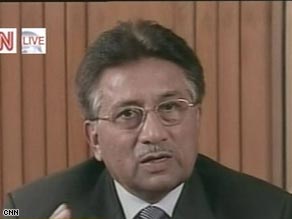
Pakistan's Pervez Musharraf has until now stubbornly resisted pressure to quit.

Pakistan's Pervez Musharraf has until now stubbornly resisted pressure to quit.

Musharraf told the nation in a televised address that he would step down -- nearly nine years after he seized power in a bloodless coup in 1999.

"I don't want the people of Pakistan to slide deeper and deeper into uncertainty," Musharraf said.

"For the interest of the nation, I have decided to resign as president," he said. "I am not asking for anything. I will let the people of Pakistan decide my future." Video Watch Musharraf resign »

Musharraf has been a keen ally of the West in the fight on terror, receiving billions in military aid from the U.S. and launching attacks on militant groups near the country's border with Afghanistan.

He was expected to turn in his resignation to parliament Monday.

"It will be accepted, there is no second opinion about that," said Iqbal Zaffar Jhagra, the secretary general of the junior partner in the ruling coalition, the Pakistan Muslim League-N (PML-N).

Musharraf quit as the ruling coalition was taking steps to impeach him.

Local media reports said he had been granted "safe passage" out of the country.

Until now, Musharraf, 65, had resisted pressure to resign. But his power had eroded since parties opposed to his rule swept to victory in February's parliamentary elections.

Musharraf spent a large part of his speech delivering a state-of-the-union style list of Pakistan's "accomplishments" under his rule. He contrasted it with what he called the deteriorating economic situation now.

"After the elections, the nation wanted solutions from the new government," he said. "But the politicians could not do so. A personal vendetta was started." View a timeline of Musharraf's time in power »

A coalition committee spent last week compiling a list of charges against Musharraf including corruption, economic mismanagement and violating the constitution.

Pakistan's four provincial assemblies called on the president to give up power. Parliament was expected to consider an impeachment motion Monday or Tuesday.

"I am confident that not a single charge can stand against me," Musharraf said. "I have not done anything for my personal gain. Whatever I have done, I have done it for Pakistan."

Faisal Kapadia, a commodities trader in Karachi who runs a blog about Pakistan called Deadpan Thoughts, said Musharraf's decision would get a mixed reaction.

"Leading Pakistan is not an easy task, and anyone doing it comes under a lot of criticism," he said.

"In the start, most Pakistanis were for him. And he still has some supporters -- especially because the new government, which promised to do things differently, has failed to do much in the past 100 days in power."

Musharraf grabbed power in 1999. He was serving as military chief when then-Prime Minister Nawaz Sharif dismissed him, setting off a confrontation.

As Musharraf was returning from an overseas visit in October 1999, Sharif refused to allow the commercial airliner with 200 passengers on board to land.

Within hours the army had deposed Sharif in a bloodless coup, and the plane was allowed to touch down with only 10 minutes of fuel left.

Musharraf was welcomed by a nation on the brink of economic ruin.

"I think at this point, his intentions were good," said Lt. Gen. Talat Masood, a political analyst. "He wanted to serve the country and to be different."

During his rule, Pakistan attained respectable growth rates and established a generally favorable investment climate.

Along with that came a growing middle class, a more aggressive media, and a more assertive judiciary.

"He brought parliamentary reforms. He brought women into the parliament," said Ahmed Bilal Mehboob, director of the Pakistan Institute of Legislative Development and Transparency.

But, analysts say, Musharraf never lost his military mindset.

"He in a way, always believed in a unity of command, a very centralized command, which means his command, in fact," said Masood.

After the September 11, 2001, terrorist attacks in the United States, Musharraf found himself on the frontline of the 'war on terror.'

Pakistan had supported the Taliban during the Soviet occupation of Afghanistan in the 1980s.

But after the 2001 attacks, Musharraf aligned himself with the U.S. to help rout the fundamentalist Islamic movement.

Washington gave Musharraf billions in aid as he vowed to deprive the militants of the sanctuary they had established along the country's border with Afghanistan.

He cast himself as indispensable -- to the West and to Pakistan, analysts said.

To Pakistanis he sold himself as the man who could deliver peace with India, a country with which Pakistan has fought three wars. To the West, he was the man to safeguard the country's nuclear arsenal.

However, Musharraf's popularity began to plummet last year following the March suspension of Supreme Court Chief Justice Iftikhar Chaudhry.

The move triggered protests and accusations that he was trying to influence the Supreme Court's ruling on whether he could run for another five-year term.

Chaudhry was reinstated but the damage was done.

"Undoubtedly, that was the catalyst," Masood said. "This is where he went wrong, and he underestimated the value of democracy."

Four months later, in July 2007, Pakistani security forces seized the Red Mosque in the capital city Islamabad.

The raid, intended to rout Islamic extremists who hoped to establish a Taliban-style rule in the capital, killed more than 100 people. A raft of suicide bombings followed.

In October, Musharraf was re-elected president by a parliament critics said was stacked with his supporters. Opposition parties filed a challenge.

The next month, he declared a state of emergency, suspended Pakistan's constitution, replaced the chief judge again and blacked out independent TV outlets.

Under pressure from the West, he later lifted the emergency and promised elections in January. Video Watch a PPP leader discuss opposition to Musharraf »

He allowed Sharif, the prime minister he deposed, to return from exile. He also let in another political foe, Benazir Bhutto. She, too, had been a prime minister, and led the Pakistan People's Party.

However, in December, the country was plunged into further turmoil when Bhutto was killed at a rally in Rawalpindi.

Musharraf's government and the CIA contend the killing was orchestrated by Baitullah Mehsud, a leader of the Pakistani Taliban with ties to al Qaeda. But nationwide polls found that a majority of Pakistanis believe Musharraf's government was complicit in the assassination.

Meanwhile, several other factors compounded Musharraf's declining popularity: a shortage of essential food items, power cuts, and a skyrocketing inflation.

Original article posted here.


Sunday, August 17, 2008

It's sad when Pakistan's government has more credibility and legitimacy than the US's

Pakistan coalition gives two-day Musharraf ultimatum

ISLAMABAD (AFP) — Pakistan's ruling coalition tightened the screw on President Pervez Musharraf Sunday, saying it would launch impeachment proceedings within two days if the key US ally does not stand down.

Defence Minister Ahmed Mukhtar told AFP that "the charge sheet will be presented in parliament by Tuesday", as coalition officials put the finishing touches to the list of allegations against him.

His comment came a day after Foreign Minister Shah Mehmood Qureshi said that the former general had to make a decision on resigning to avoid being impeached "by today or tomorrow, as there is no room for any delay".

A spokesman for Musharraf -- who seized power in a bloodless military coup in 1999 and went on to become a lynchpin in the US-led "war on terror" -- has repeatedly denied that the president is going to resign.

But Musharraf's allies and coalition officials have said separately that his aides are in talks with the government in a bid to secure him an indemnity from prosecution if he does throw in the towel.

Saudi Arabia and, reportedly, the United States and Britain, have sent envoys in a bid to resolve the crisis in the nuclear-armed nation, which is also suffering from a severe economic crunch.

A coalition source said fresh discussions were under way Sunday.

"The emissaries of Musharraf are still in contact with the government and as far as we know, Musharraf's aides are advising him either to resign seeking an assurance for indemnity or try the Supreme Court," the source told AFP.

Local newspapers said Musharraf was consulting his personal legal advisers over the possibility of challenging any impeachment move in the country's Supreme Court.

With Pakistan's powerful army taking a neutral stance towards its former chief, the court is the only institution Musharraf can still count on, as he purged it of opponents during a state of emergency last November.

The talks on getting immunity for Musharraf have also been hampered by the opposition of former premier Nawaz Sharif, who leads the second biggest group in the coalition after the Pakistan People's Party of Benazir Bhutto.

A spokesman for Sharif's party, Siddiqul Farooq, said that coalition partners and constitutional experts were gathering in Islamabad on Sunday to give the charge sheet "final shape".

No president has ever been impeached in Pakistan's 61-year history.

The army's stance is still unclear and analysts say it could react badly to seeing its former leader humiliated by impeachment. Musharraf quit as army chief in November last year under international pressure.

The coalition is counting on independent MPs and defectors from Musharraf's camp to win the two-thirds combined majority it would need in the upper and lower houses of parliament to impeach him.

Musharraf's other courses of action -- either dissolving the national assembly or imposing another state of emergency -- are fraught with risk.

The White House has also struck a neutral tone on a man long regarded as a key ally in the US-led "war on terror", saying that the impeachment threat was an internal matter.

Western allies want Pakistan to resolve the impasse so it can deal with the fight against Taliban and Al-Qaeda militants in the tribal areas bordering Afghanistan, where nearly 500 people have died in the past week.

Dozens of Islamic hardliners protested against Musharraf in the central city of Multan on Sunday, witnesses said.

Musharraf's popularity first slumped after he tried to sack the country's chief justice in March 2007.

His Supreme Court purge in November allowed him to force through his re-election to another five-year term by the outgoing parliament, but his political allies were then trounced in elections in February.

Original article posted here
.

Tuesday, February 19, 2008

Bush cronies in Pakistan can't win what was expected to be a rigged election (but maybe we need a bit of help from our friend as to what it means)

Pakistan ruling party concedes poll


Pakistan's newspapers heralded the
defeat of Musharraf's allies.

Pakistan's ruling party has conceded electoral defeat, as opposition parties won enough seats to form a new government that could threaten the rule of Pervez Musharraf, the Pakistani president, according to partial results.

Tariq Azeem, spokesman for the Pakistan Muslim League-Q (PML-Q), which backed Musharraf announced on Tuesday that the party would "accept the verdict of the nation".

"We officially concede defeat," he said.

Several of the leading PML-Q candidates, including its chief, lost their seats in Monday's election and unofficial results, announced on state television, showed they could not attain a parliamentary majority.

"This is the basic spirit of democracy," Azeem said. "We believe the elections were free and fair and everybody must accept the decision for the betterment of Pakistan."

Chaudhry Shujaat Hussain, head of the PML-Q, said that his party accepted the result and "will sit on opposition benches".

With counting in from 257 constituencies, PML-Q and its allies had taken a total of 57 seats.

The Pakistan People's party (PPP), the party of Benazir Bhutto, the opposition leader assassinated in December last year, had 85 seats, according to preliminary results.

The Pakistan Muslim League (PML-N) faction of Nawaz Sharif, a former prime minister, had 65 seats, with PML-Q, smaller parties and independents taking the rest, state television said.

Full results were not expected until late on Tuesday or early Wednesday.

Musharraf threatened

Musharraf has said he would work with the new government regardless of which party wins.

- Pakistan has 81 million registered voters, out of a population of 160 million people.

- Voters choose 272 members of the National Assembly, or lower house of parliament, for a five-year term.

- Another 60 seats are reserved for women and 10 for religious minorities.

- There are 106 parties, 15 of which were represented in the last parliament.


- More than 60,000 polling stations were set up across the country.

- Key issues include restoration of a full civilian government, reinstatement of sacked judges, rising militancy, economy and high unemployment.
"I will give them full co-operation as president, whatever is my role," he said after voting in Rawalpindi.

But with the support of smaller groups and independent candidates, the opposition could now gain the two-thirds majority in parliament needed to impeach the president.

Musharraf's popularity suffered last year following his decision to impose emergency rule, purge the judiciary, jail political opponents and curtail press freedoms.

Musharraf has also supported the US in its so-called "war on terror", sanctioning Pakistani military operations against al-Qaeda and Taliban fighters in northwest Pakistan where it borders Afghanistan.

By contrast, Sharif and others have called for dialogue with the fighters and have criticised military operations in the area because of their impact on civilians.

Electoral violence

Opposition parties had feared the polls would be rigged, but analysts from Washington-based Strategic Forecasting said the elections "seem to have been decently free and fair".

Sarwar Bari, of the non-profit Free and Fair Elections Network, said his group's 20,000 election observers reported a voter turnout of about 35 per cent, the same as in the 1997 election and the lowest in Pakistan's history.

Ayaz Baig, the election commissioner in Punjab, estimated the turnout there to be at between 30 per cent and 40 per cent, slightly lower than in the 2002 election.

In Baluchistan and Sindh provinces, turnout was estimated at about 35 per cent, officials said.

Although fear and possible apathy kept millions of voters at home on Monday, Talat Hussein from AAJ TV said turnout was similar to previous years.

"Going by previous trends in Pakistan it is not that disappointing. At the end of the day, the voting did pick up and 42 per cent is not exactly a big disappointment," Hussein told Al Jazeera.

The PPP said 15 of its members had been killed and hundreds more injured in scattered violence "deliberately engineered to deter voters".

In northwest Pakistan on Tuesday, witnesses said more than 2,000 tribesmen blocked the main highway from Peshawar to the Afghan border, protesting that their favoured candidate had been defeated by electoral fraud.

At least 24 people were killed in election-related violence, mostly in Punjab province.

Original article posted here.

Saturday, February 16, 2008

Bush style democracy in Pakistan

Tape caught Pakistani official saying vote will be rigged

By Jonathan S. Landay

FAISALABAD, Pakistan — A prominent U.S.-based human rights group Friday released what it said was a recording of Pakistan's attorney general acknowledging that next week's national elections would be "massively" rigged.

Human Rights Watch said a journalist made the recording during a telephone interview with Attorney General Malik Qayyum when Qayyum took a second call without disconnecting the first, allowing his end of the second conversation to be overheard and recorded.

In the recording, Qayyum, Pakistan's top legal officer, can be heard advising the caller to accept a ticket he is being offered by an unidentified political party for a seat, Human Rights Watch said.

"They will massively rig to get their own people to win," Qayyum said, according to a transcript released by Human Rights Watch. "If you get a ticket from these guys, take it."

The potentially incendiary recording was made the day that elections were announced for Jan. 8, according to Human Rights Watch, which said the Urdu-language recording could be heard on its Web site, www.hrw.org. The polls for the national assembly and four provincial legislatures were postponed until this Monday after large-scale violence ignited by the Dec. 27 assassination of former prime minister Benazir Bhutto.

The recording was certain to add to widespread fears that the polls will be rigged in favor of the Pakistan Muslim League-Q, the party that supports the authoritarian and hugely unpopular president, Pervez Musharraf, a retired army general who seized power in a 1999 coup.

On Thursday, Musharraf warned the opposition that it must accept the outcome of Monday's voting, without resorting to massive street protests.

"Let there be no doubt that anyone will be allowed to resort to lawlessness in the garb of allegations about rigging in the elections," Musharraf was quoted as telling a seminar of government officials in Islamabad by the state-run Associated Press of Pakistan. "Let this serve as a warning to all those who think they can disturb the peace of the country. They will not be allowed. Do not test the resolve of the government."

"No agitation, anarchy or chaos can be acceptable," he said. "I assure you that the elections will be fair, free, and transparent and peaceful."

Fears that the polls will be fixed have been stoked by a series of public opinion surveys showing the Pakistan Peoples Party and other parties poised to capture enough seats to begin impeachment proceedings against Musharraf for controversial constitutional changes he imposed last year to extend his grip on power.

Musharraf's standing, and that of the Pakistan Muslim League-Q, also has been hurt by skyrocketing prices, shortages of electricity, gas and wheat, a failure to contain the Islamic insurgency based in the tribal area bordering Afghanistan and Pakistan's support for the Bush administration's fight against al Qaida.

"There have been numerous allegations of irregularities, including arrests and harassment of opposition candidates and party members. There are also allegations that state resources, administration, and state machinery are being used to the advantage of candidates backed by President Pervez Musharraf," Human Rights Watch said in a statement.

Human Rights Watch said it had tried repeatedly to contact Qayyum, a staunch supporter of Musharraf, but had been unable to reach him.

In Washington on Friday, State Department spokesman Sean McCormack said he was not familiar with the Human Rights Watch report. But he said the Bush administration has stressed to the Musharraf government that " the Pakistani people should have a reasonable degree of assurance that their ballot will in fact be reflected in the results."

"Look, you know, there have been in the past irregularities within the Pakistani electoral process," McCormack said.

On Thursday, the widower of assassinated former Prime Minister Benazir Bhutto, Asif Ali Zadari, held a final campaign rally in the same dusty park where his wife gave her first political address in 1977.

Security was intense, reflecting a surge in suicide bombings that's included attacks on opposition campaign rallies. Police sharpshooters scanned the crowds from rooftops and black-clad commandos stood among scores of security men deployed around the stage.

The stage itself was set far back from fences of steel scaffolding and barbed wire that restrained the flag- and banner-waving crowd of about 6,000. Zadari spoke from behind a podium made of bulletproof glass and steel.

Without mentioning Musharraf by name, Zardari, who assumed joint chairmanship of the party with his son after Bhutto's slaying, said that it was time "to change our system."

"Benazir was a martyr. She believed in you, in the brothers and sisters, and I also believe in you," he proclaimed.

Original article posted here.

Sunday, January 27, 2008

Every day cronies taking fewer order from Washington

Pakistan Rebuffs Secret U.S. Plea for C.I.A. Buildup
Published: January 27, 2008

WASHINGTON — The top two American intelligence officials traveled secretly to Pakistan early this month to press President Pervez Musharraf to allow the Central Intelligence Agency greater latitude to operate in the tribal territories where Al Qaeda, the Taliban and other militant groups are all active, according to several officials who have been briefed on the visit.

But in the unannounced meetings on Jan. 9 with the two American officials — Mike McConnell, the director of national intelligence, and Gen. Michael V. Hayden, the C.I.A. director — Mr. Musharraf rebuffed proposals to expand any American combat presence in Pakistan, either through unilateral covert C.I.A. missions or by joint operations with Pakistani security forces.

Instead, Pakistan and the United States are discussing a series of other joint efforts, including increasing the number and scope of missions by armed Predator surveillance aircraft over the tribal areas, and identifying ways that the United States can speed information about people suspected of being militants to Pakistani security forces, officials said.

American and Pakistani officials have questioned each other in recent months about the quality and time lines of information that the United States has given to Pakistan to use in focusing on those extremists. American officials have complained that the Pakistanis are not seriously pursuing Al Qaeda in the region.

The Jan. 9 meetings, the first visit with Mr. Musharraf by senior administration officials since the assassination of Benazir Bhutto, also included the new army chief, Gen. Ashfaq Parvez Kayani, and the director of Pakistan’s leading military intelligence agency, Lt. Gen. Nadeem Taj. American officials said the visit was prompted by an increasing sense of urgency at the highest levels of the United States government that Al Qaeda and the Taliban are intensifying efforts to destabilize the Pakistani government.

The C.I.A. has fired missiles from Predator aircraft in the tribal areas several times, with varying degrees of success. Intelligence officials said they believed that in January 2006 an airstrike narrowly missed killing Ayman al-Zawahri, the second-ranking Qaeda leader, who had attended a dinner in Damadola, a Pakistani village.

Pakistani authorities, in interviews, say they have more than 100,000 troops operating in the region, including a sizable force conducting what they said was a major offensive in South Waziristan. But in the White House, the Pentagon and the C.I.A., frustrations remain high, and there is concern that Mr. Musharraf’s political problems will distract him from what the administration regards as its last chance to take aggressive action.

Despite the insistence of administration officials that the United States and Pakistan have a common goal in fighting Al Qaeda, Mr. Musharraf has made clear in public proclamations that it is far from his first priority. At the Davos World Economic Forum in Switzerland last week, Mr. Musharraf said several times that the 100,000 Pakistani troops that he said were now along the border were hunting for Taliban extremists and “miscreants,” but he also said there was no particular effort being put into the search for Qaeda fighters.

In Washington, however, the Bush administration has said that fighting terrorists, chiefly Al Qaeda, is the primary purpose of the $10 billion in American aid that has been sent to Pakistan, mostly for reimbursements for the cost of patrolling the tribal areas. President Bush has often praised Mr. Musharraf for fighting terrorism, pointing out that Al Qaeda has tried to kill the Pakistani leader. But White House officials were silent when Mr. Musharraf said this week that his efforts were focused on the Taliban, and that the main problem the United States faced was in Afghanistan, not Pakistan.

Accounts of the discussions between Mr. Musharraf and the intelligence officials were provided by American and Pakistani officials over the past two weeks after The New York Times inquired about the secret trip. While officials confirmed some details of the discussion, much remains unknown about the continuing dialogue between Islamabad and Washington.

The trip by Mr. McConnell and General Hayden, a 14,000-mile over-and-back visit for one day of discussions, occurred just five days after senior administration officials debated new strategies for dealing with Pakistan. No decisions were made at that meeting of the National Security Council, which gathered all of Mr. Bush’s top national security officials but not the president.

In the ensuing three weeks, however, the debate appeared to be intensifying, as senior American officials said they believed that American forces — whether as combat troops or trainers — could enhance the efforts of Pakistan’s military in the mountainous and lawless Federally Administered Tribal Areas.

“The purpose of the mission,” a senior official said, “was to convince Musharraf that time is ticking away,” and that the increased attacks on Pakistan would ultimately undermine his effort to stay in office.

Other officials said that recent intelligence analysis indicated that Al Qaeda was now operating in the tribal areas with an impunity similar to the freedom that it had in Afghanistan before the attacks on Sept. 11, 2001.

The C.I.A. operatives in Afghanistan and the covert Special Operations forces there have made little secret of their desire to move into the tribal areas with or without Mr. Musharraf’s explicit approval. In the administration, there has been discussion of whether Mr. Bush should give orders to allow them more latitude. Mr. Musharraf has explicitly rejected that, and within days after Mr. McConnell and General Hayden’s departure, he told a Singapore newspaper that any unilateral action by the United States would be regarded as an invasion. In Davos, he dismissed the idea that Americans could be effective in the tribal areas.

On Thursday, Defense Secretary Robert M. Gates said the United States was willing to send combat troops to Pakistan to conduct joint operations against Al Qaeda and other militants if the Pakistani government asked for American help. Mr. Gates said that Pakistan had not requested American assistance, and that any American troops sent to Pakistan would likely be assigned solely to train Pakistani forces. The top American commander in the region, Adm. William J. Fallon, visited Pakistan last Tuesday to discuss counterterrorism issues with senior Pakistani officials, including General Kayani.

American and Pakistani spokesmen confirmed that the meetings between Mr. Musharraf and American intelligence officials took place, but they declined to offer any details. Pakistan’s ambassador to the United States, Mahmud Ali Durrani, said in an interview that the meetings were about “improving coordination, discussing the war on terror, and filling the gaps between intelligence and operations,” but he declined to provide details.

Last Tuesday, the State Department’s counterterrorism chief, Lt. Gen. Dell L. Dailey, echoed some of those concerns, telling reporters that there were gaps in what the United States knew about the threat in the tribal areas. “We don’t have enough information about what’s going on there,” said General Dailey, who retired from the Army with extensive experience in military Special Operations. “Not on Al Qaeda. Not on foreign fighters. Not on the Taliban.”

In dealing with the American requests, Mr. Musharraf is conducting a delicate balancing act. American officials contend that now, more than ever, he recognizes the need to step up the battle against extremists who are seeking to topple his government. But he also believes that if American forces are discovered operating in Pakistan, the backlash will be more than he can control, especially because the Taliban and Al Qaeda are trying to cast him as a pawn of Washington. One result appears to be a compromise: Mr. Musharraf is willing, they say, to accept training, equipment, and technical help, but has insisted that no Americans get involved in ground operations.

Pakistani officials insist they are taking the militant threat seriously and have completed major operations in the Swat Valley to drive out extremists. In the past few days, about 1,000 Pakistan Army troops and Frontier Corps paramilitary forces have also begun a three-pronged attack against the South Waziristan stronghold of Baitullah Mehsud, a militant leader with links to Al Qaeda who is the main suspect in the assassination of Ms. Bhutto.

Original article posted here.

Saturday, January 12, 2008

No, I didn't kill her, but . . .

Musharraf rejects U.N. inquiry on Bhutto

PARIS (Reuters) - Pakistan President Pervez Musharraf ruled out a U.N. inquiry into the assassination of opposition leader Benazir Bhutto, as demanded by her party, saying that Pakistan should not be compared to Lebanon.

"It is not possible. Is another country involved?" he said in an interview with Le Figaro newspaper published on its website on Friday. "Pakistan is not Lebanon."

Bhutto's party has called for a U.N. inquiry into her death comparable to one into the 2005 killing of former Lebanese prime minister Rafik al-Hariri, whose death was blamed by many Lebanese on Syria. Damascus denies involvement.

Musharraf said Pakistan had its own institutions to manage the inquiry into Bhutto's assassination, and noted they would also be helped by British police.

He said there was a campaign by al Qaeda to undermine Pakistan but denied his country was about to fall apart.

"They do not have the capacity to destabilize the country, but their suicide attacks create disorder and dishearten the population. However Pakistan is not on the verge of disintegration."

He also said Pakistan's economy would survive if the United States decided to cut financial aid -- as suggested by some politicians unless Pakistan does more to fight terrorism and restores full civil rights.

"Do you think Pakistan would die if it didn't receive this money? Our economy is doing well," he said.

"Over the last 6 years, we have received a total of around $9 billion. More than half for fighting terrorism ... If the Americans don't want to pay any more, they should ask other people to help them. But the fight against terrorism would suffer," Musharraf said.

Original article posted here.

Monday, January 07, 2008

The world changing before your eyes

US military not welcome in Pakistan: army, foreign ministry

ISLAMABAD (AFP) - Pakistan reacted angrily Sunday to reports that US President George W. Bush is considering covert military operations in the country's volatile tribal areas bordering Afghanistan.

"It is not up to the US administration, it is Pakistan's government who is responsible for this country," chief military spokesman Major General Waheed Arshad told AFP.

"There are no overt or covert US operations inside Pakistan. Such reports are baseless and we reject them."

The New York Times reported on its website late Saturday that under a proposal being discussed in Washington, CIA operatives based in Afghanistan would be able to call on direct military support for counter-terrorism operations in neighbouring Pakistan.

Citing unnamed senior administration officials, the newspaper said the proposal called for giving Central Intelligence Agency agents broader powers to strike targets in Pakistan.

Pakistan's western tribal belt is seen as a safe haven for Taliban and Al-Qaeda militants who carry out attacks in Afghanistan, as well as the most likely hideout for Al-Qaeda leader Osama bin Laden.

The United States now has about 50 soldiers in Pakistan, the report said.

The new plan was reportedly discussed by vice-president Dick Cheney, secretary of state Condoleezza Rice and national security aides in the wake of the December 27 assassination of Pakistani opposition leader Benazir Bhutto.

Pakistani President Pervez Musharraf had not been consulted, the New York Times reported.

Military spokesman Arshad also dismissed comments from White House hopeful Hillary Clinton that she would propose a joint US-British team to oversee the security of Pakistan's nuclear arsenal if she was elected president.

"We do not require anybody's assistance. We are fully capable of doing it on our own," he said.

Pakistan's foreign ministry spokesman Mohammad Sadiq late Sunday described the New York Times report as "speculative" but said any suggestion of US forces on its territory was "unacceptable".

On Clinton's remarks about nuclear weapons, Sadiq added: "It must be clearly understood that Pakistan alone is and will be responsible for the security of its nuclear assets."

Original article posted here
.

Sunday, January 06, 2008

Blame the victim aka "Anyone but me"

Musharraf: Bhutto bears responsibility for death

Photo

By Randall Mikkelsen

WASHINGTON (Reuters) - Pakistan President Pervez Musharraf conceded that a gunman may have shot Benazir Bhutto but said the opposition leader exposed herself to danger and bore responsibility for her death, CBS News said on Saturday.

Musharraf was also quoted as telling the CBS "60 Minutes" program to be broadcast on Sunday that his government did everything it could to provide security for Bhutto, who was killed last week in a gun and suicide-bomb attack after a political rally.

"For standing up outside the car, I think it was she to blame alone. Nobody else. Responsibility is hers," Musharraf said in the interview taped on Saturday morning.

Pakistan's government has said Bhutto died when she struck her head on a handle on her vehicle's sunroof -- a contention widely derided in Pakistan where many people suspect Musharraf's government of complicity. The government has also blamed al Qaeda for the attack.

Musharraf was asked by CBS, which provided excerpts of the interview, whether a gunshot could have caused Bhutto's head injury. He replied, "Yes, yes."

The questioner asked, "So she may have been shot?" and Musharraf said, "Yes, absolutely, yes. Possibility."

Bhutto's widower called on Saturday for a U.N. investigation of the killing.

In an opinion article in the Washington Post, Asif Ali Zardari urged that a caretaker government be named to oversee national elections that were postponed until next month and he outlined other standards for assessing their legitimacy.

"Democracy in Pakistan can be saved, and extremism and fanaticism contained, only if the elections, when they are held, are free, fair and credible," he wrote.

Zardari is the new co-chairman of Bhutto's Pakistan People's Party, alongside their son Bilawal.

Musharraf, a U.S. ally in its battle against terrorism, postponed the general election from January 8 to February 18, and the PPP is expected to benefit from a wave of sympathy for Bhutto.

Musharraf, whose re-election as president in October is still disputed by the opposition, will need support in the next parliament and looks likely to have to renew efforts to reach an understanding with the Bhutto's party, analysts say.

CARETAKER GOVERNMENT

Zardari has said the PPP would take part in the vote. But the elections, he said in the Post, must be conducted under a "new, neutral caretaker government, free of cronies from Musharraf's party."

He also called for an independent election commission, monitoring by trained international observers with access polling stations and an ability to conduct exit polls, press freedom and an independent judiciary.

He urged that the United States and Britain join the push for a U.N. probe. Britain has sent a team from Scotland Yard to help the government of nuclear-armed Pakistan investigate the killing, and Washington has endorsed the step.

However, Zardari said, "an investigation conducted by the government of Pakistan will have no credibility, in my country or anywhere else."

Bhutto had complained to an acquaintance shortly before she died that the Pakistani government was not meeting her security pleas.

CBS asked Musharraf whether he believed the government did everything possible for her security. "Absolutely," he said. "She was given more security than any other person."

Original article posted here.

Thursday, January 03, 2008

Pakistan's Punishment or Reward

Lockheed to supply 18 F-16s to Pakistan

WASHINGTON, Dec 31 (Reuters) - Lockheed Martin Corp LMT.N> was awarded a $498.2 million contract to supply F-16 aircraft to Pakistan, the U.S. Pentagon said on Monday, as Pakistani officials mulled whether to go ahead with a Jan. 8 election after the assassination of opposition leader Benazir Bhutto.

Lockheed will sell 12 F-16C plus 6 F-16D planes to Pakistan under the contract, the Pentagon said in its daily list of defense contract awards. The U.S. Defense Department, which oversees sales of military weapons to foreign governments, did not say how soon the fighter jets would be delivered.

Pakistan has received about $10 billion in U.S. funding since 2001 because Washington views Pakistan as a key ally in President George W. Bush's campaign against terrorism.

Bhutto's death on Thursday wrecked U.S. hopes of a power-sharing deal between her and President Pervez Musharraf, who took power in a 1999 military coup but left the army last month to become a civilian president.

The United States has agreed to sell Pakistan up to 36 new F-16 jets together with refurbished F-16s.

Last month, two senior Democratic U.S. lawmakers urged the suspension of some U.S. military sales, including the sale of F-16 fighter jets, if Pakistani President Pervez Musharraf did not revoke emergency rule.

Lockheed, the Pentagon's No. 1 contractor, won a $144 million contract in 2006 for materials needed to build the F-16s.

Original article posted here
.

Wednesday, January 02, 2008

Well, this explains a lot

Bhutto broke her agreement with the CIA, she wanted to talk with the Islamists

According to the manar newspaper the CIA in coordination with Musharraf’s ISI [International Services Intelligence (ISI) of Pakistan] are behind the assassination of Benazir Bhutto.

Musharraf briefed the Americans that Bhutto contacted the Islamic movement in Pakistan to reach an agreement for reconciliation leading to future stability of the country and breaking Pakistan link with American war-on -terror.

This explanation seems logical, few days ago two British diplomats were expelled from Afghanistan for conducting talks with the Taliban [check out this link also, very funny and true said about the Americans:

The Americans have a way of painting this black and white,……For them it’s like a cowboy film - you’re either a good guy or a bad guy.]

Remember when Karzai told the CNN that he was being held back from serious peace negotiations by the US?, Bhutto was convinced that Bin Laden is dead [watch Al-Jazeera video], so there is no need for the US fake so called “war-o-terror”.

Maloy Krishna Dhar [author of Fulcrum of Evil ISI - CIA - Al Qaeda Nexus], in his article agrees with this conclusion.

Original article posted here.

Tuesday, January 01, 2008

Tariq Ali on the sad state of affairs in Pakistan

My heart bleeds for Pakistan. It deserves better than this grotesque feudal charade

By Tariq Ali, Pakistan-born writer, broadcaster and commentator

Six hours before she was executed, Mary, Queen of Scots wrote to her brother-in-law, Henry III of France: "...As for my son, I commend him to you in so far as he deserves, for I cannot answer for him." The year was 1587.

On 30 December 2007, a conclave of feudal potentates gathered in the home of the slain Benazir Bhutto to hear her last will and testament being read out and its contents subsequently announced to the world media. Where Mary was tentative, her modern-day equivalent left no room for doubt. She could certainly answer for her son.

A triumvirate consisting of her husband, Asif Zardari (one of the most venal and discredited politicians in the country and still facing corruption charges in three European courts) and two ciphers will run the party till Benazir's 19-year-old son, Bilawal, comes of age. He will then become chairperson-for-life and, no doubt, pass it on to his children. The fact that this is now official does not make it any less grotesque. The Pakistan People's Party is being treated as a family heirloom, a property to be disposed of at the will of its leader.

Nothing more, nothing less. Poor Pakistan. Poor People's Party supporters. Both deserve better than this disgusting, medieval charade.

Benazir's last decision was in the same autocratic mode as its predecessors, an approach that would cost her – tragically – her own life. Had she heeded the advice of some party leaders and not agreed to the Washington-brokered deal with Pervez Musharraf or, even later, decided to boycott his parliamentary election she might still have been alive. Her last gift to the country does not augur well for its future.

How can Western-backed politicians be taken seriously if they treat their party as a fiefdom and their supporters as serfs, while their courtiers abroad mouth sycophantic niceties concerning the young prince and his future.

That most of the PPP inner circle consists of spineless timeservers leading frustrated and melancholy lives is no excuse. All this could be transformed if inner-party democracy was implemented. There is a tiny layer of incorruptible and principled politicians inside the party, but they have been sidelined. Dynastic politics is a sign of weakness, not strength. Benazir was fond of comparing her family to the Kennedys, but chose to ignore that the Democratic Party, despite an addiction to big money, was not the instrument of any one family.

The issue of democracy is enormously important in a country that has been governed by the military for over half of its life. Pakistan is not a "failed state" in the sense of the Congo or Rwanda. It is a dysfunctional state and has been in this situation for almost four decades.

At the heart of this dysfunctionality is the domination by the army and each period of military rule has made things worse. It is this that has prevented political stability and the emergence of stable institutions. Here the US bears direct responsibility, since it has always regarded the military as the only institution it can do business with and, unfortunately, still does so. This is the rock that has focused choppy waters into a headlong torrent.

The military's weaknesses are well known and have been amply documented. But the politicians are not in a position to cast stones. After all, Mr Musharraf did not pioneer the assault on the judiciary so conveniently overlooked by the US Deputy Secretary of State, John Negroponte, and the Foreign Secretary, David Miliband. The first attack on the Supreme Court was mounted by Nawaz Sharif's goons who physically assaulted judges because they were angered by a decision that ran counter to their master's interests when he was prime minister.

Some of us had hoped that, with her death, the People's Party might start a new chapter. After all, one of its main leaders, Aitzaz Ahsan, president of the Bar Association, played a heroic role in the popular movement against the dismissal of the chief justice. Mr Ahsan was arrested during the emergency and kept in solitary confinement. He is still under house arrest in Lahore. Had Benazir been capable of thinking beyond family and faction she should have appointed him chairperson pending elections within the party. No such luck.

The result almost certainly will be a split in the party sooner rather than later. Mr Zardari was loathed by many activists and held responsible for his wife's downfall. Once emotions have subsided, the horror of the succession will hit the many traditional PPP followers except for its most reactionary segment: bandwagon careerists desperate to make a fortune.

All this could have been avoided, but the deadly angel who guided her when she was alive was, alas, not too concerned with democracy. And now he is in effect leader of the party.

Meanwhile there is a country in crisis. Having succeeded in saving his own political skin by imposing a state of emergency, Mr Musharraf still lacks legitimacy. Even a rigged election is no longer possible on 8 January despite the stern admonitions of President George Bush and his unconvincing Downing Street adjutant. What is clear is that the official consensus on who killed Benazir is breaking down, except on BBC television. It has now been made public that, when Benazir asked the US for a Karzai-style phalanx of privately contracted former US Marine bodyguards, the suggestion was contemptuously rejected by the Pakistan government, which saw it as a breach of sovereignty.

Now both Hillary Clinton and Senator Joseph Biden, chairman of the Senate Foreign Relations Committee, are pinning the convict's badge on Mr Musharraf and not al-Qa'ida for the murder, a sure sign that sections of the US establishment are thinking of dumping the President.

Their problem is that, with Benazir dead, the only other alternative for them is General Ashraf Kiyani, head of the army. Nawaz Sharif is seen as a Saudi poodle and hence unreliable, though, given the US-Saudi alliance, poor Mr Sharif is puzzled as to why this should be the case. For his part, he is ready to do Washiongton's bidding but would prefer the Saudi King rather than Mr Musharraf to be the imperial message-boy.

A solution to the crisis is available. This would require Mr Musharraf's replacement by a less contentious figure, an all-party government of unity to prepare the basis for genuine elections within six months, and the reinstatement of the sacked Supreme Court judges to investigate Benazir's murder without fear or favour. It would be a start.

Original article posted here.

Lining up to defend a killer

US presidential candidates pledge support to Pakistani dictator

By Patrick Martin

The response of the leading US presidential candidates to the December 27 assassination of former Pakistani prime minister Benazir Bhutto has been to pledge continued American support to the Musharraf military dictatorship, with little more than lip service to the democratic rights of the people of Pakistan.

While offering a variety of criticisms, either of US government policy or of their rivals for the presidential nomination, both Democrats and Republicans embraced the basic framework of the Bush administration’s approach, which views the Musharraf regime as the most reliable guarantor of the interests of US imperialism in the region.

Not one of the candidates so much as mentioned the likelihood that the military regime itself organized the murder of Bhutto, either on direct orders from Musharraf himself or by sections of the military-intelligence apparatus, which maintains close ties to Islamic fundamentalist groups.

The Republican candidates cited the apparent suicide bombing as another example of terrorist attacks going back to 9/11, and each sought to posture as the future commander-in-chief most determined to continue the Bush administration’s “war on terror.”

Former New York City mayor Rudolph Giuliani and Senator John McCain of Arizona, who have focused their campaigns on terrorism and the war in Iraq, respectively, were the most fervent in seeking to whip up popular fear for their own political benefit.

Giuliani rushed out a statement calling the Bhutto assassination a “reminder that terrorism anywhere—whether in New York, London, Tel Aviv or Rawalpindi—is an enemy of freedom.” His campaign also unveiled a new television commercial including footage of the 9/11 attacks.

McCain openly sought to exploit the event politically, raising the Pakistani events repeatedly in campaign appearances in Iowa. He boasted of his personal acquaintance with Bhutto and Musharraf, declaring that Bhutto’s murder “may serve to enhance those credentials or make people understand that I’ve been to Waziristan, I know Musharraf, I can pick up the phone and call him.”

He told reporters in New Hampshire that he continues “to believe Musharraf has done a pretty good job, done a lot of the things that we wanted him to do.” McCain called the Pakistani dictator “personally scrupulously honest,” although he heads one of the most corrupt regimes on the planet, in which top military officers routinely end their careers as multimillionaires.

Another leading Republican, former Massachusetts governor Mitt Romney, issued a self-contradictory statement asserting that no one knew who was responsible for Bhutto’s assassination, while at the same time blaming “global, radical, violent jihadism.”

The Republican frontrunner in Iowa, former Arkansas governor Mike Huckabee, provided the most parochial response to the Bhutto killing, attempting to link it to the issue of illegal immigration in the United States, an issue on which he has been under fire from his rivals for being insufficiently reactionary.

He claimed that unrest in Pakistan was particularly troubling because “we have more Pakistani illegals coming across our border than all other nationalities, except those immediately south of the border.”

Huckabee followed up this bizarre assertion—the total number of Pakistanis detained for illegal entry into the US was only 660 over the most recent four-year period— by warning, “the immigration issue is not so much about people coming across to pick lettuce or make beds, it’s about people who can come with a shoulder-fired missile and can do serious damage and harm to us.”

On the Democratic side of the presidential contest, there were equally brazen efforts to use the Bhutto assassination to score points based on past experience in national security matters. Former senator John Edwards announced that he had spoken with Musharraf on the telephone after the killing, while Senator Joseph Biden, chairman of the Foreign Relations Committee, cited his own past declarations that nuclear-armed Pakistan is “the most dangerous nation on the planet.”

One Democrat, New Mexico Governor Bill Richardson, called for Musharraf to step down and urged the Bush administration to halt all military aid to Pakistan. He went so far as to link Bhutto’s murder to Musharraf’s declaration of martial law, but when questioned by reporters, Richardson endorsed the consensus view that Al Qaeda terrorists, and not Musharraf, were responsible for the assassination.

Richardson said, “Some of my Democratic opponents have misplaced faith in Musharraf. Like the Bush administration, they cling to the misguided notion that Musharraf can be trusted as an ally to fight terrorism.” This formulation suggests that Musharraf’s main offense was an inadequate military effort against Taliban and Al Qaeda militants in the mountainous Afghanistan-Pakistan border region, not his brutal suppression of the democratic rights of the Pakistani people.

The two Democratic frontrunners, Hillary Clinton and Barack Obama, each used the Bhutto assassination to argue that the Bush administration had become too preoccupied with the war in Iraq to conduct an effective foreign policy in Afghanistan, South Asia or the world in general.

Clinton noted her past acquaintance with Benazir Bhutto, and criticized the Bush administration for a policy that “put way too much emphasis on Musharraf instead of dealing with broader Pakistani society.” But she declined to endorse Richardson’s call for the removal of Musharraf.

Clinton’s husband, former president Bill Clinton, addressed the issue in apocalyptic language, telling a meeting in Iowa Saturday that unforeseen catastrophes like the Bhutto killing made it necessary to select “a leader who is strong and commanding and convincing enough ... to deal with the unexpected.”

“There is a better than 50 percent chance that sometime in the first year or 18 months of the next presidency, something will happen that is not being discussed in this campaign,” he said. “And if you’re not ready for that, then everything else you do can be undermined. You need a president that you trust to deal with something that we will not discuss in this campaign.”

Obama cited the Bhutto assassination to bolster his argument that Ms. Clinton was too closely associated with the Bush administration’s foreign policy because of her vote in 2002 to authorize the war in Iraq. “I’ve been saying for some time that we’ve got a very big problem” in Pakistan, Obama said. “We were distracted from focusing on them.” The war in Iraq had “resulted in us taking our eye off the ball” in terms of the struggle against Al Qaeda, he concluded.

Despite his posture as a candidate of “change,” Obama’s position is virtually identical to that espoused by the Democratic presidential candidate in 2004, John Kerry, who argued that the war in Iraq was a diversion from the more important “war” against Al Qaeda and terrorism, which a Democratic administration would wage more effectively than the Republicans. Last summer Obama caused a brief political stir when he advocated a US invasion of Pakistan to capture Osama bin Laden and destroy Taliban and Al Qaeda forces hiding out in the border region.

All of the major presidential candidates, Democrat and Republican alike, stand on a common platform of defending American imperialism. Some Democrats, like Richardson and Obama, emphasize diplomacy and dialogue; others, like Clinton and the Republicans, are more open supporters of military action. But their fundamental goal is the same: upholding the strategic and economic interests of the American financial aristocracy.

Original article posted here.

Relevant information regarding Bhutto hit

Bhutto sought to tar security services

Naudero, Pakistan — On the day she was assassinated, Benazir Bhutto had planned to reveal damning new allegations of the involvement of Pakistan's intelligence agencies in rigging the country's coming elections.

She was due to meet two visiting U.S. politicians to hand over a report compiled by her Pakistan Peoples Party. The document detailed an operation the party said was run by the notorious Inter-Services Intelligence agency to fix the polls in the favour of President Pervez Musharraf.

The report was "very sensitive," according to Sarfraz Khan Lashari, a member of the PPP election monitoring group, and the party wanted to initially share it with trusted U.S. politicians rather than the country's administration, which has strongly backed Mr. Musharraf.

"It was compiled from sources within the [intelligence] services who were working directly with Benazir Bhutto," Mr. Lashari said yesterday, speaking at Ms. Bhutto's house in her ancestral village of Naudero, where her husband and children continued to mourn her death.

Last Thursday, the day she was killed, the two-time former prime minister was due to meet Arlen Specter, a Republican senator, and Patrick Kenď nedy, a Democrat congressman.ď She was assassinated as she left an election rally in Rawalpindi early that evening. It is unclear whether the two U.S. lawmakers had any indication that they were to be provided with the report.

After Ms. Bhutto's death, Mr. Specter told reporters: "Our foreign policy had relied on her presence as a stabilizing force.

"I knew her personally. ¡K She was, as you know, glamorous, beautiful smart," he said. "Her loss is a setback. But you have to face what is. And now, without her, we have to regroup."

The document included information on a "safe house" being run by the ISI in a central neighbourhood of Islamabad called G-5, which was the alleged headquarters of the rigging operation.

It named a recently retired army brigadier who served in the ISI as the head of the unit. It said that he was working in tandem with the chief of a civilian intelligence agency, a man Ms. Bhutto had previously said was plotting to kill her.

The report said that U.S. aid funds were being used for the election-fixing. Ballot papers, stamped in favour of the Pakistan Muslim League-Q, which supports Mr. Musharraf, were to be produced by the intelligence agencies in around 100 constituencies.

"They diverted money from aid activities. We had evidence of where they were spending the money," Mr. Lashari said.

An ISI spokesman could not be reached for comment. However, a source within the agency dismissed the allegations as "a lot of talk but not much substance."

The Peoples Party is still deciding whether to make the report public and so the allegations cannot be investigated. Independent observers from non-governmental organizations have pointed to a series of abuses in the campaigning period, such as the use of state resources by the pro-Musharraf parties.

Although intelligence agencies have a long history of involvement in Pakistan's electoral politics, there had not been detailed allegations of their intervention in this campaign until now. In the last election in 2002, it has been widely charged that the ISI used blackmail tactics to get candidates to switch parties to the side that backed Mr. Musharraf.

In the 1990 election campaign, the then chief of the ISI, Mirza Aslam Beg, gave out the equivalent of $2-million to the opponents of the Peoples Party, he has admitted in court. This time, Mr. Lashari said, the ISI "must be spending more than ten times as much."

Mr. Lashari, who used to teach environmental economics at Britain's Cranfield University, said that the current effort was directed at constituencies where the result was likely to be decided by a small margin, so it would not be obvious.

Mr. Musharraf has been highly critical of those who allege that his regime is involved in electoral manipulation. "Now when they lose, they'll have a good rationale, that it is all rigged, it is all fraud," he said last month. "In Pakistan, the loser always cries."

Original article posted here.

Video of the Bhutto assassination. Not much room left for bullshit spin and lies.

Video: 'The most conclusive evidence' Bhutto was shot

David Edwards and Katie Baker

On Sunday, UK's Channel 4 news broadcasted a new video of the Bhutto assassination which they say "provides the most conclusive evidence yet that Benazir Bhutto was shot."

Although the Pakistani government officially claims that Bhutto died from hitting her head on the sunroof as she ducked into her car, evidence in the video drastically contradicts that account.

The video shows a large crowd swarming around Bhutto's car. A clean-shaven man in sunglasses is visibly watching, concealing a gun; behind him stands the suspected suicide bomber dressed in white. As the video rolls, the man in sunglasses moves closer to Bhutto's car and fires three shots. Directly after, the suicide bomber detonates his device and chaos ensues.Reporter Jonathan Rugman points out how, as the gunman fires, Bhutto's hair is lifted and her shawl seems to rise as she falls inside her car.

"These images ... apparently [contradict] the official version of events," Rugman asserts.

"As more such images come to light," he says, "they will fuel the anger of protesters both here at the scene of the crime and around the country who feel that they've been lied to by the government and that there's been a deliberate coverup of what amounts to a massive security failure to protect this country's best known politician."

Authorities initially said that Bhutto died from bullet wounds, and a surgeon who treated her said the impact from shrapnel on her skull killed her. But, Rugman points out, no blood was found on the bulletproof car -- and, every other passenger in the car survived. The video clearly shows three policeman to the left of the car, doing nothing to hold back the crowd. Was the government trying to cover-up a security lapse? Those close to the president say that was not the case.

"We do things here [quite differently]," says Senator Tarif Azeem, a friend of President Musharraf, citing Bhutto's want to "be amongst the crowd" as the reason why she stood through the sunroof without much security around her.

Officials have rejected calls for independent foreign inquiry, although they have offered to exhume her body if requested. According to Rugman, the government's actions suggest they may be hiding something.

"[The truth] really matters in a country where scores of people have died in protests against Mrs. Bhutto's death and indeed against the circumstances of Mrs. Bhutto's death," Rugman says, adding that the "great fear" in Pakistan is that the assassination will go unsolved.

This video is from Channel 4 News, broadcast on December 30, 2007.


Original article posted here.

Not good PR for our "Intelligence" agency

48% of news readers say CIA assassinated Bhutto

From: Mathaba

In an online poll conducted by Mathaba News following the assassination of Pakistan female opposition leader Benazhir Bhutto, results show only 20% of readers believe Al-Qaida is responsible.

22% of those voting held Musharaf, the current leader of Pakistan responsible, while 48% thought the C.I.A. had the leader assassinated.

The poll further reveals that western media do not ask such questions of readers, perhaps afraid of what the results may show to the general public, probably preferring to conduct such polls away from media publicity.

It presents a challenge to U.S. media such as C.N.N. to ask similar questions, giving the options to their readers to choose options which may be unpalatable, concerning their leaders and government institutions.

13% of respondents expressed no opinion or "did not know". As the poll simply asked "Who assassinated Bhutto?" and not "Who do you think assassinated Bhutto?", the results show a very high level of mistrust of western intelligence agencies among the general news reading public.

The CNN poll run at the same time, asked readers simply if Bhutto's body should now be exhumed for a post-mortem, giving only 2 options "yes" or "no".

Original article posted here.

Monday, December 31, 2007

Nice clean shave and glasses for Bhutto assassin. Muslim extremists going "Intelligence Chic"

First photos of Bhutto's assassins


/photo.cms?msid=2661760
The picture, according to the Pakistani news channel, was taken by an amateur photographer (Reuters Photo)
ISLAMABAD: A Pakistani TV news channel has aired photographs of two men it said were involved in the assassination of former premier Benazir Bhutto after an election rally in Rawalpindi on Thursday.

One of the two grainy photos -- which Dawn News channel said were clicked by an amateur photographer -- showed a youth wearing sunglasses aiming a pistol at Bhutto's back while she waved through the sun-roof of her bulletproof vehicle to her supporters.

The other picture, apparently taken before the shooting, showed the same youth standing next to another man who had a white cloth wrapped around his face. Dawn News described the second man as the "suspected suicide bomber".

The position of the youth with the pistol in the photo coincided with the position of the shooter seen in video footage of the attack on Bhutto released by the interior ministry on Saturday. In that footage, the face of the shooter is obscured but his hand can be seen holding a pistol that is used to fire three to four shots towards Bhutto.

Original article posted here
.

Sunday, December 30, 2007

Keep walking, keep moving, nothing to see here . . .

Revealed: Pakistan hosed away scene after Bhutto attack

John Byrne

May have violated law by skipping autopsy

Despite official reports by Pakistan's interior ministry claiming that the government had intercepted congratulatory messages sent by al Qaeda surrounding the assassination of former Prime Minister Benazir Bhutto, a motley of strange occurrences has sparked new suspicion of the government's official story.

On Friday, doctors at Rawalpindi General Hospital, where she died, said that Bhutto had been killed by shrapnel to the head from an explosion, not by two bullets that Bhutto supporters cited in the aftermath of the attack. Bhutto, 54, was killed as in the aftermath of a shooting and suicide bombing as she left a political rally in the city of Rawalpindi.

The government soon changed their story, saying she'd been killed by hitting the sunroof of her LandCruiser after she'd stood up to wave to a crowd. Doctors said there were no bullet marks on the former prime minister's body, and released a limited x-ray of what they said was her skull.

More alarming, however, to Bhutto supporters was the fact no autopsy was conducted prior to burial. The official line -- according to Pakistan's interim prime minister Mohammadmian Soomro -- was that Bhutto's husband had insisted no autopsy be performed.

But according to veteran lawyer Athar Minallah who spoke to McClatchy Newspapers Friday, "an autopsy is mandatory under Pakistan's criminal law in a case of this nature."

"It is absurd, because without autopsy it is not possible to investigate," Minallah told McClatchy's Saeed Shah and Warren Strobel in a little publicized piece. "Is the state not interested in reaching the perpetrators of this heinous crime or there was a cover-up?"

Autopsies are generally not conducted in Islam unless ordered by a court, because the religion calls for burial as quickly as possible. It's unclear whether Bhutto's circumstances would have warranted an exception.

According to the reporters, "the scene of the attack also was watered down with a high-pressure hose within an hour, washing away evidence."

Shah, who reported from the scene Thursday, wrote in a second piece that police rangers charged with protecting her "abandoned their posts" shortly before the bombing, leaving just a handful of Bhutto's own bodyguards protecting her.

"Police officers had frisked the 3,000 to 4,000 people attending Thursday's rally when they entered the park, but as the speakers from Bhutto's Pakistan People's Party droned on, the police abandoned many of their posts," Shah wrote. "As she drove out through the gate, her main protection appeared to be her own bodyguards, who wore their usual white T-shirts inscribed: 'Willing to die for Benazir.'"

Some of Bhutto's supporters were suspect of the "sunroof theory."

A "senior official" of Bhutto's Pakistan People's Party called the claim "false," saying he'd seen at least two bullet marks on her body after the attack.

"It was a targeted, planned killing," BPP's Babar Awan said. "The firing was from more than one side."

Another newspaper also asserted witnesses saw her shot.

Multiple reports said Bhutto had shown disregard for her personal safety by waving to the crowd.

"In her enthusiasm, she got carried away, and exposed herself in ways" she shouldn't have, a former State Department official told Shah.

Pakistan indicated Saturday it would delay January elections because of turmoil caused by Bhutto's death. Protests and looting have left at least 38 people dead.

Updated to include background on autopsies as regards Islam.

Original article posted here.

Saturday, December 29, 2007

More context for the Bhutto hit

Robert Fisk: They don't blame al-Qa'ida. They blame Musharraf

Weird, isn't it, how swiftly the narrative is laid down for us. Benazir Bhutto, the courageous leader of the Pakistan People's Party, is assassinated in Rawalpindi – attached to the very capital of Islamabad wherein ex-General Pervez Musharraf lives – and we are told by George Bush that her murderers were "extremists" and "terrorists". Well, you can't dispute that.

But the implication of the Bush comment was that Islamists were behind the assassination. It was the Taliban madmen again, the al-Qa'ida spider who struck at this lone and brave woman who had dared to call for democracy in her country.

Of course, given the childish coverage of this appalling tragedy – and however corrupt Ms Bhutto may have been, let us be under no illusions that this brave lady is indeed a true martyr – it's not surprising that the "good-versus-evil" donkey can be trotted out to explain the carnage in Rawalpindi.

Who would have imagined, watching the BBC or CNN on Thursday, that her two brothers, Murtaza and Shahnawaz, hijacked a Pakistani airliner in 1981 and flew it to Kabul where Murtaza demanded the release of political prisoners in Pakistan. Here, a military officer on the plane was murdered. There were Americans aboard the flight – which is probably why the prisoners were indeed released.

Only a few days ago – in one of the most remarkable (but typically unrecognised) scoops of the year – Tariq Ali published a brilliant dissection of Pakistan (and Bhutto) corruption in the London Review of Books, focusing on Benazir and headlined: "Daughter of the West". In fact, the article was on my desk to photocopy as its subject was being murdered in Rawalpindi.

Towards the end of this report, Tariq Ali dwelt at length on the subsequent murder of Murtaza Bhutto by police close to his home at a time when Benazir was prime minister – and at a time when Benazir was enraged at Murtaza for demanding a return to PPP values and for condemning Benazir's appointment of her own husband as minister for industry, a highly lucrative post.

In a passage which may yet be applied to the aftermath of Benazir's murder, the report continues: "The fatal bullet had been fired at close range. The trap had been carefully laid, but, as is the way in Pakistan, the crudeness of the operation – false entries in police log-books, lost evidence, witnesses arrested and intimidated – a policeman killed who they feared might talk – made it obvious that the decision to execute the prime minister's brother had been taken at a very high level."

When Murtaza's 14-year-old daughter, Fatima, rang her aunt Benazir to ask why witnesses were being arrested – rather than her father's killers – she says Benazir told her: "Look, you're very young. You don't understand things." Or so Tariq Ali's exposé would have us believe. Over all this, however, looms the shocking power of Pakistan's ISI, the Inter Services Intelligence.

This vast institution – corrupt, venal and brutal – works for Musharraf.

But it also worked – and still works – for the Taliban. It also works for the Americans. In fact, it works for everybody. But it is the key which Musharraf can use to open talks with America's enemies when he feels threatened or wants to put pressure on Afghanistan or wants to appease the " extremists" and "terrorists" who so oppress George Bush. And let us remember, by the way, that Daniel Pearl, the Wall Street Journal reporter beheaded by his Islamist captors in Karachi, actually made his fatal appointment with his future murderers from an ISI commander's office. Ahmed Rashid's book Taliban provides riveting proof of the ISI's web of corruption and violence. Read it, and all of the above makes more sense.

But back to the official narrative. George Bush announced on Thursday he was "looking forward" to talking to his old friend Musharraf. Of course, they would talk about Benazir. They certainly would not talk about the fact that Musharraf continues to protect his old acquaintance – a certain Mr Khan – who supplied all Pakistan's nuclear secrets to Libya and Iran. No, let's not bring that bit of the "axis of evil" into this.

So, of course, we were asked to concentrate once more on all those " extremists" and "terrorists", not on the logic of questioning which many Pakistanis were feeling their way through in the aftermath of Benazir's assassination.

It doesn't, after all, take much to comprehend that the hated elections looming over Musharraf would probably be postponed indefinitely if his principal political opponent happened to be liquidated before polling day.

So let's run through this logic in the way that Inspector Ian Blair might have done in his policeman's notebook before he became the top cop in London.

Question: Who forced Benazir Bhutto to stay in London and tried to prevent her return to Pakistan? Answer: General Musharraf.

Question: Who ordered the arrest of thousands of Benazir's supporters this month? Answer: General Musharraf.

Question: Who placed Benazir under temporary house arrest this month? Answer: General Musharraf.

Question: Who declared martial law this month? Answer General Musharraf.

Question: who killed Benazir Bhutto?

Er. Yes. Well quite.

You see the problem? Yesterday, our television warriors informed us the PPP members shouting that Musharraf was a "murderer" were complaining he had not provided sufficient security for Benazir. Wrong. They were shouting this because they believe he killed her.

Original article posted here.